Galin, SQA from theory to implementation © Pearson Education Limited 2004
1
Chapter 3
Software Quality Factors
Galin, SQA from theory to implementation © Pearson Education Limited 2004
2
• The need for comprehensive Software Quality Requirements
• Classification of requirements into Software Quality Factors
• Product Operation Factors
• Product Revision Factors
• Product Transition Factors
• Alternative models of software quality factors
• Who is interested in defining quality requirements?
• Software compliance with Quality Factors
Chapter ThreeChapter Three
Software Quality Factors
Galin, SQA from theory to implementation © Pearson Education Limited 2004
3
The Requirements Document
• Requirement Documentation (Specification) is one of the
most important elements for achieving software quality
• Need to explore what constitutes a good software
requirements document.
• Some SQA Models suggest 11-15 factors categorized;
some fewer; some more
• Want to become familiar with these quality factors, and
• Who is really interested in them.
• The need for comprehensive software quality
requirements is pervasive in numerous case studies (see
a few in this chapter).
• (Where do the quality factors go??)
Galin, SQA from theory to implementation © Pearson Education Limited 2004
4 Need for Comprehensive Software Quality
Requirements
• Need for improving poor requirements documents is widespread
• Frequently lack quality factors such as: usability, reusability,
maintainability, …
• Software industry groups the long list of related attributes into
what we call quality factors. (Sometimes non-functional
requirements)
• Natural to assume an unequal emphasis on all quality factors.
• Emphasis varies from project to project
– Scalability; maintainability; reliability; portability; etc.
• Let’s look at some of the categories…
Galin, SQA from theory to implementation © Pearson Education Limited 2004
5
Extra Thoughts
• Seems like in Software Engineering we concentrate on capturing,
designing, implementing, and deploying with emphasis on
functional requirements.
• Little (not none!) emphasis on the non-functional requirements
(quality factors).
• More and more emphasis now placed on quality factors
• Can be a critical factor in satisfying overall requirements.
• In the RUP, non-functional requirements are captured in the
Software Requirements Specification (SRS); functional
requirement usually captured in Use Case stories.
Galin, SQA from theory to implementation © Pearson Education Limited 2004
6
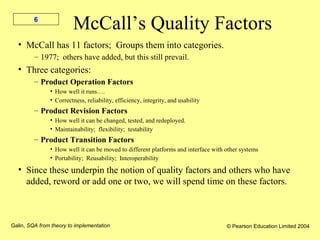
McCall’s Quality Factors
• McCall has 11 factors; Groups them into categories.
– 1977; others have added, but this still prevail.
• Three categories:
– Product Operation Factors
• How well it runs….
• Correctness, reliability, efficiency, integrity, and usability
– Product Revision Factors
• How well it can be changed, tested, and redeployed.
• Maintainability; flexibility; testability
– Product Transition Factors
• How well it can be moved to different platforms and interface with other systems
• Portability; Reusability; Interoperability
• Since these underpin the notion of quality factors and others who have
added, reword or add one or two, we will spend time on these factors.
Galin, SQA from theory to implementation © Pearson Education Limited 2004
7
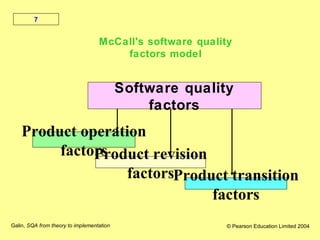
Software quality
factors
Product operation
factorsProduct revision
factorsProduct transition
factors
McCall's software quality
factors model
Galin, SQA from theory to implementation © Pearson Education Limited 2004
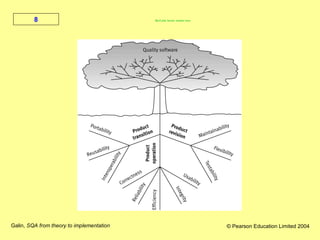
8 McCalls factor model tree
Galin, SQA from theory to implementation © Pearson Education Limited 2004
9
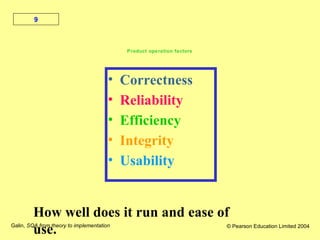
• Correctness
• Reliability
• Efficiency
• Integrity
• Usability
Product operation factors
How well does it run and ease of
use.
Galin, SQA from theory to implementation © Pearson Education Limited 2004
10 McCall’s Quality Factors
Category: Product Operation Factors
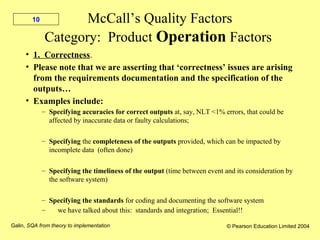
• 1. Correctness.
• Please note that we are asserting that ‘correctness’ issues are arising
from the requirements documentation and the specification of the
outputs…
• Examples include:
– Specifying accuracies for correct outputs at, say, NLT <1% errors, that could be
affected by inaccurate data or faulty calculations;
– Specifying the completeness of the outputs provided, which can be impacted by
incomplete data (often done)
– Specifying the timeliness of the output (time between event and its consideration by
the software system)
– Specifying the standards for coding and documenting the software system
– we have talked about this: standards and integration; Essential!!
Galin, SQA from theory to implementation © Pearson Education Limited 2004
11 McCall’s Quality Factors
Category: Product Operation Factors
• 2. Reliability Requirements. (remember, this quality factor is specified in
the specs!)
• Reliability requirements deal with the failure to provide service.
– Address failure rates either overall or to required functions.
• Example specs:
– A heart monitoring system must have a failure rate of less than one per million cases.
– Downtime for a system will not be more than ten minutes per month (me)
– MTBF and MTTR - old and engineering, but still applicable.
• 3. Efficiency Requirements. Deals with the hardware resources needed to
perform the functions of the software.
– Here we consider MIPS, MHz (cycles per second); data storage capabilities measured in MB
or TB; communication lines (usually measured in KBPS, MBPS, or GBPS).
– Example spec: simply very slow communications…
Galin, SQA from theory to implementation © Pearson Education Limited 2004
12 McCall’s Quality Factors
Category: Product Operation Factors
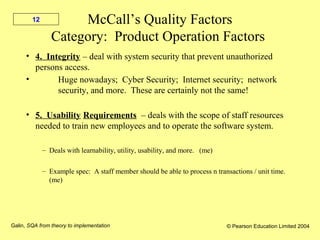
• 4. Integrity – deal with system security that prevent unauthorized
persons access.
• Huge nowadays; Cyber Security; Internet security; network
security, and more. These are certainly not the same!
• 5. Usability Requirements – deals with the scope of staff resources
needed to train new employees and to operate the software system.
– Deals with learnability, utility, usability, and more. (me)
– Example spec: A staff member should be able to process n transactions / unit time.
(me)
Galin, SQA from theory to implementation © Pearson Education Limited 2004
13
• Maintainability
• Flexibility
• Testability
Product revision factors
Can I fix it easily, retest, version it, and deploy it
easily?
Galin, SQA from theory to implementation © Pearson Education Limited 2004
14
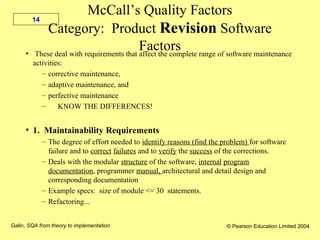
McCall’s Quality Factors
Category: Product Revision Software
Factors• These deal with requirements that affect the complete range of software maintenance
activities:
– corrective maintenance,
– adaptive maintenance, and
– perfective maintenance
– KNOW THE DIFFERENCES!
• 1. Maintainability Requirements
– The degree of effort needed to identify reasons (find the problem) for software
failure and to correct failures and to verify the success of the corrections.
– Deals with the modular structure of the software, internal program
documentation, programmer manual, architectural and detail design and
corresponding documentation
– Example specs: size of module <= 30 statements.
– Refactoring...
Galin, SQA from theory to implementation © Pearson Education Limited 2004
15 McCall’s Quality Factors
Category: Product Revision Software Factors
• 2. Flexibility Requirements – deals with resources to change
(adopt) software to different types of customers that use the app
perhaps a little differently;
– May also involve a little perfective maintenance to perhaps do a little
better due to the customer’s perhaps slightly more robust environment.
– Different clients exercise software differently. This is big!
• 3. Testability Requirements –
– Are intermediate results of computations predefined to assist testing?
– Are log files created? Backup?
– Does the software diagnose itself prior to and perhaps during operations?
Galin, SQA from theory to implementation © Pearson Education Limited 2004
16
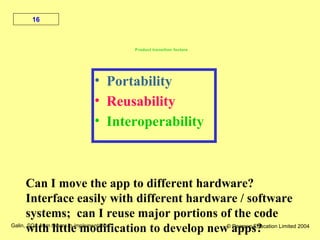
• Portability
• Reusability
• Interoperability
Product transition factors
Can I move the app to different hardware?
Interface easily with different hardware / software
systems; can I reuse major portions of the code
with little modification to develop new apps?
Galin, SQA from theory to implementation © Pearson Education Limited 2004
17
McCall’s Quality Factors
Category: Product Transition Software Quality Factors
• 1. Portability Requirements: If the software must be
ported to different environments (different hardware,
operating systems, …) and still maintain an existing
environment, then portability is a must.
• 2. Reusability Requirements: Are we able to reuse parts
of the app for new applications?
– Can save immense development costs due to errors found / tested.
– Certainly higher quality software and development more quickly
results.
– Very big deal nowadays.
Galin, SQA from theory to implementation © Pearson Education Limited 2004
18
McCall’s Quality Factors
Category: Product Transition Software Quality Factors
• 3. Interoperability Requirements: Does the application
need to interface with other existing systems
–Frequently these will be known ahead of time and plans can be made
to provide for this requirement during design time.
• Sometimes these systems can be quite different; different platforms, different
databases, and more
–Also, industry or standard application structures in areas can be
specified as requirements.
Galin, SQA from theory to implementation © Pearson Education Limited 2004
19
Alternatives
• Some other SQA professionals have offered essentially renamed quality
factors.
• One has offered 12 factors; another 15 factors.
• Totally five new factors were suggested
• Evans and Marciniak offer two ‘new’ ones:
– Verifiability and Expandability
• Deutsch and Willis offer three ‘new’ ones.
– Safety
– Manageability, and
– Survivability
Galin, SQA from theory to implementation © Pearson Education Limited 2004
20
McCall's factor model
and alternative models
Galin, SQA from theory to implementation © Pearson Education Limited 2004
21
Alternatives
Evans and Marciniak offer Verifiability and Expandability
– 1. Verifiability Requirements addresses design and
programming features that allow for efficient verification
of design and programming;
• This does not refer to outputs; rather, structure of code; design
elements and their dependencies, coupling, cohesion; patterns…
– apply to modularity, simplicity, adherence to
documentation and programming guidelines, etc.
– Look at the UML for dependencies, cohesion, coupling…
– 2. Expandability Requirements really refers to
scalability and extensibility to provide more usability.
• Essentially this is McCall’s flexibility
Galin, SQA from theory to implementation © Pearson Education Limited 2004
22
Alternatives
Deutsch and Willis offer Safety, Manageability, and Survivability
– 1. Safety Requirements address conditions that could bring the
equipment or application down especially for controlling software, as
in setting alarms or sounding warnings.
•Especially important to process control / real time software such as that
running conveyor belts or instrumentation for ordinance…
– 2. Manageability Requirements refer to tools primarily
administrative to control versions, configurations and change
management / tracking.
•We must have tools to manage versions and various configurations that
may vary from customer to customer.
– 3. Survivability Requirements refer to MTBF, or continuity of
service, as well as MTTR (mean time to recover).
• Appears to be quite similar to Reliability in McCall’s model
Galin, SQA from theory to implementation © Pearson Education Limited 2004
23
Comparisons
• These all are pretty close.
• Both models do add Verifiability,
• I like this one; addresses design and programming.
(programming conventions / standards, etc.)
– As we have developed as a discipline, I think this is essential.
• Safety is clearly important as computers control more and
more of what we do especially in both hardware and in
software.
– New cars will now sound an alarm as we back up; software will sound
when power is interrupted. This is important.
Galin, SQA from theory to implementation © Pearson Education Limited 2004
24
So, Who Cares?
• Both developers and clients need to care. One group may
care more than the other for certain quality factors.
• Certainly the nature of the app dictates more concern on
some of these factors than others (safety, for example)
• In the Rational Unified Process, we call this component of
the requirements the SRS (software requirement
specifications, which contains these ‘non-functional
requirements’ which are requirements in every sense of the
word – just not functional requirements, as the term is
normally used.
• What are your feelings about these quality factors?
Galin, SQA from theory to implementation © Pearson Education Limited 2004
25 Homework #3
You may work alone or with one student on this assignment:
•1. Please address each of the McCall’s quality factors and address how
each apply to software and/or hardware (not using the examples in the
chapter). Please add verifiability and safety.
– Develop a short paper in Word that has no less than a single paragraph
addressing each of these quality factors. (This may take a two pages)
– Table 3.3 may provide some assistance.
•2. Answer question 3.2
•Due: Next Wednesday no later than (NLT) 4pm via Blackboard.
Galin, SQA from theory to implementation © Pearson Education Limited 2004
26
Team Discussion
• Team 3 is to lead the discussion on the
following questions:
• You must summarize the main points in the
chapter, and lead discussions on:
• 3.3
• 3.4
• 3.5

McCall's Quality Factors

  • 1.
    Galin, SQA fromtheory to implementation © Pearson Education Limited 2004 1 Chapter 3 Software Quality Factors
  • 2.
    Galin, SQA fromtheory to implementation © Pearson Education Limited 2004 2 • The need for comprehensive Software Quality Requirements • Classification of requirements into Software Quality Factors • Product Operation Factors • Product Revision Factors • Product Transition Factors • Alternative models of software quality factors • Who is interested in defining quality requirements? • Software compliance with Quality Factors Chapter ThreeChapter Three Software Quality Factors
  • 3.
    Galin, SQA fromtheory to implementation © Pearson Education Limited 2004 3 The Requirements Document • Requirement Documentation (Specification) is one of the most important elements for achieving software quality • Need to explore what constitutes a good software requirements document. • Some SQA Models suggest 11-15 factors categorized; some fewer; some more • Want to become familiar with these quality factors, and • Who is really interested in them. • The need for comprehensive software quality requirements is pervasive in numerous case studies (see a few in this chapter). • (Where do the quality factors go??)
  • 4.
    Galin, SQA fromtheory to implementation © Pearson Education Limited 2004 4 Need for Comprehensive Software Quality Requirements • Need for improving poor requirements documents is widespread • Frequently lack quality factors such as: usability, reusability, maintainability, … • Software industry groups the long list of related attributes into what we call quality factors. (Sometimes non-functional requirements) • Natural to assume an unequal emphasis on all quality factors. • Emphasis varies from project to project – Scalability; maintainability; reliability; portability; etc. • Let’s look at some of the categories…
  • 5.
    Galin, SQA fromtheory to implementation © Pearson Education Limited 2004 5 Extra Thoughts • Seems like in Software Engineering we concentrate on capturing, designing, implementing, and deploying with emphasis on functional requirements. • Little (not none!) emphasis on the non-functional requirements (quality factors). • More and more emphasis now placed on quality factors • Can be a critical factor in satisfying overall requirements. • In the RUP, non-functional requirements are captured in the Software Requirements Specification (SRS); functional requirement usually captured in Use Case stories.
  • 6.
    Galin, SQA fromtheory to implementation © Pearson Education Limited 2004 6 McCall’s Quality Factors • McCall has 11 factors; Groups them into categories. – 1977; others have added, but this still prevail. • Three categories: – Product Operation Factors • How well it runs…. • Correctness, reliability, efficiency, integrity, and usability – Product Revision Factors • How well it can be changed, tested, and redeployed. • Maintainability; flexibility; testability – Product Transition Factors • How well it can be moved to different platforms and interface with other systems • Portability; Reusability; Interoperability • Since these underpin the notion of quality factors and others who have added, reword or add one or two, we will spend time on these factors.
  • 7.
    Galin, SQA fromtheory to implementation © Pearson Education Limited 2004 7 Software quality factors Product operation factorsProduct revision factorsProduct transition factors McCall's software quality factors model
  • 8.
    Galin, SQA fromtheory to implementation © Pearson Education Limited 2004 8 McCalls factor model tree
  • 9.
    Galin, SQA fromtheory to implementation © Pearson Education Limited 2004 9 • Correctness • Reliability • Efficiency • Integrity • Usability Product operation factors How well does it run and ease of use.
  • 10.
    Galin, SQA fromtheory to implementation © Pearson Education Limited 2004 10 McCall’s Quality Factors Category: Product Operation Factors • 1. Correctness. • Please note that we are asserting that ‘correctness’ issues are arising from the requirements documentation and the specification of the outputs… • Examples include: – Specifying accuracies for correct outputs at, say, NLT <1% errors, that could be affected by inaccurate data or faulty calculations; – Specifying the completeness of the outputs provided, which can be impacted by incomplete data (often done) – Specifying the timeliness of the output (time between event and its consideration by the software system) – Specifying the standards for coding and documenting the software system – we have talked about this: standards and integration; Essential!!
  • 11.
    Galin, SQA fromtheory to implementation © Pearson Education Limited 2004 11 McCall’s Quality Factors Category: Product Operation Factors • 2. Reliability Requirements. (remember, this quality factor is specified in the specs!) • Reliability requirements deal with the failure to provide service. – Address failure rates either overall or to required functions. • Example specs: – A heart monitoring system must have a failure rate of less than one per million cases. – Downtime for a system will not be more than ten minutes per month (me) – MTBF and MTTR - old and engineering, but still applicable. • 3. Efficiency Requirements. Deals with the hardware resources needed to perform the functions of the software. – Here we consider MIPS, MHz (cycles per second); data storage capabilities measured in MB or TB; communication lines (usually measured in KBPS, MBPS, or GBPS). – Example spec: simply very slow communications…
  • 12.
    Galin, SQA fromtheory to implementation © Pearson Education Limited 2004 12 McCall’s Quality Factors Category: Product Operation Factors • 4. Integrity – deal with system security that prevent unauthorized persons access. • Huge nowadays; Cyber Security; Internet security; network security, and more. These are certainly not the same! • 5. Usability Requirements – deals with the scope of staff resources needed to train new employees and to operate the software system. – Deals with learnability, utility, usability, and more. (me) – Example spec: A staff member should be able to process n transactions / unit time. (me)
  • 13.
    Galin, SQA fromtheory to implementation © Pearson Education Limited 2004 13 • Maintainability • Flexibility • Testability Product revision factors Can I fix it easily, retest, version it, and deploy it easily?
  • 14.
    Galin, SQA fromtheory to implementation © Pearson Education Limited 2004 14 McCall’s Quality Factors Category: Product Revision Software Factors• These deal with requirements that affect the complete range of software maintenance activities: – corrective maintenance, – adaptive maintenance, and – perfective maintenance – KNOW THE DIFFERENCES! • 1. Maintainability Requirements – The degree of effort needed to identify reasons (find the problem) for software failure and to correct failures and to verify the success of the corrections. – Deals with the modular structure of the software, internal program documentation, programmer manual, architectural and detail design and corresponding documentation – Example specs: size of module <= 30 statements. – Refactoring...
  • 15.
    Galin, SQA fromtheory to implementation © Pearson Education Limited 2004 15 McCall’s Quality Factors Category: Product Revision Software Factors • 2. Flexibility Requirements – deals with resources to change (adopt) software to different types of customers that use the app perhaps a little differently; – May also involve a little perfective maintenance to perhaps do a little better due to the customer’s perhaps slightly more robust environment. – Different clients exercise software differently. This is big! • 3. Testability Requirements – – Are intermediate results of computations predefined to assist testing? – Are log files created? Backup? – Does the software diagnose itself prior to and perhaps during operations?
  • 16.
    Galin, SQA fromtheory to implementation © Pearson Education Limited 2004 16 • Portability • Reusability • Interoperability Product transition factors Can I move the app to different hardware? Interface easily with different hardware / software systems; can I reuse major portions of the code with little modification to develop new apps?
  • 17.
    Galin, SQA fromtheory to implementation © Pearson Education Limited 2004 17 McCall’s Quality Factors Category: Product Transition Software Quality Factors • 1. Portability Requirements: If the software must be ported to different environments (different hardware, operating systems, …) and still maintain an existing environment, then portability is a must. • 2. Reusability Requirements: Are we able to reuse parts of the app for new applications? – Can save immense development costs due to errors found / tested. – Certainly higher quality software and development more quickly results. – Very big deal nowadays.
  • 18.
    Galin, SQA fromtheory to implementation © Pearson Education Limited 2004 18 McCall’s Quality Factors Category: Product Transition Software Quality Factors • 3. Interoperability Requirements: Does the application need to interface with other existing systems –Frequently these will be known ahead of time and plans can be made to provide for this requirement during design time. • Sometimes these systems can be quite different; different platforms, different databases, and more –Also, industry or standard application structures in areas can be specified as requirements.
  • 19.
    Galin, SQA fromtheory to implementation © Pearson Education Limited 2004 19 Alternatives • Some other SQA professionals have offered essentially renamed quality factors. • One has offered 12 factors; another 15 factors. • Totally five new factors were suggested • Evans and Marciniak offer two ‘new’ ones: – Verifiability and Expandability • Deutsch and Willis offer three ‘new’ ones. – Safety – Manageability, and – Survivability
  • 20.
    Galin, SQA fromtheory to implementation © Pearson Education Limited 2004 20 McCall's factor model and alternative models
  • 21.
    Galin, SQA fromtheory to implementation © Pearson Education Limited 2004 21 Alternatives Evans and Marciniak offer Verifiability and Expandability – 1. Verifiability Requirements addresses design and programming features that allow for efficient verification of design and programming; • This does not refer to outputs; rather, structure of code; design elements and their dependencies, coupling, cohesion; patterns… – apply to modularity, simplicity, adherence to documentation and programming guidelines, etc. – Look at the UML for dependencies, cohesion, coupling… – 2. Expandability Requirements really refers to scalability and extensibility to provide more usability. • Essentially this is McCall’s flexibility
  • 22.
    Galin, SQA fromtheory to implementation © Pearson Education Limited 2004 22 Alternatives Deutsch and Willis offer Safety, Manageability, and Survivability – 1. Safety Requirements address conditions that could bring the equipment or application down especially for controlling software, as in setting alarms or sounding warnings. •Especially important to process control / real time software such as that running conveyor belts or instrumentation for ordinance… – 2. Manageability Requirements refer to tools primarily administrative to control versions, configurations and change management / tracking. •We must have tools to manage versions and various configurations that may vary from customer to customer. – 3. Survivability Requirements refer to MTBF, or continuity of service, as well as MTTR (mean time to recover). • Appears to be quite similar to Reliability in McCall’s model
  • 23.
    Galin, SQA fromtheory to implementation © Pearson Education Limited 2004 23 Comparisons • These all are pretty close. • Both models do add Verifiability, • I like this one; addresses design and programming. (programming conventions / standards, etc.) – As we have developed as a discipline, I think this is essential. • Safety is clearly important as computers control more and more of what we do especially in both hardware and in software. – New cars will now sound an alarm as we back up; software will sound when power is interrupted. This is important.
  • 24.
    Galin, SQA fromtheory to implementation © Pearson Education Limited 2004 24 So, Who Cares? • Both developers and clients need to care. One group may care more than the other for certain quality factors. • Certainly the nature of the app dictates more concern on some of these factors than others (safety, for example) • In the Rational Unified Process, we call this component of the requirements the SRS (software requirement specifications, which contains these ‘non-functional requirements’ which are requirements in every sense of the word – just not functional requirements, as the term is normally used. • What are your feelings about these quality factors?
  • 25.
    Galin, SQA fromtheory to implementation © Pearson Education Limited 2004 25 Homework #3 You may work alone or with one student on this assignment: •1. Please address each of the McCall’s quality factors and address how each apply to software and/or hardware (not using the examples in the chapter). Please add verifiability and safety. – Develop a short paper in Word that has no less than a single paragraph addressing each of these quality factors. (This may take a two pages) – Table 3.3 may provide some assistance. •2. Answer question 3.2 •Due: Next Wednesday no later than (NLT) 4pm via Blackboard.
  • 26.
    Galin, SQA fromtheory to implementation © Pearson Education Limited 2004 26 Team Discussion • Team 3 is to lead the discussion on the following questions: • You must summarize the main points in the chapter, and lead discussions on: • 3.3 • 3.4 • 3.5