Effect of Inflation Targeting on Emerging Markets Economies 1 Leonardo Leiderman 17 October 2002
5 Key Questions on Inflation Targeting Why lower inflation? Why use inflation targeting? How does inflation targeting work? What would be ideal conditions for their implementation? How does EM reality deviate from these “ideal” conditions? Impact of inflation targeting on financial markets? 2
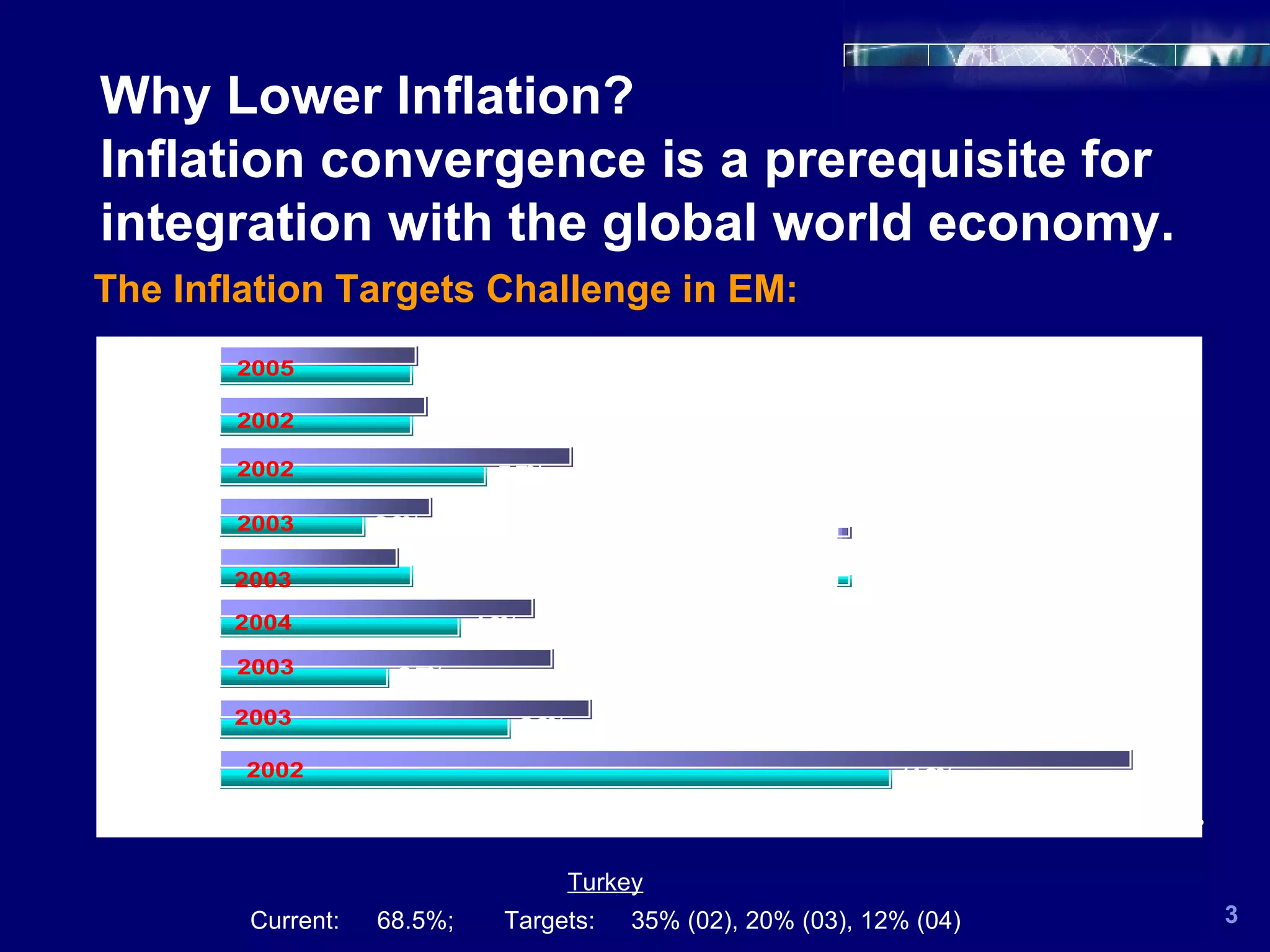
Why Lower Inflation?  Inflation convergence is a prerequisite for integration with the global world economy. The Inflation Targets Challenge in EM: 3 Turkey Current: 68.5%; Targets: 35% (02), 20% (03), 12% (04)
Why Use Inflation Targeting? Other monetary policy regimes gave no satisfactory results, such as: -fixed money growth rules -fixed exchange rates -crawling pegs -monetary conditions index rules Since their inception in the late 1980’s to date, no single country that adopted inflation targeting abandoned this regime. 4
How to Implement Inflation Targeting? 5 Policy must be forward looking.  The central bank sets rates so as to ensure that monetary conditions support the achievement of the inflation target.  If inflation is expected to deviate from target, policy adjustments will be required.  To be effective, policy must be clear, transparent, and have credibility.  Multi-year targets are better than single-year ones.  The ideal setting:  targets are set by the government and implemented by an instrument-independent central bank, fiscal policy and wage policy are compatible with the target, and a floating exchange-rate regime is in place.
EM Realities Pose Some Difficulties for Inflation Targeting 6 Many EM have a history of high and chronic inflation.  This has resulted in some inflation inertia in economic institutions and individuals’ expectations.  Together, these create some lack of credibility at the initial stages of targeting. One example: strong passthrough from exchange rates to prices. Fiscal policy often does not internalize the inflation targets. Wages are not always consistent with the target. Implications:  need a 'conservative' central bank and there is likely to be an overburdening of monetary policy.  When possible, fx market intervention should be avoided, as in many cases it has proven to be counterproductive.
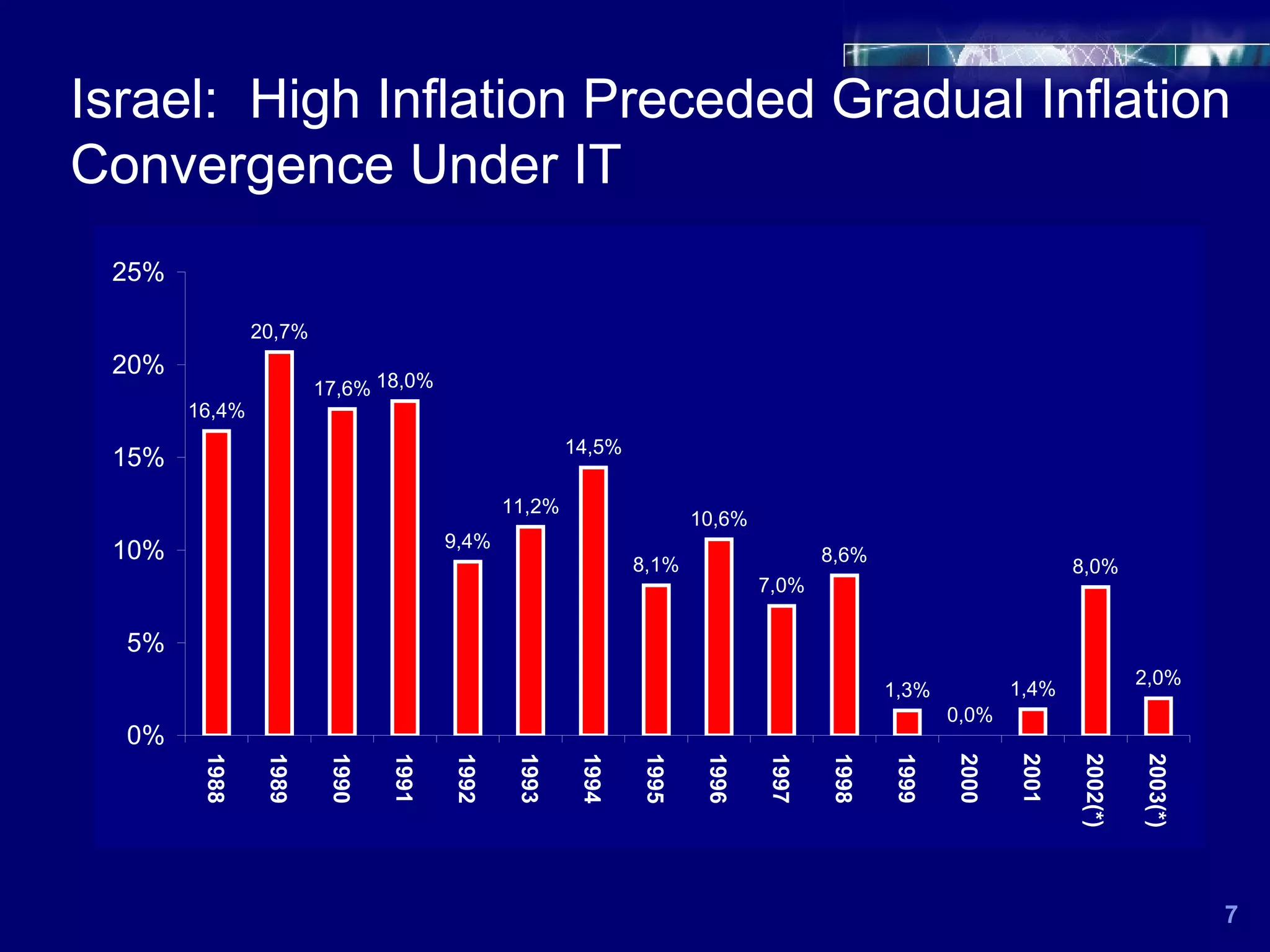
Israel:  High Inflation Preceded Gradual Inflation Convergence Under IT 7
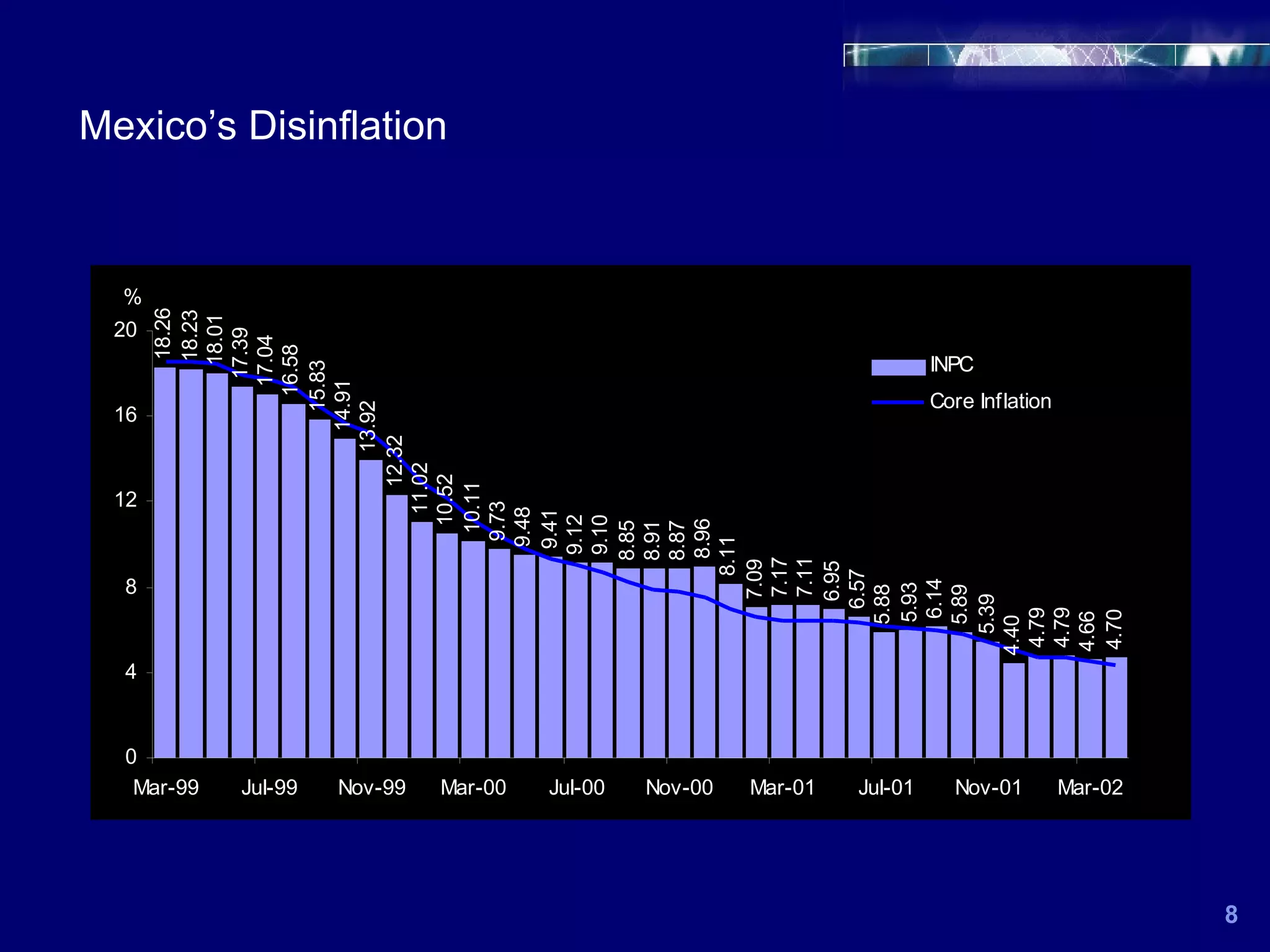
Mexico’s Disinflation 8
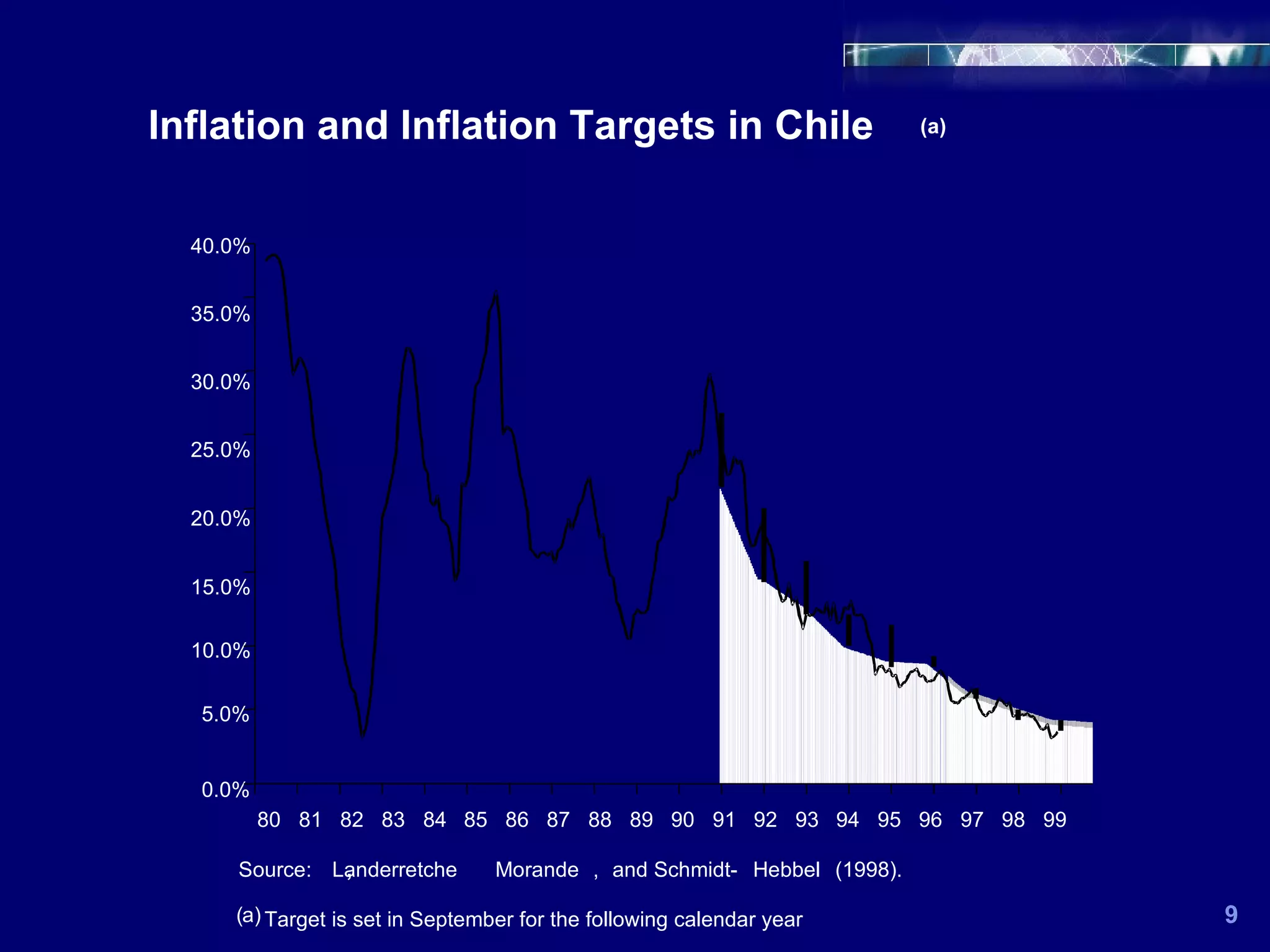
Inflation and Inflation Targets in Chile ( a) 9 0.0% 5.0% 10.0% 15.0% 20.0% 25.0% 30.0% 35.0% 40.0% 80 81 82 83 84 85 86 87 88 89 90 91 92 93 94 95 96 97 98 99 Source: Landerretche , Morande ,  and Schmidt- Hebbel (1998). ( a) Target is set in September for the following calendar year
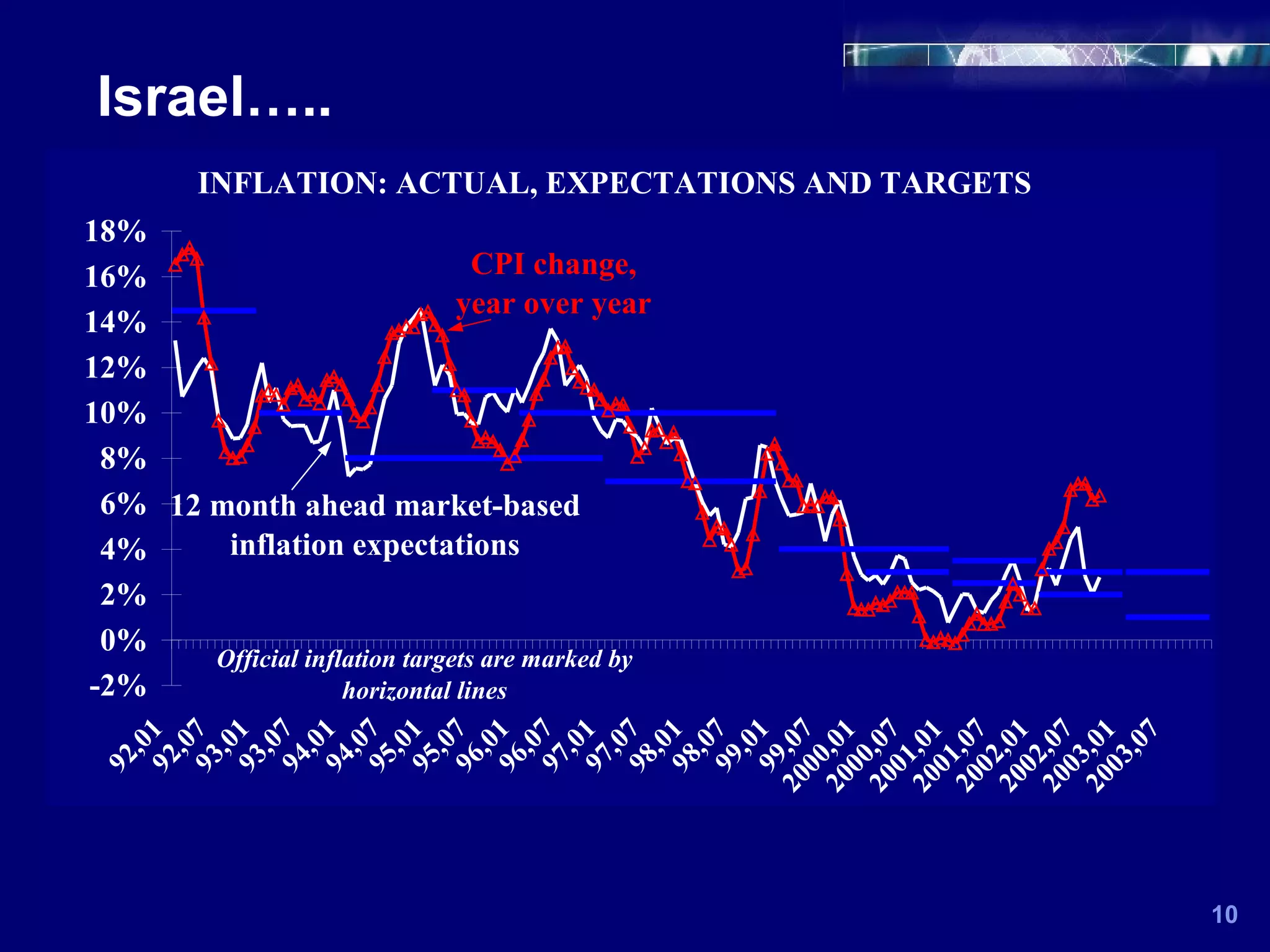
Israel….. 10
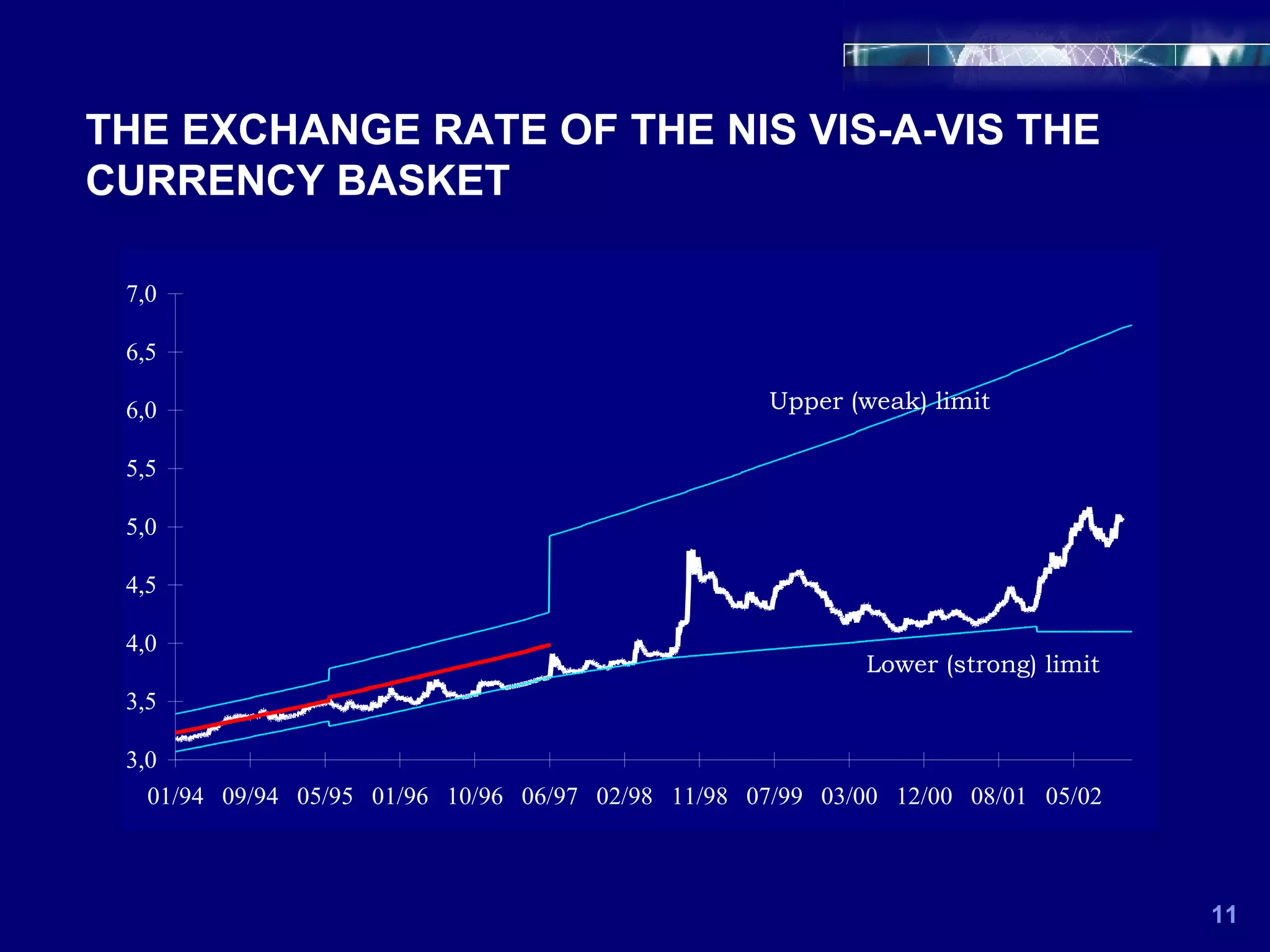
THE EXCHANGE RATE OF THE NIS VIS-A-VIS THE CURRENCY BASKET 11
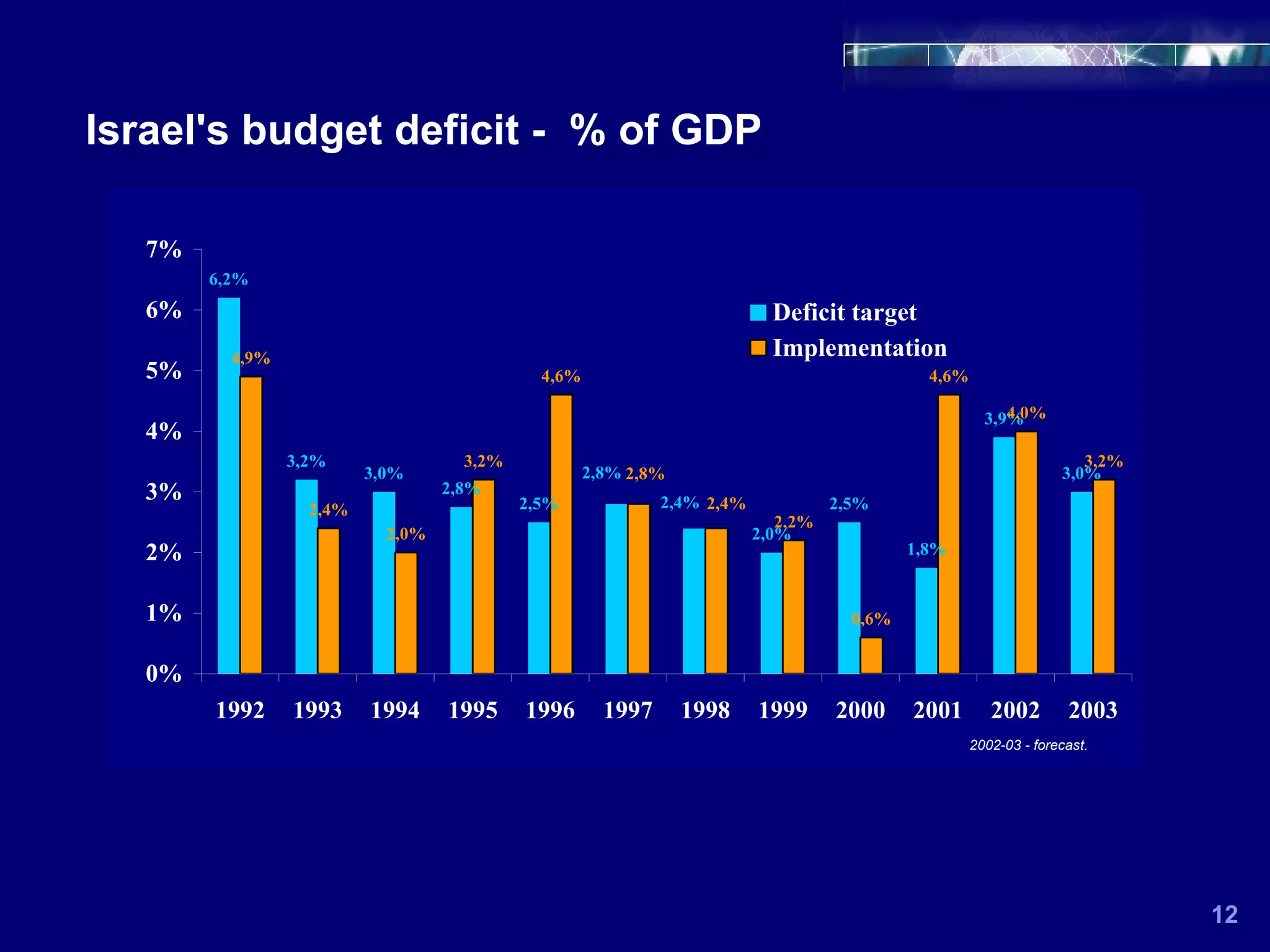
Israel's budget deficit -  % of GDP 12
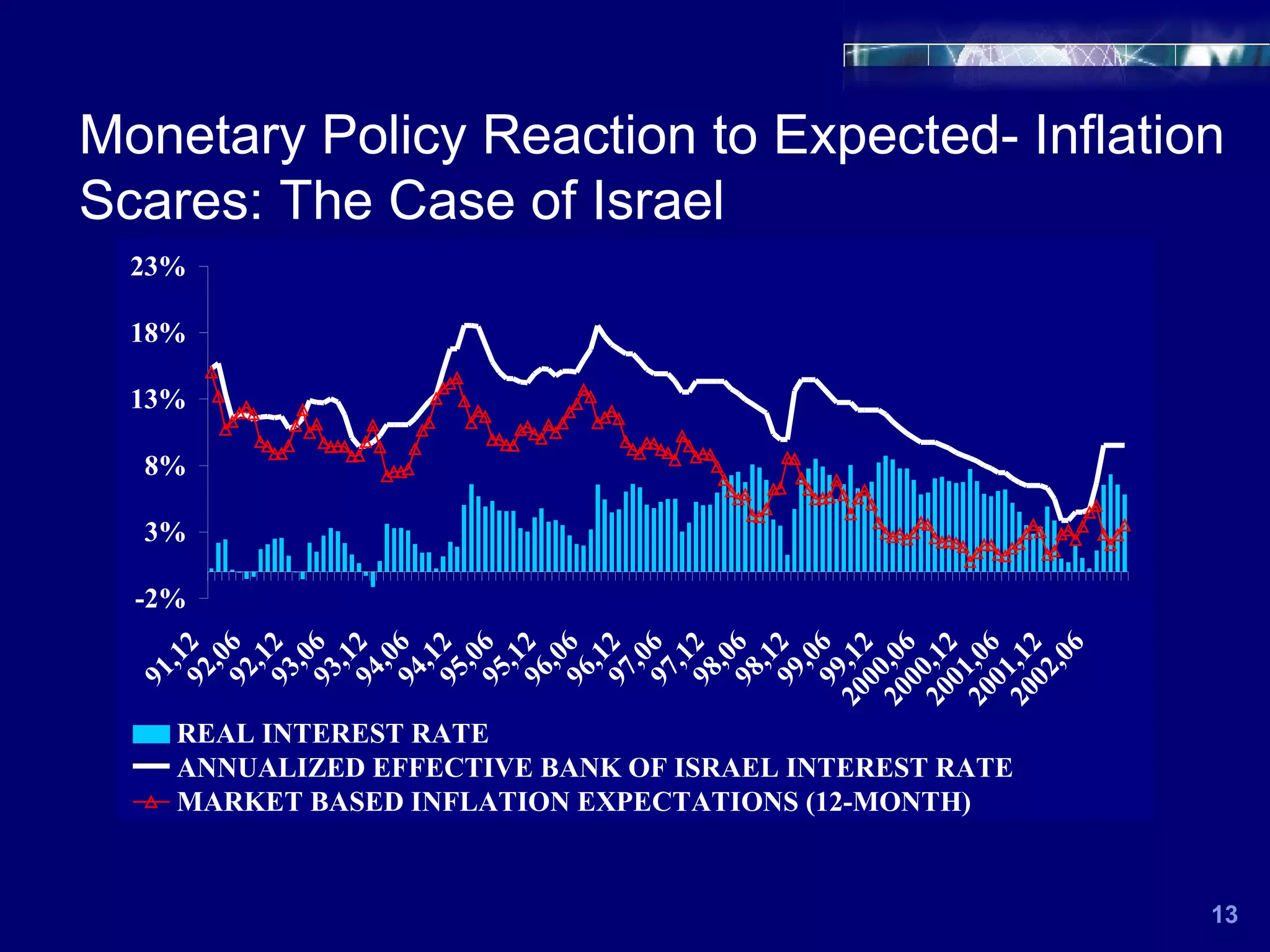
Monetary Policy Reaction to Expected- Inflation Scares: The Case of Israel 13
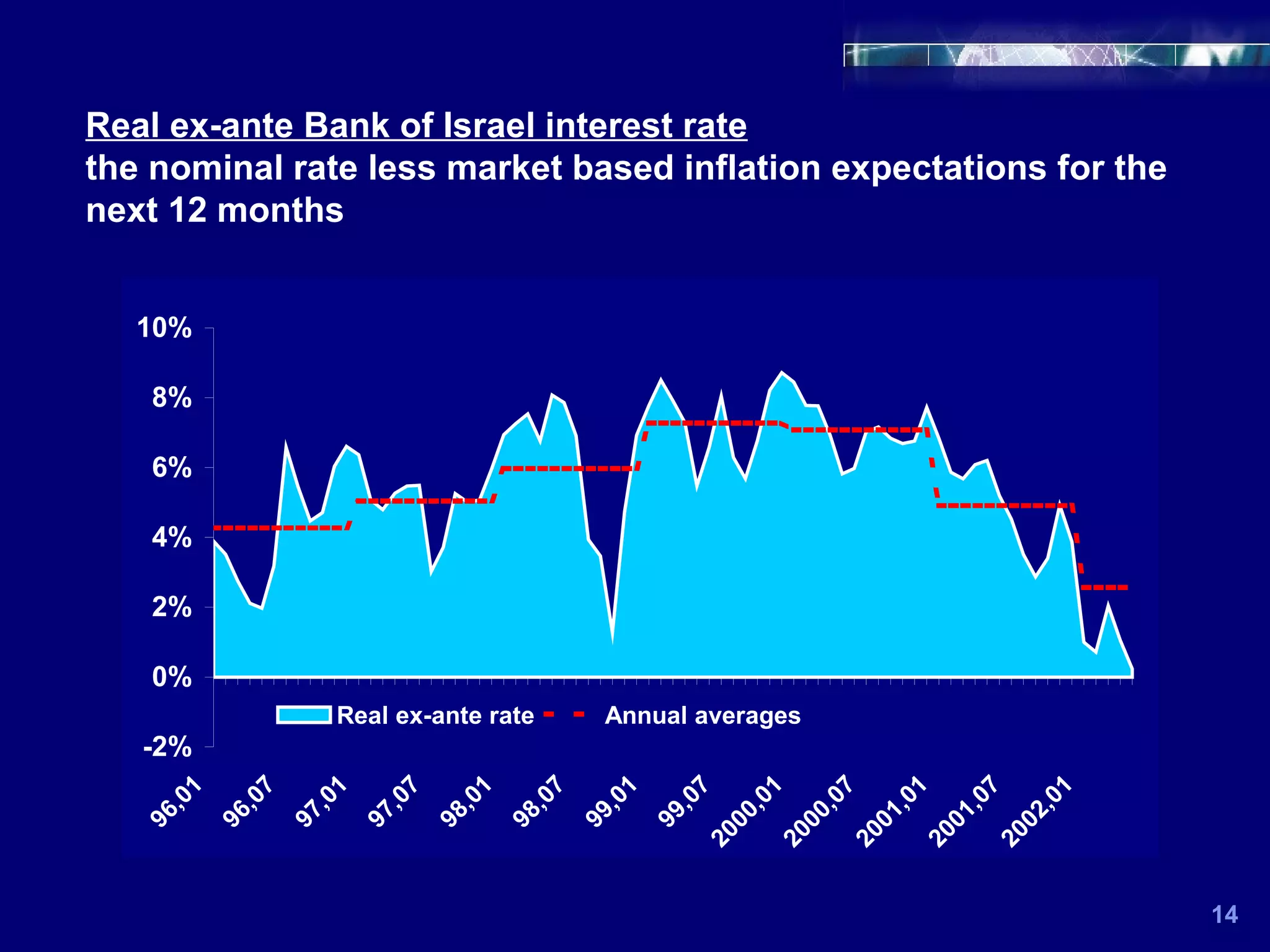
Real ex-ante Bank of Israel interest rate the nominal rate less market based inflation expectations for the next 12 months 14
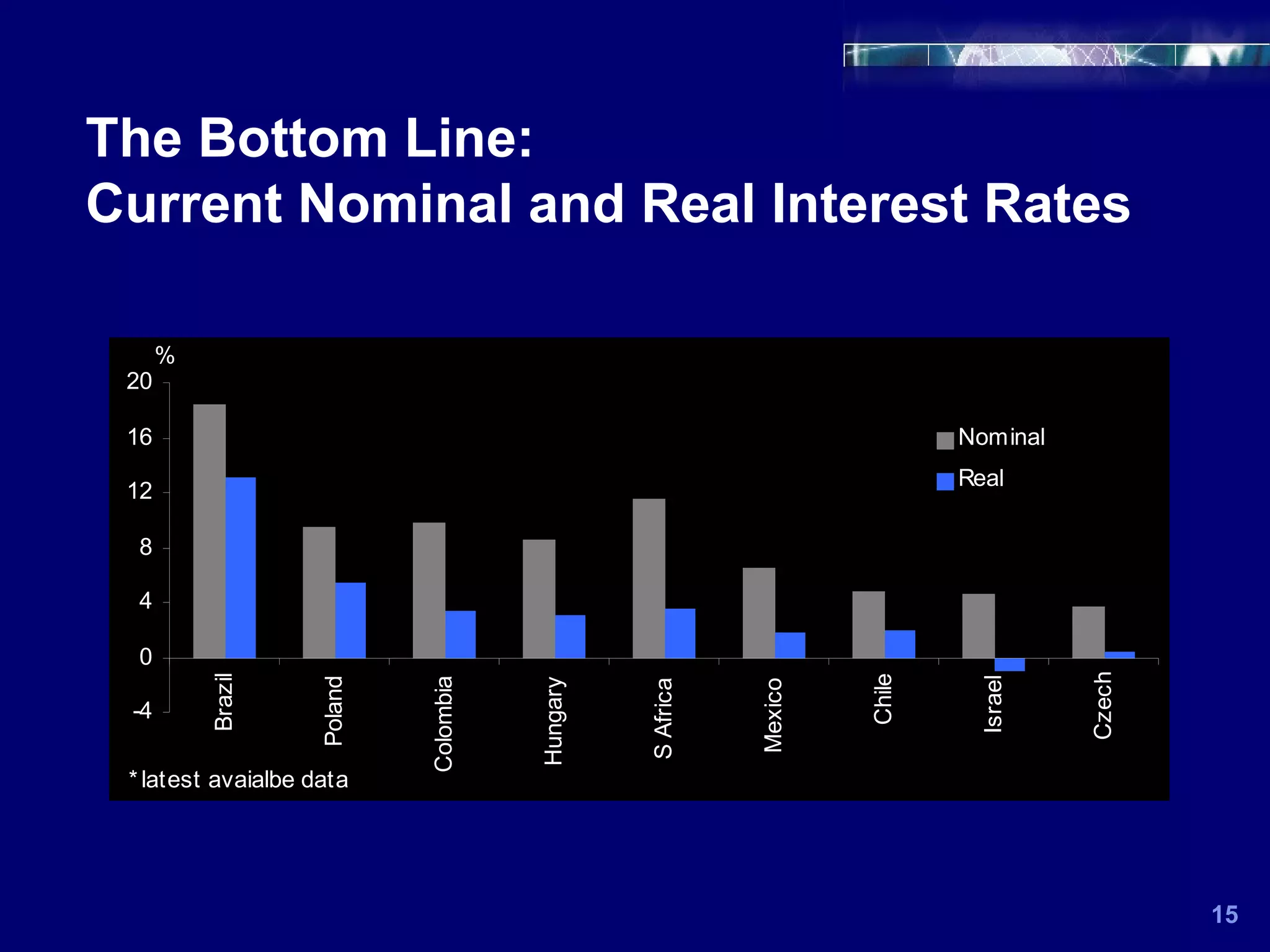
The Bottom Line: Current Nominal and Real Interest Rates 15
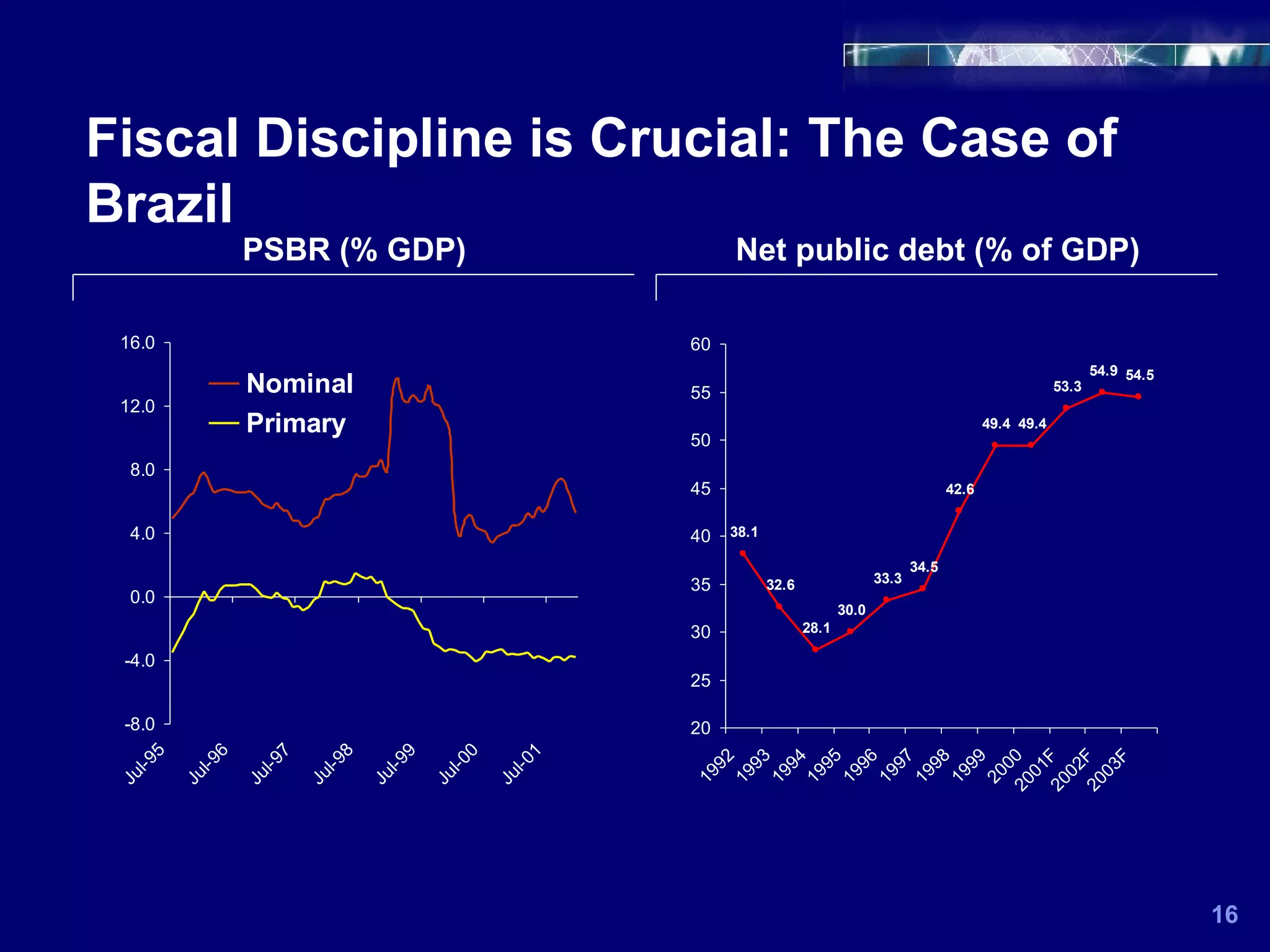
Fiscal Discipline is Crucial: The Case of Brazil Net public debt (% of GDP) PSBR (% GDP) 16
Impact on Financial Markets 17 Focus on inflation forecasts.  There are 3 types: from econometric models, from private sector surveys, and from market-based inflation expectations. Focus on the central bank reaction function.  Central-bank watching as a learning process.  The need for transparency, clarity, and good communication with the public.  Policy will be seen as forward looking. The hope is for smaller medium-term inflation uncertainty while adjusting to currency volatility at the same time.
Effect of Inflation Targeting on Emerging Markets Economies 18 Leonardo Leiderman 17 October 2002

Inflation Targeting

  • 1.
    Effect of InflationTargeting on Emerging Markets Economies 1 Leonardo Leiderman 17 October 2002
  • 2.
    5 Key Questionson Inflation Targeting Why lower inflation? Why use inflation targeting? How does inflation targeting work? What would be ideal conditions for their implementation? How does EM reality deviate from these “ideal” conditions? Impact of inflation targeting on financial markets? 2
  • 3.
    Why Lower Inflation? Inflation convergence is a prerequisite for integration with the global world economy. The Inflation Targets Challenge in EM: 3 Turkey Current: 68.5%; Targets: 35% (02), 20% (03), 12% (04)
  • 4.
    Why Use InflationTargeting? Other monetary policy regimes gave no satisfactory results, such as: -fixed money growth rules -fixed exchange rates -crawling pegs -monetary conditions index rules Since their inception in the late 1980’s to date, no single country that adopted inflation targeting abandoned this regime. 4
  • 5.
    How to ImplementInflation Targeting? 5 Policy must be forward looking. The central bank sets rates so as to ensure that monetary conditions support the achievement of the inflation target. If inflation is expected to deviate from target, policy adjustments will be required. To be effective, policy must be clear, transparent, and have credibility. Multi-year targets are better than single-year ones. The ideal setting: targets are set by the government and implemented by an instrument-independent central bank, fiscal policy and wage policy are compatible with the target, and a floating exchange-rate regime is in place.
  • 6.
    EM Realities PoseSome Difficulties for Inflation Targeting 6 Many EM have a history of high and chronic inflation. This has resulted in some inflation inertia in economic institutions and individuals’ expectations. Together, these create some lack of credibility at the initial stages of targeting. One example: strong passthrough from exchange rates to prices. Fiscal policy often does not internalize the inflation targets. Wages are not always consistent with the target. Implications: need a 'conservative' central bank and there is likely to be an overburdening of monetary policy. When possible, fx market intervention should be avoided, as in many cases it has proven to be counterproductive.
  • 7.
    Israel: HighInflation Preceded Gradual Inflation Convergence Under IT 7
  • 8.
  • 9.
    Inflation and InflationTargets in Chile ( a) 9 0.0% 5.0% 10.0% 15.0% 20.0% 25.0% 30.0% 35.0% 40.0% 80 81 82 83 84 85 86 87 88 89 90 91 92 93 94 95 96 97 98 99 Source: Landerretche , Morande , and Schmidt- Hebbel (1998). ( a) Target is set in September for the following calendar year
  • 10.
  • 11.
    THE EXCHANGE RATEOF THE NIS VIS-A-VIS THE CURRENCY BASKET 11
  • 12.
  • 13.
    Monetary Policy Reactionto Expected- Inflation Scares: The Case of Israel 13
  • 14.
    Real ex-ante Bankof Israel interest rate the nominal rate less market based inflation expectations for the next 12 months 14
  • 15.
    The Bottom Line:Current Nominal and Real Interest Rates 15
  • 16.
    Fiscal Discipline isCrucial: The Case of Brazil Net public debt (% of GDP) PSBR (% GDP) 16
  • 17.
    Impact on FinancialMarkets 17 Focus on inflation forecasts. There are 3 types: from econometric models, from private sector surveys, and from market-based inflation expectations. Focus on the central bank reaction function. Central-bank watching as a learning process. The need for transparency, clarity, and good communication with the public. Policy will be seen as forward looking. The hope is for smaller medium-term inflation uncertainty while adjusting to currency volatility at the same time.
  • 18.
    Effect of InflationTargeting on Emerging Markets Economies 18 Leonardo Leiderman 17 October 2002

Editor's Notes