Multiprocessor and Real-
Time Scheduling
Chapter 10
Classifications of
Multiprocessor
Loosely coupled multiprocessor
each processor has its own memory and I/O
channels
Functionally specialized processors
such as I/O processor
controlled by a master processor
Tightly coupled multiprocessing
processors share main memory
controlled by operating system
Independent Parallelism
Separate processes running
No synchronization
Example is time sharing
average response time to users is less
Very Coarse Parallelism
Distributed processing across network
nodes to form a single computing
environment
Good when there is infrequent interaction
among processes
overhead of network would slow down
communications
Coarse Parallelism
Similar to running many processes on one
processor except it is spread to more
processors
Multiprocessing
Medium Parallelism
Parallel processing or multitasking within
a single application
Single application is a collection of
threads
Threads usually interact frequently
Process Scheduling
Single queue for all processes
Multiple queues are used for priorities
All queues feed to the common pool of
processors
Specific scheduling disciplines is less
important with more than on processor
Threads
Executes separate from the rest of the
process
An application can be a set of threads that
cooperate and execute concurrently in
the same address space
Threads running on separate processors
yields a dramatic gain in performance
Multiprocessor Thread
Scheduling
Load sharing
processes are not assigned to a particular
processor
Gang scheduling
a set of related threads is scheduled to run
on a set of processors at the same time
Multiprocessor Thread
Scheduling
Dedicated processor assignment
threads are assigned to a specific processor
Dynamic scheduling
number of threads can be altered during
course of execution
Load Sharing
Load is distributed evenly across the
processors
Assures no processor is idle
No centralized scheduler required
Use global queues
Disadvantages of Load
Sharing
Central queue needs mutual exclusion
may be a bottleneck when more than one
processor looks for work at the same time
Preemptive threads are unlikely resume
execution on the same processor
cache use is less efficient
If all threads are in the global queue, all
threads of a program will not gain
access to the processors at the same
Gang Scheduling
Simultaneous scheduling of threads that
make up a single process
Useful for applications where
performance severely degrades when
any part of the application is not
running
Threads often need to synchronize with
each other
Dedicated Processor
Assignment
When application is scheduled, its threads
are assigned to a processor
Some processors may be idle
Avoids process switching
Dynamic Scheduling
Number of threads in a process are
altered dynamically by the application
Operating system adjust the load to
improve use
assign idle processors
new arrivals may be assigned to a processor
that is used by a job currently using more
than one processor
hold request until processor is available
new arrivals will be given a processor before
Real-Time Systems
Correctness of the system depends not
only on the logical result of the
computation but also on the time at
which the results are produced
Tasks or processes attempt to control or
react to events that take place in the
outside world
These events occur in “real time” and
process must be able to keep up with
Real-Time Systems
Control of laboratory experiments
Process control plants
Robotics
Air traffic control
Telecommunications
Characteristics of Real-
Time Operating Systems
Deterministic
operations are performed at fixed,
predetermined times or within
predetermined time intervals
concerned with how long the operating
system delays before acknowledging an
interrupt
Characteristics of Real-
Time Operating Systems
Responsiveness
how long, after acknowledgment, it takes the
operating system to service the interrupt
includes amount of time to begin execution
of the interrupt
includes the amount of time to perform the
interrupt
Characteristics of Real-
Time Operating Systems
User control
specify paging
what processes must always reside in main
memory
rights of processes
Characteristics of Real-
Time Operating Systems
Reliability
degradation of performance may have
catastrophic consequences
most critical, high priority tasks execute
Features of Real-Time
Operating Systems
Fast context switch
Small size
Ability to respond to external interrupts
quickly
Multitasking with interprocess
communication tools such as
semaphores, signals, and events
Files that accumulate data at a fast rate
Features of Real-Time
Operating Systems
Preemptive scheduling base on priority
immediate preemption allows operating
system to respond to an interrupt quickly
Minimization of intervals during which
interrupts are disabled
Delay tasks for fixed amount of time
Special alarms and timeouts
Real-Time Scheduling
Static table-driven
determines at run time when a task begins
execution
Static priority-driven preemptive
traditional priority-driven scheduler is used
Dynamic planning-based
Dynamic best effort
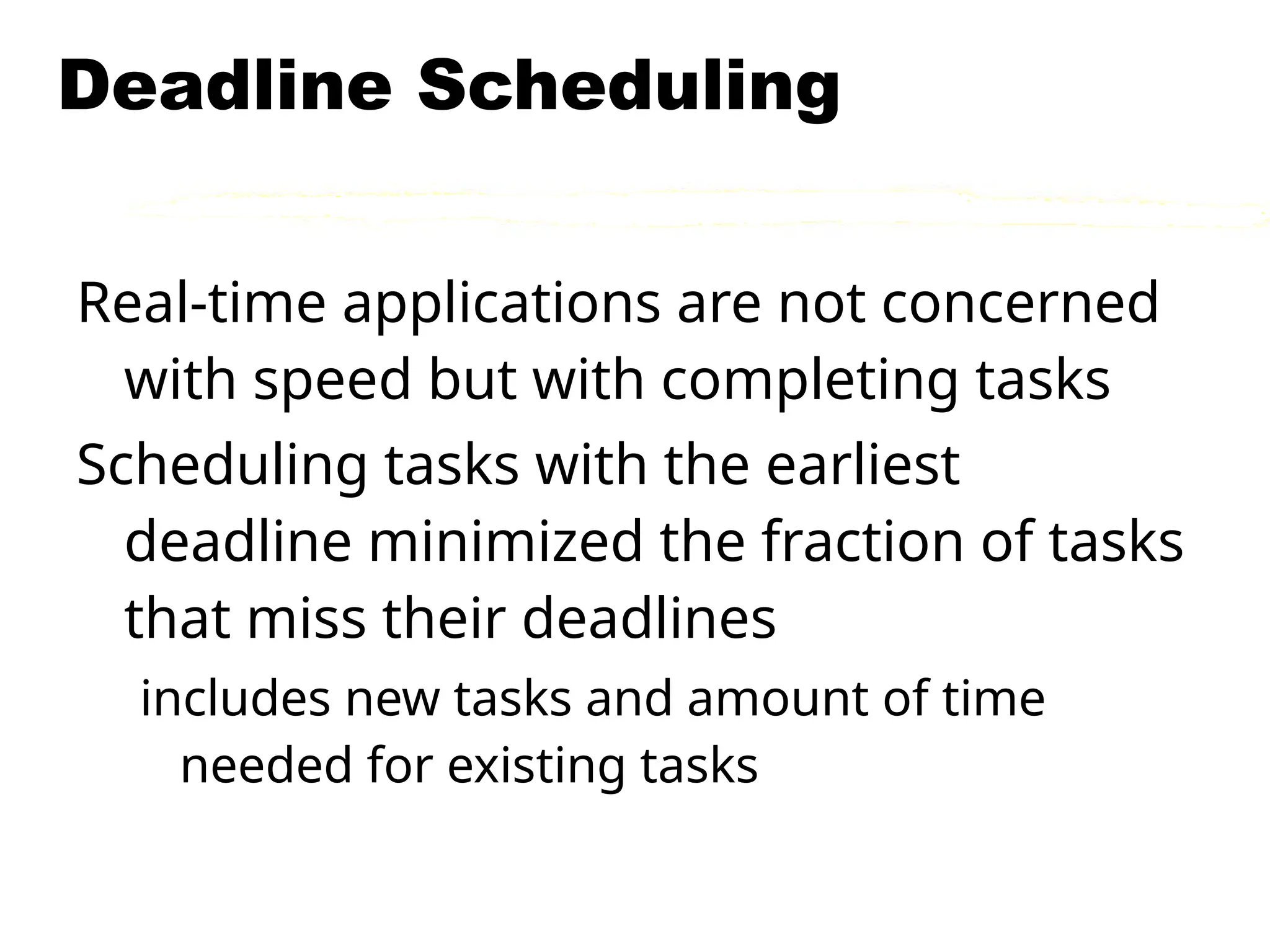
Deadline Scheduling
Real-time applications are not concerned
with speed but with completing tasks
Scheduling tasks with the earliest
deadline minimized the fraction of tasks
that miss their deadlines
includes new tasks and amount of time
needed for existing tasks
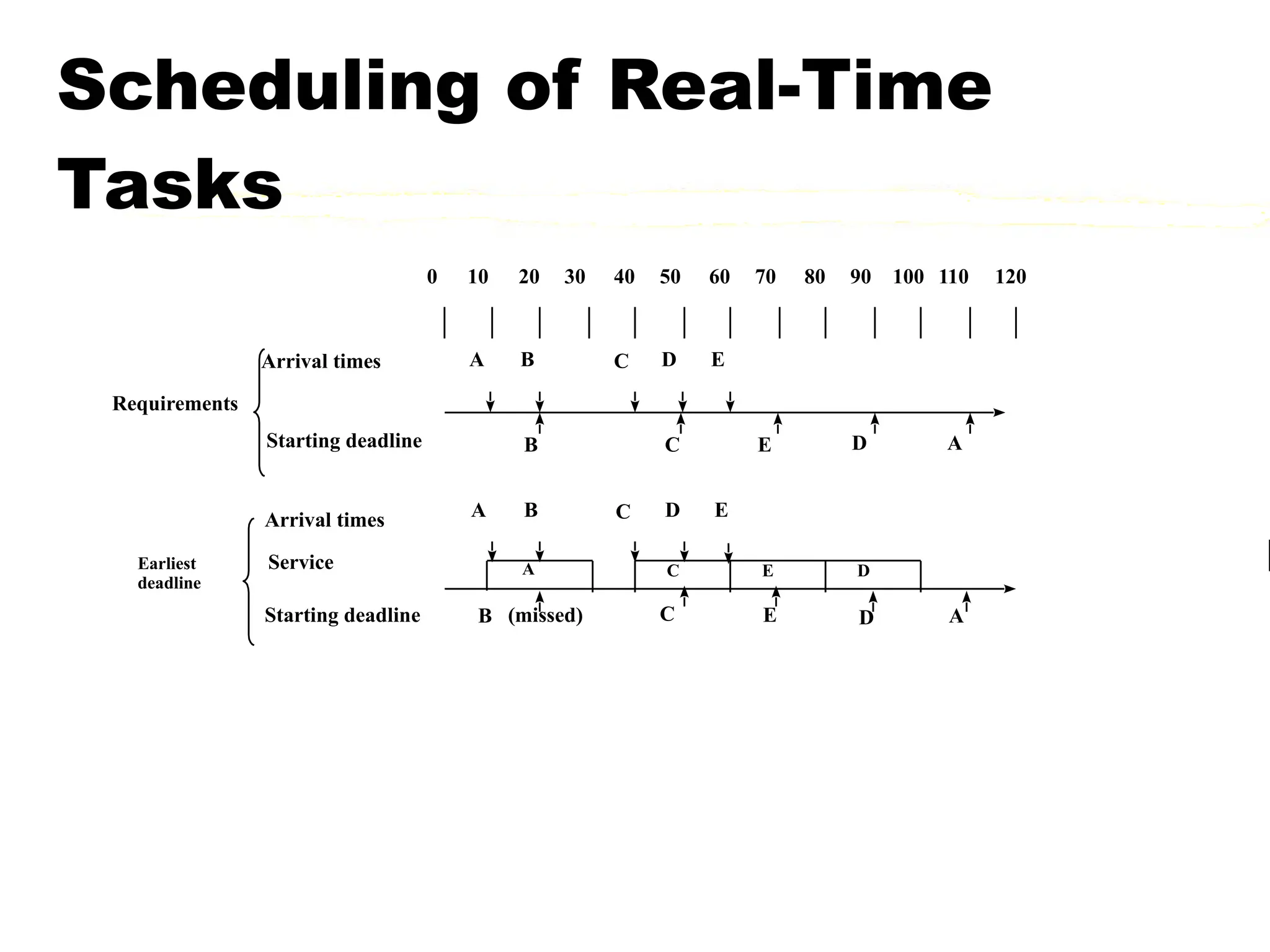
Scheduling of Real-Time
Tasks
0 10 20 30 40 50 60 70 80 90 100 110 120
A B
B A
C
C
D
D
E
E
Arrival times
Starting deadline
Requirements
A
A
B
B C
C
D
D
E
E
(missed)
Arrival times
Service
Starting deadline
Earliest
deadline
A C E D
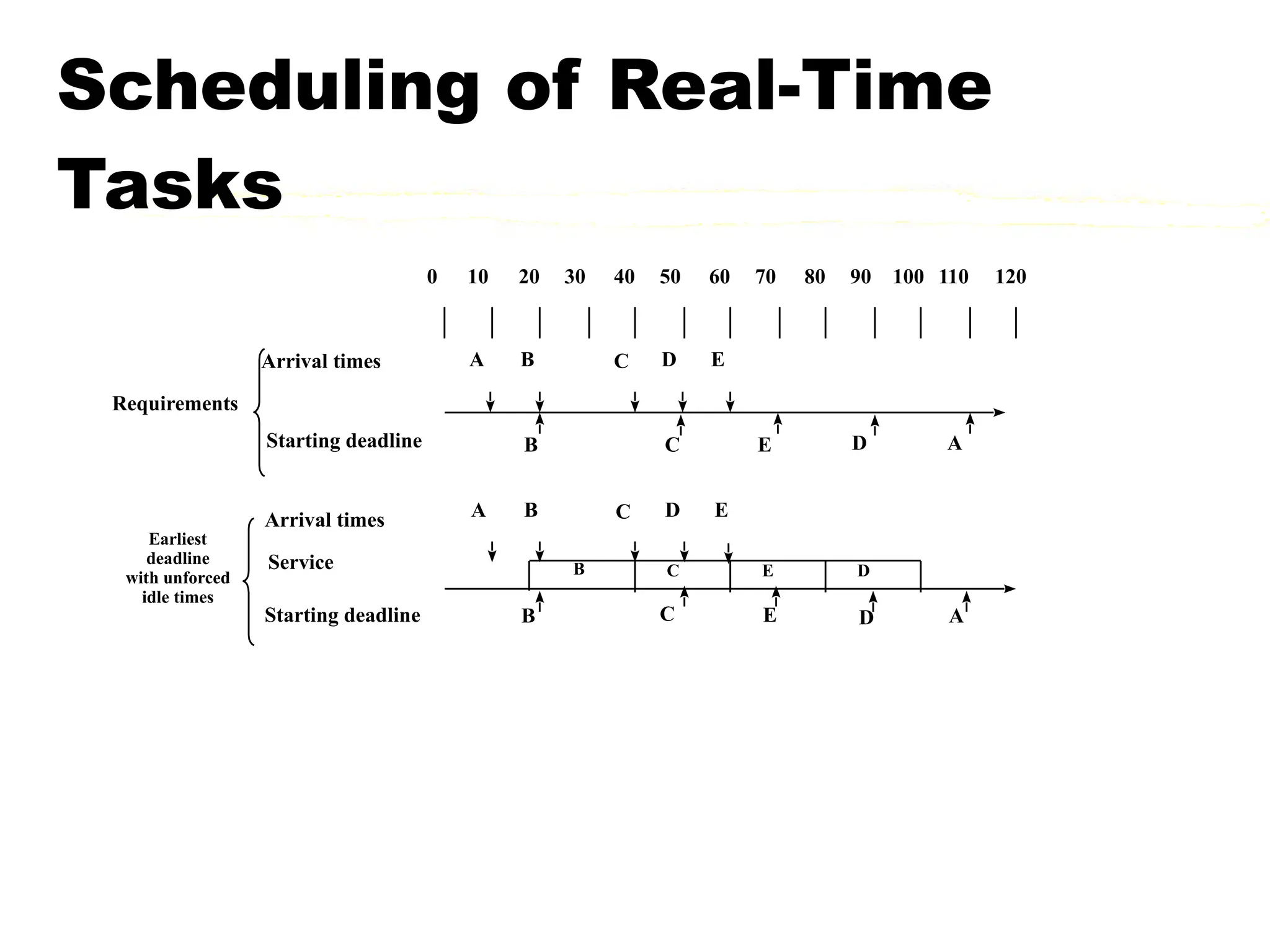
Scheduling of Real-Time
Tasks
0 10 20 30 40 50 60 70 80 90 100 110 120
A B
B A
C
C
D
D
E
E
Arrival times
Starting deadline
Requirements
A
A
B
B C
C
D
D
E
E
Arrival times
Service
Starting deadline
Earliest
deadline
with unforced
idle times
B C E D
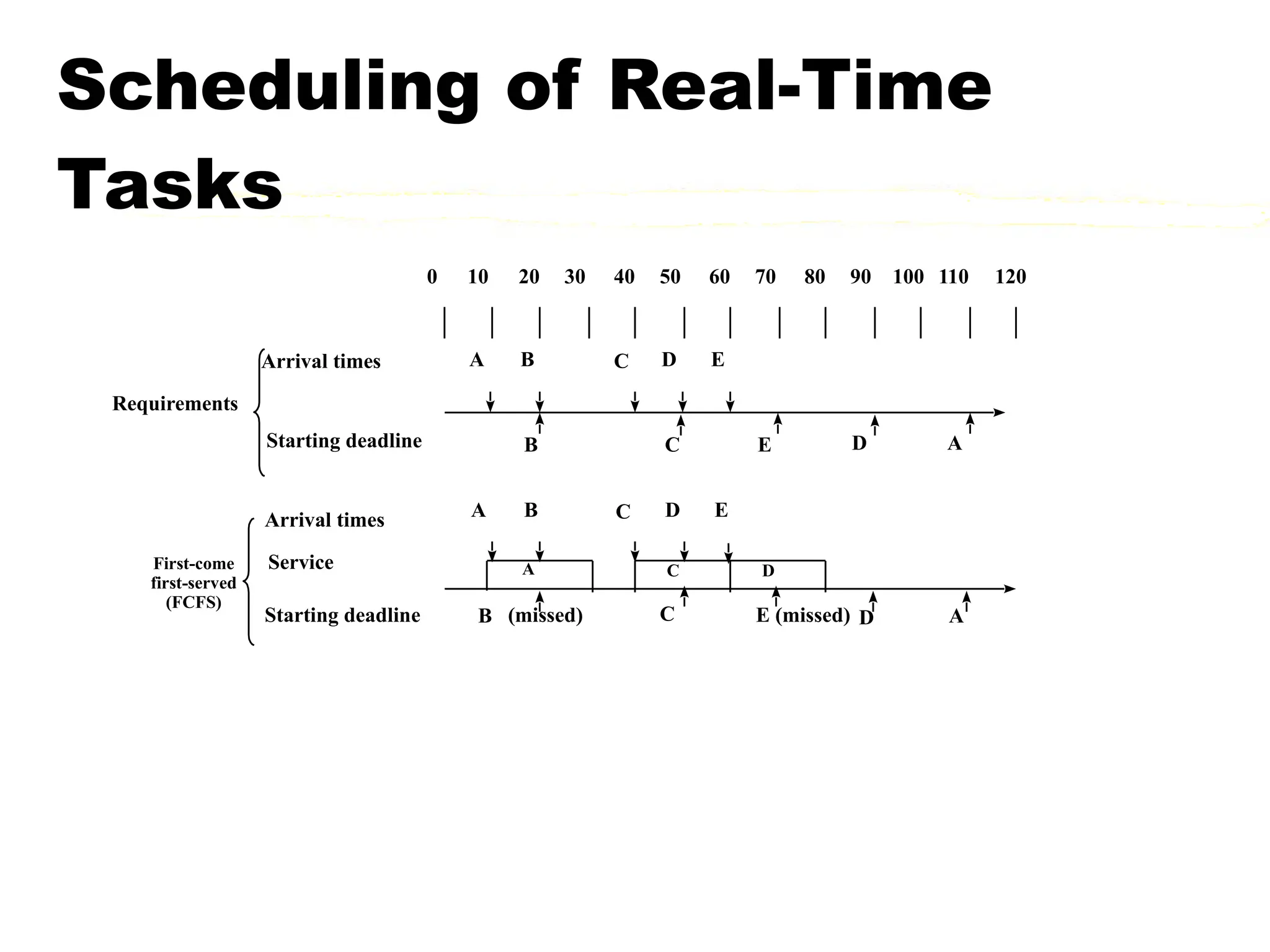
Scheduling of Real-Time
Tasks
0 10 20 30 40 50 60 70 80 90 100 110 120
A B
B A
C
C
D
D
E
E
Arrival times
Starting deadline
Requirements
A
A
B
B C
C
D
D
E
E (missed)
(missed)
Arrival times
Service
Starting deadline
First-come
first-served
(FCFS)
A C D
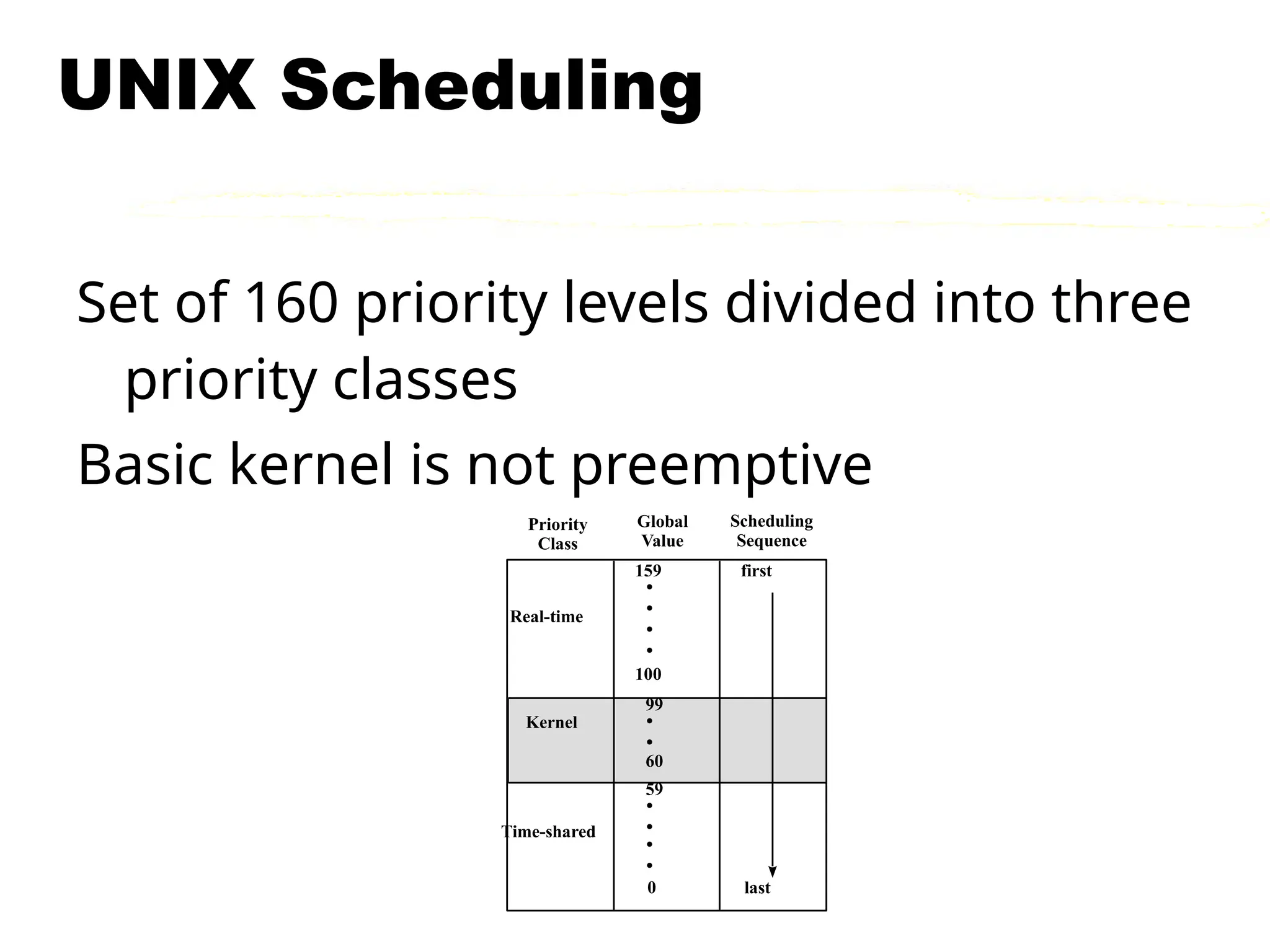
UNIX Scheduling
Set of 160 priority levels divided into three
priority classes
Basic kernel is not preemptive
Priority
Class
Global
Value
Scheduling
Sequence
Real-time
159
100
first
last
Kernel
99
60
0
59
Time-shared
.
.
.
.
.
.
.
.
.
.
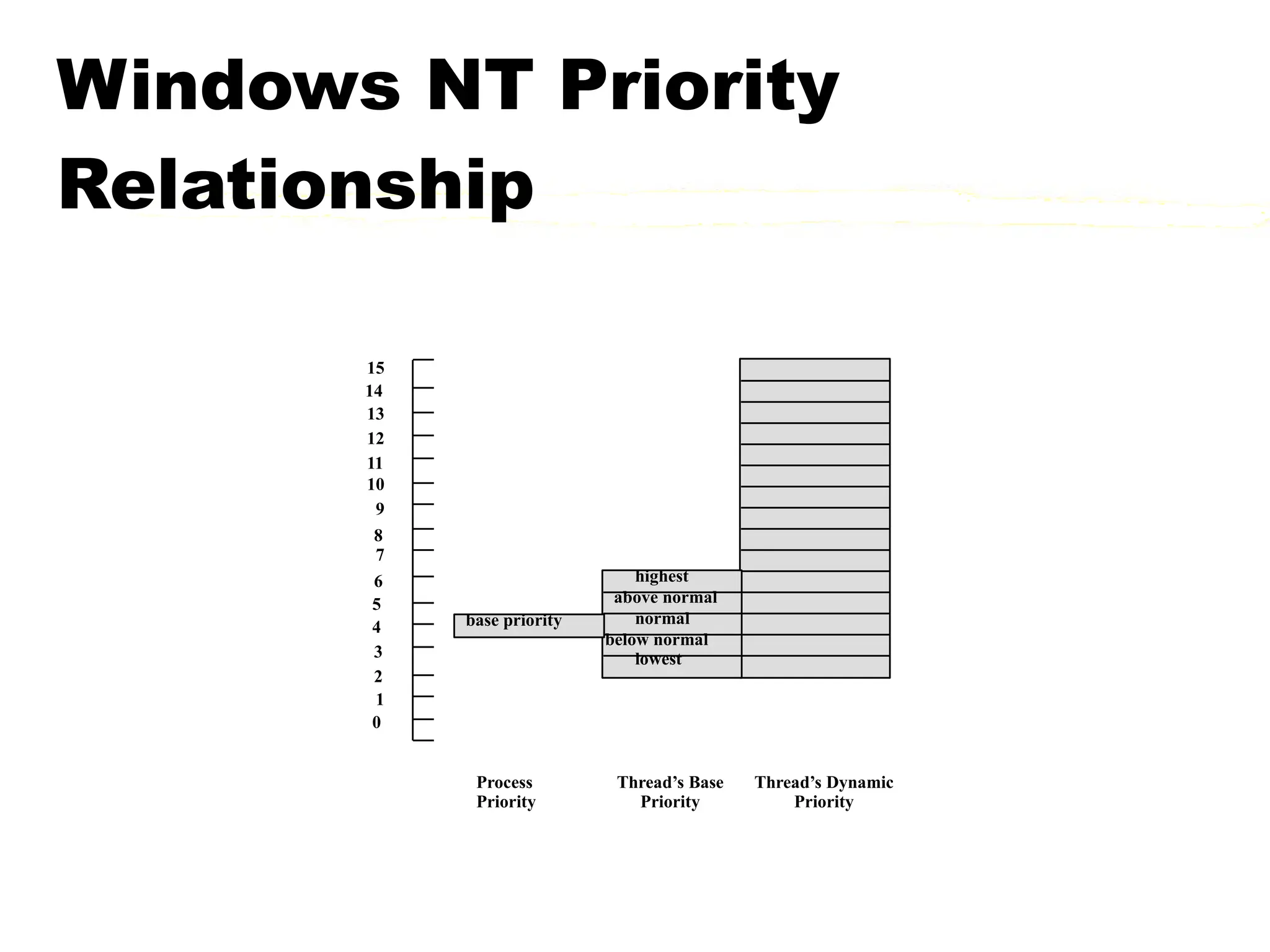
Windows NT Priority
Relationship
Process
Priority
Thread’s Base
Priority
Thread’s Dynamic
Priority
0
1
2
3
4
5
6
7
8
9
10
11
12
13
14
15
base priority
highest
above normal
normal
below normal
lowest

Chap10 real time for multiprocessor7.ppt

  • 1.
    Multiprocessor and Real- TimeScheduling Chapter 10
  • 2.
    Classifications of Multiprocessor Loosely coupledmultiprocessor each processor has its own memory and I/O channels Functionally specialized processors such as I/O processor controlled by a master processor Tightly coupled multiprocessing processors share main memory controlled by operating system
  • 3.
    Independent Parallelism Separate processesrunning No synchronization Example is time sharing average response time to users is less
  • 4.
    Very Coarse Parallelism Distributedprocessing across network nodes to form a single computing environment Good when there is infrequent interaction among processes overhead of network would slow down communications
  • 5.
    Coarse Parallelism Similar torunning many processes on one processor except it is spread to more processors Multiprocessing
  • 6.
    Medium Parallelism Parallel processingor multitasking within a single application Single application is a collection of threads Threads usually interact frequently
  • 7.
    Process Scheduling Single queuefor all processes Multiple queues are used for priorities All queues feed to the common pool of processors Specific scheduling disciplines is less important with more than on processor
  • 8.
    Threads Executes separate fromthe rest of the process An application can be a set of threads that cooperate and execute concurrently in the same address space Threads running on separate processors yields a dramatic gain in performance
  • 9.
    Multiprocessor Thread Scheduling Load sharing processesare not assigned to a particular processor Gang scheduling a set of related threads is scheduled to run on a set of processors at the same time
  • 10.
    Multiprocessor Thread Scheduling Dedicated processorassignment threads are assigned to a specific processor Dynamic scheduling number of threads can be altered during course of execution
  • 11.
    Load Sharing Load isdistributed evenly across the processors Assures no processor is idle No centralized scheduler required Use global queues
  • 12.
    Disadvantages of Load Sharing Centralqueue needs mutual exclusion may be a bottleneck when more than one processor looks for work at the same time Preemptive threads are unlikely resume execution on the same processor cache use is less efficient If all threads are in the global queue, all threads of a program will not gain access to the processors at the same
  • 13.
    Gang Scheduling Simultaneous schedulingof threads that make up a single process Useful for applications where performance severely degrades when any part of the application is not running Threads often need to synchronize with each other
  • 14.
    Dedicated Processor Assignment When applicationis scheduled, its threads are assigned to a processor Some processors may be idle Avoids process switching
  • 15.
    Dynamic Scheduling Number ofthreads in a process are altered dynamically by the application Operating system adjust the load to improve use assign idle processors new arrivals may be assigned to a processor that is used by a job currently using more than one processor hold request until processor is available new arrivals will be given a processor before
  • 16.
    Real-Time Systems Correctness ofthe system depends not only on the logical result of the computation but also on the time at which the results are produced Tasks or processes attempt to control or react to events that take place in the outside world These events occur in “real time” and process must be able to keep up with
  • 17.
    Real-Time Systems Control oflaboratory experiments Process control plants Robotics Air traffic control Telecommunications
  • 18.
    Characteristics of Real- TimeOperating Systems Deterministic operations are performed at fixed, predetermined times or within predetermined time intervals concerned with how long the operating system delays before acknowledging an interrupt
  • 19.
    Characteristics of Real- TimeOperating Systems Responsiveness how long, after acknowledgment, it takes the operating system to service the interrupt includes amount of time to begin execution of the interrupt includes the amount of time to perform the interrupt
  • 20.
    Characteristics of Real- TimeOperating Systems User control specify paging what processes must always reside in main memory rights of processes
  • 21.
    Characteristics of Real- TimeOperating Systems Reliability degradation of performance may have catastrophic consequences most critical, high priority tasks execute
  • 22.
    Features of Real-Time OperatingSystems Fast context switch Small size Ability to respond to external interrupts quickly Multitasking with interprocess communication tools such as semaphores, signals, and events Files that accumulate data at a fast rate
  • 23.
    Features of Real-Time OperatingSystems Preemptive scheduling base on priority immediate preemption allows operating system to respond to an interrupt quickly Minimization of intervals during which interrupts are disabled Delay tasks for fixed amount of time Special alarms and timeouts
  • 24.
    Real-Time Scheduling Static table-driven determinesat run time when a task begins execution Static priority-driven preemptive traditional priority-driven scheduler is used Dynamic planning-based Dynamic best effort
  • 25.
    Deadline Scheduling Real-time applicationsare not concerned with speed but with completing tasks Scheduling tasks with the earliest deadline minimized the fraction of tasks that miss their deadlines includes new tasks and amount of time needed for existing tasks
  • 26.
    Scheduling of Real-Time Tasks 010 20 30 40 50 60 70 80 90 100 110 120 A B B A C C D D E E Arrival times Starting deadline Requirements A A B B C C D D E E (missed) Arrival times Service Starting deadline Earliest deadline A C E D
  • 27.
    Scheduling of Real-Time Tasks 010 20 30 40 50 60 70 80 90 100 110 120 A B B A C C D D E E Arrival times Starting deadline Requirements A A B B C C D D E E Arrival times Service Starting deadline Earliest deadline with unforced idle times B C E D
  • 28.
    Scheduling of Real-Time Tasks 010 20 30 40 50 60 70 80 90 100 110 120 A B B A C C D D E E Arrival times Starting deadline Requirements A A B B C C D D E E (missed) (missed) Arrival times Service Starting deadline First-come first-served (FCFS) A C D
  • 29.
    UNIX Scheduling Set of160 priority levels divided into three priority classes Basic kernel is not preemptive Priority Class Global Value Scheduling Sequence Real-time 159 100 first last Kernel 99 60 0 59 Time-shared . . . . . . . . . .
  • 30.
    Windows NT Priority Relationship Process Priority Thread’sBase Priority Thread’s Dynamic Priority 0 1 2 3 4 5 6 7 8 9 10 11 12 13 14 15 base priority highest above normal normal below normal lowest