Chapter 10
Multiprocessor
and Real-Time
Scheduling
Seventh Edition
By William Stallings
Operating
Systems:
Internals
and
Design
Principles
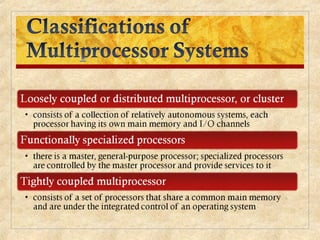
Operating Systems:
Operating Systems:
Internals and Design Principles
Bear in mind, Sir Henry, one of the phrases in that queer
old legend which Dr. Mortimer has read to us, and
avoid the moor in those hours of darkness when the
powers of evil are exalted.
— THE HOUND OF THE BASKERVILLES,
Arthur Conan Doyle
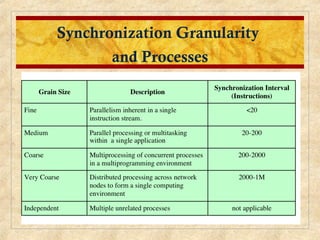
Synchronization Granularity
and Processes
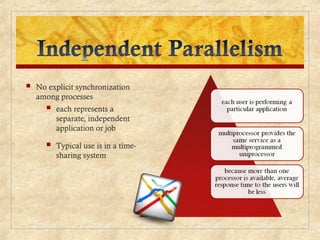
 No explicit synchronization
among processes
 each represents a
separate, independent
application or job
 Typical use is in a time-
sharing system
 Synchronization among processes, but at a very gross level
 Good for concurrent processes running on a multiprogrammed
uniprocessor
 can be supported on a multiprocessor with little or no change to user
software
 Single application can be effectively implemented as a collection of
threads within a single process
 programmer must explicitly specify the potential parallelism of an
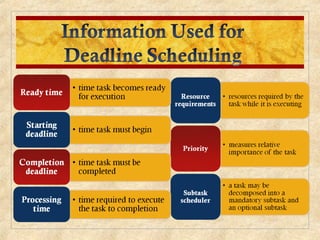
application
 there needs to be a high degree of coordination and interaction among
the threads of an application, leading to a medium-grain level of
synchronization
 Because the various threads of an application interact so frequently,
scheduling decisions concerning one thread may affect the
performance of the entire application
 Represents a much more complex use of parallelism than is found in
the use of threads
 Is a specialized and fragmented area with many different approaches
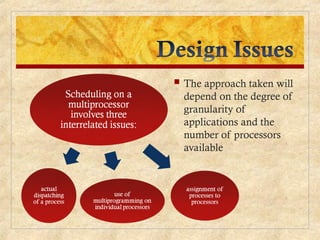
 The approach taken will
depend on the degree of
granularity of
applications and the
number of processors
available
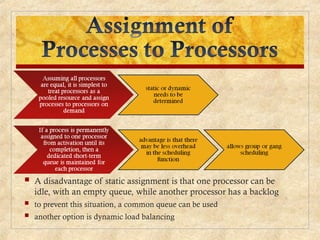
 A disadvantage of static assignment is that one processor can be
idle, with an empty queue, while another processor has a backlog
 to prevent this situation, a common queue can be used
 another option is dynamic load balancing
 Both dynamic and static methods require some
way of assigning a process to a processor
 Approaches:
 Master/Slave
 Peer
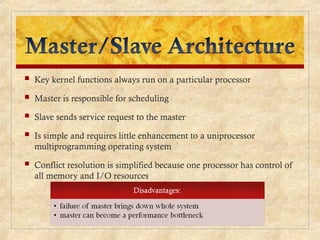
 Key kernel functions always run on a particular processor
 Master is responsible for scheduling
 Slave sends service request to the master
 Is simple and requires little enhancement to a uniprocessor
multiprogramming operating system
 Conflict resolution is simplified because one processor has control of
all memory and I/O resources
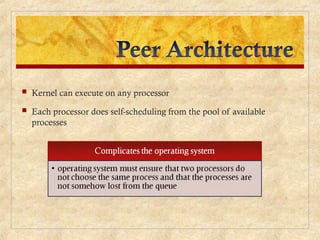
 Kernel can execute on any processor
 Each processor does self-scheduling from the pool of available
processes
 Usually processes are not dedicated to processors
 A single queue is used for all processors
 if some sort of priority scheme is used, there are multiple queues based
on priority
 System is viewed as being a multi-server queuing architecture
 With static assignment: should individual processors be multiprogrammed
or should each be dedicated to a single process?
 Often it is best to have one process per processor; particularly in the case of
multithreaded programs where it is advantageous to have all threads of a
single process executing at the same time.
 Thread execution is separated from the rest of the definition of a process
 An application can be a set of threads that cooperate and execute
concurrently in the same address space
 On a uniprocessor, threads can be used as a program structuring aid and
to overlap I/O with processing
 In a multiprocessor system kernel-level threads can be used to exploit
true parallelism in an application
 Dramatic gains in performance are possible in multi-processor systems
 Small differences in thread management and scheduling can have an
impact on applications that require significant interaction among threads
a set of related thread
scheduled to run on a set of
processors at the same
time, on a one-to-one basis
processes are not
assigned to a particular
processor
provides implicit scheduling
defined by the assignment of
threads to processors
the number of threads in a process
can be altered during the course of
execution
 Simplest approach and carries over most directly from a uniprocessor
environment
 Versions of load sharing:
 first-come-first-served
 smallest number of threads first
 preemptive smallest number of threads first
 Central queue occupies a region of memory that must be accessed in a
manner that enforces mutual exclusion
 can lead to bottlenecks
 Preemptive threads are unlikely to resume execution on the same processor
 caching can become less efficient
 If all threads are treated as a common pool of threads, it is unlikely that all
of the threads of a program will gain access to processors at the same time
 the process switches involved may seriously compromise performance
 Simultaneous scheduling of the threads that make up a single process
 Useful for medium-grained to fine-grained parallel applications
whose performance severely degrades when any part of the
application is not running while other parts are ready to run
 Also beneficial for any parallel application
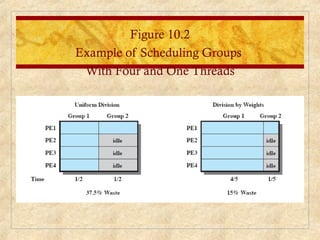
Figure 10.2
Example of Scheduling Groups
With Four and One Threads
 When an application is scheduled, each of its threads is assigned to a
processor that remains dedicated to that thread until the application
runs to completion
 If a thread of an application is blocked waiting for I/O or for
synchronization with another thread, then that thread’s processor
remains idle
 there is no multiprogramming of processors
 Defense of this strategy:
 in a highly parallel system, with tens or hundreds of processors,
processor utilization is no longer so important as a metric for
effectiveness or performance
 the total avoidance of process switching during the lifetime of a
program should result in a substantial speedup of that program
Figure 10.3
Application Speedup as a Function of Number of Threads
 For some applications it is possible to provide language and system
tools that permit the number of threads in the process to be altered
dynamically
 this would allow the operating system to adjust the load to improve
utilization
 Both the operating system and the application are involved in
making scheduling decisions
 The scheduling responsibility of the operating system is
primarily limited to processor allocation
 This approach is superior to gang scheduling or dedicated
processor assignment for applications that can take advantage of it
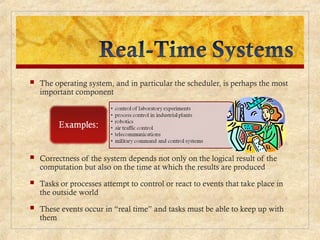
 The operating system, and in particular the scheduler, is perhaps the most
important component
 Correctness of the system depends not only on the logical result of the
computation but also on the time at which the results are produced
 Tasks or processes attempt to control or react to events that take place in
the outside world
 These events occur in “real time” and tasks must be able to keep up with
them
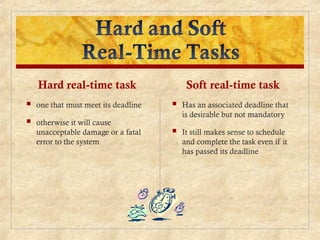
Hard real-time task
 one that must meet its deadline
 otherwise it will cause
unacceptable damage or a fatal
error to the system
Soft real-time task
 Has an associated deadline that
is desirable but not mandatory
 It still makes sense to schedule
and complete the task even if it
has passed its deadline
 Periodic tasks
 requirement may be stated as:
 once per period T
 exactly T units apart
 Aperiodic tasks
 has a deadline by which it must finish or start
 may have a constraint on both start and finish time
 Concerned with how long an operating system delays before
acknowledging an interrupt
 Operations are performed at fixed, predetermined times or within
predetermined time intervals
 when multiple processes are competing for resources and processor
time, no system will be fully deterministic
 Together with determinism make up the response time to external
events
 critical for real-time systems that must meet timing requirements
imposed by individuals, devices, and data flows external to the
system
 Concerned with how long, after acknowledgment, it takes an
operating system to service the interrupt
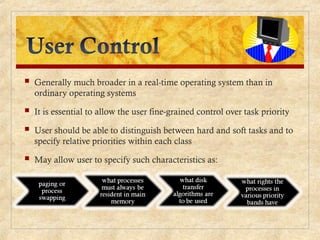
 Generally much broader in a real-time operating system than in
ordinary operating systems
 It is essential to allow the user fine-grained control over task priority
 User should be able to distinguish between hard and soft tasks and to
specify relative priorities within each class
 May allow user to specify such characteristics as:
 More important for real-time systems than non-real time systems
 Real-time systems respond to and control events in real time so
loss or degradation of performance may have catastrophic
consequences such as:
 financial loss
 major equipment damage
 loss of life
 A characteristic that refers to the ability of a system to fail in such a way as
to preserve as much capability and data as possible
 Important aspect is stability
 a real-time system is stable if the system will meet the deadlines of its
most critical, highest-priority tasks even if some less critical task
deadlines are not always met
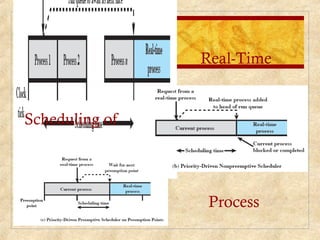
Real-Time
Scheduling of
Process
 Real-time operating systems are designed with the objective of
starting real-time tasks as rapidly as possible and emphasize rapid
interrupt handling and task dispatching
 Real-time applications are generally not concerned with sheer speed
but rather with completing (or starting) tasks at the most valuable
times
 Priorities provide a crude tool and do not capture the requirement of
completion (or initiation) at the most valuable time
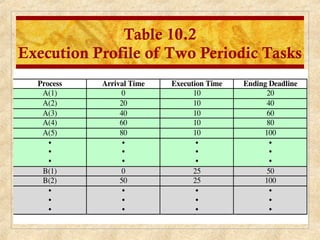
Table 10.2
Execution Profile of Two Periodic Tasks
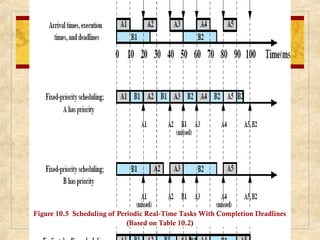
Figure 10.5 Scheduling of Periodic Real-Time Tasks With Completion Deadlines
(Based on Table 10.2)
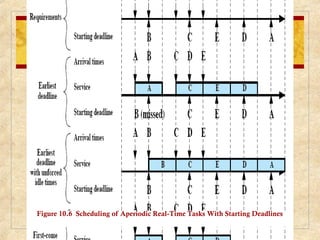
Figure 10.6 Scheduling of Aperiodic Real-Time Tasks With Starting Deadlines
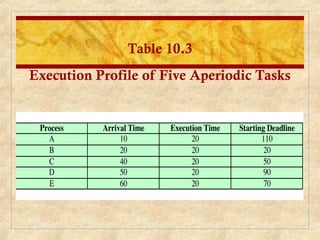
Table 10.3
Execution Profile of Five Aperiodic Tasks
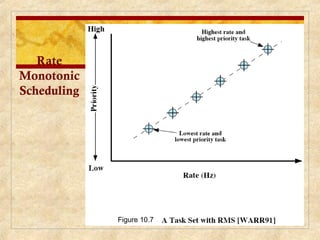
Figure 10.7
Rate
Monotonic
Scheduling
Periodic Task
Timing Diagram
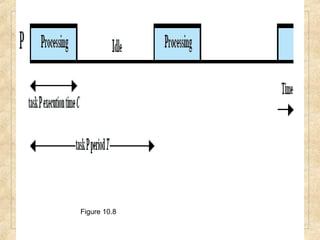
Figure 10.8
Value of the
RMS Upper
Bound
Table 10.4
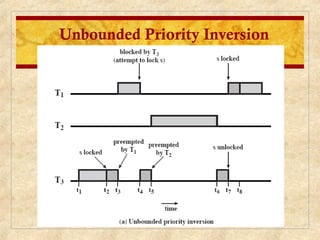
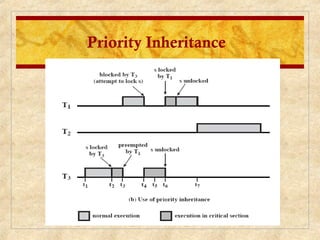
 Can occur in any priority-based preemptive scheduling scheme
 Particularly relevant in the context of real-time scheduling
 Best-known instance involved the Mars Pathfinder mission
 Occurs when circumstances within the system force a higher priority
task to wait for a lower priority task
Unbounded Priority Inversion
Priority Inheritance
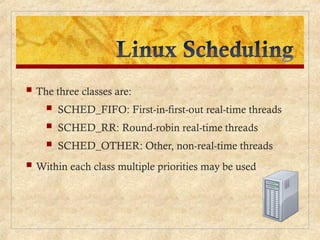
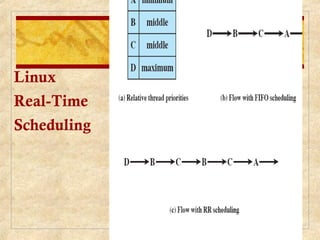
 The three classes are:
 SCHED_FIFO: First-in-first-out real-time threads
 SCHED_RR: Round-robin real-time threads
 SCHED_OTHER: Other, non-real-time threads
 Within each class multiple priorities may be used
Linux
Real-Time
Scheduling
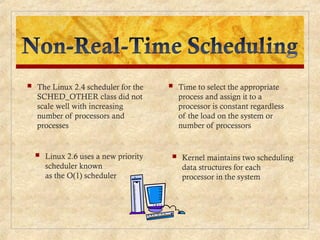
 The Linux 2.4 scheduler for the
SCHED_OTHER class did not
scale well with increasing
number of processors and
processes
 Kernel maintains two scheduling
data structures for each
processor in the system
 Linux 2.6 uses a new priority
scheduler known
as the O(1) scheduler
 Time to select the appropriate
process and assign it to a
processor is constant regardless
of the load on the system or
number of processors
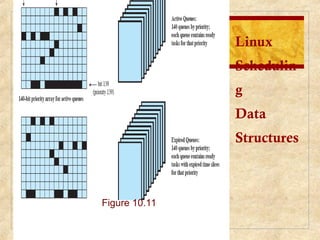
Linux
Schedulin
g
Data
Structures
Figure 10.11
 A complete overhaul of the scheduling algorithm used in earlier UNIX systems
 Major modifications:
 addition of a preemptable static priority scheduler and the introduction of
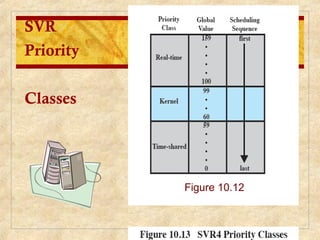
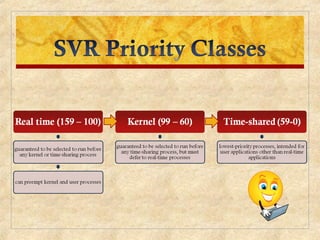
a set of 160 priority levels divided into three priority classes
 insertion of preemption points
SVR
Priority
Classes
Figure 10.12
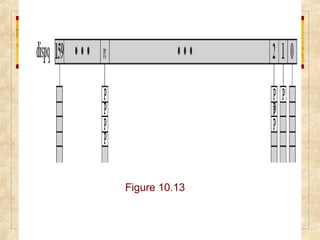
SVR4 Dispatch Queues
Figure 10.13
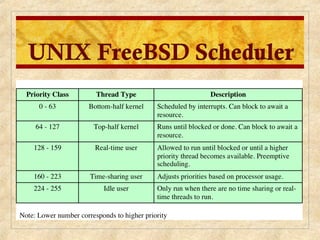
 FreeBSD scheduler was designed to provide effective scheduling for a
SMP or multicore system
 Design goals:
 address the need for processor affinity in SMP and multicore
systems
 processor affinity – a scheduler that only migrates a thread
when necessary to avoid having an idle processor
 provide better support for multithreading on multicore systems
 improve the performance of the scheduling algorithm so that it is
no longer a function of the number of threads in the system
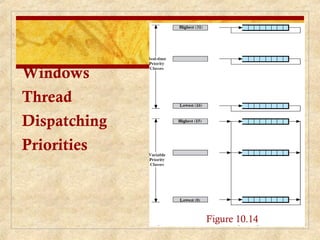
Windows
Thread
Dispatching
Priorities
Figure 10.14
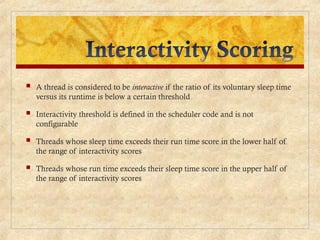
 A thread is considered to be interactive if the ratio of its voluntary sleep time
versus its runtime is below a certain threshold
 Interactivity threshold is defined in the scheduler code and is not
configurable
 Threads whose sleep time exceeds their run time score in the lower half of
the range of interactivity scores
 Threads whose run time exceeds their sleep time score in the upper half of
the range of interactivity scores
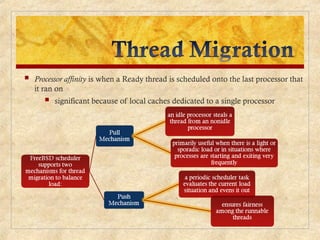
 Processor affinity is when a Ready thread is scheduled onto the last processor that
it ran on
 significant because of local caches dedicated to a single processor
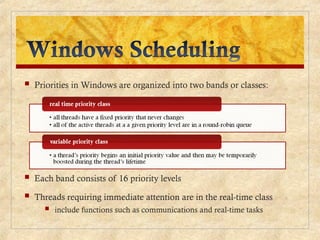
 Priorities in Windows are organized into two bands or classes:
 Each band consists of 16 priority levels
 Threads requiring immediate attention are in the real-time class
 include functions such as communications and real-time tasks
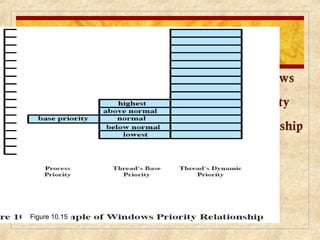
Figure 10.15
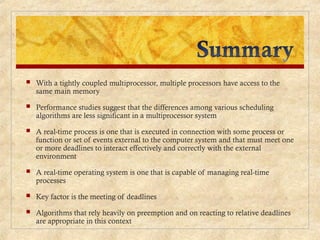
 With a tightly coupled multiprocessor, multiple processors have access to the
same main memory
 Performance studies suggest that the differences among various scheduling
algorithms are less significant in a multiprocessor system
 A real-time process is one that is executed in connection with some process or
function or set of events external to the computer system and that must meet one
or more deadlines to interact effectively and correctly with the external
environment
 A real-time operating system is one that is capable of managing real-time
processes
 Key factor is the meeting of deadlines
 Algorithms that rely heavily on preemption and on reacting to relative deadlines
are appropriate in this context

Chapter10-OS7el real time presentati.ppt

  • 1.
    Chapter 10 Multiprocessor and Real-Time Scheduling SeventhEdition By William Stallings Operating Systems: Internals and Design Principles
  • 2.
    Operating Systems: Operating Systems: Internalsand Design Principles Internals and Design Principles Bear in mind, Sir Henry, one of the phrases in that queer old legend which Dr. Mortimer has read to us, and avoid the moor in those hours of darkness when the powers of evil are exalted. — THE HOUND OF THE BASKERVILLES, Arthur Conan Doyle
  • 4.
  • 5.
     No explicitsynchronization among processes  each represents a separate, independent application or job  Typical use is in a time- sharing system
  • 6.
     Synchronization amongprocesses, but at a very gross level  Good for concurrent processes running on a multiprogrammed uniprocessor  can be supported on a multiprocessor with little or no change to user software
  • 7.
     Single applicationcan be effectively implemented as a collection of threads within a single process  programmer must explicitly specify the potential parallelism of an application  there needs to be a high degree of coordination and interaction among the threads of an application, leading to a medium-grain level of synchronization  Because the various threads of an application interact so frequently, scheduling decisions concerning one thread may affect the performance of the entire application
  • 8.
     Represents amuch more complex use of parallelism than is found in the use of threads  Is a specialized and fragmented area with many different approaches
  • 9.
     The approachtaken will depend on the degree of granularity of applications and the number of processors available
  • 10.
     A disadvantageof static assignment is that one processor can be idle, with an empty queue, while another processor has a backlog  to prevent this situation, a common queue can be used  another option is dynamic load balancing
  • 11.
     Both dynamicand static methods require some way of assigning a process to a processor  Approaches:  Master/Slave  Peer
  • 12.
     Key kernelfunctions always run on a particular processor  Master is responsible for scheduling  Slave sends service request to the master  Is simple and requires little enhancement to a uniprocessor multiprogramming operating system  Conflict resolution is simplified because one processor has control of all memory and I/O resources
  • 13.
     Kernel canexecute on any processor  Each processor does self-scheduling from the pool of available processes
  • 14.
     Usually processesare not dedicated to processors  A single queue is used for all processors  if some sort of priority scheme is used, there are multiple queues based on priority  System is viewed as being a multi-server queuing architecture
  • 15.
     With staticassignment: should individual processors be multiprogrammed or should each be dedicated to a single process?  Often it is best to have one process per processor; particularly in the case of multithreaded programs where it is advantageous to have all threads of a single process executing at the same time.
  • 16.
     Thread executionis separated from the rest of the definition of a process  An application can be a set of threads that cooperate and execute concurrently in the same address space  On a uniprocessor, threads can be used as a program structuring aid and to overlap I/O with processing  In a multiprocessor system kernel-level threads can be used to exploit true parallelism in an application  Dramatic gains in performance are possible in multi-processor systems  Small differences in thread management and scheduling can have an impact on applications that require significant interaction among threads
  • 17.
    a set ofrelated thread scheduled to run on a set of processors at the same time, on a one-to-one basis processes are not assigned to a particular processor provides implicit scheduling defined by the assignment of threads to processors the number of threads in a process can be altered during the course of execution
  • 18.
     Simplest approachand carries over most directly from a uniprocessor environment  Versions of load sharing:  first-come-first-served  smallest number of threads first  preemptive smallest number of threads first
  • 19.
     Central queueoccupies a region of memory that must be accessed in a manner that enforces mutual exclusion  can lead to bottlenecks  Preemptive threads are unlikely to resume execution on the same processor  caching can become less efficient  If all threads are treated as a common pool of threads, it is unlikely that all of the threads of a program will gain access to processors at the same time  the process switches involved may seriously compromise performance
  • 20.
     Simultaneous schedulingof the threads that make up a single process  Useful for medium-grained to fine-grained parallel applications whose performance severely degrades when any part of the application is not running while other parts are ready to run  Also beneficial for any parallel application
  • 21.
    Figure 10.2 Example ofScheduling Groups With Four and One Threads
  • 22.
     When anapplication is scheduled, each of its threads is assigned to a processor that remains dedicated to that thread until the application runs to completion  If a thread of an application is blocked waiting for I/O or for synchronization with another thread, then that thread’s processor remains idle  there is no multiprogramming of processors  Defense of this strategy:  in a highly parallel system, with tens or hundreds of processors, processor utilization is no longer so important as a metric for effectiveness or performance  the total avoidance of process switching during the lifetime of a program should result in a substantial speedup of that program
  • 23.
    Figure 10.3 Application Speedupas a Function of Number of Threads
  • 24.
     For someapplications it is possible to provide language and system tools that permit the number of threads in the process to be altered dynamically  this would allow the operating system to adjust the load to improve utilization  Both the operating system and the application are involved in making scheduling decisions  The scheduling responsibility of the operating system is primarily limited to processor allocation  This approach is superior to gang scheduling or dedicated processor assignment for applications that can take advantage of it
  • 25.
     The operatingsystem, and in particular the scheduler, is perhaps the most important component  Correctness of the system depends not only on the logical result of the computation but also on the time at which the results are produced  Tasks or processes attempt to control or react to events that take place in the outside world  These events occur in “real time” and tasks must be able to keep up with them
  • 26.
    Hard real-time task one that must meet its deadline  otherwise it will cause unacceptable damage or a fatal error to the system Soft real-time task  Has an associated deadline that is desirable but not mandatory  It still makes sense to schedule and complete the task even if it has passed its deadline
  • 27.
     Periodic tasks requirement may be stated as:  once per period T  exactly T units apart  Aperiodic tasks  has a deadline by which it must finish or start  may have a constraint on both start and finish time
  • 29.
     Concerned withhow long an operating system delays before acknowledging an interrupt  Operations are performed at fixed, predetermined times or within predetermined time intervals  when multiple processes are competing for resources and processor time, no system will be fully deterministic
  • 30.
     Together withdeterminism make up the response time to external events  critical for real-time systems that must meet timing requirements imposed by individuals, devices, and data flows external to the system  Concerned with how long, after acknowledgment, it takes an operating system to service the interrupt
  • 31.
     Generally muchbroader in a real-time operating system than in ordinary operating systems  It is essential to allow the user fine-grained control over task priority  User should be able to distinguish between hard and soft tasks and to specify relative priorities within each class  May allow user to specify such characteristics as:
  • 32.
     More importantfor real-time systems than non-real time systems  Real-time systems respond to and control events in real time so loss or degradation of performance may have catastrophic consequences such as:  financial loss  major equipment damage  loss of life
  • 33.
     A characteristicthat refers to the ability of a system to fail in such a way as to preserve as much capability and data as possible  Important aspect is stability  a real-time system is stable if the system will meet the deadlines of its most critical, highest-priority tasks even if some less critical task deadlines are not always met
  • 34.
  • 37.
     Real-time operatingsystems are designed with the objective of starting real-time tasks as rapidly as possible and emphasize rapid interrupt handling and task dispatching  Real-time applications are generally not concerned with sheer speed but rather with completing (or starting) tasks at the most valuable times  Priorities provide a crude tool and do not capture the requirement of completion (or initiation) at the most valuable time
  • 39.
    Table 10.2 Execution Profileof Two Periodic Tasks
  • 40.
    Figure 10.5 Schedulingof Periodic Real-Time Tasks With Completion Deadlines (Based on Table 10.2)
  • 41.
    Figure 10.6 Schedulingof Aperiodic Real-Time Tasks With Starting Deadlines
  • 42.
    Table 10.3 Execution Profileof Five Aperiodic Tasks
  • 43.
  • 44.
  • 45.
    Value of the RMSUpper Bound Table 10.4
  • 46.
     Can occurin any priority-based preemptive scheduling scheme  Particularly relevant in the context of real-time scheduling  Best-known instance involved the Mars Pathfinder mission  Occurs when circumstances within the system force a higher priority task to wait for a lower priority task
  • 47.
  • 48.
  • 49.
     The threeclasses are:  SCHED_FIFO: First-in-first-out real-time threads  SCHED_RR: Round-robin real-time threads  SCHED_OTHER: Other, non-real-time threads  Within each class multiple priorities may be used
  • 50.
  • 51.
     The Linux2.4 scheduler for the SCHED_OTHER class did not scale well with increasing number of processors and processes  Kernel maintains two scheduling data structures for each processor in the system  Linux 2.6 uses a new priority scheduler known as the O(1) scheduler  Time to select the appropriate process and assign it to a processor is constant regardless of the load on the system or number of processors
  • 52.
  • 53.
     A completeoverhaul of the scheduling algorithm used in earlier UNIX systems  Major modifications:  addition of a preemptable static priority scheduler and the introduction of a set of 160 priority levels divided into three priority classes  insertion of preemption points
  • 54.
  • 56.
    SVR4 Dispatch Queues SVR4Dispatch Queues Figure 10.13
  • 58.
     FreeBSD schedulerwas designed to provide effective scheduling for a SMP or multicore system  Design goals:  address the need for processor affinity in SMP and multicore systems  processor affinity – a scheduler that only migrates a thread when necessary to avoid having an idle processor  provide better support for multithreading on multicore systems  improve the performance of the scheduling algorithm so that it is no longer a function of the number of threads in the system
  • 59.
  • 60.
     A threadis considered to be interactive if the ratio of its voluntary sleep time versus its runtime is below a certain threshold  Interactivity threshold is defined in the scheduler code and is not configurable  Threads whose sleep time exceeds their run time score in the lower half of the range of interactivity scores  Threads whose run time exceeds their sleep time score in the upper half of the range of interactivity scores
  • 61.
     Processor affinityis when a Ready thread is scheduled onto the last processor that it ran on  significant because of local caches dedicated to a single processor
  • 62.
     Priorities inWindows are organized into two bands or classes:  Each band consists of 16 priority levels  Threads requiring immediate attention are in the real-time class  include functions such as communications and real-time tasks
  • 63.
  • 65.
     With atightly coupled multiprocessor, multiple processors have access to the same main memory  Performance studies suggest that the differences among various scheduling algorithms are less significant in a multiprocessor system  A real-time process is one that is executed in connection with some process or function or set of events external to the computer system and that must meet one or more deadlines to interact effectively and correctly with the external environment  A real-time operating system is one that is capable of managing real-time processes  Key factor is the meeting of deadlines  Algorithms that rely heavily on preemption and on reacting to relative deadlines are appropriate in this context

Editor's Notes

  • #1 “Operating Systems: Internal and Design Principles”, 7/e, by William Stallings, Chapter 10 “Multiprocessor and Real-Time Scheduling”.
  • #2 This chapter continues our survey of process and thread scheduling. We begin with an examination of issues raised by the availability of more than one processor. A number of design issues are explored. This is followed by a look at the scheduling of processes on a multiprocessor system. Then the somewhat different design considerations for multiprocessor thread scheduling are examined. The second section of this chapter covers real-time scheduling. The section begins with a discussion of the characteristics of real-time processes and then looks at the nature of the scheduling process. Two approaches to real-time scheduling, deadline scheduling and rate monotonic scheduling, are examined.
  • #3 When a computer system contains more than a single processor, several new issues are introduced into the design of the scheduling function. We begin with a brief overview of multiprocessors and then look at the rather different considerations when scheduling is done at the process level and at the thread level. We can classify multiprocessor systems as follows: • Loosely coupled or distributed multiprocessor, or cluster: Consists of a collection of relatively autonomous systems, each processor having its own main memory and I/O channels. We address this type of configuration in Chapter 16 . • Functionally specialized processors: An example is an I/O processor. In this case, there is a master, general-purpose processor; specialized processors are controlled by the master processor and provide services to it. Issues relating to I/O processors are addressed in Chapter 11 . • Tightly coupled multiprocessor: Consists of a set of processors that share a common main memory and are under the integrated control of an operating system. Our concern in this section is with the last category, and specifically with issues relating to scheduling.
  • #4 A good way of characterizing multiprocessors and placing them in context with other architectures is to consider the synchronization granularity, or frequency of synchronization, between processes in a system. We can distinguish five categories of parallelism that differ in the degree of granularity. These are summarized in Table 10.1 , which is adapted from [GEHR87] and [WOOD89].
  • #5 With independent parallelism, there is no explicit synchronization among processes. Each represents a separate, independent application or job. A typical use of this type of parallelism is in a time-sharing system. Each user is performing a particular application, such as word processing or using a spreadsheet. The multiprocessor provides the same service as a multiprogrammed uniprocessor. Because more than one processor is available, average response time to the users will be less. It is possible to achieve a similar performance gain by providing each user with a personal computer or workstation. If any files or information are to be shared, then the individual systems must be hooked together into a distributed system supported by a network. This approach is examined in Chapter 16 . On the other hand, a single, multiprocessor shared system in many instances is more cost-effective than a distributed system, allowing economies of scale in disks and other peripherals.
  • #6 With coarse and very coarse grained parallelism, there is synchronization among processes, but at a very gross level. This kind of situation is easily handled as a set of concurrent processes running on a multiprogrammed uniprocessor and can be supported on a multiprocessor with little or no change to user software. A simple example of an application that can exploit the existence of a multiprocessor is given in [WOOD89]. The authors have developed a program that takes a specification of files needing recompilation to rebuild a piece of software and determines which of these compiles (usually all of them) can be run simultaneously. The program then spawns one process for each parallel compile. The authors report that the speedup on a multiprocessor actually exceeds what would be expected by simply adding up the number of processors in use, due to synergies in the disk buffer caches (a topic explored in Chapter 11 ) and sharing of compiler code, which is loaded into memory only once. In general, any collection of concurrent processes that need to communicate or synchronize can benefit from the use of a multiprocessor architecture. In the case of very infrequent interaction among processes, a distributed system can provide good support. However, if the interaction is somewhat more frequent, then the overhead of communication across the network may negate some of the potential speedup. In that case, the multiprocessor organization provides the most effective support.
  • #7 We saw in Chapter 4 that a single application can be effectively implemented as a collection of threads within a single process. In this case, the programmer must explicitly specify the potential parallelism of an application. Typically, there will need to be rather a high degree of coordination and interaction among the threads of an application, leading to a medium-grain level of synchronization. Whereas independent, very coarse, and coarse-grained parallelism can be supported on either a multiprogrammed uniprocessor or a multiprocessor with little or no impact on the scheduling function, we need to reexamine scheduling when dealing with the scheduling of threads. Because the various threads of an application interact so frequently, scheduling decisions concerning one thread may affect the performance of the entire application. We return to this issue later in this section.
  • #8 Fine-grained parallelism represents a much more complex use of parallelism than is found in the use of threads. Although much work has been done on highly parallel applications, this is so far a specialized and fragmented area, with many different approaches. Chapter 4 provides an example of the use of granularity for the Valve game software.
  • #9 Scheduling on a multiprocessor involves three interrelated issues: • The assignment of processes to processors • The use of multiprogramming on individual processors • The actual dispatching of a process It is important to keep in mind that the approach taken will depend, in general, on the degree of granularity of the applications and on the number of processors available.
  • #10 If we assume that the architecture of the multiprocessor is uniform, in the sense that no processor has a particular physical advantage with respect to access to main memory or to I/O devices, then the simplest scheduling approach is to treat the processors as a pooled resource and assign processes to processors on demand. The question then arises as to whether the assignment should be static or dynamic. If a process is permanently assigned to one processor from activation until its completion, then a dedicated short-term queue is maintained for each processor. An advantage of this approach is that there may be less overhead in the scheduling function, because the processor assignment is made once and for all. Also, the use of dedicated processors allows a strategy known as group or gang scheduling, as discussed later. A disadvantage of static assignment is that one processor can be idle, with an empty queue, while another processor has a backlog. To prevent this situation, a common queue can be used. All processes go into one global queue and are scheduled to any available processor. Thus, over the life of a process, the process may be executed on different processors at different times. In a tightly coupled shared memory architecture, the context information for all processes will be available to all processors, and therefore the cost of scheduling a process will be independent of the identity of the processor on which it is scheduled. Yet another option is dynamic load balancing, in which threads are moved for a queue for one processor to a queue for another processor; Linux uses this approach.
  • #11 Regardless of whether processes are dedicated to processors, some means is needed to assign processes to processors. Two approaches have been used: master/ slave and peer.
  • #12 With a master/slave architecture, key kernel functions of the operating system always run on a particular processor. The other processors may only execute user programs. The master is responsible for scheduling jobs. Once a process is active, if the slave needs service (e.g., an I/O call), it must send a request to the master and wait for the service to be performed. This approach is quite simple and requires little enhancement to a uniprocessor multiprogramming operating system. Conflict resolution is simplified because one processor has control of all memory and I/O resources. There are two disadvantages to this approach: (1) A failure of the master brings down the whole system, and (2) the master can become a performance bottleneck.
  • #13 In a peer architecture, the kernel can execute on any processor, and each processor does self-scheduling from the pool of available processes. This approach complicates the operating system. The operating system must ensure that two processors do not choose the same process and that the processes are not somehow lost from the queue. Techniques must be employed to resolve and synchronize competing claims to resources. There is, of course, a spectrum of approaches between these two extremes. One approach is to provide a subset of processors dedicated to kernel processing instead of just one. Another approach is simply to manage the difference between the needs of kernel processes and other processes on the basis of priority and execution history.
  • #14 In most traditional multiprocessor systems, processes are not dedicated to processors. Rather there is a single queue for all processors, or if some sort of priority scheme is used, there are multiple queues based on priority, all feeding into the common pool of processors. In any case, we can view the system as being a multiserver queuing architecture.
  • #15 In most traditional multiprocessor systems, processes are not dedicated to processors. Rather there is a single queue for all processors, or if some sort of priority scheme is used, there are multiple queues based on priority, all feeding into the common pool of processors. In any case, we can view the system as being a multiserver queuing architecture.
  • #16 As we have seen, with threads, the concept of execution is separated from the rest of the definition of a process. An application can be implemented as a set of threads, which cooperate and execute concurrently in the same address space. On a uniprocessor, threads can be used as a program structuring aid and to overlap I/O with processing. Because of the minimal penalty in doing a thread switch compared to a process switch, these benefits are realized with little cost. However, the full power of threads becomes evident in a multiprocessor system. In this environment, threads can be used to exploit true parallelism in an application. If the various threads of an application are simultaneously run on separate processors, dramatic gains in performance are possible. However, it can be shown that for applications that require significant interaction among threads (medium-grain parallelism), small differences in thread management and scheduling can have a significant performance impact [ANDE89].
  • #17 Among the many proposals for multiprocessor thread scheduling and processor assignment, four general approaches stand out: • Load sharing : Processes are not assigned to a particular processor. A global queue of ready threads is maintained, and each processor, when idle, selects a thread from the queue. The term load sharing is used to distinguish this strategy from load-balancing schemes in which work is allocated on a more permanent basis (e.g., see [FEIT90a]). 2 • Gang scheduling : A set of related threads is scheduled to run on a set of processors at the same time, on a one-to-one basis. • Dedicated processor assignment: This is the opposite of the load-sharing approach and provides implicit scheduling defined by the assignment of threads to processors. Each program, for the duration of its execution, is allocated a number of processors equal to the number of threads in the program. When the program terminates, the processors return to the general pool for possible allocation to another program. • Dynamic scheduling: The number of threads in a process can be altered during the course of execution.
  • #18 Load sharing is perhaps the simplest approach and the one that carries over most directly from a uniprocessor environment. It has several advantages: • The load is distributed evenly across the processors, assuring that no processor is idle while work is available to do. • No centralized scheduler is required; when a processor is available, the scheduling routine of the operating system is run on that processor to select the next thread. The global queue can be organized and accessed using any of the schemes discussed in Chapter 9 , including priority-based schemes and schemes that consider execution history or anticipated processing demands. [LEUT90] analyzes three different versions of load sharing: • First-come-first-served (FCFS): When a job arrives, each of its threads is placed consecutively at the end of the shared queue. When a processor becomes idle, it picks the next ready thread, which it executes until completion or blocking. • Smallest number of threads first: The shared ready queue is organized as a priority queue, with highest priority given to threads from jobs with the smallest number of unscheduled threads. Jobs of equal priority are ordered according to which job arrives first. As with FCFS, a scheduled thread is run to completion or blocking. • Preemptive smallest number of threads first: Highest priority is given to jobs with the smallest number of unscheduled threads. An arriving job with a smaller number of threads than an executing job will preempt threads belonging to the scheduled job.
  • #19 Using simulation models, the authors report that, over a wide range of job characteristics, FCFS is superior to the other two policies in the preceding list. Further, the authors find that some form of gang scheduling, discussed in the next subsection, is generally superior to load sharing. There are several disadvantages of load sharing: • The central queue occupies a region of memory that must be accessed in a manner that enforces mutual exclusion. Thus, it may become a bottleneck if many processors look for work at the same time. When there is only a small number of processors, this is unlikely to be a noticeable problem. However, when the multiprocessor consists of dozens or even hundreds of processors, the potential for bottleneck is real. • Preempted threads are unlikely to resume execution on the same processor. If each processor is equipped with a local cache, caching becomes less efficient. • If all threads are treated as a common pool of threads, it is unlikely that all of the threads of a program will gain access to processors at the same time. If a high degree of coordination is required between the threads of a program, the process switches involved may seriously compromise performance. Despite the potential disadvantages, load sharing is one of the most commonly used schemes in current multiprocessors. A refinement of the load-sharing technique is used in the Mach operating system [BLAC90, WEND89]. The operating system maintains a local run queue for each processor and a shared global run queue. The local run queue is used by threads that have been temporarily bound to a specific processor. A processor examines the local run queue first to give bound threads absolute preference over unbound threads. As an example of the use of bound threads, one or more processors could be dedicated to running processes that are part of the operating system. Another example is that the threads of a particular application could be distributed among a number of processors; with the proper additional software, this provides support for gang scheduling, discussed next.
  • #20 The concept of scheduling a set of processes simultaneously on a set of processors predates the use of threads. [JONE80] refers to the concept as group scheduling and cites the following benefits: • If closely related processes execute in parallel, synchronization blocking may be reduced, less process switching may be necessary, and performance will increase. • Scheduling overhead may be reduced because a single decision affects a number of processors and processes at one time. On the Cm * multiprocessor, the term coscheduling is used [GEHR87]. Coscheduling is based on the concept of scheduling a related set of tasks, called a task force. The individual elements of a task force tend to be quite small and are hence close to the idea of a thread. The term gang scheduling has been applied to the simultaneous scheduling of the threads that make up a single process [FEIT90b]. Gang scheduling is useful for medium-grained to fine-grained parallel applications whose performance severely degrades when any part of the application is not running while other parts are ready to run. It is also beneficial for any parallel application, even one that is not quite so performance sensitive. The need for gang scheduling is widely recognized, and implementations exist on a variety of multiprocessor operating systems. One obvious way in which gang scheduling improves the performance of a single application is that process switches are minimized. Suppose one thread of a process is executing and reaches a point at which it must synchronize with another thread of the same process. If that other thread is not running, but is in a ready queue, the first thread is hung up until a process switch can be done on some other processor to bring in the needed thread. In an application with tight coordination among threads, such switches will dramatically reduce performance. The simultaneous scheduling of cooperating threads can also save time in resource allocation. For example, multiple gang-scheduled threads can access a file without the additional overhead of locking during a seek, read/write operation.
  • #21 The use of gang scheduling creates a requirement for processor allocation. One possibility is the following. Suppose that we have N processors and M applications, each of which has N or fewer threads. Then each application could be given 1/ M of the available time on the N processors, using time slicing. [FEIT90a] notes that this strategy can be inefficient. Consider an example in which there are two applications, one with four threads and one with one thread. Using uniform time allocation wastes 37.5% of the processing resource, because when the single-thread application runs, three processors are left idle (see Figure 10.2 ). If there are several one-thread applications, these could all be fit together to increase processor utilization. If that option is not available, an alternative to uniform scheduling is scheduling that is weighted by the number of threads. Thus, the four-thread application could be given four-fifths of the time and the one-thread application given only one-fifth of the time, reducing the processor waste to 15%.
  • #22 An extreme form of gang scheduling, suggested in [TUCK89], is to dedicate a group of processors to an application for the duration of the application. That is, when an application is scheduled, each of its threads is assigned a processor that remains dedicated to that thread until the application runs to completion. This approach would appear to be extremely wasteful of processor time. If a thread of an application is blocked waiting for I/O or for synchronization with another thread, then that thread’s processor remains idle: there is no multiprogramming of processors. Two observations can be made in defense of this strategy: 1. In a highly parallel system, with tens or hundreds of processors, each of which represents a small fraction of the cost of the system, processor utilization is no longer so important as a metric for effectiveness or performance. 2. The total avoidance of process switching during the lifetime of a program should result in a substantial speedup of that program.
  • #23 Both [TUCK89] and [ZAHO90] report analyses that support statement 2. Figure 10.3 shows the results of one experiment [TUCK89]. The authors ran two applications simultaneously (executing concurrently), a matrix multiplication and a fast Fourier transform (FFT) calculation, on a system with 16 processors. Each application breaks its problem into a number of tasks, which are mapped onto the threads executing that application. The programs are written in such a way as to allow the number of threads to be used to vary. In essence, a number of tasks are defined and queued by an application. Tasks are taken from the queue and mapped onto the available threads by the application. If there are fewer threads than tasks, then leftover tasks remain queued and are picked up by threads as they complete their assigned tasks. Clearly, not all applications can be structured in this way, but many numerical problems and some other applications can be dealt with in this fashion. Figure 10.3 shows the speedup for the applications as the number of threads executing the tasks in each application is varied from 1 to 24. For example, we see that when both applications are started simultaneously with 24 threads each, the speedup obtained, compared to using a single thread for each application, is 2.8 for matrix multiplication and 2.4 for FFT. The figure shows that the performance of both applications worsens considerably when the number of threads in each application exceeds eight and thus the total number of processes in the system exceeds the number of processors. Furthermore, the larger the number of threads the worse the performance gets, because there is a greater frequency of thread preemption and rescheduling. This excessive preemption results in inefficiency from many sources, including time spent waiting for a suspended thread to leave a critical section, time wasted in process switching, and inefficient cache behavior. The authors conclude that an effective strategy is to limit the number of active threads to the number of processors in the system. If most of the applications are either single thread or can use the task-queue structure, this will provide an effective and reasonably efficient use of the processor resources. Both dedicated processor assignment and gang scheduling attack the scheduling problem by addressing the issue of processor allocation. One can observe that the processor allocation problem on a multiprocessor more closely resembles the memory allocation problem on a uniprocessor than the scheduling problem on a uniprocessor. The issue is how many processors to assign to a program at any given time, which is analogous to how many page frames to assign to a given process at any time. [GEHR87] proposes the term activity working set , analogous to a virtual memory working set, as the minimum number of activities (threads) that must be scheduled simultaneously on processors for the application to make acceptable progress. As with memory management schemes, the failure to schedule all of the elements of an activity working set can lead to processor thrashing. This occurs when the scheduling of threads whose services are required induces the descheduling of other threads whose services will soon be needed. Similarly, processor fragmentation refers to a situation in which some processors are left over when others are allocated, and the leftover processors are either insufficient in number or unsuitably organized to support the requirements of waiting applications. Gang scheduling and dedicated processor allocation are meant to avoid these problems.
  • #24 For some applications, it is possible to provide language and system tools that permit the number of threads in the process to be altered dynamically. This would allow the operating system to adjust the load to improve utilization. [ZAHO90] proposes an approach in which both the operating system and the application are involved in making scheduling decisions. The operating system is responsible for partitioning the processors among the jobs. Each job uses the processors currently in its partition to execute some subset of its runnable tasks by mapping these tasks to threads. An appropriate decision about which subset to run, as well as which thread to suspend when a process is preempted, is left to the individual applications (perhaps through a set of run-time library routines). This approach may not be suitable for all applications. However, some applications could default to a single thread while others could be programmed to take advantage of this particular feature of the operating system. In this approach, the scheduling responsibility of the operating system is primarily limited to processor allocation and proceeds according to the following policy. When a job requests one or more processors (either when the job arrives for the first time or because its requirements change), 1. If there are idle processors, use them to satisfy the request. 2. Otherwise, if the job making the request is a new arrival, allocate it a single processor by taking one away from any job currently allocated more than one processor. 3. If any portion of the request cannot be satisfied, it remains outstanding until either a processor becomes available for it or the job rescinds the request (e.g., if there is no longer a need for the extra processors). Upon release of one or more processors (including job departure), 4. Scan the current queue of unsatisfied requests for processors. Assign a single processor to each job in the list that currently has no processors (i.e., to all waiting new arrivals). Then scan the list again, allocating the rest of the processors on an FCFS basis. Analyses reported in [ZAHO90] and [MAJU88] suggest that for applications that can take advantage of dynamic scheduling, this approach is superior to gang scheduling or dedicated processor assignment. However, the overhead of this approach may negate this apparent performance advantage. Experience with actual systems is needed to prove the worth of dynamic scheduling.
  • #25 Real-time computing is becoming an increasingly important discipline. The operating system, and in particular the scheduler, is perhaps the most important component of a real-time system. Examples of current applications of real-time systems include control of laboratory experiments, process control in industrial plants, robotics, air traffic control, telecommunications, and military command and control systems. Next-generation systems will include the autonomous land rover, controllers of robots with elastic joints, systems found in intelligent manufacturing, the space station, and undersea exploration. Real-time computing may be defined as that type of computing in which the correctness of the system depends not only on the logical result of the computation but also on the time at which the results are produced. We can define a real-time system by defining what is meant by a real-time process, or task. In general, in a real-time system, some of the tasks are real-time tasks, and these have a certain degree of urgency to them. Such tasks are attempting to control or react to events that take place in the outside world. Because these events occur in “real time,” a real-time task must be able to keep up with the events with which it is concerned.
  • #26 Thus, it is usually possible to associate a deadline with a particular task, where the deadline specifies either a start time or a completion time. Such a task may be classified as hard or soft. A hard real-time task is one that must meet its deadline; otherwise it will cause unacceptable damage or a fatal error to the system. A soft real-time task has an associated deadline that is desirable but not mandatory; it still makes sense to schedule and complete the task even if it has passed its deadline.
  • #27 Another characteristic of real-time tasks is whether they are periodic or aperiodic. An aperiodic task has a deadline by which it must finish or start, or it may have a constraint on both start and finish time. In the case of a periodic task , the requirement may be stated as “once per period T ” or “exactly T units apart.”
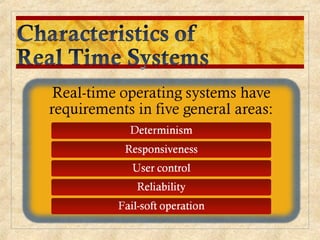
  • #28 Real-time operating systems can be characterized as having unique requirements in five general areas: • Determinism • Responsiveness • User control • Reliability • Fail-soft operation
  • #29 An operating system is deterministic to the extent that it performs operations at fixed, predetermined times or within predetermined time intervals. When multiple processes are competing for resources and processor time, no system will be fully deterministic. In a real-time operating system, process requests for service are dictated by external events and timings. The extent to which an operating system can deterministically satisfy requests depends first on the speed with which it can respond to interrupts and, second, on whether the system has sufficient capacity to handle all requests within the required time. One useful measure of the ability of an operating system to function deterministically is the maximum delay from the arrival of a high-priority device interrupt to when servicing begins. In non-real-time operating systems, this delay may be in the range of tens to hundreds of milliseconds, while in real-time operating systems that delay may have an upper bound of anywhere from a few microseconds to a millisecond.
  • #30 A related but distinct characteristic is responsiveness . Determinism is concerned with how long an operating system delays before acknowledging an interrupt. Responsiveness is concerned with how long, after acknowledgment, it takes an operating system to service the interrupt. Aspects of responsiveness include the following: 1. The amount of time required to initially handle the interrupt and begin execution of the interrupt service routine (ISR). If execution of the ISR requires a process switch, then the delay will be longer than if the ISR can be executed within the context of the current process. 2. The amount of time required to perform the ISR. This generally is dependent on the hardware platform. 3. The effect of interrupt nesting. If an ISR can be interrupted by the arrival of another interrupt, then the service will be delayed. Determinism and responsiveness together make up the response time to external events. Response time requirements are critical for real-time systems, because such systems must meet timing requirements imposed by individuals, devices, and data flows external to the system.
  • #31 User control is generally much broader in a real-time operating system than in ordinary operating systems. In a typical non-real-time operating system, the user either has no control over the scheduling function of the operating system or can only provide broad guidance, such as grouping users into more than one priority class. In a real-time system, however, it is essential to allow the user fine-grained control over task priority. The user should be able to distinguish between hard and soft tasks and to specify relative priorities within each class. A real-time system may also allow the user to specify such characteristics as the use of paging or process swapping, what processes must always be resident in main memory, what disk transfer algorithms are to be used, what rights the processes in various priority bands have, and so on.
  • #32 Reliability is typically far more important for real-time systems than non-realtime systems. A transient failure in a non-real-time system may be solved by simply rebooting the system. A processor failure in a multiprocessor non-real-time system may result in a reduced level of service until the failed processor is repaired or replaced. But a real-time system is responding to and controlling events in real time. Loss or degradation of performance may have catastrophic consequences, ranging from financial loss to major equipment damage and even loss of life.
  • #33 As in other areas the difference between a real-time and a non-real-time operating system is one of degree. Even a real-time system must be designed to respond to various failure modes. Fail-soft operation is a characteristic that refers to the ability of a system to fail in such a way as to preserve as much capability and data as possible. For example, a typical traditional UNIX system, when it detects a corruption of data within the kernel, issues a failure message on the system console, dumps the memory contents to disk for later failure analysis, and terminates execution of the system. In contrast, a real-time system will attempt either to correct the problem or minimize its effects while continuing to run. Typically, the system notifies a user or user process that it should attempt corrective action and then continues operation perhaps at a reduced level of service. In the event a shutdown is necessary, an attempt is made to maintain file and data consistency. An important aspect of fail-soft operation is referred to as stability. A real-time system is stable if, in cases where it is impossible to meet all task deadlines, the system will meet the deadlines of its most critical, highest-priority tasks, even if some less critical task deadlines are not always met. To meet the foregoing requirements, real-time operating systems typically include the following features [STAN89]: • Fast process or thread switch • Small size (with its associated minimal functionality) • Ability to respond to external interrupts quickly • Multitasking with interprocess communication tools such as semaphores, signals, and events • Use of special sequential files that can accumulate data at a fast rate • Preemptive scheduling based on priority • Minimization of intervals during which interrupts are disabled • Primitives to delay tasks for a fixed amount of time and to pause/resume tasks • Special alarms and timeouts The heart of a real-time system is the short-term task scheduler. In designing such a scheduler, fairness and minimizing average response time are not paramount. What is important is that all hard real-time tasks complete (or start) by their deadline and that as many as possible soft real-time tasks also complete (or start) by their deadline. Most contemporary real-time operating systems are unable to deal directly with deadlines. Instead, they are designed to be as responsive as possible to real-time tasks so that, when a deadline approaches, a task can be quickly scheduled. From this point of view, real-time applications typically require deterministic response times in the several-millisecond to submillisecond span under a broad set of conditions; leading-edge applications—in simulators for military aircraft, for example— often have constraints in the range of 10–100 μs [ATLA89].
  • #34 Figure 10.4 illustrates a spectrum of possibilities. In a preemptive scheduler that uses simple round-robin scheduling, a real-time task would be added to the ready queue to await its next time slice, as illustrated in Figure 10.4a . In this case, the scheduling time will generally be unacceptable for real-time applications. Alternatively, in a nonpreemptive scheduler, we could use a priority scheduling mechanism, giving real-time tasks higher priority. In this case, a real-time task that is ready would be scheduled as soon as the current process blocks or runs to completion ( Figure 10.4b ). This could lead to a delay of several seconds if a slow, low-priority task were executing at a critical time. Again, this approach is not acceptable. A more promising approach is to combine priorities with clock-based interrupts. Preemption points occur at regular intervals. When a preemption point occurs, the currently running task is preempted if a higher-priority task is waiting. This would include the preemption of tasks that are part of the operating system kernel. Such a delay may be on the order of several milliseconds ( Figure 10.4c ). While this last approach may be adequate for some real-time applications, it will not suffice for more demanding applications. In those cases, the approach that has been taken is sometimes referred to as immediate preemption. In this case, the operating system responds to an interrupt almost immediately, unless the system is in a critical-code lockout section. Scheduling delays for a real-time task can then be reduced to 100 μs or less.
  • #35 Real-time scheduling is one of the most active areas of research in computer science. In this subsection, we provide an overview of the various approaches to real-time scheduling and look at two popular classes of scheduling algorithms. In a survey of real-time scheduling algorithms, [RAMA94] observes that the various scheduling approaches depend on (1) whether a system performs schedulability analysis, (2) if it does, whether it is done statically or dynamically, and (3) whether the result of the analysis itself produces a schedule or plan according to which tasks are dispatched at run time.
  • #36 Based on these considerations, the authors identify the following classes of algorithms: • Static table-driven approaches: These perform a static analysis of feasible schedules of dispatching. The result of the analysis is a schedule that determines, at run time, when a task must begin execution. • Static priority-driven preemptive approaches: Again, a static analysis is performed, but no schedule is drawn up. Rather, the analysis is used to assign priorities to tasks, so that a traditional priority-driven preemptive scheduler can be used. • Dynamic planning-based approaches: Feasibility is determined at run time (dynamically) rather than offline prior to the start of execution (statically). An arriving task is accepted for execution only if it is feasible to meet its time constraints. One of the results of the feasibility analysis is a schedule or plan that is used to decide when to dispatch this task. • Dynamic best effort approaches: No feasibility analysis is performed. The system tries to meet all deadlines and aborts any started process whose deadline is missed. Static table-driven scheduling is applicable to tasks that are periodic. Input to the analysis consists of the periodic arrival time, execution time, periodic ending deadline, and relative priority of each task. The scheduler attempts to develop a schedule that enables it to meet the requirements of all periodic tasks. This is a predictable approach but one that is inflexible, because any change to any task requirements requires that the schedule be redone. Earliest-deadline-first or other periodic deadline techniques (discussed subsequently) are typical of this category of scheduling algorithms. Static priority-driven preemptive scheduling makes use of the priority-driven preemptive scheduling mechanism common to most non-real-time multiprogramming systems. In a non-real-time system, a variety of factors might be used to determine priority. For example, in a time-sharing system, the priority of a process changes depending on whether it is processor bound or I/O bound. In a real-time system, priority assignment is related to the time constraints associated with each task. One example of this approach is the rate monotonic algorithm (discussed subsequently), which assigns static priorities to tasks based on the length of their periods. With dynamic planning-based scheduling , after a task arrives, but before its execution begins, an attempt is made to create a schedule that contains the previously scheduled tasks as well as the new arrival. If the new arrival can be scheduled in such a way that its deadlines are satisfied and that no currently scheduled task misses a deadline, then the schedule is revised to accommodate the new task. Dynamic best effort scheduling is the approach used by many real-time systems that are currently commercially available. When a task arrives, the system assigns a priority based on the characteristics of the task. Some form of deadline scheduling, such as earliest-deadline scheduling, is typically used. Typically, the tasks are aperiodic and so no static scheduling analysis is possible. With this type of scheduling, until a deadline arrives or until the task completes, we do not know whether a timing constraint will be met. This is the major disadvantage of this form of scheduling. Its advantage is that it is easy to implement.
  • #37 Most contemporary real-time operating systems are designed with the objective of starting real-time tasks as rapidly as possible, and hence emphasize rapid interrupt handling and task dispatching. In fact, this is not a particularly useful metric in evaluating real-time operating systems. Real-time applications are generally not concerned with sheer speed but rather with completing (or starting) tasks at the most valuable times, neither too early nor too late, despite dynamic resource demands and conflicts, processing overloads, and hardware or software faults. It follows that priorities provide a crude tool and do not capture the requirement of completion (or initiation) at the most valuable time.
  • #38 There have been a number of proposals for more powerful and appropriate approaches to real-time task scheduling. All of these are based on having additional information about each task. In its most general form, the following information about each task might be used: • Ready time: Time at which task becomes ready for execution. In the case of a repetitive or periodic task, this is actually a sequence of times that is known in advance. In the case of an aperiodic task, this time may be known in advance, or the operating system may only be aware when the task is actually ready. • Starting deadline: Time by which a task must begin. • Completion deadline: Time by which a task must be completed. The typical real-time application will either have starting deadlines or completion deadlines, but not both. • Processing time: Time required to execute the task to completion. In some cases, this is supplied. In others, the operating system measures an exponential average (as defined in Chapter 9 ). For still other scheduling systems, this information is not used. • Resource requirements: Set of resources (other than the processor) required by the task while it is executing. • Priority: Measures relative importance of the task. Hard real-time tasks may have an “absolute” priority, with the system failing if a deadline is missed. If the system is to continue to run no matter what, then both hard and soft realtime tasks may be assigned relative priorities as a guide to the scheduler. • Subtask structure: A task may be decomposed into a mandatory subtask and an optional subtask. Only the mandatory subtask possesses a hard deadline. There are several dimensions to the real-time scheduling function when deadlines are taken into account: which task to schedule next, and what sort of preemption is allowed. It can be shown, for a given preemption strategy and using either starting or completion deadlines, that a policy of scheduling the task with the earliest deadline minimizes the fraction of tasks that miss their deadlines [BUTT99, HONG89, PANW88]. This conclusion holds both for single-processor and multiprocessor configurations.
  • #39 The other critical design issue is that of preemption. When starting deadlines are specified, then a nonpreemptive scheduler makes sense. In this case, it would be the responsibility of the real-time task to block itself after completing the mandatory or critical portion of its execution, allowing other real-time starting deadlines to be satisfied. This fits the pattern of Figure 10.4b . For a system with completion deadlines, a preemptive strategy ( Figure 10.4c or 10.4d) is most appropriate. For example, if task X is running and task Y is ready, there may be circumstances in which the only way to allow both X and Y to meet their completion deadlines is to preempt X, execute Y to completion, and then resume X to completion. As an example of scheduling periodic tasks with completion deadlines, consider a system that collects and processes data from two sensors, A and B. The deadline for collecting data from sensor A must be met every 20 ms, and that for B every 50 ms. It takes 10 ms, including operating system overhead, to process each sample of data from A and 25 ms to process each sample of data from B. Table 10.2 summarizes the execution profile of the two tasks.
  • #40 Figure 10.5 compares three scheduling techniques using the execution profile of Table 10.2 . The first row of Figure 10.5 repeats the information in Table 10.2 ; the remaining three rows illustrate three scheduling techniques. The computer is capable of making a scheduling decision every 10 ms. 4 Suppose that, under these circumstances, we attempted to use a priority scheduling scheme. The first two timing diagrams in Figure 10.5 show the result. If A has higher priority, the first instance of task B is only given 20 ms of processing time, in two 10-ms chunks, by the time its deadline is reached, and thus fails. If B is given higher priority, then A will miss its first deadline. The final timing diagram shows the use of earliest- deadline scheduling. At time t = 0 , both A1 and B1 arrive. Because A1 has the earliest deadline, it is scheduled first. When A1 completes, B1 is given the processor. At t = 20 , A2 arrives. Because A2 has an earlier deadline than B1, B1 is interrupted so that A2 can execute to completion. Then B1 is resumed at t = 30 . At t = 40 , A3 arrives. However, B1 has an earlier ending deadline and is allowed to execute to completion at t = 45 . A3 is then given the processor and finishes at t = 55 . In this example, by scheduling to give priority at any preemption point to the task with the nearest deadline, all system requirements can be met. Because the tasks are periodic and predictable, a static table-driven scheduling approach is used.
  • #41 Now consider a scheme for dealing with aperiodic tasks with starting deadlines. The top part of Figure 10.6 shows the arrival times and starting deadlines for an example consisting of five tasks each of which has an execution time of 20 ms.
  • #42 Table 10.3 summarizes the execution profile of the five tasks. A straightforward scheme is to always schedule the ready task with the earliest deadline and let that task run to completion. When this approach is used in the example of Figure 10.6 , note that although task B requires immediate service, the service is denied. This is the risk in dealing with aperiodic tasks, especially with starting deadlines. A refinement of the policy will improve performance if deadlines can be known in advance of the time that a task is ready. This policy, referred to as earliest deadline with unforced idle times, operates as follows: Always schedule the eligible task with the earliest deadline and let that task run to completion. An eligible task may not be ready, and this may result in the processor remaining idle even though there are ready tasks. Note that in our example the system refrains from scheduling task A even though that is the only ready task. The result is that, even though the processor is not used to maximum efficiency, all scheduling requirements are met. Finally, for comparison, the FCFS policy is shown. In this case, tasks B and E do not meet their deadlines.
  • #43 One of the more promising methods of resolving multitask scheduling conflicts for periodic tasks is rate monotonic scheduling (RMS). The scheme was first proposed in [LIU73] but has only recently gained popularity [BRIA99, SHA94]. RMS assigns priorities to tasks on the basis of their periods. For RMS, the highest-priority task is the one with the shortest period, the second highest-priority task is the one with the second shortest period, and so on. When more than one task is available for execution, the one with the shortest period is serviced first. If we plot the priority of tasks as a function of their rate, the result is a monotonically increasing function ( Figure 10.7 ); hence the name, rate monotonic scheduling.
  • #44 Figure 10.8 illustrates the relevant parameters for periodic tasks. The task’s period, T , is the amount of time between the arrival of one instance of the task and the arrival of the next instance of the task. A task’s rate (in hertz) is simply the inverse of its period (in seconds). For example, a task with a period of 50 ms occurs at a rate of 20 Hz. Typically, the end of a task’s period is also the task’s hard deadline, although some tasks may have earlier deadlines. The execution (or computation) time, C , is the amount of processing time required for each occurrence of the task. It should be clear that in a uniprocessor system, the execution time must be no greater than the period (must have C … T ). If a periodic task is always run to completion, that is, if no instance of the task is ever denied service because of insufficient resources, then the utilization of the processor by this task is U = C/T . For example, if a task has a period of 80 ms and an execution time of 55 ms, its processor utilization is 55/80 = 0.6875 .
  • #45 One measure of the effectiveness of a periodic scheduling algorithm is whether or not it guarantees that all hard deadlines are met. Suppose that we have n tasks, each with a fixed period and execution time. Then for it to be possible to meet all deadlines, the following inequality must hold: The sum of the processor utilizations of the individual tasks cannot exceed a value of 1, which corresponds to total utilization of the processor. Equation ( 10.1 ) provides a bound on the number of tasks that a perfect scheduling algorithm can successfully schedule. For any particular algorithm, the bound may be lower. For RMS, it can be shown that the following inequality holds: Table 10.4 gives some values for this upper bound. As the number of tasks increases, the scheduling bound converges to ln 2 0.693 . As an example, consider the case of three periodic tasks, where Ui = Ci/Ti : • Task P 1 : C1 = 20 ; T1 = 100 ; U1 = 0.2 • Task P 2 : C2 = 40 ; T2 = 150 ; U2 = 0.267 • Task P 3 : C3 = 100 ; T3 = 350 ; U3 = 0.286
  • #46 Priority inversion is a phenomenon that can occur in any priority-based preemptive scheduling scheme but is particularly relevant in the context of real-time scheduling. The best-known instance of priority inversion involved the Mars Pathfinder mission. This rover robot landed on Mars on July 4, 1997 and began gathering and transmitting voluminous data back to Earth. But a few days into the mission, the lander software began experiencing total system resets, each resulting in losses of data. After much effort by the Jet Propulsion Laboratory (JPL) team that built the Pathfinder, the problem was traced to priority inversion [JONE97]. In any priority scheduling scheme, the system should always be executing the task with the highest priority. Priority inversion occurs when circumstances within the system force a higher-priority task to wait for a lower-priority task. A simple example of priority inversion occurs if a lower-priority task has locked a resource (such as a device or a binary semaphore) and a higher-priority task attempts to lock that same resource. The higher-priority task will be put in a blocked state until the resource is available. If the lower-priority task soon finishes with the resource and releases it, the higher-priority task may quickly resume and it is possible that no real-time constraints are violated. A more serious condition is referred to as an unbounded priority inversion , in which the duration of a priority inversion depends not only on the time required to handle a shared resource, but also on the unpredictable actions of other unrelated tasks. The priority inversion experienced in the Pathfinder software was unbounded and serves as a good example of the phenomenon.
  • #47 Our discussion follows that of [TIME02]. The Pathfinder software included the following three tasks, in decreasing order of priority: T 1 : Periodically checks the health of the spacecraft systems and software T 2 : Processes image data T 3 : Performs an occasional test on equipment status After T 1 executes, it reinitializes a timer to its maximum value. If this timer ever expires, it is assumed that the integrity of the lander software has somehow been compromised. The processor is halted, all devices are reset, the software is completely reloaded, the spacecraft systems are tested, and the system starts over. This recovery sequence does not complete until the next day. T 1 and T 3 share a common data structure, protected by a binary semaphore s . Figure 10.9a shows the sequence that caused the priority inversion: t 1 : T 3 begins executing. t 2 : T 3 locks semaphore s and enters its critical section. t 3 : T 1 , which has a higher priority than T 3 , preempts T 3 and begins executing. t 4 : T 1 attempts to enter its critical section but is blocked because the semaphore is locked by T 3 ; T 3 resumes execution in its critical section. t 5 : T 2 , which has a higher priority than T 3 , preempts T 3 and begins executing. t 6 : T 2 is suspended for some reason unrelated to T 1 and T 3 ; T 3 resumes. t 7 : T 3 leaves its critical section and unlocks the semaphore. T 1 preempts T 3 , locks the semaphore and enters its critical section. In this set of circumstances, T 1 must wait for both T 3 and T 2 to complete and fails to reset the timer before it expires. In practical systems, two alternative approaches are used to avoid unbounded priority inversion: priority inheritance protocol and priority ceiling protocol.
  • #48 The basic idea of priority inheritance is that a lower-priority task inherits the priority of any higher-priority task pending on a resource they share. This priority change takes place as soon as the higher-priority task blocks on the resource; it should end when the resource is released by the lower-priority task. Figure 10.9b shows that priority inheritance resolves the problem of unbounded priority inversion illustrated in Figure 10.9a . The relevant sequence of events is as follows: t 1 : T 3 begins executing. t 2 : T 3 locks semaphore s and enters its critical section. t 3 : T 1 , which has a higher priority than T 3 , preempts T 3 and begins executing. t 4 : T 1 attempts to enter its critical section but is blocked because the semaphore is locked by T 3 . T 3 is immediately and temporarily assigned the same priority as T 1 . T 3 resumes execution in its critical section. t 5 : T 2 is ready to execute but, because T 3 now has a higher priority, T 2 is unable to preempt T 3 . t 6 : T 3 leaves its critical section and unlocks the semaphore: its priority level is downgraded to its previous default level. T 1 preempts T 3 , locks the semaphore, and enters its critical section. t 7 : T 1 is suspended for some reason unrelated to T 2 , and T 2 begins executing. This was the approach taken to solving the Pathfinder problem. In the priority ceiling approach, a priority is associated with each resource. The priority assigned to a resource is one level higher than the priority of its highest priority user. The scheduler then dynamically assigns this priority to any task that accesses the resource. Once the task finishes with the resource, its priority returns to normal.
  • #49 For Linux 2.4 and earlier, Linux provided a real-time scheduling capability coupled with a scheduler for non-real-time processes that made use of the traditional UNIX scheduling algorithm described in Section 9.3 . Linux 2.6 includes essentially the same real-time scheduling capability as previous releases and a substantially revised scheduler for non-real-time processes. We examine these two areas in turn. The three Linux scheduling classes are • SCHED_FIFO: First-in-first-out real-time threads • SCHED_RR: Round-robin real-time threads • SCHED_OTHER: Other, non-real-time threads Within each class, multiple priorities may be used, with priorities in the real-time classes higher than the priorities for the SCHED_OTHER class. The default values are as follows: Real-time priority classes range from 0 to 99 inclusively, and SCHED_OTHER classes range from 100 to 139. A lower number equals a higher priority.
  • #50 Figure 10.10 is an example that illustrates the distinction between FIFO and RR scheduling. Assume a process has four threads with three relative priorities assigned as shown in Figure 10.10a . Assume that all waiting sthreads are ready to execute when the current thread waits or terminates and that no higher-priority thread is awakened while a thread is executing. Figure 10.10b shows a flow in which all of the threads are in the SCHED_FIFO class. Thread D executes until it waits or terminates. Next, although threads B and C have the same priority, thread B starts because it has been waiting longer than thread C. Thread B executes until it waits or terminates, then thread C executes until it waits or terminates. Finally, thread A executes. Figure 10.10c shows a sample flow if all of the threads are in the SCHED_RR class. Thread D executes until it waits or terminates. Next, threads B and C are time sliced, because they both have the same priority. Finally, thread A executes. The final scheduling class is SCHED_OTHER . A thread in this class can only execute if there are no real-time threads ready to execute.
  • #51 The Linux 2.4 scheduler for the SCHED_OTHER class did not scale well with increasing number of processors and increasing number of processes. The drawbacks of this scheduler include the following: • The Linux 2.4 scheduler uses a single runqueue for all processors in a symmetric multiprocessing system (SMP). This means a task can be scheduled on any processor, which can be good for load balancing but bad for memory caches. For example, suppose a task executed on CPU-1, and its data were in that processor’s cache. If the task got rescheduled to CPU-2, its data would need to be invalidated in CPU-1 and brought into CPU-2. • The Linux 2.4 scheduler uses a single runqueue lock. Thus, in an SMP system, the act of choosing a task to execute locks out any other processor from manipulating the runqueues. The result is idle processors awaiting release of the runqueue lock and decreased efficiency. • Preemption is not possible in the Linux 2.4 scheduler; this means that a lower priority task can execute while a higher-priority task waited for it to complete. To correct these problems, Linux 2.6 uses a completely new priority scheduler known as the O(1) scheduler. 5 The scheduler is designed so that the time to select the appropriate process and assign it to a processor is constant, regardless of the load on the system or the number of processors.
  • #52 The kernel maintains two scheduling data structure for each processor in the system, of the following form ( Figure 10.11 ): struct prio_array { int nr_active; /* number of tasks in this array*/ unsigned long bitmap[BITMAP_SIZE]; /* priority bitmap */ struct list_head queue[MAX_PRIO]; /* priority queues */ A separate queue is maintained for each priority level. The total number of queues in the structure is MAX_PRIO , which has a default value of 140. The structure also includes a bitmap array of sufficient size to provide one bit per priority level. Thus, with 140 priority levels and 32-bit words, BITMAP_SIZE has a value of 5. This creates a bitmap of 160 bits, of which 20 bits are ignored. The bitmap indicates which queues are not empty. Finally, nr_active indicates the total number of tasks present on all queues. Two structures are maintained: an active queues structure and an expired queues structure. Initially, both bitmaps are set to all zeroes and all queues are empty. As a process becomes ready, it is assigned to the appropriate priority queue in the active queues structure and is assigned the appropriate timeslice. If a task is preempted before it completes its timeslice, it is returned to an active queue. When a task completes its timeslice, it goes into the appropriate queue in the expired queues structure and is assigned a new timeslice. All scheduling is done from among tasks in the active queues structure. When the active queues structure is empty, a simple pointer assignment results in a switch of the active and expired queues, and scheduling continues. Scheduling is simple and efficient. On a given processor, the scheduler picks the highest-priority nonempty queue. If multiple tasks are in that queue, the tasks are scheduled in round-robin fashion. Linux also includes a mechanism for moving tasks from the queue lists of one processor to that of another. Periodically, the scheduler checks to see if there is a substantial imbalance among the number of tasks assigned to each processor. To balance the load, the schedule can transfer some tasks. The highest-priority active tasks are selected for transfer, because it is more important to distribute high-priority tasks fairly.
  • #53 The scheduling algorithm used in UNIX SVR4 is a complete overhaul of the scheduling algorithm used in earlier UNIX systems (described in Section 9.3 ). The new algorithm is designed to give highest preference to real-time processes, next-highest preference to kernel-mode processes, and lowest preference to other user-mode processes, referred to as time-shared processes. 6 The two major modifications implemented in SVR4 are as follows: 1. The addition of a preemptable static priority scheduler and the introduction of a set of 160 priority levels divided into three priority classes. 2. The insertion of preemption points. Because the basic kernel is not preemptive, it can only be split into processing steps that must run to completion without interruption. In between the processing steps, safe places known as preemption points have been identified where the kernel can safely interrupt processing and schedule a new process. A safe place is defined as a region of code where all kernel data structures are either updated and consistent or locked via a semaphore.
  • #54 Figure 10.12 illustrates the 160 priority levels defined in SVR4. Each process is defined to belong to one of three priority classes and is assigned a priority level within that class.
  • #55 Real time (159-100): Processes at these priority levels are guaranteed to be selected to run before any kernel or time-sharing process. In addition, real-time processes can make use of preemption points to preempt kernel processes and user processes. • Kernel (99-60): Processes at these priority levels are guaranteed to be selected to run before any time-sharing process but must defer to real-time processes. • Time-shared (59-0): The lowest-priority processes, intended for user applications other than real-time applications.
  • #56 Figure 10.13 indicates how scheduling is implemented in SVR4. A dispatch queue is associated with each priority level, and processes at a given priority level are executed in round-robin fashion. A bit-map vector, dqactmap , contains one bit for each priority level; the bit is set to one for any priority level with a nonempty queue. Whenever a running process leaves the Running state, due to a block, timeslice expiration, or preemption, the dispatcher checks dqactmap and dispatches a ready process from the highest-priority nonempty queue. In addition, whenever a defined preemption point is reached, the kernel checks a flag called kprunrun . If set, this indicates that at least one real-time process is in the Ready state, and the kernel preempts the current process if it is of lower priority than the highest-priority real-time ready process. Within the time-sharing class, the priority of a process is variable. The scheduler reduces the priority of a process each time it uses up a time quantum, and it raises its priority if it blocks on an event or resource. The time quantum allocated to a timesharing process depends on its priority, ranging from 100 ms for priority 0 to 10 ms for priority 59. Each real-time process has a fixed priority and a fixed time quantum.
  • #57 The UNIX FreeBSD scheduler is designed to provide a more efficient operation than previous UNIX schedulers under heavy load and when used on a multiprocessor or multicore platform. The scheduler is quite complex and here we present on overview of the most significant design features; for more detail, see [MCKU05] and [ROBE03]. The underlying priority mechanism in the FreeBSD 5.1 scheduler is similar to that of UNIX SVR4. For FreeBSD, five priority classes are defined ( Table 10.5 ); the first two classes are for kernel-mode thread and the remaining classes for user-mode threads. Kernel threads execute code that is complied into the kernel’s load image and operate with the kernel’s privileged execution code. The highest-priority threads are referred to as bottom-half kernel. Threads in this class run in the kernel are scheduled based on interrupt priorities. These priorities are set when the corresponding devices are configured and do not change. Top-half kernel threads also run in the kernel and execute various kernel functions. These priorities are set based on predefined priorities and never change. The next lower priority class is referred to as real-time user. A thread with a real-time priority is not subject to priority degradation. That is, a real-time thread maintains the priority it began with and does not drop to a lower priority as a result of using resources. Next comes the time-sharing user priority class. For threads in this class, priority is periodically recalculated based on a number of parameters, including the amount of processor time used, the amount of memory resources held, and other resource consumption parameters. The lowest range of priorities is referred to as the idle user class. This class is intended for applications that will only consume processor time when no other threads are ready to execute.
  • #58 The latest version of the FreeBSD scheduler, introduced with FreeBSD 5.0, was designed to provide effective scheduling for a SMP or multicore system. The new scheduler meets three design goals: • Address the need for processor affinity in SMP and multicore systems. The term processor affinity refers to a scheduler that only migrates a thread (moves thread from one processor to another) when necessary to avoid having an idle processor. • Provide better support for multithreading on multicore systems. • Improve the performance of the scheduling algorithm, so that it is no longer a function of the number of threads in the system. In this subsection, we look at three key features of the new scheduler: queue structure, interactivity scoring, and thread migration.
  • #59 Priorities are handled somewhat differently in the two classes In the real-time priority class, all threads have a fixed priority that never changes. All of the active threads at a given priority level are in a round-robin queue. In the variable priority class, a thread’s priority begins at some initial assigned value and then may be temporarily boosted (raised) during the thread’s lifetime. There is a FIFO queue at each priority level; a thread will change queues among the variable priority classes as its own priority changes. However, a thread at priority level 15 or below is never boosted to level 16 or any other level in the real-time class.
  • #60 A thread is considered to be interactive if the ratio of its voluntary sleep time versus its runtime is below a certain threshold. Interactive threads typically have high sleep times as they wait for user input. These sleep intervals are followed by bursts of processor activity as the thread processes the user’s request. The interactivity threshold is defined in the scheduler code and is not configurable. The scheduler uses two equations to compute the interactivity score of a thread. The result is that threads whose sleep time exceeds their run time score in the lower half of the range of interactivity scores, and threads whose run time exceeds their sleep time score in the upper half of the range.
  • #61 In general, it is desirable to schedule a Ready thread onto the last processor that it ran on; this is called processor affinity . The alternative is to allow a thread to migrate to another processor for its next execution time slice. Processor affinity is significant because of local caches dedicated to a single processor. When a thread is run, it may still have data in the cache of its last processor. Changing to another processor means that the necessary data must be loaded into caches in the new processor and cache lines from the preceding processor must be invalidated. On the other hand, processor migration may allow a better load balancing and may prevent idle periods on some processors while other processor have more work than they can handle in a timely fashion. The FreeBSD scheduler supports two mechanisms for thread migration to balance load: pull and push. With the pull mechanism , and idle processor steals a thread from a nonidle processor. When a processor has no work to do, it sets a bit in a global bit-mask indicating that it is idle. When an active processor is about to add work to its own run queue, it first checks for such idle bits and if a set idle bit is found, passes the thread to the idle processor. It is primarily useful when there is a light or sporadic load, or in situations where processes are starting and exiting very frequently. The pull mechanism is effective in preventing the waste of a processor due to idleness. But it is not effective, or indeed relevant, in a situation in which every processor has work to do but the load has developed in an uneven fashion. With the push mechanism , a periodic scheduler task evaluates the current load situation and evens it out. Twice per second, this task picks the most-loaded and least-loaded processors in the system and equalizes their run queues. Push migration ensures fairness among the runnable threads.
  • #62 Windows is designed to be as responsive as possible to the needs of a single user in a highly interactive environment or in the role of a server. Windows implements a preemptive scheduler with a flexible system of priority levels that includes round robin scheduling within each level and, for some levels, dynamic priority variation on the basis of their current thread activity. Threads are the unit of scheduling in Windows rather than processes. Priorities in Windows are organized into two bands, or classes: real time and variable. Each of these bands consists of 16 priority levels. Threads requiring immediate attention are in the real-time class, which includes functions such as communications and real-time tasks. Overall, because Windows makes use of a priority-driven preemptive scheduler, threads with real-time priorities have precedence over other threads. When a thread becomes ready whose priority is higher than the currently executing thread, the lowe rpriority thread is preempted and the processor given to the higher-priority thread. Priorities are handled somewhat differently in the two classes ( Figure 10.14 ). In the real-time priority class , all threads have a fixed priority that never changes. All of the active threads at a given priority level are in a round-robin queue. In the variable priority class , a thread’s priority begins an initial priority value and then may be temporarily boosted (raised) during the thread’s lifetime. There is a FIFO queue at each priority level; a thread will change queues among the variable priority classes as its own priority changes. However, a thread at priority level 15 or below is never boosted to level 16 or any other level in the real-time class. The initial priority of a thread in the variable priority class is determined by two quantities: process base priority and thread base priority. The process base priority is an attribute of the process object, and can take on any value from 1 through 15 (priority 0 is reserved for the Executive’s per-processor idle threads). Each thread object associated with a process object has a thread base priority attribute that indicates the thread’s base priority relative to that of the process. The thread’s base priority can be equal to that of its process or within two levels above or below that of the process. So, for example, if a process has a base priority of 4 and one of its threads has a base priority of - 1 , then the initial priority of that thread is 3.
  • #63 Once a thread in the variable priority class has been created, its actual priority, referred to as the thread’s current priority, may fluctuate within given boundaries. The current priority may never fall below the thread’s base priority and it may never exceed 15. Figure 10.15 gives an example. The process object has a base priority attribute of 4. Each thread object associated with this process object must have an initial priority of between 2 and 6. Suppose the base priority for thread is 4. Then the current priority for that thread may fluctuate in the range from 4 through 15 depending on what boosts it has been given. If a thread is interrupted to wait on an I/O event, the kernel boosts its priority. If a boosted thread is interrupted because it has used up its current time quantum, the kernel lowers its priority. Thus, processor- bound threads tend toward lower priorities and I/O-bound threads tend toward higher priorities. In the case of I/O-bound threads, the kernel boosts the priority more for interactive waits (e.g., wait on keyboard or mouse) than for other types of I/O (e.g., disk I/O). Thus, interactive threads tend to have the highest priorities within the variable priority class.
  • #64 The Linux VServer virtual machine facility, introduced in Chapter 2 , provides a way of controlling VM use of processor time. VServer overlays a token bucket filter (TBF) on top of the standard Linux schedule. The purpose of the TBF is to determine how much of the processor execution time (single processor, multiprocessor, or multicore) is allocated to each VM. If only the underlying Linux scheduler is used to globally schedule processes across all VMs, then resource hunger processes in one VM crowd out processes in other VMs. Figure 10.16 illustrates the TBF concept. For each VM, a bucket is defined with a capacity of S tokens. Tokens are added to the bucket at a rate of R tokens during every time interval of length T. When the bucket is full, additional incoming tokens are simply discarded. When a process is executing on this VM, it consumes one token for each timer clock tick. If the bucket empties, the process is put in a hold and cannot be restarted until the bucket is refilled to a minimum threshold value of M tokens. At that point, the process is rescheduled. A significant consequence of the TBF approach is that a VM may accumulate tokens during a period of quiescence, and then later use the tokens in a burst when required.
  • #65 With a tightly coupled multiprocessor, multiple processors have access to the same main memory. In this configuration, the scheduling structure is somewhat more complex. For example, a given process may be assigned to the same processor for its entire life or dispatched to any processor each time it enters the Running state. Performance studies suggest that the differences among various scheduling algorithms are less significant in a multiprocessor system. A real-time process or task is one that is executed in connection with some process or function or set of events external to the computer system and that must meet one or more deadlines to interact effectively and correctly with the external environment. A real-time operating system is one that is capable of managing realtime processes. In this context, the traditional criteria for a scheduling algorithm do not apply. Rather, the key factor is the meeting of deadlines. Algorithms that rely heavily on preemption and on reacting to relative deadlines are appropriate in this context.