Anatomy of the Respiratory
System
ZAHID ALI
NURSING INSTRUCTOR
ANATOMY AND PHYSIOLOGY
Zaibunisa institute of Nursing And
Allied health sciences Ghotki
Objectives
• At the end of the presentation student will be
able to:
• Introduction of respiratory system.
• Describe the anatomy and physiology of
respiratory system.
• Define upper and lower respiratory tract.
• Inlist the organs of respiratory system.
• Functions of the respiratory system.
Anatomy of the Respiratory
System
Respiration
Respiration is the act of breathing:
Inhaling. The act of breathing in oxygen.
Exhaling. The act of breathing out carbon
dioxide.
Respiratory system
• Your respiratory system is the network of organs and tissues that
help you breathe. This system helps your body absorb oxygen from
the air so your organs can work. It also cleans waste gases, such as
carbon dioxide, from your blood.
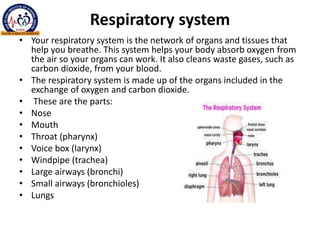
• The respiratory system is made up of the organs included in the
exchange of oxygen and carbon dioxide.
• These are the parts:
• Nose
• Mouth
• Throat (pharynx)
• Voice box (larynx)
• Windpipe (trachea)
• Large airways (bronchi)
• Small airways (bronchioles)
• Lungs
• Mouth and nose: Openings that pull air from outside
your body into your respiratory system.
• Sinuses: Hollow areas between the bones in your head
that help regulate the temperature and humidity of the
air you inhale.
• Pharynx (throat): Tube that delivers air from your
mouth and nose to the trachea (windpipe).
• Trachea: Passage connecting your throat and lungs.
• Bronchial tubes: Tubes at the bottom of your windpipe
that connect into each lung.
• Lungs: Two organs that remove oxygen from the air
and pass it into your blood.
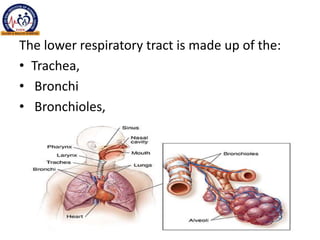
The upper respiratory tract is made up of the:
• Nose or nostrils,
• Nasal cavity,
• Throat (pharynx),
and voice box (larynx).
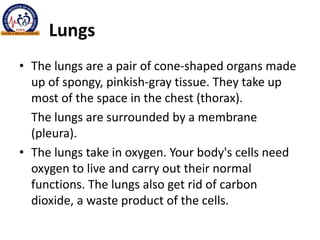
The lower respiratory tract is made up of the:
• Trachea,
• Bronchi
• Bronchioles,
• Alveoli,
Lungs
• The lungs are a pair of cone-shaped organs made
up of spongy, pinkish-gray tissue. They take up
most of the space in the chest (thorax).
The lungs are surrounded by a membrane
(pleura).
• The lungs take in oxygen. Your body's cells need
oxygen to live and carry out their normal
functions. The lungs also get rid of carbon
dioxide, a waste product of the cells.
• The lungs are separated from each other by
the mediastinum, an area that contains the:
• Heart and its large vessels
• Trachea
• Esophagus
• Thymus gland
• Lymph nodes
• The right lung has 3 sections, called lobes. The
left lung has 2 lobes. When you breathe in:
• Air enters your body through your nose or
mouth.
• Air then travels down the throat through the
larynx and trachea.
• Air goes into the lungs through tubes called
main-stem bronchi.
• One main-stem bronchus leads to the right
lung and one to the left lung:
• In the lungs, the main-stem bronchi divide
into smaller bronchi.
• The smaller bronchi divide into even smaller
tubes (bronchioles).
• Bronchioles end in tiny air sacs (alveoli) where
the exchange of oxygen and carbon dioxide
occurs.
• You then breathe out carbon dioxide.
Function of respiratory system
• Allows you to talk and to smell.
• Warms air to match your body temperature and
moisturizes it to the humidity level your body needs.
• Delivers oxygen to the cells in your body.
• Removes waste gases, including carbon dioxide, from
the body when you exhale.
• Protects your airways from harmful substances and
irritants.
References
• Reference Books
• Anatomy and Physiology for Healthcare by Paul
Marshall; Beverly Gallacher; Jim Jolly; Shupikai
Rinomhota. ...
• Atlas of Human Anatomy by Frank H. ...
• Big Picture: Gross Anatomy, Medical Course & Step 1
Review, Second Edition by David A. ...
• Big Picture Physiology: Medical Course by Jonathan D.
•
Respiratory system.pptx

Respiratory system.pptx

  • 1.
    Anatomy of theRespiratory System ZAHID ALI NURSING INSTRUCTOR ANATOMY AND PHYSIOLOGY Zaibunisa institute of Nursing And Allied health sciences Ghotki
  • 2.
    Objectives • At theend of the presentation student will be able to: • Introduction of respiratory system. • Describe the anatomy and physiology of respiratory system. • Define upper and lower respiratory tract. • Inlist the organs of respiratory system. • Functions of the respiratory system.
  • 3.
    Anatomy of theRespiratory System Respiration Respiration is the act of breathing: Inhaling. The act of breathing in oxygen. Exhaling. The act of breathing out carbon dioxide.
  • 4.
    Respiratory system • Yourrespiratory system is the network of organs and tissues that help you breathe. This system helps your body absorb oxygen from the air so your organs can work. It also cleans waste gases, such as carbon dioxide, from your blood. • The respiratory system is made up of the organs included in the exchange of oxygen and carbon dioxide. • These are the parts: • Nose • Mouth • Throat (pharynx) • Voice box (larynx) • Windpipe (trachea) • Large airways (bronchi) • Small airways (bronchioles) • Lungs
  • 5.
    • Mouth andnose: Openings that pull air from outside your body into your respiratory system. • Sinuses: Hollow areas between the bones in your head that help regulate the temperature and humidity of the air you inhale. • Pharynx (throat): Tube that delivers air from your mouth and nose to the trachea (windpipe). • Trachea: Passage connecting your throat and lungs. • Bronchial tubes: Tubes at the bottom of your windpipe that connect into each lung. • Lungs: Two organs that remove oxygen from the air and pass it into your blood.
  • 6.
    The upper respiratorytract is made up of the: • Nose or nostrils, • Nasal cavity, • Throat (pharynx), and voice box (larynx).
  • 7.
    The lower respiratorytract is made up of the: • Trachea, • Bronchi • Bronchioles, • Alveoli,
  • 8.
    Lungs • The lungsare a pair of cone-shaped organs made up of spongy, pinkish-gray tissue. They take up most of the space in the chest (thorax). The lungs are surrounded by a membrane (pleura). • The lungs take in oxygen. Your body's cells need oxygen to live and carry out their normal functions. The lungs also get rid of carbon dioxide, a waste product of the cells.
  • 9.
    • The lungsare separated from each other by the mediastinum, an area that contains the: • Heart and its large vessels • Trachea • Esophagus • Thymus gland • Lymph nodes
  • 10.
    • The rightlung has 3 sections, called lobes. The left lung has 2 lobes. When you breathe in: • Air enters your body through your nose or mouth. • Air then travels down the throat through the larynx and trachea. • Air goes into the lungs through tubes called main-stem bronchi.
  • 11.
    • One main-stembronchus leads to the right lung and one to the left lung: • In the lungs, the main-stem bronchi divide into smaller bronchi. • The smaller bronchi divide into even smaller tubes (bronchioles). • Bronchioles end in tiny air sacs (alveoli) where the exchange of oxygen and carbon dioxide occurs. • You then breathe out carbon dioxide.
  • 12.
    Function of respiratorysystem • Allows you to talk and to smell. • Warms air to match your body temperature and moisturizes it to the humidity level your body needs. • Delivers oxygen to the cells in your body. • Removes waste gases, including carbon dioxide, from the body when you exhale. • Protects your airways from harmful substances and irritants.
  • 13.
    References • Reference Books •Anatomy and Physiology for Healthcare by Paul Marshall; Beverly Gallacher; Jim Jolly; Shupikai Rinomhota. ... • Atlas of Human Anatomy by Frank H. ... • Big Picture: Gross Anatomy, Medical Course & Step 1 Review, Second Edition by David A. ... • Big Picture Physiology: Medical Course by Jonathan D. •