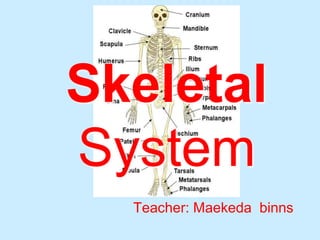
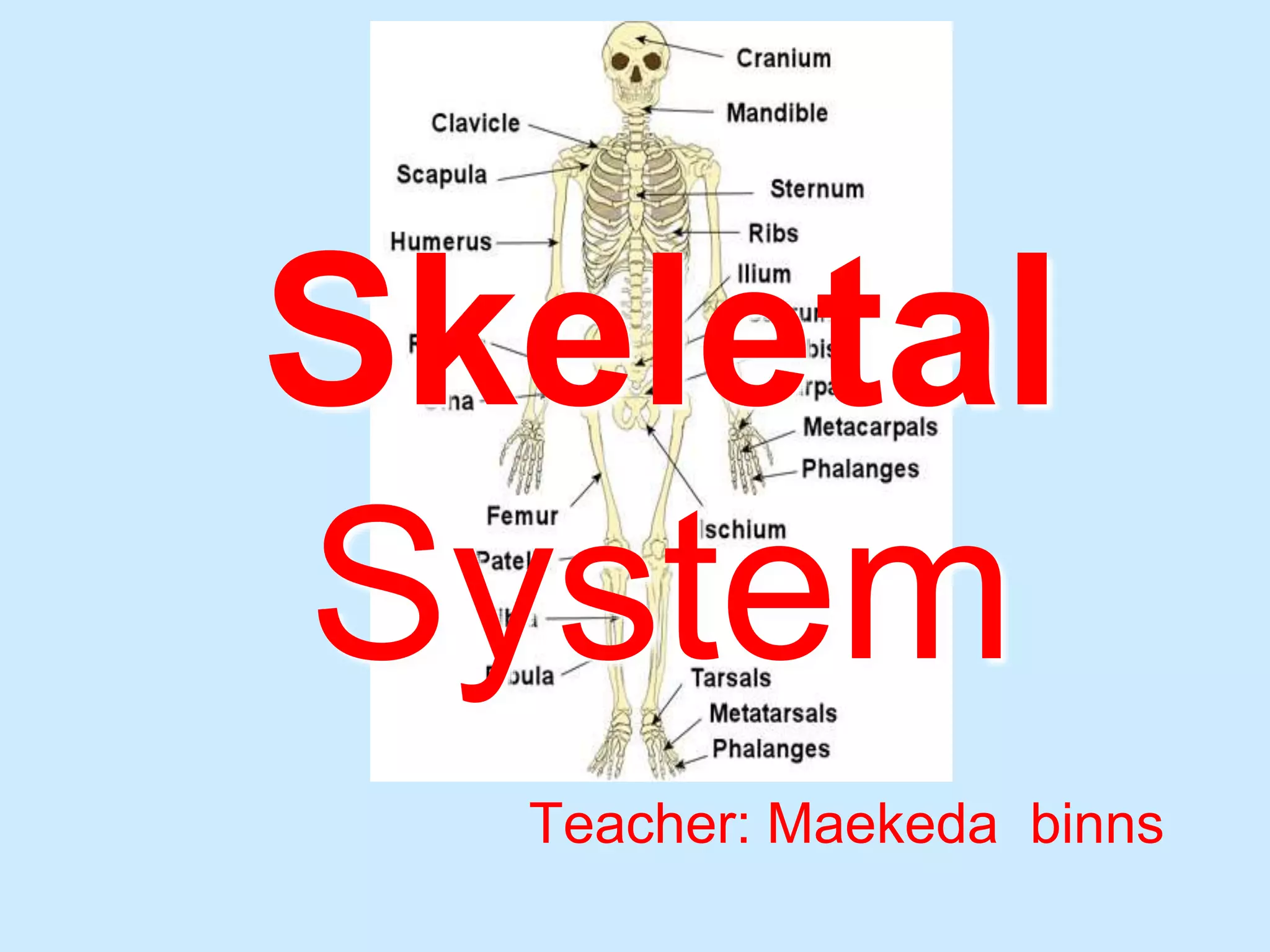
Skeletal
System
Teacher: Maekeda binns
Introduction
• Objective : Students will be able to identify
the function and structures of the skeletal
system.
• Distinguish between the appendicular and
axial skeletons.
• Finally, identify 23 major bones of the human
body and their functions.
What is the skeleton system ?
Function
• Five functions of the Skeletal System:
– 1) Provide points of attachments for
muscles
– 2) Protect and support softer underlying
tissues
– 3) House blood producing cells
– 4) Store inorganic salts
– 5) Contain passage ways for blood vessels
and nerves
SUPPORT
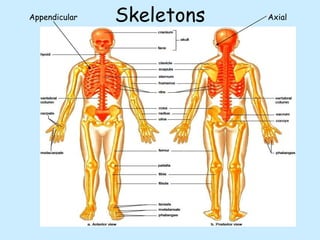
Skeletons
Appendicular Axial
Axial & Appendicular skeleton
• The axial skeleton contains 80 bones.
There are 22 bones in the skull, 6 auditory
ossicles, 26 vertebra, 24 ribs, a sternum,
and a hyoid bone.
• Bones of the Appendicular skeleton:
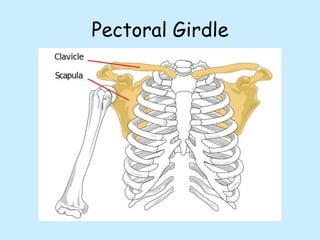
• 4 bones in the shoulder girdle (clavicle and
scapula each side) 6 bones in the arm and
forearm (humerus,ulna and radius) 58
bones 2 pelvis bones 8 bones in the legs
(femur, tibia, patella and fibula) 56 bones
in the feet.
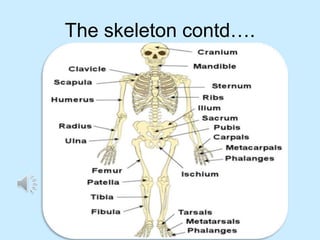
The skeleton contd….
23 Major Bones of the
Human Body
Video
Skull
Skull
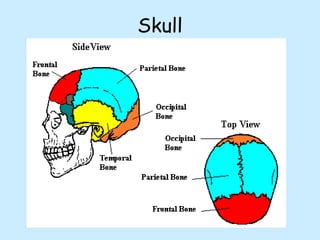
• The cranium is the flat bone that covers
and protects the brain and forms the
shape of the face. Babies have spaces
between the bones in their skull to allow
them to fit through the birth canal, explains
KidsHealth.
Vertebral Column
Spine
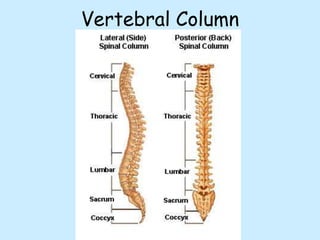
• The spine is made up of 24 irregular
bones called the vertebrae, the sacrum
and the coccyx, according to Teacher
Vision. The spine help with balance and
weight bearing. The sacrum is also the
bone that is attached to the pelvis, or
hipbone.
Pectoral Girdle
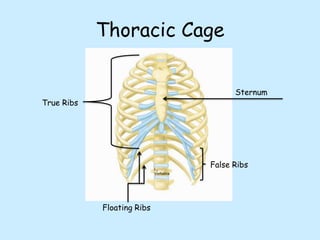
Thoracic Cage
Sternum
True Ribs
False Ribs
Floating Ribs
Ribs
• The ribs create a bony cage protecting
organs such as the heart, lungs and liver.
According to Kids Health, while most
people have 12 pairs of ribs, occasionally
someone has one extra or one missing
pair of ribs. The top seven ribs connect to
the sternum, or breastbone.
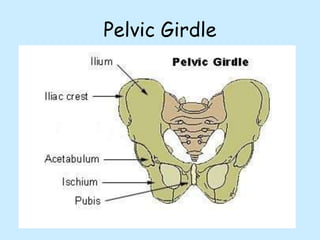
Pelvic Girdle
Upper Limb
Lower Limb
Limbs
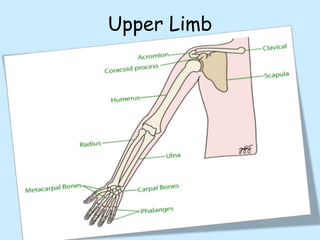
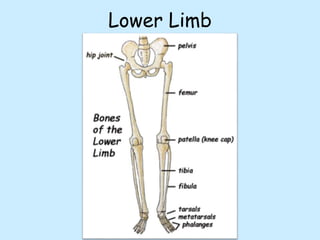
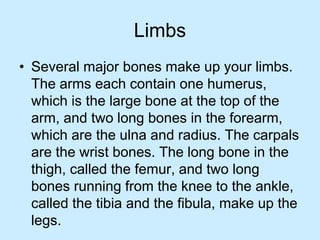
• Several major bones make up your limbs.
The arms each contain one humerus,
which is the large bone at the top of the
arm, and two long bones in the forearm,
which are the ulna and radius. The carpals
are the wrist bones. The long bone in the
thigh, called the femur, and two long
bones running from the knee to the ankle,
called the tibia and the fibula, make up the
legs.
Activity Time
https://www.purposegames.com/game/1009
Quick Review
• How many bones are there in the human body?
• A. 206
• B. 208
• C. 180
• D. 60
YOUTUBE VIDEO
• The class will be split into groups one
member will choose a computer and on
that computer the tasks are given.
• Students will save their videos on a thumb
drive and the teacher will upload their
videos to a science YouTube channel in
which the group that gets the most likes
will win classroom tokens.
• https://www.youtube.com/channel/UCR4Q
tGZeP7THrNSxJIfKEfw
Thank You for your
attention!! 

Skeletal_System_ppt.ppt

  • 1.
  • 2.
    Introduction • Objective :Students will be able to identify the function and structures of the skeletal system. • Distinguish between the appendicular and axial skeletons. • Finally, identify 23 major bones of the human body and their functions.
  • 3.
    What is theskeleton system ?
  • 4.
    Function • Five functionsof the Skeletal System: – 1) Provide points of attachments for muscles – 2) Protect and support softer underlying tissues – 3) House blood producing cells – 4) Store inorganic salts – 5) Contain passage ways for blood vessels and nerves SUPPORT
  • 5.
  • 6.
    Axial & Appendicularskeleton • The axial skeleton contains 80 bones. There are 22 bones in the skull, 6 auditory ossicles, 26 vertebra, 24 ribs, a sternum, and a hyoid bone. • Bones of the Appendicular skeleton: • 4 bones in the shoulder girdle (clavicle and scapula each side) 6 bones in the arm and forearm (humerus,ulna and radius) 58 bones 2 pelvis bones 8 bones in the legs (femur, tibia, patella and fibula) 56 bones in the feet.
  • 7.
  • 8.
    23 Major Bonesof the Human Body
  • 9.
  • 10.
  • 11.
    Skull • The craniumis the flat bone that covers and protects the brain and forms the shape of the face. Babies have spaces between the bones in their skull to allow them to fit through the birth canal, explains KidsHealth.
  • 12.
  • 13.
    Spine • The spineis made up of 24 irregular bones called the vertebrae, the sacrum and the coccyx, according to Teacher Vision. The spine help with balance and weight bearing. The sacrum is also the bone that is attached to the pelvis, or hipbone.
  • 14.
  • 15.
  • 16.
    Ribs • The ribscreate a bony cage protecting organs such as the heart, lungs and liver. According to Kids Health, while most people have 12 pairs of ribs, occasionally someone has one extra or one missing pair of ribs. The top seven ribs connect to the sternum, or breastbone.
  • 17.
  • 18.
  • 19.
  • 20.
    Limbs • Several majorbones make up your limbs. The arms each contain one humerus, which is the large bone at the top of the arm, and two long bones in the forearm, which are the ulna and radius. The carpals are the wrist bones. The long bone in the thigh, called the femur, and two long bones running from the knee to the ankle, called the tibia and the fibula, make up the legs.
  • 21.
  • 22.
    Quick Review • Howmany bones are there in the human body? • A. 206 • B. 208 • C. 180 • D. 60
  • 25.
    YOUTUBE VIDEO • Theclass will be split into groups one member will choose a computer and on that computer the tasks are given. • Students will save their videos on a thumb drive and the teacher will upload their videos to a science YouTube channel in which the group that gets the most likes will win classroom tokens. • https://www.youtube.com/channel/UCR4Q tGZeP7THrNSxJIfKEfw
  • 26.
    Thank You foryour attention!! 