Organizational Design Chapter 8 Part 3  Organizing Challenges in the 21st Century
Explain why organizational design is important for organizational success. Identify the three major components of organizational design. Discuss the four types of organizational structure and the strategic conditions under which each might be appropriate. Describe the factors that affect an organization’s need for coordination and explain how integrating mechanisms can be used to coordinate organizational activities. Explain the concept of locus of decision making and when centralized or decentralized decision making might be appropriate. LEARNING OBJECTIVES When you have finished studying this chapter, you should be able to:
Organizational Design Organizational Design Defined A plan for arranging and coordinating the activities of an organization for the purpose of fulfilling its mission and achieving its goals. Components of Organizational Design Overall organizational design is defined by three primary components: Organizational structure Integrating mechanisms Locus of decision making
Figure 8.1   Dimensions of Organizational Design
Organizational Structure Defines the primary reporting relationships that exist within an organization. The chain of command and hierarchy of responsibility, authority, and accountability are established through organizational structure. Common Forms of Organizational Structure Functional structure Divisional structure Matrix structure Network structure
Functional Structure: Specialization and Efficiency Members of the organization are grouped according to the particular function that they perform within the organization. Appropriate when an organization’s greatest source of complexity comes from the diverse tasks that must be performed rather than from its products, geographic markets, or consumer groups.
Figure 8. 2  Functional Structure
Functional Structure Advantages Facilitates specialization Cohesive work groups Improved operational efficiency Disadvantages Focus on departmental versus organizational issues Difficult to develop generalists needed for top-level management Only top-level management held accountable for profitability
Divisional Structures: Providing Focus Members of the organization are grouped on the basis of: Common products Geographic markets Customers served
Types of Divisional Structure Product Divisions For organizations with relatively diverse product lines that require specialized efforts to achieve high product quality. Geographic Divisions For organizations with limited product lines that either have wide geographic coverage or desire to grow through geographic expansion. Customer Divisions For organizations that have separate customer groups with very specific and distinct needs.
Product Divisional Structure Advantages Enhanced coordination. Better assessment of manager performance and responsibility. Development of generalist managers. Disadvantages Managers may lack expertise to operate in wide geographic areas. Duplication of resources.
Figure 8. 3  Product Divisional Structure: Clariant Source:  From the website http://www.clariant.com. Copyright by Clariant 2005. All rights reserved. *Services Production Services, Supply Chain Management, Sourcing, ESHA, IT, International Coordination **Technology Intellectual Property, Innovation & Knowledge Management, New Business Development
Geographic Divisional Advantages Allows for focus on specific new markets. Good structure for growth along geographic lines. Adaptable to local needs. Disadvantages Duplication of product or product/technology efforts. Coordination and integration are difficult. May be difficult to manage diverse product lines.
Figure 8. 4  Geographic Divisional Structure: Canadian National Railway Company Source:  “Illinois Central Spurs Reorganization by Canadian National,”  Wall Street Journal,  15 April 1999, A4.
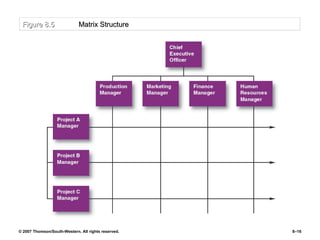
Matrix Structure: A Dual Focus A structure in which the tasks of the organization are grouped along two organizational dimensions simultaneously. Examples include: Product/function Product/geographic region
Figure 8. 5  Matrix Structure
Matrix Structure  (cont’d) Disadvantages Complex, leading to difficulties in implementation Behavioral difficulties from “two bosses” Time consuming from a planning/coordination perspective Advantages Can achieve simultaneous objectives Managers focus on two organizational dimensions, resulting in more specific job skills
Network Structures: Flexibility An organizational structure that is founded on a set of alliances with other organizations that serve a wide variety of functions. An organization that has a core coordinating with other organizations or organizational units.
Figure 8. 6  Network Structure (Building Contractor)
Types of Network Structure Internal Network A network structure that relies on internally developed units to provide services to a core organizational unit. Stable Network A network structure that utilizes external alliances selectively as a mechanism for gaining strategic flexibility. Dynamic Network A network structure that makes extensive use of outsourcing through alliances with outside organizations.
Network Structure  (cont’d) Advantages Maximizes the effectiveness of the core unit Do more with less resources Flexibility Disadvantages Fragmentation makes it difficult to develop control systems Success is dependent on ability to locate sources Difficult to develop employee loyalty
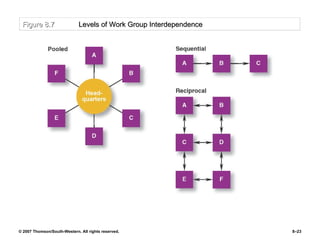
Managing Complexity Through Integration Interdependence The degree to which work groups are interrelated. Primary levels of work group integration: Pooled interdependence Sequential interdependence Reciprocal interdependence
Figure 8. 7  Levels of Work Group Interdependence
Pooled Interdependence Occurs when organizational units have a common resource but no interrelationship with one another. B C D A F E Head- quarters
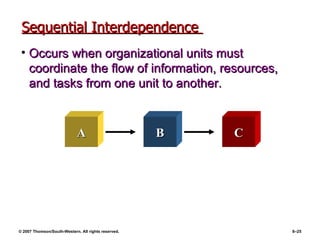
Sequential Interdependence  Occurs when organizational units must coordinate the flow of information, resources, and tasks from one unit to another. A B C
Reciprocal Interdependence Occurs when information, resources, and tasks must be passed back and forth between work groups. A C E F D B
Integrating Mechanisms Methods for managing the flow of information, resources, and tasks within the organization. Major categories of integrating mechanisms are: General management systems. Methods of increasing coordination potential. Methods of reducing the need for coordination.
Figure 8. 8  Integrating Mechanisms Source:  Adapted by permission, J. R. Galbraith, “Organizational Design: An Information Processing View,”  Interfaces  4 (May 1974): 3. Copyright 1974, The Institute of Management Sciences and the Operations Research Society of America (currently INFORMS), 2 Charles Street, Suite 300, Providence, RI 02904 USA.
General Management Systems Some coordination of work units may be achieved through the development of general management systems such as: The managerial hierarchy Rules and procedures Plans and goals Such mechanisms form the foundation of an organization’s integration system.
Increasing Coordination Potential Two mechanisms for increasing the coordination potential both vertically and horizontally in the organization are  information systems  and  lateral relationships . Information systems  facilitate the flow of information up and down the traditional chain of command and across organizational units. Lateral relationships  exist across work units and serve as mechanisms for exchanging decision-making information.
Boundary Spanning Coordination Lateral relationships that help to integrate and coordinate the activities of the organization. Examples include: Liaisons Committees Task forces Integrating positions Interfunctional work teams
Reducing the Need for Coordination The organization creates “slack resources” that reduce the interdependence of the work groups. Actions that reduce the need for coordination: Longer lead times Larger inventories Work units that have only pooled interdependence As a result, the need for integrating mechanisms is reduced.
Locus of Decision Making The degree to which decision making is centralized versus decentralized. Centralized Decision Making Advantage: gives top-level management maximum control. Disadvantage: limits the organization’s ability to respond quickly and effectively to changes in the environment. Decentralized Decision Making Advantage: rapid and effective response to environmental change because the decision makers are the people closest to the situation. Disadvantage: top-level managers lose some control.
Mechanistic Versus Organic Systems Mechanistic Systems Highly centralized organizations in which decision-making authority rests with top-level management. Organic Systems Decentralized organizations that push decision making to the lowest levels of the organization in an effort to respond more effectively to environmental change.
The Impact of Environmental Stability Stable Environments Environments that experience little change. Turbulent Environments Environments that are characterized by rapid and significant change. Organizational Design for a Changing Environment An  adaptive organization  eliminates bureaucracy limiting employee creativity and brings the decision makers closer to the customer.
Implications for Leaders Remember that organizational design provides an important mechanism for achieving the strategic and operational goals of the organization. Understand the makeup of the forms of organizational structure and under what conditions it would be appropriate to use each. Understand the potential advantages and disadvantages of the functional, division, matrix, and network structures. Look for ways to increase the integration potential of the organization or to reduce the need for integration. Understand the circumstances in which centralized or decentralized decision making would work well and how to use each approach.
Implications for Leaders (cont’d) Look for ways to increase the integration potential of the organization or to reduce the need for integration. Evaluate the advantages and disadvantages associated with centralized versus decentralized decision making, given the specific circumstances of the organization. Strive to develop an adaptive and flexible organization that is effective in a dynamic  business environment.
Table 8. 1  Potential Advantages and Disadvantages of Organizational Structures

Chap08

  • 1.
    Organizational Design Chapter8 Part 3 Organizing Challenges in the 21st Century
  • 2.
    Explain why organizationaldesign is important for organizational success. Identify the three major components of organizational design. Discuss the four types of organizational structure and the strategic conditions under which each might be appropriate. Describe the factors that affect an organization’s need for coordination and explain how integrating mechanisms can be used to coordinate organizational activities. Explain the concept of locus of decision making and when centralized or decentralized decision making might be appropriate. LEARNING OBJECTIVES When you have finished studying this chapter, you should be able to:
  • 3.
    Organizational Design OrganizationalDesign Defined A plan for arranging and coordinating the activities of an organization for the purpose of fulfilling its mission and achieving its goals. Components of Organizational Design Overall organizational design is defined by three primary components: Organizational structure Integrating mechanisms Locus of decision making
  • 4.
    Figure 8.1 Dimensions of Organizational Design
  • 5.
    Organizational Structure Definesthe primary reporting relationships that exist within an organization. The chain of command and hierarchy of responsibility, authority, and accountability are established through organizational structure. Common Forms of Organizational Structure Functional structure Divisional structure Matrix structure Network structure
  • 6.
    Functional Structure: Specializationand Efficiency Members of the organization are grouped according to the particular function that they perform within the organization. Appropriate when an organization’s greatest source of complexity comes from the diverse tasks that must be performed rather than from its products, geographic markets, or consumer groups.
  • 7.
    Figure 8. 2 Functional Structure
  • 8.
    Functional Structure AdvantagesFacilitates specialization Cohesive work groups Improved operational efficiency Disadvantages Focus on departmental versus organizational issues Difficult to develop generalists needed for top-level management Only top-level management held accountable for profitability
  • 9.
    Divisional Structures: ProvidingFocus Members of the organization are grouped on the basis of: Common products Geographic markets Customers served
  • 10.
    Types of DivisionalStructure Product Divisions For organizations with relatively diverse product lines that require specialized efforts to achieve high product quality. Geographic Divisions For organizations with limited product lines that either have wide geographic coverage or desire to grow through geographic expansion. Customer Divisions For organizations that have separate customer groups with very specific and distinct needs.
  • 11.
    Product Divisional StructureAdvantages Enhanced coordination. Better assessment of manager performance and responsibility. Development of generalist managers. Disadvantages Managers may lack expertise to operate in wide geographic areas. Duplication of resources.
  • 12.
    Figure 8. 3 Product Divisional Structure: Clariant Source: From the website http://www.clariant.com. Copyright by Clariant 2005. All rights reserved. *Services Production Services, Supply Chain Management, Sourcing, ESHA, IT, International Coordination **Technology Intellectual Property, Innovation & Knowledge Management, New Business Development
  • 13.
    Geographic Divisional AdvantagesAllows for focus on specific new markets. Good structure for growth along geographic lines. Adaptable to local needs. Disadvantages Duplication of product or product/technology efforts. Coordination and integration are difficult. May be difficult to manage diverse product lines.
  • 14.
    Figure 8. 4 Geographic Divisional Structure: Canadian National Railway Company Source: “Illinois Central Spurs Reorganization by Canadian National,” Wall Street Journal, 15 April 1999, A4.
  • 15.
    Matrix Structure: ADual Focus A structure in which the tasks of the organization are grouped along two organizational dimensions simultaneously. Examples include: Product/function Product/geographic region
  • 16.
    Figure 8. 5 Matrix Structure
  • 17.
    Matrix Structure (cont’d) Disadvantages Complex, leading to difficulties in implementation Behavioral difficulties from “two bosses” Time consuming from a planning/coordination perspective Advantages Can achieve simultaneous objectives Managers focus on two organizational dimensions, resulting in more specific job skills
  • 18.
    Network Structures: FlexibilityAn organizational structure that is founded on a set of alliances with other organizations that serve a wide variety of functions. An organization that has a core coordinating with other organizations or organizational units.
  • 19.
    Figure 8. 6 Network Structure (Building Contractor)
  • 20.
    Types of NetworkStructure Internal Network A network structure that relies on internally developed units to provide services to a core organizational unit. Stable Network A network structure that utilizes external alliances selectively as a mechanism for gaining strategic flexibility. Dynamic Network A network structure that makes extensive use of outsourcing through alliances with outside organizations.
  • 21.
    Network Structure (cont’d) Advantages Maximizes the effectiveness of the core unit Do more with less resources Flexibility Disadvantages Fragmentation makes it difficult to develop control systems Success is dependent on ability to locate sources Difficult to develop employee loyalty
  • 22.
    Managing Complexity ThroughIntegration Interdependence The degree to which work groups are interrelated. Primary levels of work group integration: Pooled interdependence Sequential interdependence Reciprocal interdependence
  • 23.
    Figure 8. 7 Levels of Work Group Interdependence
  • 24.
    Pooled Interdependence Occurswhen organizational units have a common resource but no interrelationship with one another. B C D A F E Head- quarters
  • 25.
    Sequential Interdependence Occurs when organizational units must coordinate the flow of information, resources, and tasks from one unit to another. A B C
  • 26.
    Reciprocal Interdependence Occurswhen information, resources, and tasks must be passed back and forth between work groups. A C E F D B
  • 27.
    Integrating Mechanisms Methodsfor managing the flow of information, resources, and tasks within the organization. Major categories of integrating mechanisms are: General management systems. Methods of increasing coordination potential. Methods of reducing the need for coordination.
  • 28.
    Figure 8. 8 Integrating Mechanisms Source: Adapted by permission, J. R. Galbraith, “Organizational Design: An Information Processing View,” Interfaces 4 (May 1974): 3. Copyright 1974, The Institute of Management Sciences and the Operations Research Society of America (currently INFORMS), 2 Charles Street, Suite 300, Providence, RI 02904 USA.
  • 29.
    General Management SystemsSome coordination of work units may be achieved through the development of general management systems such as: The managerial hierarchy Rules and procedures Plans and goals Such mechanisms form the foundation of an organization’s integration system.
  • 30.
    Increasing Coordination PotentialTwo mechanisms for increasing the coordination potential both vertically and horizontally in the organization are information systems and lateral relationships . Information systems facilitate the flow of information up and down the traditional chain of command and across organizational units. Lateral relationships exist across work units and serve as mechanisms for exchanging decision-making information.
  • 31.
    Boundary Spanning CoordinationLateral relationships that help to integrate and coordinate the activities of the organization. Examples include: Liaisons Committees Task forces Integrating positions Interfunctional work teams
  • 32.
    Reducing the Needfor Coordination The organization creates “slack resources” that reduce the interdependence of the work groups. Actions that reduce the need for coordination: Longer lead times Larger inventories Work units that have only pooled interdependence As a result, the need for integrating mechanisms is reduced.
  • 33.
    Locus of DecisionMaking The degree to which decision making is centralized versus decentralized. Centralized Decision Making Advantage: gives top-level management maximum control. Disadvantage: limits the organization’s ability to respond quickly and effectively to changes in the environment. Decentralized Decision Making Advantage: rapid and effective response to environmental change because the decision makers are the people closest to the situation. Disadvantage: top-level managers lose some control.
  • 34.
    Mechanistic Versus OrganicSystems Mechanistic Systems Highly centralized organizations in which decision-making authority rests with top-level management. Organic Systems Decentralized organizations that push decision making to the lowest levels of the organization in an effort to respond more effectively to environmental change.
  • 35.
    The Impact ofEnvironmental Stability Stable Environments Environments that experience little change. Turbulent Environments Environments that are characterized by rapid and significant change. Organizational Design for a Changing Environment An adaptive organization eliminates bureaucracy limiting employee creativity and brings the decision makers closer to the customer.
  • 36.
    Implications for LeadersRemember that organizational design provides an important mechanism for achieving the strategic and operational goals of the organization. Understand the makeup of the forms of organizational structure and under what conditions it would be appropriate to use each. Understand the potential advantages and disadvantages of the functional, division, matrix, and network structures. Look for ways to increase the integration potential of the organization or to reduce the need for integration. Understand the circumstances in which centralized or decentralized decision making would work well and how to use each approach.
  • 37.
    Implications for Leaders(cont’d) Look for ways to increase the integration potential of the organization or to reduce the need for integration. Evaluate the advantages and disadvantages associated with centralized versus decentralized decision making, given the specific circumstances of the organization. Strive to develop an adaptive and flexible organization that is effective in a dynamic business environment.
  • 38.
    Table 8. 1 Potential Advantages and Disadvantages of Organizational Structures