SETTING UP AND MANAGING AN
EFFECTIVE SALES FUNCTION
PERSPECTIVE, EXPERIENCES AND BEST PRACTICES
DISCLAIMER
 The thoughts that are represented are an amalgamation and sequencing of
multiple articles and publications on the web.
 This is my view of how an organization attempting to setup a stronger sales
function should start looking at the problem.The dimensions laid out are based
on my experiences
 These are at a level of abstraction that it should be applicable to most
organizations. However, I am told that these are more applicable to enterprise
sales than other models. I leave the decision up to you.
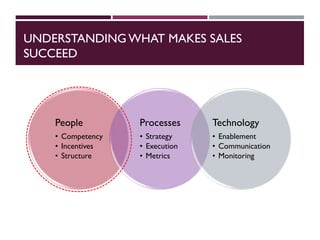
UNDERSTANDING WHAT MAKES SALES
SUCCEED
People
• Competency
• Incentives
• Structure
Processes
• Strategy
• Execution
• Metrics
Technology
• Enablement
• Communication
• Monitoring
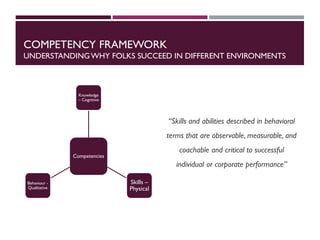
COMPETENCY FRAMEWORK
UNDERSTANDINGWHY FOLKS SUCCEED IN DIFFERENT ENVIRONMENTS
Competencies
Knowledge
– Cognitive
Skills –
Physical
Behaviour -
Qualitative
“Skills and abilities described in behavioral
terms that are observable, measurable, and
coachable and critical to successful
individual or corporate performance”
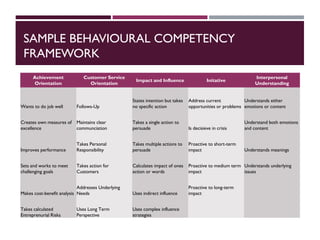
SAMPLE BEHAVIOURAL COMPETENCY
FRAMEWORK
Achievement
Orientation
Customer Service
Orientation
Impact and Influence Initative
Interpersonal
Understanding
Wants to do job well Follows-Up
States intention but takes
no specific action
Address current
opportunities or problems
Understands either
emotions or content
Creates own measures of
excellence
Maintains clear
communciation
Takes a single action to
persuade Is decisieve in crisis
Understand both emotions
and content
Improves performance
Takes Personal
Responsibility
Takes multiple actions to
persuade
Proactive to short-term
impact Understands meanings
Sets and works to meet
challenging goals
Takes action for
Customers
Calculates impact of ones
action or words
Proactive to medium term
impact
Understands underlying
issues
Makes cost-benefit analysis
Addresses Underlying
Needs Uses indirect influence
Proactive to long-term
impact
Takes calculated
Entreprenurial Risks
Uses Long Term
Perspective
Uses complex influence
strategies
INCENTIVES
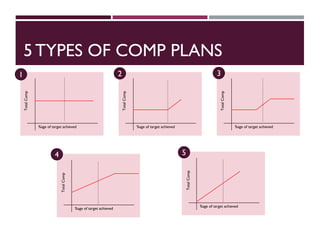
5 TYPES OF COMP PLANS
%age of target achieved
Total
Comp
%age of target achieved
Total
Comp
%age of target achieved
Total
Comp
%age of target achieved
Total
Comp
%age of target achieved
Total
Comp
1 2 3
4 5
STRUCTURE
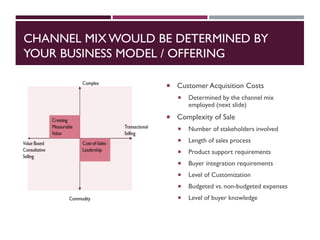
CHANNEL MIX WOULD BE DETERMINED BY
YOUR BUSINESS MODEL / OFFERING
 Customer Acquisition Costs
 Determined by the channel mix
employed (next slide)
 Complexity of Sale
 Number of stakeholders involved
 Length of sales process
 Product support requirements
 Buyer integration requirements
 Level of Customization
 Budgeted vs. non-budgeted expenses
 Level of buyer knowledge
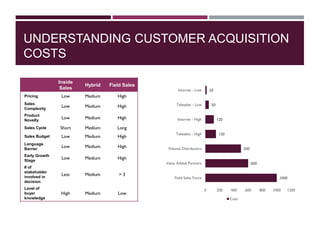
1000
600
500
150
120
50
20
0 200 400 600 800 1000 1200
Field Sales Force
Value Added Partners
Volume Distributors
Telesales - High
Internet - High
Telesales - Low
Internet - Low
Cost
UNDERSTANDING CUSTOMER ACQUISITION
COSTS
Inside
Sales
Hybrid Field Sales
Pricing Low Medium High
Sales
Complexity
Low Medium High
Product
Novelty
Low Medium High
Sales Cycle Short Medium Long
Sales Budget Low Medium High
Language
Barrier
Low Medium High
Early Growth
Stage
Low Medium High
# of
stakeholder
involved in
decision
Less Medium > 3
Level of
buyer
knowledge
High Medium Low
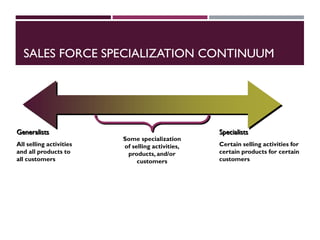
SALES FORCE SPECIALIZATION CONTINUUM
Some specialization
of selling activities,
products, and/or
customers
All selling activities
and all products to
all customers
Generalists
Certain selling activities for
certain products for certain
customers
Specialists
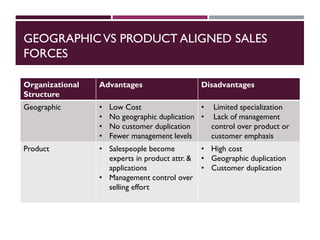
GEOGRAPHICVS PRODUCT ALIGNED SALES
FORCES
Organizational
Structure
Advantages Disadvantages
Geographic • Low Cost
• No geographic duplication
• No customer duplication
• Fewer management levels
• Limited specialization
• Lack of management
control over product or
customer emphasis
Product • Salespeople become
experts in product attr. &
applications
• Management control over
selling effort
• High cost
• Geographic duplication
• Customer duplication
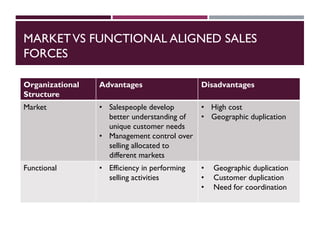
MARKETVS FUNCTIONAL ALIGNED SALES
FORCES
Organizational
Structure
Advantages Disadvantages
Market • Salespeople develop
better understanding of
unique customer needs
• Management control over
selling allocated to
different markets
• High cost
• Geographic duplication
Functional • Efficiency in performing
selling activities
• Geographic duplication
• Customer duplication
• Need for coordination
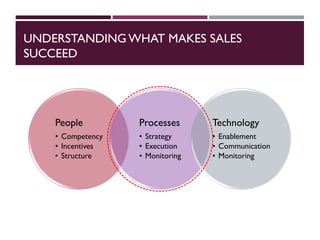
UNDERSTANDING WHAT MAKES SALES
SUCCEED
People
• Competency
• Incentives
• Structure
Processes
• Strategy
• Execution
• Monitoring
Technology
• Enablement
• Communication
• Monitoring
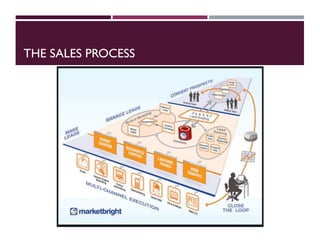
THE SALES PROCESS
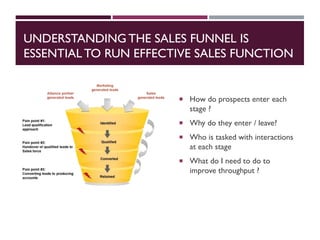
UNDERSTANDING THE SALES FUNNEL IS
ESSENTIAL TO RUN EFFECTIVE SALES FUNCTION
 How do prospects enter each
stage ?
 Why do they enter / leave?
 Who is tasked with interactions
at each stage
 What do I need to do to
improve throughput ?
WE ALSO NEED TO UNDERSTAND HOW
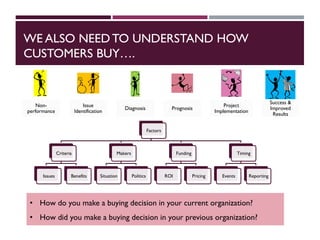
CUSTOMERS BUY….
Non-
performance
Issue
Identification
Diagnosis Prognosis
Project
Implementation
Success &
Improved
Results
• How do you make a buying decision in your current organization?
• How did you make a buying decision in your previous organization?
Factors
Criteria
Issues Benefits
Makers
Situation Politics
Funding
ROI Pricing
Timing
Events Reporting
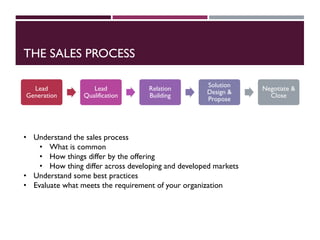
THE SALES PROCESS
Lead
Generation
Lead
Qualification
Relation
Building
Solution
Design &
Propose
Negotiate &
Close
• Understand the sales process
• What is common
• How things differ by the offering
• How thing differ across developing and developed markets
• Understand some best practices
• Evaluate what meets the requirement of your organization
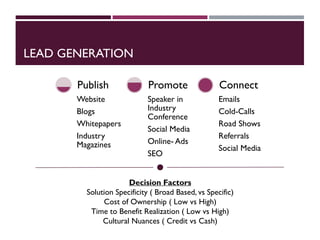
LEAD GENERATION
Website
Blogs
Whitepapers
Industry
Magazines
Publish
Speaker in
Industry
Conference
Social Media
Online- Ads
SEO
Promote
Emails
Cold-Calls
Road Shows
Referrals
Social Media
Connect
Decision Factors
Solution Specificity ( Broad Based, vs Specific)
Cost of Ownership ( Low vs High)
Time to Benefit Realization ( Low vs High)
Cultural Nuances ( Credit vs Cash)
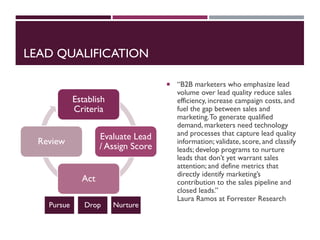
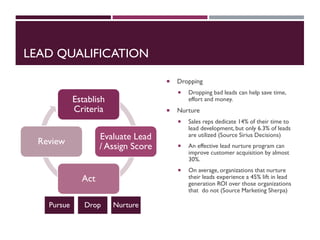
LEAD QUALIFICATION
Establish
Criteria
Evaluate Lead
/ Assign Score
Act
Review
 “B2B marketers who emphasize lead
volume over lead quality reduce sales
efficiency, increase campaign costs, and
fuel the gap between sales and
marketing.To generate qualified
demand, marketers need technology
and processes that capture lead quality
information; validate, score, and classify
leads; develop programs to nurture
leads that don’t yet warrant sales
attention; and define metrics that
directly identify marketing’s
contribution to the sales pipeline and
closed leads.”
Laura Ramos at Forrester Research
Pursue Drop Nurture
LEAD QUALIFICATION
 Dropping
 Dropping bad leads can help save time,
effort and money.
 Nurture
 Sales reps dedicate 14% of their time to
lead development, but only 6.3% of leads
are utilized (Source Sirius Decisions)
 An effective lead nurture program can
improve customer acquisition by almost
30%.
 On average, organizations that nurture
their leads experience a 45% lift in lead
generation ROI over those organizations
that do not (Source Marketing Sherpa)
Establish
Criteria
Evaluate Lead
/ Assign Score
Act
Review
Pursue Drop Nurture
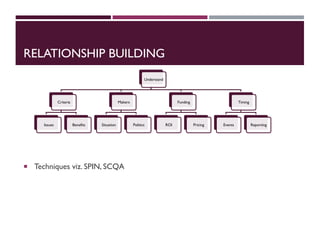
RELATIONSHIP BUILDING
 Techniques viz. SPIN, SCQA
Understand
Criteria
Issues Benefits
Makers
Situation Politics
Funding
ROI Pricing
Timing
Events Reporting
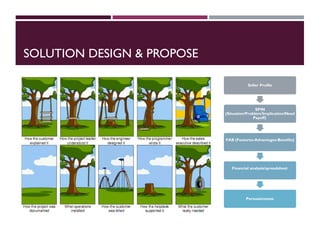
SOLUTION DESIGN & PROPOSE
Seller Profile
SPIN
(Situation/Problem/Implication/Need
Payoff)
FAB (Features-Advantages-Benefits)
Financial analysis/spreadsheet
Persuasiveness
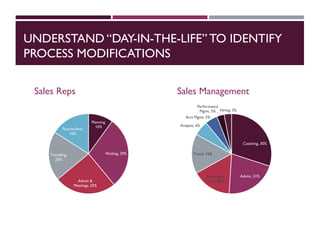
UNDERSTAND “DAY-IN-THE-LIFE” TO IDENTIFY
PROCESS MODIFICATIONS
Sales Reps
Planning,
10%
Waiting, 29%
Admin &
Meetings, 25%
Travelling,
20%
Face-to-face,
16%
Sales Management
Coaching, 30%
Admin, 21%
Meetings &
Conf, 16%
Travel, 16%
Analysis, 6%
Acct Mgmt, 5%
Performance
Mgmt, 3% Hiring, 3%
REFERENCES
 www.google.com
 Predictable Revenue:TurnYour Business Into a Sales Machine with the $100
Million Best Practices of Salesforce.com by Aaron Ross
 The Pyramid Principle: Logic in Writing andThinking by Barbara Minto
THANKYOU!
srirang@yethi.in
++919008324890

Establishing and Managing a sales organization

  • 1.
    SETTING UP ANDMANAGING AN EFFECTIVE SALES FUNCTION PERSPECTIVE, EXPERIENCES AND BEST PRACTICES
  • 2.
    DISCLAIMER  The thoughtsthat are represented are an amalgamation and sequencing of multiple articles and publications on the web.  This is my view of how an organization attempting to setup a stronger sales function should start looking at the problem.The dimensions laid out are based on my experiences  These are at a level of abstraction that it should be applicable to most organizations. However, I am told that these are more applicable to enterprise sales than other models. I leave the decision up to you.
  • 3.
    UNDERSTANDING WHAT MAKESSALES SUCCEED People • Competency • Incentives • Structure Processes • Strategy • Execution • Metrics Technology • Enablement • Communication • Monitoring
  • 4.
    COMPETENCY FRAMEWORK UNDERSTANDINGWHY FOLKSSUCCEED IN DIFFERENT ENVIRONMENTS Competencies Knowledge – Cognitive Skills – Physical Behaviour - Qualitative “Skills and abilities described in behavioral terms that are observable, measurable, and coachable and critical to successful individual or corporate performance”
  • 5.
    SAMPLE BEHAVIOURAL COMPETENCY FRAMEWORK Achievement Orientation CustomerService Orientation Impact and Influence Initative Interpersonal Understanding Wants to do job well Follows-Up States intention but takes no specific action Address current opportunities or problems Understands either emotions or content Creates own measures of excellence Maintains clear communciation Takes a single action to persuade Is decisieve in crisis Understand both emotions and content Improves performance Takes Personal Responsibility Takes multiple actions to persuade Proactive to short-term impact Understands meanings Sets and works to meet challenging goals Takes action for Customers Calculates impact of ones action or words Proactive to medium term impact Understands underlying issues Makes cost-benefit analysis Addresses Underlying Needs Uses indirect influence Proactive to long-term impact Takes calculated Entreprenurial Risks Uses Long Term Perspective Uses complex influence strategies
  • 6.
  • 7.
    5 TYPES OFCOMP PLANS %age of target achieved Total Comp %age of target achieved Total Comp %age of target achieved Total Comp %age of target achieved Total Comp %age of target achieved Total Comp 1 2 3 4 5
  • 8.
  • 9.
    CHANNEL MIX WOULDBE DETERMINED BY YOUR BUSINESS MODEL / OFFERING  Customer Acquisition Costs  Determined by the channel mix employed (next slide)  Complexity of Sale  Number of stakeholders involved  Length of sales process  Product support requirements  Buyer integration requirements  Level of Customization  Budgeted vs. non-budgeted expenses  Level of buyer knowledge
  • 10.
    1000 600 500 150 120 50 20 0 200 400600 800 1000 1200 Field Sales Force Value Added Partners Volume Distributors Telesales - High Internet - High Telesales - Low Internet - Low Cost UNDERSTANDING CUSTOMER ACQUISITION COSTS Inside Sales Hybrid Field Sales Pricing Low Medium High Sales Complexity Low Medium High Product Novelty Low Medium High Sales Cycle Short Medium Long Sales Budget Low Medium High Language Barrier Low Medium High Early Growth Stage Low Medium High # of stakeholder involved in decision Less Medium > 3 Level of buyer knowledge High Medium Low
  • 11.
    SALES FORCE SPECIALIZATIONCONTINUUM Some specialization of selling activities, products, and/or customers All selling activities and all products to all customers Generalists Certain selling activities for certain products for certain customers Specialists
  • 12.
    GEOGRAPHICVS PRODUCT ALIGNEDSALES FORCES Organizational Structure Advantages Disadvantages Geographic • Low Cost • No geographic duplication • No customer duplication • Fewer management levels • Limited specialization • Lack of management control over product or customer emphasis Product • Salespeople become experts in product attr. & applications • Management control over selling effort • High cost • Geographic duplication • Customer duplication
  • 13.
    MARKETVS FUNCTIONAL ALIGNEDSALES FORCES Organizational Structure Advantages Disadvantages Market • Salespeople develop better understanding of unique customer needs • Management control over selling allocated to different markets • High cost • Geographic duplication Functional • Efficiency in performing selling activities • Geographic duplication • Customer duplication • Need for coordination
  • 14.
    UNDERSTANDING WHAT MAKESSALES SUCCEED People • Competency • Incentives • Structure Processes • Strategy • Execution • Monitoring Technology • Enablement • Communication • Monitoring
  • 15.
  • 16.
    UNDERSTANDING THE SALESFUNNEL IS ESSENTIAL TO RUN EFFECTIVE SALES FUNCTION  How do prospects enter each stage ?  Why do they enter / leave?  Who is tasked with interactions at each stage  What do I need to do to improve throughput ?
  • 17.
    WE ALSO NEEDTO UNDERSTAND HOW CUSTOMERS BUY…. Non- performance Issue Identification Diagnosis Prognosis Project Implementation Success & Improved Results • How do you make a buying decision in your current organization? • How did you make a buying decision in your previous organization? Factors Criteria Issues Benefits Makers Situation Politics Funding ROI Pricing Timing Events Reporting
  • 18.
    THE SALES PROCESS Lead Generation Lead Qualification Relation Building Solution Design& Propose Negotiate & Close • Understand the sales process • What is common • How things differ by the offering • How thing differ across developing and developed markets • Understand some best practices • Evaluate what meets the requirement of your organization
  • 19.
    LEAD GENERATION Website Blogs Whitepapers Industry Magazines Publish Speaker in Industry Conference SocialMedia Online- Ads SEO Promote Emails Cold-Calls Road Shows Referrals Social Media Connect Decision Factors Solution Specificity ( Broad Based, vs Specific) Cost of Ownership ( Low vs High) Time to Benefit Realization ( Low vs High) Cultural Nuances ( Credit vs Cash)
  • 20.
    LEAD QUALIFICATION Establish Criteria Evaluate Lead /Assign Score Act Review  “B2B marketers who emphasize lead volume over lead quality reduce sales efficiency, increase campaign costs, and fuel the gap between sales and marketing.To generate qualified demand, marketers need technology and processes that capture lead quality information; validate, score, and classify leads; develop programs to nurture leads that don’t yet warrant sales attention; and define metrics that directly identify marketing’s contribution to the sales pipeline and closed leads.” Laura Ramos at Forrester Research Pursue Drop Nurture
  • 21.
    LEAD QUALIFICATION  Dropping Dropping bad leads can help save time, effort and money.  Nurture  Sales reps dedicate 14% of their time to lead development, but only 6.3% of leads are utilized (Source Sirius Decisions)  An effective lead nurture program can improve customer acquisition by almost 30%.  On average, organizations that nurture their leads experience a 45% lift in lead generation ROI over those organizations that do not (Source Marketing Sherpa) Establish Criteria Evaluate Lead / Assign Score Act Review Pursue Drop Nurture
  • 22.
    RELATIONSHIP BUILDING  Techniquesviz. SPIN, SCQA Understand Criteria Issues Benefits Makers Situation Politics Funding ROI Pricing Timing Events Reporting
  • 23.
    SOLUTION DESIGN &PROPOSE Seller Profile SPIN (Situation/Problem/Implication/Need Payoff) FAB (Features-Advantages-Benefits) Financial analysis/spreadsheet Persuasiveness
  • 24.
    UNDERSTAND “DAY-IN-THE-LIFE” TOIDENTIFY PROCESS MODIFICATIONS Sales Reps Planning, 10% Waiting, 29% Admin & Meetings, 25% Travelling, 20% Face-to-face, 16% Sales Management Coaching, 30% Admin, 21% Meetings & Conf, 16% Travel, 16% Analysis, 6% Acct Mgmt, 5% Performance Mgmt, 3% Hiring, 3%
  • 25.
    REFERENCES  www.google.com  PredictableRevenue:TurnYour Business Into a Sales Machine with the $100 Million Best Practices of Salesforce.com by Aaron Ross  The Pyramid Principle: Logic in Writing andThinking by Barbara Minto
  • 26.