08/26/2013
1
Monopoly, Oligopoly, and
Monopolistic Competition
Chapter 8
Copyright Ā© 2013 by The McGraw-Hill Companies, Inc. All rights reserved.McGraw-Hill/Irwin
8-2
Learning Objectives
1. Distinguish among three types of imperfectly
competitive industries and describe how imperfect
competition differs from perfect competition
2. Identify the five sources of monopoly power and
describe why economies of scale are the most
enduring of the various sources of market power
3. Apply the concepts of marginal cost and marginal
revenue to find the output and price that maximizes a
monopolist's profits
4. Explain why the profit-maximizing output level for a
monopolist is too small from society's perspective
5. Discuss why firms offer discounts to buyers who are
willing to jump a hurdle
6. Discuss public policies that are often applied to natural
monopolies
08/26/2013
2
8-3
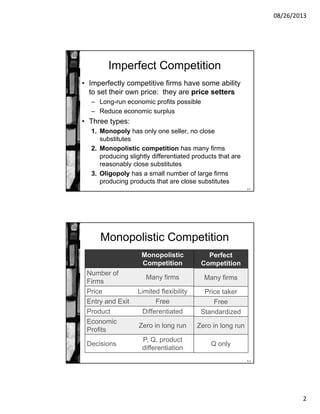
Imperfect Competition
• Imperfectly competitive firms have some ability
to set their own price: they are price setters
– Long-run economic profits possible
– Reduce economic surplus
• Three types:
1. Monopoly has only one seller, no close
substitutes
2. Monopolistic competition has many firms
producing slightly differentiated products that are
reasonably close substitutes
3. Oligopoly has a small number of large firms
producing products that are close substitutes
8-4
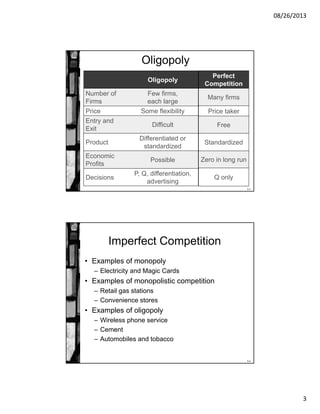
Monopolistic Competition
Monopolistic
Competition
Number of
Firms
Many firms
Price Limited flexibility
Entry and Exit Free
Product Differentiated
Economic
Profits
Zero in long run
Decisions
P, Q, product
differentiation
Perfect
Competition
Many firms
Price taker
Free
Standardized
Zero in long run
Q only
08/26/2013
3
8-5
Oligopoly
Oligopoly
Number of
Firms
Few firms,
each large
Price Some flexibility
Entry and
Exit
Difficult
Product
Differentiated or
standardized
Economic
Profits
Possible
Decisions
P, Q, differentiation,
advertising
Perfect
Competition
Many firms
Price taker
Free
Standardized
Zero in long run
Q only
8-6
Imperfect Competition
• Examples of monopoly
– Electricity and Magic Cards
• Examples of monopolistic competition
– Retail gas stations
– Convenience stores
• Examples of oligopoly
– Wireless phone service
– Cement
– Automobiles and tobacco
08/26/2013
4
8-7
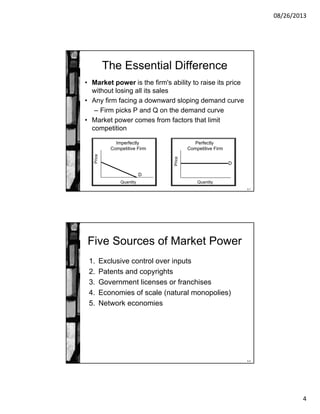
The Essential Difference
• Market power is the firm's ability to raise its price
without losing all its sales
• Any firm facing a downward sloping demand curve
– Firm picks P and Q on the demand curve
• Market power comes from factors that limit
competition
Quantity
Price
Imperfectly
Competitive Firm
D
Quantity
Price
Perfectly
Competitive Firm
D
8-8
Five Sources of Market Power
1. Exclusive control over inputs
2. Patents and copyrights
3. Government licenses or franchises
4. Economies of scale (natural monopolies)
5. Network economies
08/26/2013
5
8-9
Market Power: Economies of
Scale
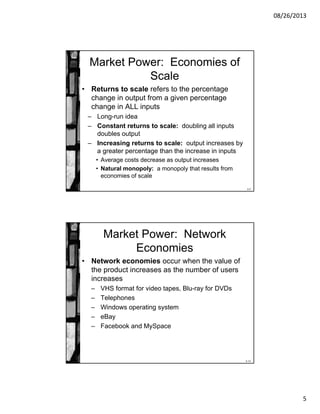
• Returns to scale refers to the percentage
change in output from a given percentage
change in ALL inputs
– Long-run idea
– Constant returns to scale: doubling all inputs
doubles output
– Increasing returns to scale: output increases by
a greater percentage than the increase in inputs
• Average costs decrease as output increases
• Natural monopoly: a monopoly that results from
economies of scale
8-10
Market Power: Network
Economies
• Network economies occur when the value of
the product increases as the number of users
increases
– VHS format for video tapes, Blu-ray for DVDs
– Telephones
– Windows operating system
– eBay
– Facebook and MySpace
08/26/2013
6
8-11
Economies of Scale and Start-
Up Costs
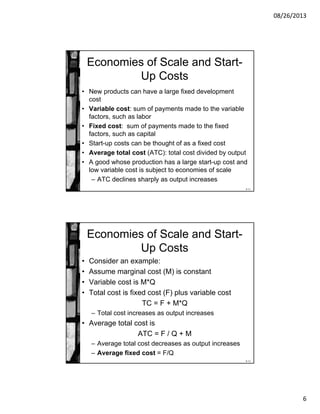
• New products can have a large fixed development
cost
• Variable cost: sum of payments made to the variable
factors, such as labor
• Fixed cost: sum of payments made to the fixed
factors, such as capital
• Start-up costs can be thought of as a fixed cost
• Average total cost (ATC): total cost divided by output
• A good whose production has a large start-up cost and
low variable cost is subject to economies of scale
– ATC declines sharply as output increases
8-12
Economies of Scale and Start-
Up Costs
• Consider an example:
• Assume marginal cost (M) is constant
• Variable cost is M*Q
• Total cost is fixed cost (F) plus variable cost
TC = F + M*Q
– Total cost increases as output increases
• Average total cost is
ATC = F / Q + M
– Average total cost decreases as output increases
– Average fixed cost = F/Q
08/26/2013
7
8-13
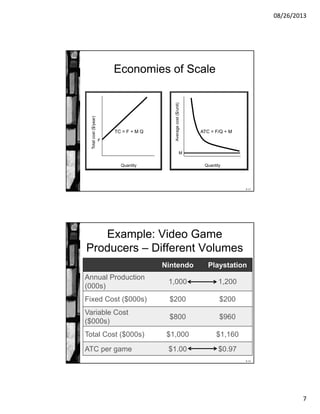
Economies of Scale
Quantity
Totalcost($/year)
F
TC = F + M Q
Averagecost($/unit)
Quantity
ATC = F/Q + M
M
8-14
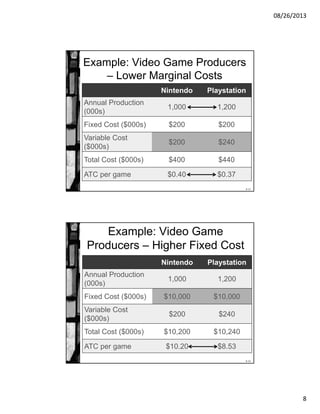
Example: Video Game
Producers – Different Volumes
Nintendo Playstation
Annual Production
(000s)
1,000 1,200
Fixed Cost ($000s) $200 $200
Variable Cost
($000s)
$800 $960
Total Cost ($000s) $1,000 $1,160
ATC per game $1.00 $0.97
08/26/2013
8
8-15
Example: Video Game Producers
– Lower Marginal Costs
Nintendo Playstation
Annual Production
(000s)
1,000 1,200
Fixed Cost ($000s) $200 $200
Variable Cost
($000s)
$200 $240
Total Cost ($000s) $400 $440
ATC per game $0.40 $0.37
8-16
Example: Video Game
Producers – Higher Fixed Cost
Nintendo Playstation
Annual Production
(000s)
1,000 1,200
Fixed Cost ($000s) $10,000 $10,000
Variable Cost
($000s)
$200 $240
Total Cost ($000s) $10,200 $10,240
ATC per game $10.20 $8.53
08/26/2013
9
8-17
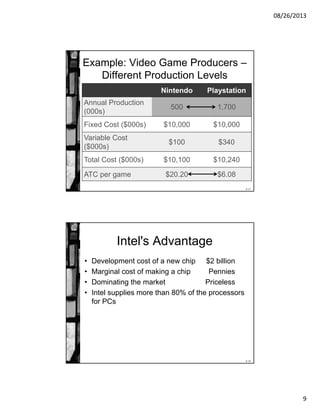
Example: Video Game Producers –
Different Production Levels
Nintendo Playstation
Annual Production
(000s)
500 1,700
Fixed Cost ($000s) $10,000 $10,000
Variable Cost
($000s)
$100 $340
Total Cost ($000s) $10,100 $10,240
ATC per game $20.20 $6.08
8-18
Intel's Advantage
• Development cost of a new chip $2 billion
• Marginal cost of making a chip Pennies
• Dominating the market Priceless
• Intel supplies more than 80% of the processors
for PCs
08/26/2013
10
8-19
Profit Maximization for the
Monopolist
• Like all other firms, a monopolist:
– Maximizes profits
– Applies the Cost-Benefit Principle:
• Increase output if marginal benefit > marginal cost
• Decrease output is marginal benefit < marginal cost
• Marginal benefit is called marginal revenue:
– Change in total revenue from a one-unit change in
output
– Equal to price for the perfectly competitive firm
– Less than price for the monopolist
8-20
Price($/unit)
Quantity (units/week)
Profit Maximization for the
Monopolist
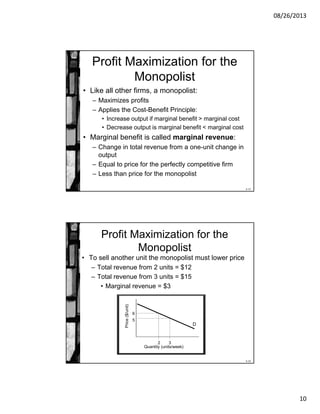
• To sell another unit the monopolist must lower price
– Total revenue from 2 units = $12
– Total revenue from 3 units = $15
• Marginal revenue = $3
D
2
6
3
5
08/26/2013
11
8-21
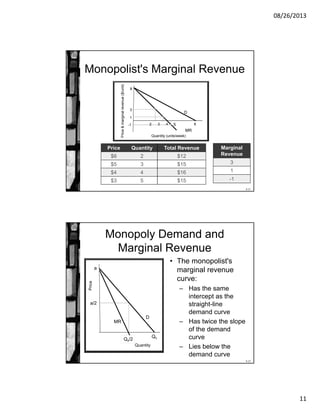
Monopolist's Marginal Revenue
Total Revenue
$12
$15
$16
$15
Price Quantity
$6 2
$5 3
$4 4
$3 5
Price&marginalrevenue($/unit) 8
8
D
Quantity (units/week)
MR
32
3
1
4-1 5
Marginal
Revenue
3
1
-1
8-22
Monopoly Demand and
Marginal Revenue
• The monopolist's
marginal revenue
curve:
– Has the same
intercept as the
straight-line
demand curve
– Has twice the slope
of the demand
curve
– Lies below the
demand curve
Price
Quantity
a
D
Q0
Q0/2
a/2
MR
08/26/2013
12
8-23
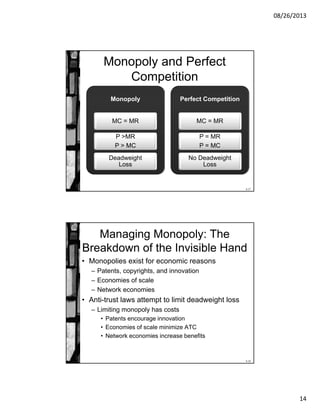
Deciding Quantity
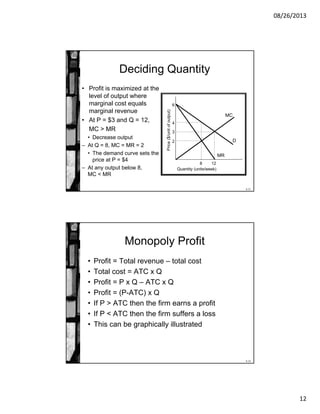
• Profit is maximized at the
level of output where
marginal cost equals
marginal revenue
• At P = $3 and Q = 12,
MC > MR
• Decrease output
– At Q = 8, MC = MR = 2
• The demand curve sets the
price at P = $4
– At any output below 8,
MC < MR
Price($/unitofoutput) Quantity (units/week)
3
MC
2
6
D
12
MR
4
8
8-24
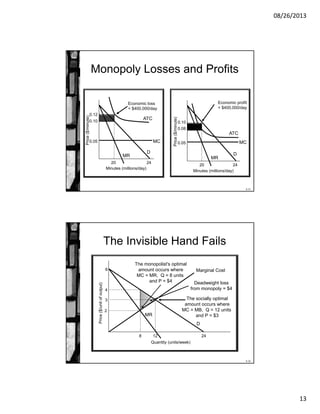
Monopoly Profit
• Profit = Total revenue – total cost
• Total cost = ATC x Q
• Profit = P x Q – ATC x Q
• Profit = (P-ATC) x Q
• If P > ATC then the firm earns a profit
• If P < ATC then the firm suffers a loss
• This can be graphically illustrated
08/26/2013
13
8-25
Monopoly Losses and Profits
Price($/minute)
Minutes (millions/day)
20
0.12
0.10
ATC
Economic loss
= $400,000/day
D
0.05 MC
MR
24
Price($/minute)
Minutes (millions/day)
2420
0.08
0.10
ATC
D
0.05 MC
MR
Economic profit
= $400,000/day
8-26
The Invisible Hand Fails
Price($/unitofoutput)
Quantity (units/week)
The socially optimal
amount occurs where
MC = MB, Q = 12 units
and P = $3
The monopolist's optimal
amount occurs where
MC = MR, Q = 8 units
and P = $4
2
MR
8
4
24
D
3
12
6 Marginal Cost
Deadweight loss
from monopoly = $4
08/26/2013
14
8-27
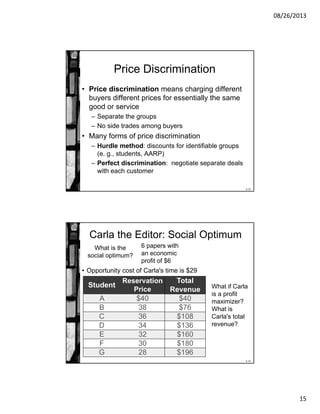
Monopoly and Perfect
Competition
Monopoly
MC = MR
P >MR
P > MC
Deadweight
Loss
Perfect Competition
MC = MR
P = MR
P = MC
No Deadweight
Loss
8-28
Managing Monopoly: The
Breakdown of the Invisible Hand
• Monopolies exist for economic reasons
– Patents, copyrights, and innovation
– Economies of scale
– Network economies
• Anti-trust laws attempt to limit deadweight loss
– Limiting monopoly has costs
• Patents encourage innovation
• Economies of scale minimize ATC
• Network economies increase benefits
08/26/2013
15
8-29
Price Discrimination
• Price discrimination means charging different
buyers different prices for essentially the same
good or service
– Separate the groups
– No side trades among buyers
• Many forms of price discrimination
– Hurdle method: discounts for identifiable groups
(e. g., students, AARP)
– Perfect discrimination: negotiate separate deals
with each customer
8-30
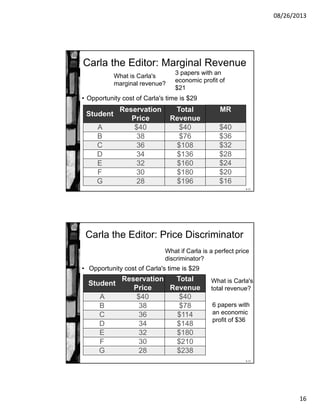
Carla the Editor: Social Optimum
• Opportunity cost of Carla's time is $29
What is the
social optimum?
What if Carla
is a profit
maximizer?
What is
Carla's total
revenue?
Student
Reservation
Price
A $40
B 38
C 36
D 34
E 32
F 30
G 28
Total
Revenue
$40
$76
$108
$136
$160
$180
$196
6 papers with
an economic
profit of $6
08/26/2013
16
8-31
Carla the Editor: Marginal Revenue
• Opportunity cost of Carla's time is $29
What is Carla's
marginal revenue?
Student
Reservation
Price
A $40
B 38
C 36
D 34
E 32
F 30
G 28
MR
$40
$36
$32
$28
$24
$20
$16
Total
Revenue
$40
$76
$108
$136
$160
$180
$196
3 papers with an
economic profit of
$21
8-32
Carla the Editor: Price Discriminator
• Opportunity cost of Carla's time is $29
What if Carla is a perfect price
discriminator?
What is Carla's
total revenue?
Student
Reservation
Price
A $40
B 38
C 36
D 34
E 32
F 30
G 28
Total
Revenue
$40
$78
$114
$148
$180
$210
$238
6 papers with
an economic
profit of $36
08/26/2013
17
8-33
Hurdle Method of Price
Discrimination
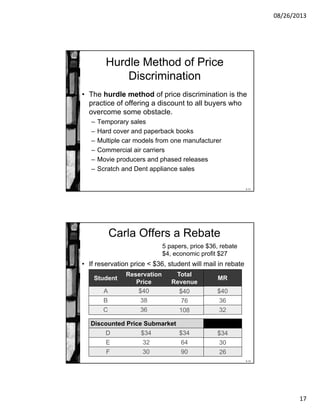
• The hurdle method of price discrimination is the
practice of offering a discount to all buyers who
overcome some obstacle.
– Temporary sales
– Hard cover and paperback books
– Multiple car models from one manufacturer
– Commercial air carriers
– Movie producers and phased releases
– Scratch and Dent appliance sales
8-34
Carla Offers a Rebate
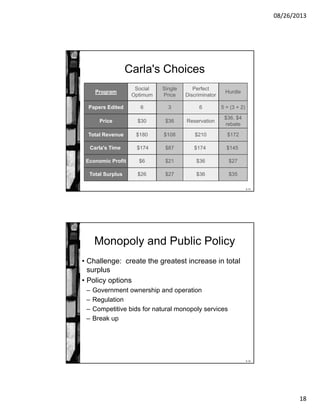
• If reservation price < $36, student will mail in rebate
Student
Reservation
Price
Total
Revenue
A $40 $40
B 38 76
C 36 108
Discounted Price Submarket
D $34 $34
E 32 64
F 30 90
MR
$40
36
32
$34
30
26
5 papers, price $36, rebate
$4, economic profit $27
08/26/2013
18
8-35
Carla's Choices
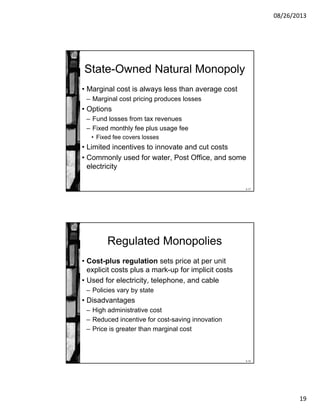
Program
Social
Optimum
Papers Edited 6
Price $30
Total Revenue $180
Carla's Time $174
Economic Profit $6
Total Surplus $26
Hurdle
5 = (3 + 2)
$36, $4
rebate
$172
$145
$27
$35
Perfect
Discriminator
6
Reservation
$210
$174
$36
$36
Single
Price
3
$36
$108
$87
$21
$27
8-36
Monopoly and Public Policy
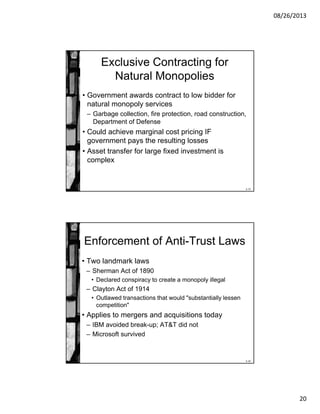
• Challenge: create the greatest increase in total
surplus
• Policy options
– Government ownership and operation
– Regulation
– Competitive bids for natural monopoly services
– Break up
08/26/2013
19
8-37
State-Owned Natural Monopoly
• Marginal cost is always less than average cost
– Marginal cost pricing produces losses
• Options
– Fund losses from tax revenues
– Fixed monthly fee plus usage fee
• Fixed fee covers losses
• Limited incentives to innovate and cut costs
• Commonly used for water, Post Office, and some
electricity
8-38
Regulated Monopolies
• Cost-plus regulation sets price at per unit
explicit costs plus a mark-up for implicit costs
• Used for electricity, telephone, and cable
– Policies vary by state
• Disadvantages
– High administrative cost
– Reduced incentive for cost-saving innovation
– Price is greater than marginal cost
08/26/2013
20
8-39
Exclusive Contracting for
Natural Monopolies
• Government awards contract to low bidder for
natural monopoly services
– Garbage collection, fire protection, road construction,
Department of Defense
• Could achieve marginal cost pricing IF
government pays the resulting losses
• Asset transfer for large fixed investment is
complex
8-40
Enforcement of Anti-Trust Laws
• Two landmark laws
– Sherman Act of 1890
• Declared conspiracy to create a monopoly illegal
– Clayton Act of 1914
• Outlawed transactions that would "substantially lessen
competition"
• Applies to mergers and acquisitions today
– IBM avoided break-up; AT&T did not
– Microsoft survived
08/26/2013
21
8-41
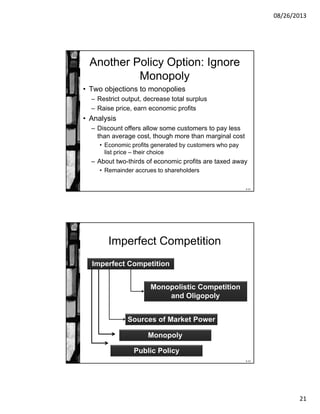
Another Policy Option: Ignore
Monopoly
• Two objections to monopolies
– Restrict output, decrease total surplus
– Raise price, earn economic profits
• Analysis
– Discount offers allow some customers to pay less
than average cost, though more than marginal cost
• Economic profits generated by customers who pay
list price – their choice
– About two-thirds of economic profits are taxed away
• Remainder accrues to shareholders
8-42
Imperfect Competition
Monopolistic Competition
and Oligopoly
Sources of Market Power
Monopoly
Public Policy
08/26/2013
22
Chapter 8 Appendix
The Algebra of
Monopoly
Maximization
8-44
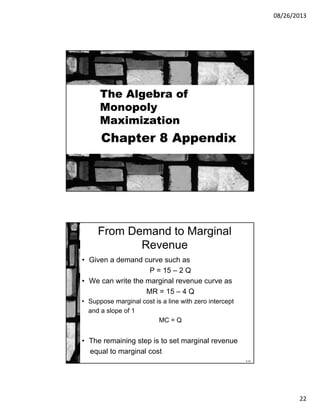
From Demand to Marginal
Revenue
• Given a demand curve such as
P = 15 – 2 Q
• We can write the marginal revenue curve as
MR = 15 – 4 Q
• Suppose marginal cost is a line with zero intercept
and a slope of 1
MC = Q
• The remaining step is to set marginal revenue
equal to marginal cost
08/26/2013
23
8-45
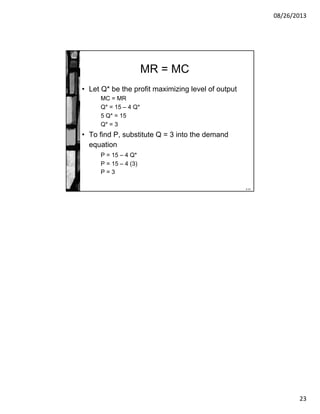
MR = MC
• Let Q* be the profit maximizing level of output
MC = MR
Q* = 15 – 4 Q*
5 Q* = 15
Q* = 3
• To find P, substitute Q = 3 into the demand
equation
P = 15 – 4 Q*
P = 15 – 4 (3)
P = 3

Chap008 lecture

  • 1.
    08/26/2013 1 Monopoly, Oligopoly, and MonopolisticCompetition Chapter 8 Copyright Ā© 2013 by The McGraw-Hill Companies, Inc. All rights reserved.McGraw-Hill/Irwin 8-2 Learning Objectives 1. Distinguish among three types of imperfectly competitive industries and describe how imperfect competition differs from perfect competition 2. Identify the five sources of monopoly power and describe why economies of scale are the most enduring of the various sources of market power 3. Apply the concepts of marginal cost and marginal revenue to find the output and price that maximizes a monopolist's profits 4. Explain why the profit-maximizing output level for a monopolist is too small from society's perspective 5. Discuss why firms offer discounts to buyers who are willing to jump a hurdle 6. Discuss public policies that are often applied to natural monopolies
  • 2.
    08/26/2013 2 8-3 Imperfect Competition • Imperfectlycompetitive firms have some ability to set their own price: they are price setters – Long-run economic profits possible – Reduce economic surplus • Three types: 1. Monopoly has only one seller, no close substitutes 2. Monopolistic competition has many firms producing slightly differentiated products that are reasonably close substitutes 3. Oligopoly has a small number of large firms producing products that are close substitutes 8-4 Monopolistic Competition Monopolistic Competition Number of Firms Many firms Price Limited flexibility Entry and Exit Free Product Differentiated Economic Profits Zero in long run Decisions P, Q, product differentiation Perfect Competition Many firms Price taker Free Standardized Zero in long run Q only
  • 3.
    08/26/2013 3 8-5 Oligopoly Oligopoly Number of Firms Few firms, eachlarge Price Some flexibility Entry and Exit Difficult Product Differentiated or standardized Economic Profits Possible Decisions P, Q, differentiation, advertising Perfect Competition Many firms Price taker Free Standardized Zero in long run Q only 8-6 Imperfect Competition • Examples of monopoly – Electricity and Magic Cards • Examples of monopolistic competition – Retail gas stations – Convenience stores • Examples of oligopoly – Wireless phone service – Cement – Automobiles and tobacco
  • 4.
    08/26/2013 4 8-7 The Essential Difference •Market power is the firm's ability to raise its price without losing all its sales • Any firm facing a downward sloping demand curve – Firm picks P and Q on the demand curve • Market power comes from factors that limit competition Quantity Price Imperfectly Competitive Firm D Quantity Price Perfectly Competitive Firm D 8-8 Five Sources of Market Power 1. Exclusive control over inputs 2. Patents and copyrights 3. Government licenses or franchises 4. Economies of scale (natural monopolies) 5. Network economies
  • 5.
    08/26/2013 5 8-9 Market Power: Economiesof Scale • Returns to scale refers to the percentage change in output from a given percentage change in ALL inputs – Long-run idea – Constant returns to scale: doubling all inputs doubles output – Increasing returns to scale: output increases by a greater percentage than the increase in inputs • Average costs decrease as output increases • Natural monopoly: a monopoly that results from economies of scale 8-10 Market Power: Network Economies • Network economies occur when the value of the product increases as the number of users increases – VHS format for video tapes, Blu-ray for DVDs – Telephones – Windows operating system – eBay – Facebook and MySpace
  • 6.
    08/26/2013 6 8-11 Economies of Scaleand Start- Up Costs • New products can have a large fixed development cost • Variable cost: sum of payments made to the variable factors, such as labor • Fixed cost: sum of payments made to the fixed factors, such as capital • Start-up costs can be thought of as a fixed cost • Average total cost (ATC): total cost divided by output • A good whose production has a large start-up cost and low variable cost is subject to economies of scale – ATC declines sharply as output increases 8-12 Economies of Scale and Start- Up Costs • Consider an example: • Assume marginal cost (M) is constant • Variable cost is M*Q • Total cost is fixed cost (F) plus variable cost TC = F + M*Q – Total cost increases as output increases • Average total cost is ATC = F / Q + M – Average total cost decreases as output increases – Average fixed cost = F/Q
  • 7.
    08/26/2013 7 8-13 Economies of Scale Quantity Totalcost($/year) F TC= F + M Q Averagecost($/unit) Quantity ATC = F/Q + M M 8-14 Example: Video Game Producers – Different Volumes Nintendo Playstation Annual Production (000s) 1,000 1,200 Fixed Cost ($000s) $200 $200 Variable Cost ($000s) $800 $960 Total Cost ($000s) $1,000 $1,160 ATC per game $1.00 $0.97
  • 8.
    08/26/2013 8 8-15 Example: Video GameProducers – Lower Marginal Costs Nintendo Playstation Annual Production (000s) 1,000 1,200 Fixed Cost ($000s) $200 $200 Variable Cost ($000s) $200 $240 Total Cost ($000s) $400 $440 ATC per game $0.40 $0.37 8-16 Example: Video Game Producers – Higher Fixed Cost Nintendo Playstation Annual Production (000s) 1,000 1,200 Fixed Cost ($000s) $10,000 $10,000 Variable Cost ($000s) $200 $240 Total Cost ($000s) $10,200 $10,240 ATC per game $10.20 $8.53
  • 9.
    08/26/2013 9 8-17 Example: Video GameProducers – Different Production Levels Nintendo Playstation Annual Production (000s) 500 1,700 Fixed Cost ($000s) $10,000 $10,000 Variable Cost ($000s) $100 $340 Total Cost ($000s) $10,100 $10,240 ATC per game $20.20 $6.08 8-18 Intel's Advantage • Development cost of a new chip $2 billion • Marginal cost of making a chip Pennies • Dominating the market Priceless • Intel supplies more than 80% of the processors for PCs
  • 10.
    08/26/2013 10 8-19 Profit Maximization forthe Monopolist • Like all other firms, a monopolist: – Maximizes profits – Applies the Cost-Benefit Principle: • Increase output if marginal benefit > marginal cost • Decrease output is marginal benefit < marginal cost • Marginal benefit is called marginal revenue: – Change in total revenue from a one-unit change in output – Equal to price for the perfectly competitive firm – Less than price for the monopolist 8-20 Price($/unit) Quantity (units/week) Profit Maximization for the Monopolist • To sell another unit the monopolist must lower price – Total revenue from 2 units = $12 – Total revenue from 3 units = $15 • Marginal revenue = $3 D 2 6 3 5
  • 11.
    08/26/2013 11 8-21 Monopolist's Marginal Revenue TotalRevenue $12 $15 $16 $15 Price Quantity $6 2 $5 3 $4 4 $3 5 Price&marginalrevenue($/unit) 8 8 D Quantity (units/week) MR 32 3 1 4-1 5 Marginal Revenue 3 1 -1 8-22 Monopoly Demand and Marginal Revenue • The monopolist's marginal revenue curve: – Has the same intercept as the straight-line demand curve – Has twice the slope of the demand curve – Lies below the demand curve Price Quantity a D Q0 Q0/2 a/2 MR
  • 12.
    08/26/2013 12 8-23 Deciding Quantity • Profitis maximized at the level of output where marginal cost equals marginal revenue • At P = $3 and Q = 12, MC > MR • Decrease output – At Q = 8, MC = MR = 2 • The demand curve sets the price at P = $4 – At any output below 8, MC < MR Price($/unitofoutput) Quantity (units/week) 3 MC 2 6 D 12 MR 4 8 8-24 Monopoly Profit • Profit = Total revenue – total cost • Total cost = ATC x Q • Profit = P x Q – ATC x Q • Profit = (P-ATC) x Q • If P > ATC then the firm earns a profit • If P < ATC then the firm suffers a loss • This can be graphically illustrated
  • 13.
    08/26/2013 13 8-25 Monopoly Losses andProfits Price($/minute) Minutes (millions/day) 20 0.12 0.10 ATC Economic loss = $400,000/day D 0.05 MC MR 24 Price($/minute) Minutes (millions/day) 2420 0.08 0.10 ATC D 0.05 MC MR Economic profit = $400,000/day 8-26 The Invisible Hand Fails Price($/unitofoutput) Quantity (units/week) The socially optimal amount occurs where MC = MB, Q = 12 units and P = $3 The monopolist's optimal amount occurs where MC = MR, Q = 8 units and P = $4 2 MR 8 4 24 D 3 12 6 Marginal Cost Deadweight loss from monopoly = $4
  • 14.
    08/26/2013 14 8-27 Monopoly and Perfect Competition Monopoly MC= MR P >MR P > MC Deadweight Loss Perfect Competition MC = MR P = MR P = MC No Deadweight Loss 8-28 Managing Monopoly: The Breakdown of the Invisible Hand • Monopolies exist for economic reasons – Patents, copyrights, and innovation – Economies of scale – Network economies • Anti-trust laws attempt to limit deadweight loss – Limiting monopoly has costs • Patents encourage innovation • Economies of scale minimize ATC • Network economies increase benefits
  • 15.
    08/26/2013 15 8-29 Price Discrimination • Pricediscrimination means charging different buyers different prices for essentially the same good or service – Separate the groups – No side trades among buyers • Many forms of price discrimination – Hurdle method: discounts for identifiable groups (e. g., students, AARP) – Perfect discrimination: negotiate separate deals with each customer 8-30 Carla the Editor: Social Optimum • Opportunity cost of Carla's time is $29 What is the social optimum? What if Carla is a profit maximizer? What is Carla's total revenue? Student Reservation Price A $40 B 38 C 36 D 34 E 32 F 30 G 28 Total Revenue $40 $76 $108 $136 $160 $180 $196 6 papers with an economic profit of $6
  • 16.
    08/26/2013 16 8-31 Carla the Editor:Marginal Revenue • Opportunity cost of Carla's time is $29 What is Carla's marginal revenue? Student Reservation Price A $40 B 38 C 36 D 34 E 32 F 30 G 28 MR $40 $36 $32 $28 $24 $20 $16 Total Revenue $40 $76 $108 $136 $160 $180 $196 3 papers with an economic profit of $21 8-32 Carla the Editor: Price Discriminator • Opportunity cost of Carla's time is $29 What if Carla is a perfect price discriminator? What is Carla's total revenue? Student Reservation Price A $40 B 38 C 36 D 34 E 32 F 30 G 28 Total Revenue $40 $78 $114 $148 $180 $210 $238 6 papers with an economic profit of $36
  • 17.
    08/26/2013 17 8-33 Hurdle Method ofPrice Discrimination • The hurdle method of price discrimination is the practice of offering a discount to all buyers who overcome some obstacle. – Temporary sales – Hard cover and paperback books – Multiple car models from one manufacturer – Commercial air carriers – Movie producers and phased releases – Scratch and Dent appliance sales 8-34 Carla Offers a Rebate • If reservation price < $36, student will mail in rebate Student Reservation Price Total Revenue A $40 $40 B 38 76 C 36 108 Discounted Price Submarket D $34 $34 E 32 64 F 30 90 MR $40 36 32 $34 30 26 5 papers, price $36, rebate $4, economic profit $27
  • 18.
    08/26/2013 18 8-35 Carla's Choices Program Social Optimum Papers Edited6 Price $30 Total Revenue $180 Carla's Time $174 Economic Profit $6 Total Surplus $26 Hurdle 5 = (3 + 2) $36, $4 rebate $172 $145 $27 $35 Perfect Discriminator 6 Reservation $210 $174 $36 $36 Single Price 3 $36 $108 $87 $21 $27 8-36 Monopoly and Public Policy • Challenge: create the greatest increase in total surplus • Policy options – Government ownership and operation – Regulation – Competitive bids for natural monopoly services – Break up
  • 19.
    08/26/2013 19 8-37 State-Owned Natural Monopoly •Marginal cost is always less than average cost – Marginal cost pricing produces losses • Options – Fund losses from tax revenues – Fixed monthly fee plus usage fee • Fixed fee covers losses • Limited incentives to innovate and cut costs • Commonly used for water, Post Office, and some electricity 8-38 Regulated Monopolies • Cost-plus regulation sets price at per unit explicit costs plus a mark-up for implicit costs • Used for electricity, telephone, and cable – Policies vary by state • Disadvantages – High administrative cost – Reduced incentive for cost-saving innovation – Price is greater than marginal cost
  • 20.
    08/26/2013 20 8-39 Exclusive Contracting for NaturalMonopolies • Government awards contract to low bidder for natural monopoly services – Garbage collection, fire protection, road construction, Department of Defense • Could achieve marginal cost pricing IF government pays the resulting losses • Asset transfer for large fixed investment is complex 8-40 Enforcement of Anti-Trust Laws • Two landmark laws – Sherman Act of 1890 • Declared conspiracy to create a monopoly illegal – Clayton Act of 1914 • Outlawed transactions that would "substantially lessen competition" • Applies to mergers and acquisitions today – IBM avoided break-up; AT&T did not – Microsoft survived
  • 21.
    08/26/2013 21 8-41 Another Policy Option:Ignore Monopoly • Two objections to monopolies – Restrict output, decrease total surplus – Raise price, earn economic profits • Analysis – Discount offers allow some customers to pay less than average cost, though more than marginal cost • Economic profits generated by customers who pay list price – their choice – About two-thirds of economic profits are taxed away • Remainder accrues to shareholders 8-42 Imperfect Competition Imperfect Competition Monopolistic Competition and Oligopoly Sources of Market Power Monopoly Public Policy
  • 22.
    08/26/2013 22 Chapter 8 Appendix TheAlgebra of Monopoly Maximization 8-44 From Demand to Marginal Revenue • Given a demand curve such as P = 15 – 2 Q • We can write the marginal revenue curve as MR = 15 – 4 Q • Suppose marginal cost is a line with zero intercept and a slope of 1 MC = Q • The remaining step is to set marginal revenue equal to marginal cost
  • 23.
    08/26/2013 23 8-45 MR = MC •Let Q* be the profit maximizing level of output MC = MR Q* = 15 – 4 Q* 5 Q* = 15 Q* = 3 • To find P, substitute Q = 3 into the demand equation P = 15 – 4 Q* P = 15 – 4 (3) P = 3