CHANGING PRACTICE   Evidence Based Implementation José Francisco García Gutiérrez Escuela Andaluza de Salud Pública PAHO HQ  HSS/HRH
The Path Continuous Improvement     Design & Evaluation   Need Redesign Design Management Audit Implementation
 
NO MAGIC BULLETS ! All strategies are effective sometimes,  but none is effective in all circumstances
Summary points Systematic reviews of rigorous studies provide the best evidence on the effectiveness of different strategies to promote the implementation of research findings Passive dissemination of information is generally ineffective It seems necessary to use specific strategies to encourage implementation of research based recommendations and to ensure changes in practice Further   research on the relative effectiveness and efficiency of different strategies is required
Interventions to promote behavioural change among health professionals Bero, Grilli Grimshaw et al (1998).  British Medical Journal. Bero, Grilli, Grimshaw and Oxman (1998).  Cochrane Library .
Consistently effective interventions Reminders  (manual or computerised) Multifaceted interventions  (a combination that includes two or more of the following: audit and feedback, reminders, local consensus processes, or marketing) Interactive educational meetings  (participation of healthcare providers in workshops that include discussion or practice)
Interventions of variable effectiveness Audit and feedback  (or any summary of clinical performance) The use of  local opinion leaders  (practitioners identified by their colleagues as influential) Local consensus processes  (inclusion of participating practitioners in discussions to ensure that they agree that the chosen clinical problem is important and the approach to managing the problem is appropriate) Patient mediated interventions  (any intervention aimed at changing the performance of healthcare providers for which specific information was sought from or given to patients)
Interventions that have little or no effect Educational materials  (distribution of recommendations for clinical care, including clinical practice guidelines, audiovisual materials, and electronic publications) Didactic educational meetings  (such as lectures)
 
TRADITIONAL  MODEL  OF DISEMINATION Publication of information Target audience Changes in clinical practice
DESIGN OF INTERVENTIONS Problem identification  (Presentation) Evaluation of barriers  (Diagnosis) Intervention design  (Prescription) Behavioural change/ Quality improvement  (Cure)
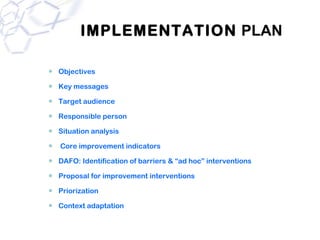
IMPLEMENTATION  PLAN Objectives Key messages Target audience Responsible person Situation analysis Core improvement indicators DAFO: Identification of barriers & “ad hoc” interventions Proposal for improvement interventions Priorization Context adaptation
FROM THEORY TO ACTION Three key questions Setting up GOALS What are we trying to achieve Establishing INDICATORS How we do know that a change is an improvement Developing CHANGES What interventions might help to achieve improvements


Changing Practice: Implementation strategies

  • 1.
    CHANGING PRACTICE Evidence Based Implementation José Francisco García Gutiérrez Escuela Andaluza de Salud Pública PAHO HQ HSS/HRH
  • 2.
    The Path ContinuousImprovement Design & Evaluation Need Redesign Design Management Audit Implementation
  • 3.
  • 4.
    NO MAGIC BULLETS! All strategies are effective sometimes, but none is effective in all circumstances
  • 5.
    Summary points Systematicreviews of rigorous studies provide the best evidence on the effectiveness of different strategies to promote the implementation of research findings Passive dissemination of information is generally ineffective It seems necessary to use specific strategies to encourage implementation of research based recommendations and to ensure changes in practice Further research on the relative effectiveness and efficiency of different strategies is required
  • 6.
    Interventions to promotebehavioural change among health professionals Bero, Grilli Grimshaw et al (1998). British Medical Journal. Bero, Grilli, Grimshaw and Oxman (1998). Cochrane Library .
  • 7.
    Consistently effective interventionsReminders (manual or computerised) Multifaceted interventions (a combination that includes two or more of the following: audit and feedback, reminders, local consensus processes, or marketing) Interactive educational meetings (participation of healthcare providers in workshops that include discussion or practice)
  • 8.
    Interventions of variableeffectiveness Audit and feedback (or any summary of clinical performance) The use of local opinion leaders (practitioners identified by their colleagues as influential) Local consensus processes (inclusion of participating practitioners in discussions to ensure that they agree that the chosen clinical problem is important and the approach to managing the problem is appropriate) Patient mediated interventions (any intervention aimed at changing the performance of healthcare providers for which specific information was sought from or given to patients)
  • 9.
    Interventions that havelittle or no effect Educational materials (distribution of recommendations for clinical care, including clinical practice guidelines, audiovisual materials, and electronic publications) Didactic educational meetings (such as lectures)
  • 10.
  • 11.
    TRADITIONAL MODEL OF DISEMINATION Publication of information Target audience Changes in clinical practice
  • 12.
    DESIGN OF INTERVENTIONSProblem identification (Presentation) Evaluation of barriers (Diagnosis) Intervention design (Prescription) Behavioural change/ Quality improvement (Cure)
  • 13.
    IMPLEMENTATION PLANObjectives Key messages Target audience Responsible person Situation analysis Core improvement indicators DAFO: Identification of barriers & “ad hoc” interventions Proposal for improvement interventions Priorization Context adaptation
  • 14.
    FROM THEORY TOACTION Three key questions Setting up GOALS What are we trying to achieve Establishing INDICATORS How we do know that a change is an improvement Developing CHANGES What interventions might help to achieve improvements
  • 15.
  • 16.