Supporting effective provider
communication: from communication
trainings to next steps
Brett Craig, PhD
Assistant Professor, Health Communication, St Louis College of Pharmacy
St Louis, MO, USA
Aizhan Kapysheva
MPA Candidate, Columbia University
New York, NY, USA
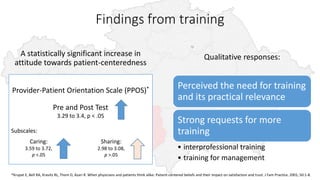
Findings from training
A statistically significant increase in
attitude towards patient-centeredness
Qualitative responses:
Provider-Patient Orientation Scale (PPOS)*
Pre and Post Test
3.29 to 3.4, p < .05
Subscales:
Perceived the need for training
and its practical relevance
Strong requests for more
training
• interprofessional training
• training for management
Caring:
3.59 to 3.72,
p <.05
Sharing:
2.98 to 3.08,
p >.05
*Krupat E, Bell RA, Kravitz RL, Thom D, Azari R. When physicians and patients think alike: Patient-centered beliefs and their impact on satisfaction and trust. J Fam Practice. 2001; 50:1-8.
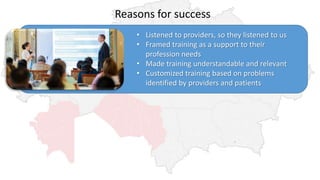
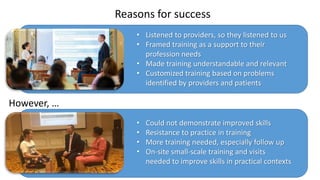
Reasons for success
• Listened to providers, so they listened to us
• Framed training as a support to their
profession needs
• Made training understandable and relevant
• Customized training based on problems
identified by providers and patients
Reasons for success
However, …
• Listened to providers, so they listened to us
• Framed training as a support to their
profession needs
• Made training understandable and relevant
• Customized training based on problems
identified by providers and patients
• Could not demonstrate improved skills
• Resistance to practice in training
• More training needed, especially follow up
• On-site small-scale training and visits
needed to improve skills in practical contexts
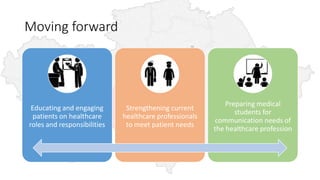
Moving forward
Educating and engaging
patients on healthcare
roles and responsibilities
Strengthening current
healthcare professionals
to meet patient needs
Preparing medical
students for
communication needs of
the healthcare profession
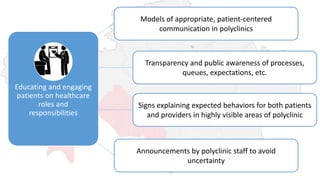
Educating and engaging
patients on healthcare
roles and
responsibilities
Models of appropriate, patient-centered
communication in polyclinics
Transparency and public awareness of processes,
queues, expectations, etc.
Signs explaining expected behaviors for both patients
and providers in highly visible areas of polyclinic
Announcements by polyclinic staff to avoid
uncertainty
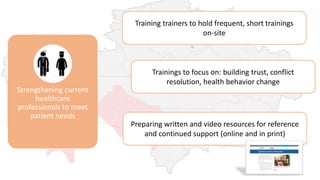
Strengthening current
healthcare
professionals to meet
patient needs
Training trainers to hold frequent, short trainings
on-site
Trainings to focus on: building trust, conflict
resolution, health behavior change
Preparing written and video resources for reference
and continued support (online and in print)
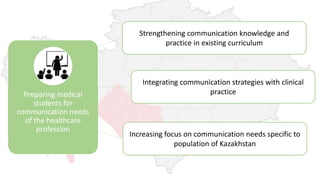
Preparing medical
students for
communication needs
of the healthcare
profession
Strengthening communication knowledge and
practice in existing curriculum
Integrating communication strategies with clinical
practice
Increasing focus on communication needs specific to
population of Kazakhstan

Supporting effective provider communication: from communication trainings to next steps

  • 1.
    Supporting effective provider communication:from communication trainings to next steps Brett Craig, PhD Assistant Professor, Health Communication, St Louis College of Pharmacy St Louis, MO, USA Aizhan Kapysheva MPA Candidate, Columbia University New York, NY, USA
  • 2.
    Findings from training Astatistically significant increase in attitude towards patient-centeredness Qualitative responses: Provider-Patient Orientation Scale (PPOS)* Pre and Post Test 3.29 to 3.4, p < .05 Subscales: Perceived the need for training and its practical relevance Strong requests for more training • interprofessional training • training for management Caring: 3.59 to 3.72, p <.05 Sharing: 2.98 to 3.08, p >.05 *Krupat E, Bell RA, Kravitz RL, Thom D, Azari R. When physicians and patients think alike: Patient-centered beliefs and their impact on satisfaction and trust. J Fam Practice. 2001; 50:1-8.
  • 3.
    Reasons for success •Listened to providers, so they listened to us • Framed training as a support to their profession needs • Made training understandable and relevant • Customized training based on problems identified by providers and patients
  • 4.
    Reasons for success However,… • Listened to providers, so they listened to us • Framed training as a support to their profession needs • Made training understandable and relevant • Customized training based on problems identified by providers and patients • Could not demonstrate improved skills • Resistance to practice in training • More training needed, especially follow up • On-site small-scale training and visits needed to improve skills in practical contexts
  • 5.
    Moving forward Educating andengaging patients on healthcare roles and responsibilities Strengthening current healthcare professionals to meet patient needs Preparing medical students for communication needs of the healthcare profession
  • 6.
    Educating and engaging patientson healthcare roles and responsibilities Models of appropriate, patient-centered communication in polyclinics Transparency and public awareness of processes, queues, expectations, etc. Signs explaining expected behaviors for both patients and providers in highly visible areas of polyclinic Announcements by polyclinic staff to avoid uncertainty
  • 7.
    Strengthening current healthcare professionals tomeet patient needs Training trainers to hold frequent, short trainings on-site Trainings to focus on: building trust, conflict resolution, health behavior change Preparing written and video resources for reference and continued support (online and in print)
  • 8.
    Preparing medical students for communicationneeds of the healthcare profession Strengthening communication knowledge and practice in existing curriculum Integrating communication strategies with clinical practice Increasing focus on communication needs specific to population of Kazakhstan