
Uploaded byWest Muse
Changing Perceptions: Reconceptualizing Museums’ Training Programs for Seasonal Educators
This document summarizes research on training programs for seasonal educators at museums. It finds that while most museums have initial training programs, the training is often brief and insufficient due to limited time and resources. It also finds that training programs typically focus more on interpretation techniques than other important topics. The researcher argues that training programs need to shift to a reconceptualized, cyclical model with ongoing development opportunities to better prepare seasonal educators.
More Related Content


Similar to Changing Perceptions: Reconceptualizing Museums’ Training Programs for Seasonal Educators


Changing Perceptions: Reconceptualizing Museums’ Training Programs for Seasonal Educators
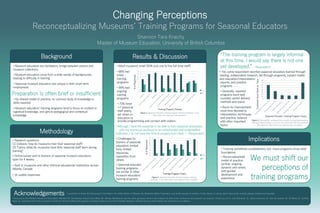
- 1. Changing Perceptions ReconceptualizingMuseums’ Training Programs for Seasonal Educators Shannon Tara Kraichy Master of Museum Education, University of British Columbia Background Methodology Results & Discussion Acknowledgements Thank you to the Western Museums Association Wanda Chin Scholarship Award Committee, Mr. Wesley Wendhardt, and the other generous donors who helped me attend this conference and present my research. Thank you to Dr. Lisa McIntosh, Dr. David Anderson, Dr. Alex de Cosson, Dr. Jill Baird, Dr. Cynthia Nicol, Dr. Jong-Mun Kim and my masters cohort for all their editing and support. As always, thank you Donald, Paulette, Stephen, Danielle and my other sisters, my ancestors and relations. Implications 0 2 4 6 8 10 12 14 16 # of Responses Training Program Delivery Yes No 0 2 4 6 8 10 12 14 # of Responses Training Program Topics Yes No 0 10 20 30 40 50 60 70 80 Combined Hours Spent on Topic Seasonal Educator Training Program Topics • Research questions: (1) Delivery: how do museums train their seasonal staff? (2) Topics: what do museums have their seasonal staff learn during training? • Training sometimes unsatisfactory, but many programs show solid foundations • Challenges for trainers of seasonal educators: limited time, limited resources, opposition from others We must shift our perceptions of training programs • Reconceptualized model of practice: cyclical, ongoing, dynamic and varied, with guided development and experience I would like to thank the Musqueam First Nation, the Métis Nation of Alberta, the Manitoba Métis Federation, and all the people of northern Turtle Island, on whose land I have lived, worked, played, studied and travelled. • Most museums small (50% only one to five full-time staff) • 88% had initial training programs “The training program is largely informal at this time. I would say there is not one yet developed.” – Respondent “Although I have the expertise to be able to train seasonal employees, with my enormous workload in an underfunded and understaffed institution, I do not have the time to properly train them.” – Respondent • Yet, same respondent reported seasonal educators learned through reading, independent research, led through programs, subject matter and education/interpretation Figure 1. Seasonal educator training program delivery methods, n=16. More than one response was accepted. Figure 2. Seasonal educator training program delivery methods, n=16. More than one response was accepted. Figure 3. Participants' combined hours spent on seasonal educator training program topics, n=15 (as one participant did not complete this section). More than one response was accepted. experts, and practice programs . . . . . • Seasonal educator training programs are similar to other museum educators' training programs • Generally, reported programs were well rounded: varied delivery methods and topics • Room for improvement: most time devoted to interpretation techniques and practice, balance with other important topics • 94% had ongoing training programs • Seasonal museum educators are unique in their short-term employment • Museum educators are facilitators; bridge between visitors and museum collections • Museum educators’ training programs tend to focus on content or logistical knowledge, and ignore pedagogical and contextual knowledge • Museum educators come from a wide variety of backgrounds, leading to difficulty in training Preparation is often brief or insufficient • No shared model of practice, no common body of knowledge or skills required • Online survey sent to trainers of seasonal museum educators, open for 4 weeks • Sent to museums and other informal educational institutions across Alberta, Canada • 16 usable responses • 75% hired <7 seasonal staff yearly, yet relied on educators to provide programming and connect with visitors