Facilitating Critical Conversations
around Exhibitions
Western Museum Associations
Saturday, October 8, 2022
Amanda Coven
Molly Wilmoth
Eliza Canty-Jones
Ariel Peasley
Outline
Individual
Introductions
+ Case Studies
Breakout
Group
Discussions
Regroup +
Shareout
Q&A
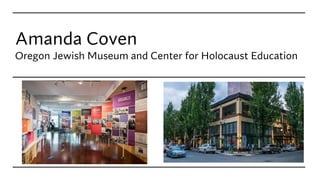
Amanda Coven
Oregon Jewish Museum and Center for Holocaust Education
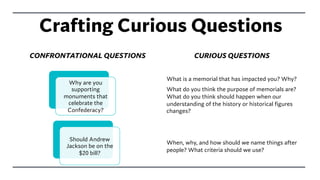
Crafting Curious Questions
CONFRONTATIONAL QUESTIONS CURIOUS QUESTIONS
Why are you
supporting
monuments that
celebrate the
Confederacy?
Should Andrew
Jackson be on the
$20 bill?
What is a memorial that has impacted you? Why?
What do you think the purpose of memorials are?
What do you think should happen when our
understanding of the history or historical figures
changes?
When, why, and how should we name things after
people? What criteria should we use?
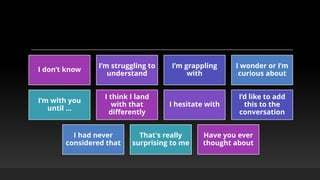
Conversing with Compassion
and Dignity
I don’t know
I’m struggling to
understand
I’m grappling
with
I wonder or I’m
curious about
I’m with you
until …
I think I land
with that
differently
I hesitate with
I’d like to add
this to the
conversation
I had never
considered that
That's really
surprising to me
Have you ever
thought about
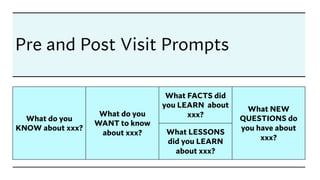
Pre and Post Visit Prompts
What do you
KNOW about xxx?
What do you
WANT to know
about xxx?
What FACTS did
you LEARN about
xxx?
What NEW
QUESTIONS do
you have about
xxx?
What LESSONS
did you LEARN
about xxx?
Breakaway
Questions
What is a question you are
considering reframing to be more
curious?
What are ways you can (or do)
prepare and/or follow up with
student groups to facilitate
productive critical conversations?
Critical Conversations
Western Museums Association
Saturday, October 8, 2022
Eliza E. Canty-Jones, Oregon Historical Society
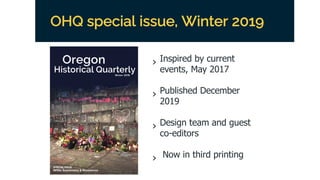
OHQ special issue, Winter 2019
› Inspired by current
events, May 2017
› Published December
2019
› Design team and guest
co-editors
› Now in third printing
“Historians and the News” series
“The [September 13] wide-ranging
conversation began with a discussion of
‘presentism’ in the work of doing
history, sparked by a recent post by
American Historical Association
president James H. Sweet and [Keisha]
Blain’s response, ‘Black Historians Know
There’s No Such Thing as Objective
History.’ Blain and [Christopher
McKnight] Nichols discussed academic
training and debates about the
relationship between past and present,
and Blain explained that ‘whether we
like it or not, the work we produce will
be used in some way, and oftentimes, it
will be used in a political way’.”
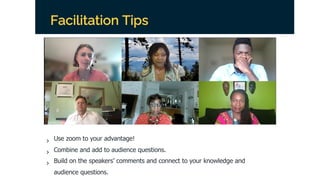
Facilitation Tips
› Use zoom to your advantage!
› Combine and add to audience questions.
› Build on the speakers’ comments and connect to your knowledge and
audience questions.
Overall Tips and Takeaways
› Don’t let peoples’ histories be defined by
the worst thing that has happened to them.
› Maintain balance in your life. Civic
engagement is a marathon, not a sprint,
and the work you are doing is mostly for
future generations, not for the present.
Breakaway Question
When, how, and why
do we let politics
impact our public
programming?
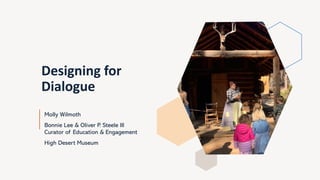
Designing for
Dialogue
Molly Wilmoth
Bonnie Lee & Oliver P. Steele III
Curator of Education & Engagement
High Desert Museum
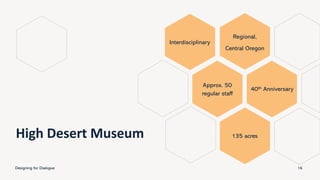
High Desert Museum
Interdisciplinary
Regional,
Central Oregon
Approx. 50
regular staff
40th Anniversary
135 acres
Presentation Title
Designing for Dialogue 16
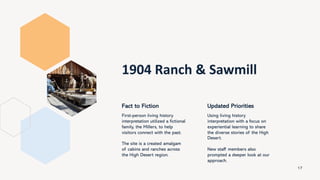
1904 Ranch & Sawmill
Fact to Fiction
First-person living history
interpretation utilized a fictional
family, the Millers, to help
visitors connect with the past.
The site is a created amalgam
of cabins and ranches across
the High Desert region.
Updated Priorities
Using living history
interpretation with a focus on
experiential learning to share
the diverse stories of the High
Desert.
New staff members also
prompted a deeper look at our
approach.
17
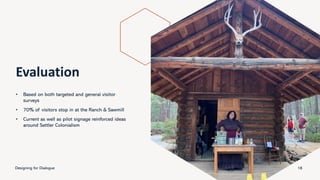
Evaluation
• Based on both targeted and general visitor
surveys
• 70% of visitors stop in at the Ranch & Sawmill
• Current as well as pilot signage reinforced ideas
around Settler Colonialism
Designing for Dialogue 18
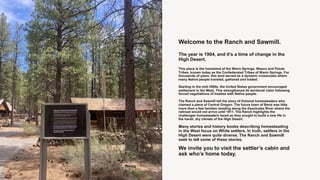
Welcome to the Ranch and Sawmill.
The year is 1904, and it’s a time of change in the
High Desert.
This place is the homeland of the Warm Springs, Wasco and Paiute
Tribes, known today as the Confederated Tribes of Warm Springs. For
thousands of years, this land served as a dynamic crossroads where
many Native people traveled, gathered and traded.
Starting in the mid-1800s, the United States government encouraged
settlement in the West. This strengthened its territorial claim following
forced negotiations of treaties with Native people.
The Ranch and Sawmill tell the story of fictional homesteaders who
claimed a piece of Central Oregon. The future town of Bend was little
more than a few families residing along the Deschutes River where the
railroad would not arrive until 1911. The Ranch highlights the
challenges homesteaders faced as they sought to build a new life in
the harsh, dry climate of the High Desert.
Many stories and history books describing homesteading
in the West focus on White settlers. In truth, settlers in the
High Desert were quite diverse. The Ranch and Sawmill
seek to tell some of these stories.
We invite you to visit the settler’s cabin and
ask who’s home today.
Resources
Intentional Practice
for Museums
Randi Korn
Hemingway Editor
App
Hemingwayapp.com
Designing for Dialogue 20
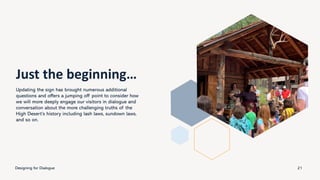
Just the beginning…
Updating the sign has brought numerous additional
questions and offers a jumping off point to consider how
we will more deeply engage our visitors in dialogue and
conversation about the more challenging truths of the
High Desert’s history including lash laws, sundown laws,
and so on.
Designing for Dialogue 21
Breakaway Question
How do we meet
visitors where they
are and how do we
productively engage
them in conversation?
Designing for Dialogue 22
ARIEL PEASLEY
(FORMER) EDUCATION & COMMUNITY ENGAGEMENT COORDINATOR
(CURRENT) INDEPENDENT MUSEUM PROFESSIONAL
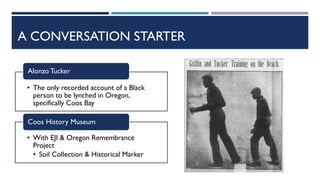
A CONVERSATION STARTER
• The only recorded account of a Black
person to be lynched in Oregon,
specifically Coos Bay
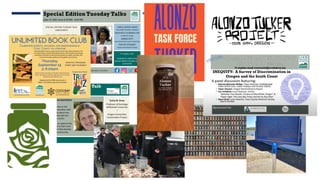
Alonzo Tucker
• With EJI & Oregon Remembrance
Project
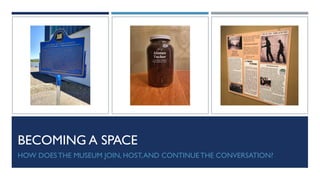
• Soil Collection & Historical Marker
Coos History Museum
COMMUNITY QUESTIONS
WHAT CAN BE DONE,
HOW CAN WE HELP?
HOW DO WE
RECOGNIZE THE
LYNCHING OF
ALONZO TUCKER?
IS THE COOS HISTORY
MUSEUM IN A
POSITION TO DO
SOMETHING?
BECOMING A SPACE
HOW DOES THE MUSEUM JOIN, HOST,AND CONTINUE THE CONVERSATION?
BREAK AWAY QUESTIONS
How do you recognize when your community is ready for conversation and action?
And how do you know when to push and when to be patient?
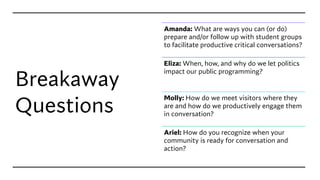
Breakaway
Questions
Amanda: What are ways you can (or do)
prepare and/or follow up with student groups
to facilitate productive critical conversations?
Eliza: When, how, and why do we let politics
impact our public programming?
Molly: How do we meet visitors where they
are and how do we productively engage them
in conversation?
Ariel: How do you recognize when your
community is ready for conversation and
action?

Facilitating Critical Conversations Around Exhibitions

  • 1.
    Facilitating Critical Conversations aroundExhibitions Western Museum Associations Saturday, October 8, 2022 Amanda Coven Molly Wilmoth Eliza Canty-Jones Ariel Peasley
  • 2.
  • 3.
    Amanda Coven Oregon JewishMuseum and Center for Holocaust Education
  • 5.
    Crafting Curious Questions CONFRONTATIONALQUESTIONS CURIOUS QUESTIONS Why are you supporting monuments that celebrate the Confederacy? Should Andrew Jackson be on the $20 bill? What is a memorial that has impacted you? Why? What do you think the purpose of memorials are? What do you think should happen when our understanding of the history or historical figures changes? When, why, and how should we name things after people? What criteria should we use?
  • 6.
    Conversing with Compassion andDignity I don’t know I’m struggling to understand I’m grappling with I wonder or I’m curious about I’m with you until … I think I land with that differently I hesitate with I’d like to add this to the conversation I had never considered that That's really surprising to me Have you ever thought about
  • 7.
    Pre and PostVisit Prompts What do you KNOW about xxx? What do you WANT to know about xxx? What FACTS did you LEARN about xxx? What NEW QUESTIONS do you have about xxx? What LESSONS did you LEARN about xxx?
  • 8.
    Breakaway Questions What is aquestion you are considering reframing to be more curious? What are ways you can (or do) prepare and/or follow up with student groups to facilitate productive critical conversations?
  • 9.
    Critical Conversations Western MuseumsAssociation Saturday, October 8, 2022 Eliza E. Canty-Jones, Oregon Historical Society
  • 10.
    OHQ special issue,Winter 2019 › Inspired by current events, May 2017 › Published December 2019 › Design team and guest co-editors › Now in third printing
  • 11.
    “Historians and theNews” series “The [September 13] wide-ranging conversation began with a discussion of ‘presentism’ in the work of doing history, sparked by a recent post by American Historical Association president James H. Sweet and [Keisha] Blain’s response, ‘Black Historians Know There’s No Such Thing as Objective History.’ Blain and [Christopher McKnight] Nichols discussed academic training and debates about the relationship between past and present, and Blain explained that ‘whether we like it or not, the work we produce will be used in some way, and oftentimes, it will be used in a political way’.”
  • 12.
    Facilitation Tips › Usezoom to your advantage! › Combine and add to audience questions. › Build on the speakers’ comments and connect to your knowledge and audience questions.
  • 13.
    Overall Tips andTakeaways › Don’t let peoples’ histories be defined by the worst thing that has happened to them. › Maintain balance in your life. Civic engagement is a marathon, not a sprint, and the work you are doing is mostly for future generations, not for the present.
  • 14.
    Breakaway Question When, how,and why do we let politics impact our public programming?
  • 15.
    Designing for Dialogue Molly Wilmoth BonnieLee & Oliver P. Steele III Curator of Education & Engagement High Desert Museum
  • 16.
    High Desert Museum Interdisciplinary Regional, CentralOregon Approx. 50 regular staff 40th Anniversary 135 acres Presentation Title Designing for Dialogue 16
  • 17.
    1904 Ranch &Sawmill Fact to Fiction First-person living history interpretation utilized a fictional family, the Millers, to help visitors connect with the past. The site is a created amalgam of cabins and ranches across the High Desert region. Updated Priorities Using living history interpretation with a focus on experiential learning to share the diverse stories of the High Desert. New staff members also prompted a deeper look at our approach. 17
  • 18.
    Evaluation • Based onboth targeted and general visitor surveys • 70% of visitors stop in at the Ranch & Sawmill • Current as well as pilot signage reinforced ideas around Settler Colonialism Designing for Dialogue 18
  • 19.
    Welcome to theRanch and Sawmill. The year is 1904, and it’s a time of change in the High Desert. This place is the homeland of the Warm Springs, Wasco and Paiute Tribes, known today as the Confederated Tribes of Warm Springs. For thousands of years, this land served as a dynamic crossroads where many Native people traveled, gathered and traded. Starting in the mid-1800s, the United States government encouraged settlement in the West. This strengthened its territorial claim following forced negotiations of treaties with Native people. The Ranch and Sawmill tell the story of fictional homesteaders who claimed a piece of Central Oregon. The future town of Bend was little more than a few families residing along the Deschutes River where the railroad would not arrive until 1911. The Ranch highlights the challenges homesteaders faced as they sought to build a new life in the harsh, dry climate of the High Desert. Many stories and history books describing homesteading in the West focus on White settlers. In truth, settlers in the High Desert were quite diverse. The Ranch and Sawmill seek to tell some of these stories. We invite you to visit the settler’s cabin and ask who’s home today.
  • 20.
    Resources Intentional Practice for Museums RandiKorn Hemingway Editor App Hemingwayapp.com Designing for Dialogue 20
  • 21.
    Just the beginning… Updatingthe sign has brought numerous additional questions and offers a jumping off point to consider how we will more deeply engage our visitors in dialogue and conversation about the more challenging truths of the High Desert’s history including lash laws, sundown laws, and so on. Designing for Dialogue 21
  • 22.
    Breakaway Question How dowe meet visitors where they are and how do we productively engage them in conversation? Designing for Dialogue 22
  • 23.
    ARIEL PEASLEY (FORMER) EDUCATION& COMMUNITY ENGAGEMENT COORDINATOR (CURRENT) INDEPENDENT MUSEUM PROFESSIONAL
  • 24.
    A CONVERSATION STARTER •The only recorded account of a Black person to be lynched in Oregon, specifically Coos Bay Alonzo Tucker • With EJI & Oregon Remembrance Project • Soil Collection & Historical Marker Coos History Museum
  • 25.
    COMMUNITY QUESTIONS WHAT CANBE DONE, HOW CAN WE HELP? HOW DO WE RECOGNIZE THE LYNCHING OF ALONZO TUCKER? IS THE COOS HISTORY MUSEUM IN A POSITION TO DO SOMETHING?
  • 26.
    BECOMING A SPACE HOWDOES THE MUSEUM JOIN, HOST,AND CONTINUE THE CONVERSATION?
  • 28.
    BREAK AWAY QUESTIONS Howdo you recognize when your community is ready for conversation and action? And how do you know when to push and when to be patient?
  • 29.
    Breakaway Questions Amanda: What areways you can (or do) prepare and/or follow up with student groups to facilitate productive critical conversations? Eliza: When, how, and why do we let politics impact our public programming? Molly: How do we meet visitors where they are and how do we productively engage them in conversation? Ariel: How do you recognize when your community is ready for conversation and action?