Preserving History
through Restoration
Making difficult choices with collections
Beth Sanders, U.S. Naval Undersea Museum
Bruce Jones, Columbia River Maritime Museum
Richard Pekelney, USS Pampanito, San Francisco Maritime National Park Association Board of Trustees
Restoration vs Conservation
It’s all about PRESERVATION!
Conservation:
• Prevents, stops, or slows down
deterioration
• ‘Do no harm’
• Allow it to be handled, stored, or
displayed without further damage
• Does not attempt to return the object to
its prior state
• Accepts an object’s wear and tear as
part of its story
• Performed by trained artifact
conservators
Restoration:
• Often involves making objects
functional or returning an object
back to its original appearance
• Removes or covers up signs of wear
and use
• Replaces or reconstructs missing or
worn parts
• Lets the viewer see what the object
originally looked like
• Often performed by subject matter
experts, rather than conservators
Extra Challenges
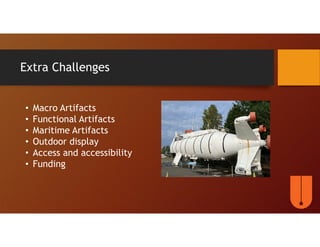
• Macro Artifacts
• Functional Artifacts
• Maritime Artifacts
• Outdoor display
• Access and accessibility
• Funding
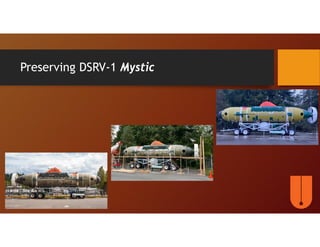
Preserving DSRV-1 Mystic
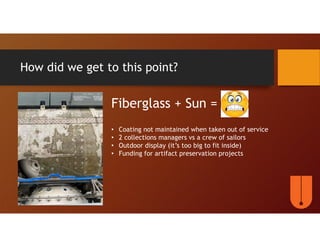
How did we get to this point?
Fiberglass + Sun =
• Coating not maintained when taken out of service
• 2 collections managers vs a crew of sailors
• Outdoor display (it’s too big to fit inside)
• Funding for artifact preservation projects
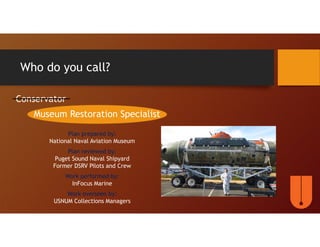
Who do you call?
Conservator
Museum Restoration Specialist
Plan prepared by:
National Naval Aviation Museum
Plan reviewed by:
Puget Sound Naval Shipyard
Former DSRV Pilots and Crew
Work performed by:
InFocus Marine
Work overseen by:
USNUM Collections Managers
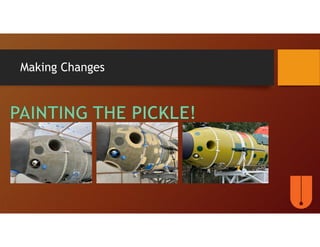
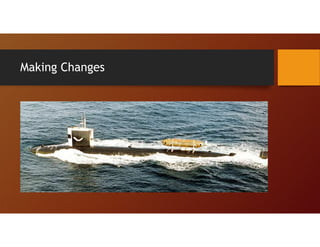
Making Changes
Making Changes
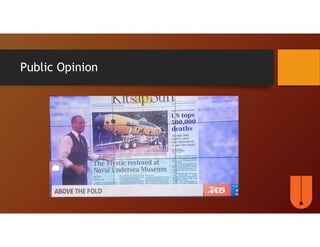
Public Opinion
Public Opinion
End result
Two years later, Mystic still sparkles!
• Vendor is local and paint job is warrantied
• Report documents areas of damage and work
that was done
• Extensive photography throughout process
• Visitors appreciate the history of the vehicle,
and aren’t distracted by its condition
• Value of the restoration project as incentive to
fund a structure over vehicles
• We can anticipate the scale, cost, and
periodicity of repainting
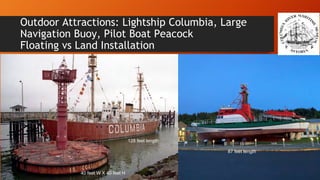
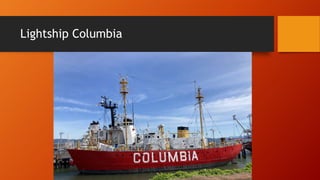
Outdoor Attractions: Lightship Columbia, Large
Navigation Buoy, Pilot Boat Peacock
Floating vs Land Installation
128 feet length
40 feet W X 40 feet H
87 feet length
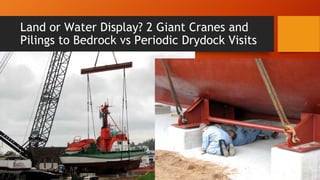
Land or Water Display? 2 Giant Cranes and
Pilings to Bedrock vs Periodic Drydock Visits
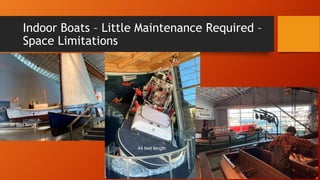
Indoor Boats – Little Maintenance Required –
Space Limitations
44 feet length
36 feet length
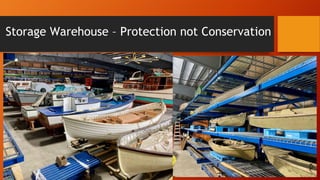
Storage Warehouse – Protection not Conservation
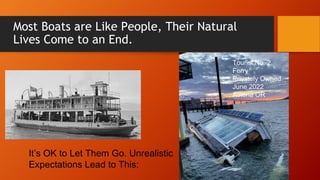
Most Boats are Like People, Their Natural
Lives Come to an End.
It’s OK to Let Them Go. Unrealistic
Expectations Lead to This:
Tourist No. 2
Ferry
Privately Owned
June 2022
Astoria OR
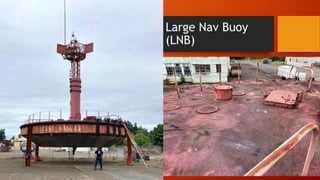
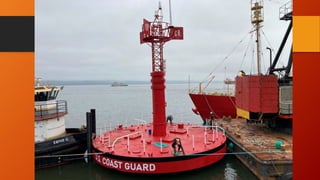
Large Nav Buoy
(LNB)
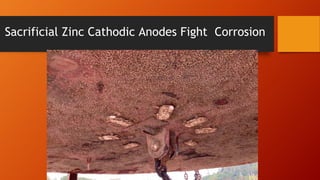
Sacrificial Zinc Cathodic Anodes Fight Corrosion
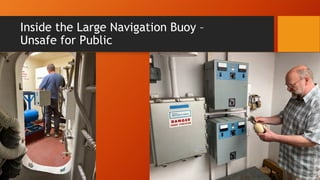
Inside the Large Navigation Buoy –
Unsafe for Public
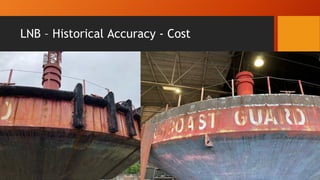
LNB – Historical Accuracy - Cost
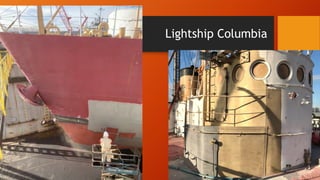
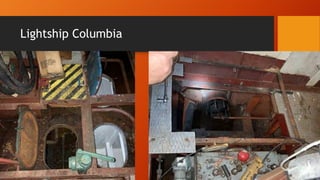
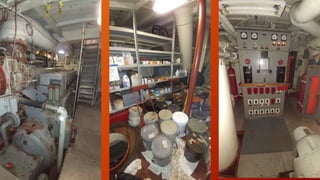
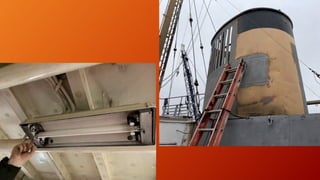
Lightship Columbia
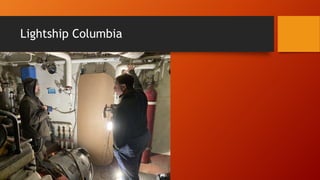
Lightship Columbia
Lightship Columbia
Lightship Columbia
Lightship Columbia
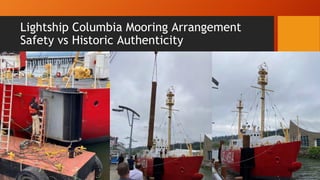
Lightship Columbia Mooring Arrangement
Safety vs Historic Authenticity
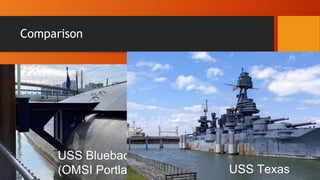
Comparison
USS Blueback
(OMSI Portland) USS Texas
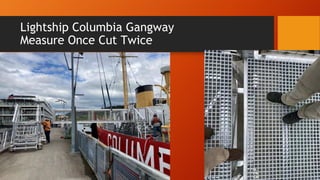
Lightship Columbia Gangway
Measure Once Cut Twice
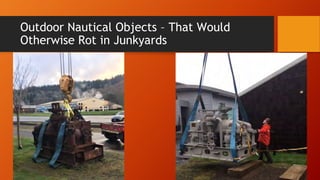
Outdoor Nautical Objects – That Would
Otherwise Rot in Junkyards
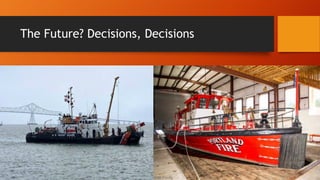
The Future? Decisions, Decisions
Operating Historic Fabric in a Museum
Aboard the USS Pampanito
Rich Pekelney, Oct 2022
Restoration Rationale
Short history of USS Pampanito, our mission
Prove Completeness
Idle equipment deteriorates faster
Safety Problems are found and corrected
Documentation is collected and created
Endangered resources are preserved
Operating equipment inspires care
Interpretation and engagement
Restoration Rationale
The History of the USS Pampanito
– 6 War Patrols from 1943 – 1945
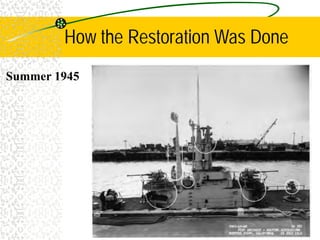
– Laid up in Summer of 1945 configuration
– 1956 Drydock maintenance period
– Reserve Trainer from 1961 – 1970
– Open for fleet stripping 1970 – 1976
– Storage and Vandalism 1976 – 1981
– Museum ship from 1982 to the present
– Since 1982, six dry dock evolutions
Restoration Rationale
Our Mission is to Bring Maritime History to Life
– Preservation
– Research
– Interpretation
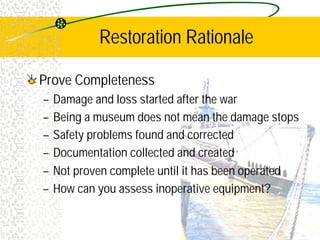
Restoration Rationale
Prove Completeness
– Damage and loss started after the war
– Being a museum does not mean the damage stops
– Safety problems found and corrected
– Documentation collected and created
– Not proven complete until it has been operated
– How can you assess inoperative equipment?
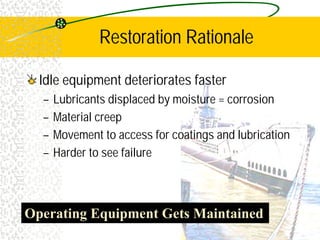
Restoration Rationale
Idle equipment deteriorates faster
– Lubricants displaced by moisture = corrosion
– Material creep
– Movement to access for coatings and lubrication
– Harder to see failure
Operating Equipment Gets Maintained
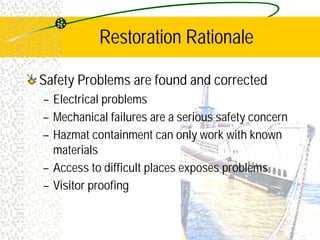
Restoration Rationale
Safety Problems are found and corrected
– Electrical problems
– Mechanical failures are a serious safety concern
– Hazmat containment can only work with known
materials
– Access to difficult places exposes problems
– Visitor proofing
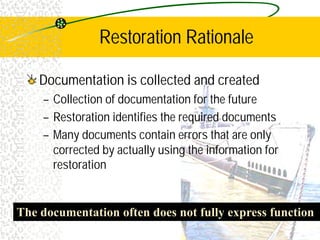
Restoration Rationale
Documentation is collected and created
– Collection of documentation for the future
– Restoration identifies the required documents
– Many documents contain errors that are only
corrected by actually using the information for
restoration
The documentation often does not fully express function
Restoration Rationale
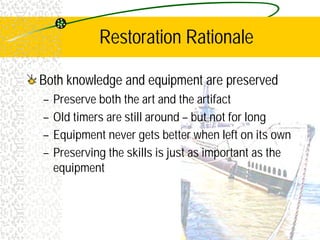
Both knowledge and equipment are preserved
– Preserve both the art and the artifact
– Old timers are still around – but not for long
– Equipment never gets better when left on its own
– Preserving the skills is just as important as the
equipment
Restoration Rationale
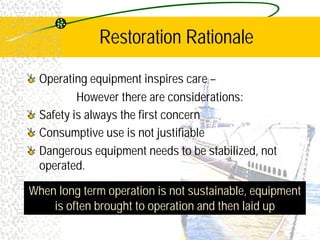
Operating equipment inspires care –
However there are considerations:
Safety is always the first concern
Consumptive use is not justifiable
Dangerous equipment needs to be stabilized, not
operated.
When long term operation is not sustainable, equipment
is often brought to operation and then laid up
Restoration Rationale
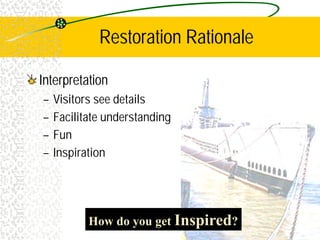
Interpretation
– Visitors see details
– Facilitate understanding
– Fun
– Inspiration
How do you get Inspired?
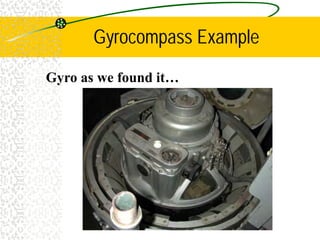
Gyrocompass Example
Gyro as we found it…
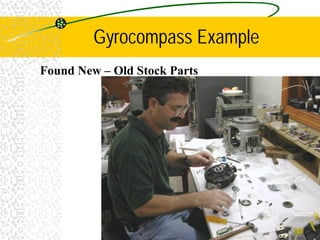
Gyrocompass Example
Found New – Old Stock Parts
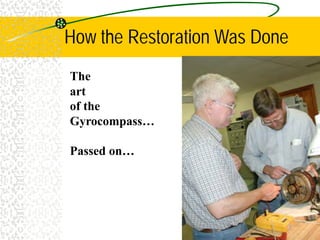
How the Restoration Was Done
The
art
of the
Gyrocompass…
Passed on…
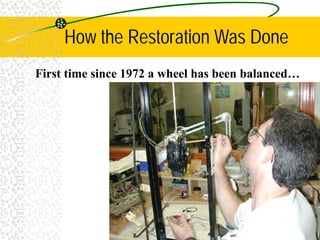
How the Restoration Was Done
First time since 1972 a wheel has been balanced…
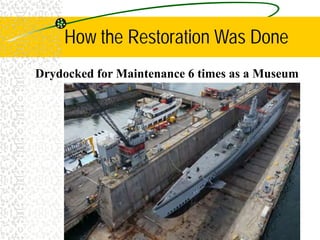
How the Restoration Was Done
Drydocked for Maintenance 6 times as a Museum
How the Restoration Was Done
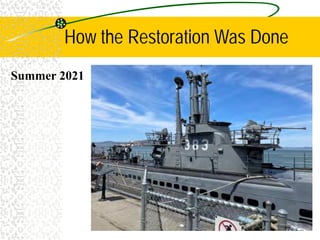
Summer 1945
How the Restoration Was Done
Summer 2021
Questions?
rpekelney@martime.org
https://maritime.org/sub
https://maritime.org/pres

Preserving History Through Restoration

  • 1.
    Preserving History through Restoration Makingdifficult choices with collections Beth Sanders, U.S. Naval Undersea Museum Bruce Jones, Columbia River Maritime Museum Richard Pekelney, USS Pampanito, San Francisco Maritime National Park Association Board of Trustees
  • 2.
    Restoration vs Conservation It’sall about PRESERVATION! Conservation: • Prevents, stops, or slows down deterioration • ‘Do no harm’ • Allow it to be handled, stored, or displayed without further damage • Does not attempt to return the object to its prior state • Accepts an object’s wear and tear as part of its story • Performed by trained artifact conservators Restoration: • Often involves making objects functional or returning an object back to its original appearance • Removes or covers up signs of wear and use • Replaces or reconstructs missing or worn parts • Lets the viewer see what the object originally looked like • Often performed by subject matter experts, rather than conservators
  • 3.
    Extra Challenges • MacroArtifacts • Functional Artifacts • Maritime Artifacts • Outdoor display • Access and accessibility • Funding
  • 4.
  • 5.
    How did weget to this point? Fiberglass + Sun = • Coating not maintained when taken out of service • 2 collections managers vs a crew of sailors • Outdoor display (it’s too big to fit inside) • Funding for artifact preservation projects
  • 6.
    Who do youcall? Conservator Museum Restoration Specialist Plan prepared by: National Naval Aviation Museum Plan reviewed by: Puget Sound Naval Shipyard Former DSRV Pilots and Crew Work performed by: InFocus Marine Work overseen by: USNUM Collections Managers
  • 7.
  • 8.
  • 9.
  • 10.
  • 11.
    End result Two yearslater, Mystic still sparkles! • Vendor is local and paint job is warrantied • Report documents areas of damage and work that was done • Extensive photography throughout process • Visitors appreciate the history of the vehicle, and aren’t distracted by its condition • Value of the restoration project as incentive to fund a structure over vehicles • We can anticipate the scale, cost, and periodicity of repainting
  • 12.
    Outdoor Attractions: LightshipColumbia, Large Navigation Buoy, Pilot Boat Peacock Floating vs Land Installation 128 feet length 40 feet W X 40 feet H 87 feet length
  • 13.
    Land or WaterDisplay? 2 Giant Cranes and Pilings to Bedrock vs Periodic Drydock Visits
  • 14.
    Indoor Boats –Little Maintenance Required – Space Limitations 44 feet length 36 feet length
  • 15.
    Storage Warehouse –Protection not Conservation
  • 16.
    Most Boats areLike People, Their Natural Lives Come to an End. It’s OK to Let Them Go. Unrealistic Expectations Lead to This: Tourist No. 2 Ferry Privately Owned June 2022 Astoria OR
  • 17.
  • 18.
    Sacrificial Zinc CathodicAnodes Fight Corrosion
  • 19.
    Inside the LargeNavigation Buoy – Unsafe for Public
  • 20.
    LNB – HistoricalAccuracy - Cost
  • 22.
  • 23.
  • 24.
  • 25.
  • 30.
  • 32.
    Lightship Columbia MooringArrangement Safety vs Historic Authenticity
  • 33.
  • 34.
  • 35.
    Outdoor Nautical Objects– That Would Otherwise Rot in Junkyards
  • 36.
  • 37.
    Operating Historic Fabricin a Museum Aboard the USS Pampanito Rich Pekelney, Oct 2022
  • 38.
    Restoration Rationale Short historyof USS Pampanito, our mission Prove Completeness Idle equipment deteriorates faster Safety Problems are found and corrected Documentation is collected and created Endangered resources are preserved Operating equipment inspires care Interpretation and engagement
  • 39.
    Restoration Rationale The Historyof the USS Pampanito – 6 War Patrols from 1943 – 1945 – Laid up in Summer of 1945 configuration – 1956 Drydock maintenance period – Reserve Trainer from 1961 – 1970 – Open for fleet stripping 1970 – 1976 – Storage and Vandalism 1976 – 1981 – Museum ship from 1982 to the present – Since 1982, six dry dock evolutions
  • 40.
    Restoration Rationale Our Missionis to Bring Maritime History to Life – Preservation – Research – Interpretation
  • 41.
    Restoration Rationale Prove Completeness –Damage and loss started after the war – Being a museum does not mean the damage stops – Safety problems found and corrected – Documentation collected and created – Not proven complete until it has been operated – How can you assess inoperative equipment?
  • 42.
    Restoration Rationale Idle equipmentdeteriorates faster – Lubricants displaced by moisture = corrosion – Material creep – Movement to access for coatings and lubrication – Harder to see failure Operating Equipment Gets Maintained
  • 43.
    Restoration Rationale Safety Problemsare found and corrected – Electrical problems – Mechanical failures are a serious safety concern – Hazmat containment can only work with known materials – Access to difficult places exposes problems – Visitor proofing
  • 44.
    Restoration Rationale Documentation iscollected and created – Collection of documentation for the future – Restoration identifies the required documents – Many documents contain errors that are only corrected by actually using the information for restoration The documentation often does not fully express function
  • 45.
    Restoration Rationale Both knowledgeand equipment are preserved – Preserve both the art and the artifact – Old timers are still around – but not for long – Equipment never gets better when left on its own – Preserving the skills is just as important as the equipment
  • 46.
    Restoration Rationale Operating equipmentinspires care – However there are considerations: Safety is always the first concern Consumptive use is not justifiable Dangerous equipment needs to be stabilized, not operated. When long term operation is not sustainable, equipment is often brought to operation and then laid up
  • 47.
    Restoration Rationale Interpretation – Visitorssee details – Facilitate understanding – Fun – Inspiration How do you get Inspired?
  • 48.
  • 49.
    Gyrocompass Example Found New– Old Stock Parts
  • 50.
    How the RestorationWas Done The art of the Gyrocompass… Passed on…
  • 51.
    How the RestorationWas Done First time since 1972 a wheel has been balanced…
  • 52.
    How the RestorationWas Done Drydocked for Maintenance 6 times as a Museum
  • 53.
    How the RestorationWas Done Summer 1945
  • 54.
    How the RestorationWas Done Summer 2021
  • 55.