Changes to the Residential Traffic
Administration Program (RTAP)
Board Transportation Committee
December 11, 2018
Steve Knudsen, Transportation Planner III
Department of Transportation
Changes to the Residential Traffic Administration
Program
• Revisions to the Traffic Calming Program.
• Edits to the other RTAP program documents.
We are seeking concurrence from the Committee to advance
the proposed changes to the Traffic Calming Program.
2
Revisions to the Traffic Calming Program
• In November 2017, VDOT published a guide for its
restructured Traffic Calming Program, entitled Traffic
Calming Guide for Neighborhood Streets. It was further
amended in September 2018.
• FCDOT subsequently rewrote the guidelines for Fairfax
County’s Traffic Calming Program. This presentation
covers only the critical changes to the program.
3
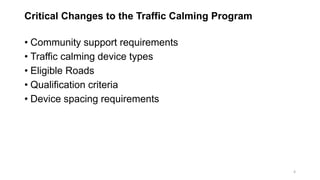
Critical Changes to the Traffic Calming Program
• Community support requirements
• Traffic calming device types
• Eligible Roads
• Qualification criteria
• Device spacing requirements
4
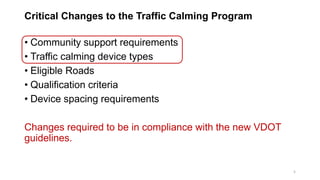
Critical Changes to the Traffic Calming Program
• Community support requirements
• Traffic calming device types
• Eligible Roads
• Qualification criteria
• Device spacing requirements
Changes required to be in compliance with the new VDOT
guidelines.
5
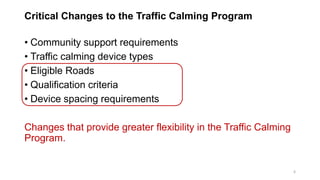
Critical Changes to the Traffic Calming Program
• Community support requirements
• Traffic calming device types
• Eligible Roads
• Qualification criteria
• Device spacing requirements
Changes that provide greater flexibility in the Traffic Calming
Program.
6
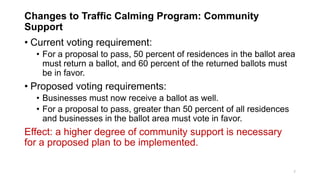
Changes to Traffic Calming Program: Community
Support
• Current voting requirement:
• For a proposal to pass, 50 percent of residences in the ballot area
must return a ballot, and 60 percent of the returned ballots must
be in favor.
• Proposed voting requirements:
• Businesses must now receive a ballot as well.
• For a proposal to pass, greater than 50 percent of all residences
and businesses in the ballot area must vote in favor.
Effect: a higher degree of community support is necessary
for a proposed plan to be implemented.
7
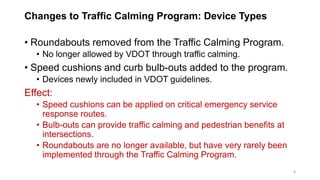
Changes to Traffic Calming Program: Device Types
• Roundabouts removed from the Traffic Calming Program.
• No longer allowed by VDOT through traffic calming.
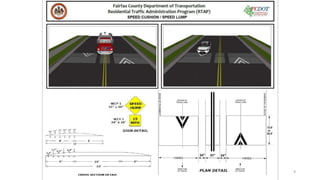
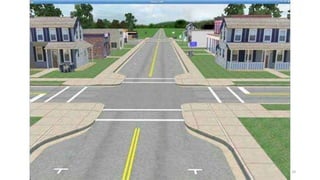
• Speed cushions and curb bulb-outs added to the program.
• Devices newly included in VDOT guidelines.
Effect:
• Speed cushions can be applied on critical emergency service
response routes.
• Bulb-outs can provide traffic calming and pedestrian benefits at
intersections.
• Roundabouts are no longer available, but have very rarely been
implemented through the Traffic Calming Program.
8
9
10
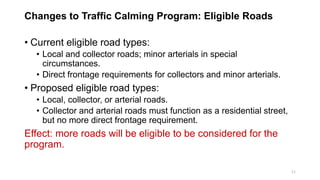
Changes to Traffic Calming Program: Eligible Roads
• Current eligible road types:
• Local and collector roads; minor arterials in special
circumstances.
• Direct frontage requirements for collectors and minor arterials.
• Proposed eligible road types:
• Local, collector, or arterial roads.
• Collector and arterial roads must function as a residential street,
but no more direct frontage requirement.
Effect: more roads will be eligible to be considered for the
program.
11
12
13
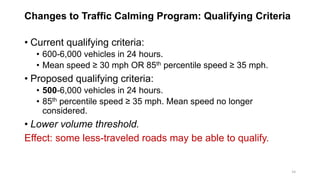
• Current qualifying criteria:
• 600-6,000 vehicles in 24 hours.
• Mean speed ≥ 30 mph OR 85th percentile speed ≥ 35 mph.
• Proposed qualifying criteria:
• 500-6,000 vehicles in 24 hours.
• 85th percentile speed ≥ 35 mph. Mean speed no longer
considered.
• Lower volume threshold.
Effect: some less-traveled roads may be able to qualify.
14
Changes to Traffic Calming Program: Qualifying Criteria
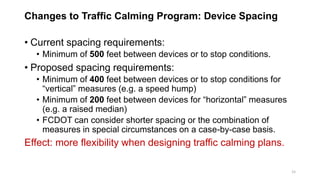
Changes to Traffic Calming Program: Device Spacing
• Current spacing requirements:
• Minimum of 500 feet between devices or to stop conditions.
• Proposed spacing requirements:
• Minimum of 400 feet between devices or to stop conditions for
“vertical” measures (e.g. a speed hump)
• Minimum of 200 feet between devices for “horizontal” measures
(e.g. a raised median)
• FCDOT can consider shorter spacing or the combination of
measures in special circumstances on a case-by-case basis.
Effect: more flexibility when designing traffic calming plans.
15
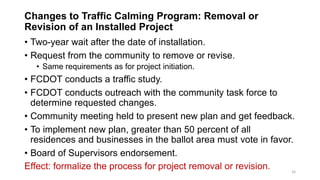
Changes to Traffic Calming Program: Removal or
Revision of an Installed Project
• Two-year wait after the date of installation.
• Request from the community to remove or revise.
• Same requirements as for project initiation.
• FCDOT conducts a traffic study.
• FCDOT conducts outreach with the community task force to
determine requested changes.
• Community meeting held to present new plan and get feedback.
• To implement new plan, greater than 50 percent of all
residences and businesses in the ballot area must vote in favor.
• Board of Supervisors endorsement.
Effect: formalize the process for project removal or revision. 16
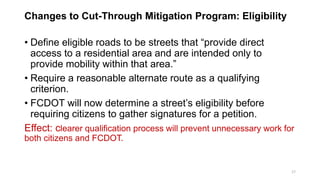
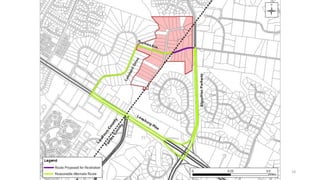
Changes to Cut-Through Mitigation Program: Eligibility
• Define eligible roads to be streets that “provide direct
access to a residential area and are intended only to
provide mobility within that area.”
• Require a reasonable alternate route as a qualifying
criterion.
• FCDOT will now determine a street’s eligibility before
requiring citizens to gather signatures for a petition.
Effect: clearer qualification process will prevent unnecessary work for
both citizens and FCDOT.
17
18
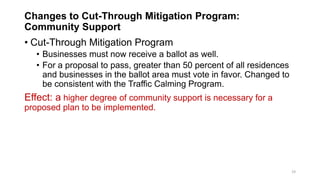
Changes to Cut-Through Mitigation Program:
Community Support
• Cut-Through Mitigation Program
• Businesses must now receive a ballot as well.
• For a proposal to pass, greater than 50 percent of all residences
and businesses in the ballot area must vote in favor. Changed to
be consistent with the Traffic Calming Program.
Effect: a higher degree of community support is necessary for a
proposed plan to be implemented.
19
Changes to Other RTAP Programs
• Clarified language for Watch for Children, $200 Additional
Fine, and Through-Truck Restriction Programs.
No changes to the operation of these programs.
20
Next Steps
• Approval of the new Traffic Calming guidelines by the
Board.
• New guidelines phased in for traffic calming projects
already underway and immediately applicable for all new
traffic calming projects.
21
Thank You!
Questions?
22

Changes to the Residential Traffic Administration Program (RTAP)

  • 1.
    Changes to theResidential Traffic Administration Program (RTAP) Board Transportation Committee December 11, 2018 Steve Knudsen, Transportation Planner III Department of Transportation
  • 2.
    Changes to theResidential Traffic Administration Program • Revisions to the Traffic Calming Program. • Edits to the other RTAP program documents. We are seeking concurrence from the Committee to advance the proposed changes to the Traffic Calming Program. 2
  • 3.
    Revisions to theTraffic Calming Program • In November 2017, VDOT published a guide for its restructured Traffic Calming Program, entitled Traffic Calming Guide for Neighborhood Streets. It was further amended in September 2018. • FCDOT subsequently rewrote the guidelines for Fairfax County’s Traffic Calming Program. This presentation covers only the critical changes to the program. 3
  • 4.
    Critical Changes tothe Traffic Calming Program • Community support requirements • Traffic calming device types • Eligible Roads • Qualification criteria • Device spacing requirements 4
  • 5.
    Critical Changes tothe Traffic Calming Program • Community support requirements • Traffic calming device types • Eligible Roads • Qualification criteria • Device spacing requirements Changes required to be in compliance with the new VDOT guidelines. 5
  • 6.
    Critical Changes tothe Traffic Calming Program • Community support requirements • Traffic calming device types • Eligible Roads • Qualification criteria • Device spacing requirements Changes that provide greater flexibility in the Traffic Calming Program. 6
  • 7.
    Changes to TrafficCalming Program: Community Support • Current voting requirement: • For a proposal to pass, 50 percent of residences in the ballot area must return a ballot, and 60 percent of the returned ballots must be in favor. • Proposed voting requirements: • Businesses must now receive a ballot as well. • For a proposal to pass, greater than 50 percent of all residences and businesses in the ballot area must vote in favor. Effect: a higher degree of community support is necessary for a proposed plan to be implemented. 7
  • 8.
    Changes to TrafficCalming Program: Device Types • Roundabouts removed from the Traffic Calming Program. • No longer allowed by VDOT through traffic calming. • Speed cushions and curb bulb-outs added to the program. • Devices newly included in VDOT guidelines. Effect: • Speed cushions can be applied on critical emergency service response routes. • Bulb-outs can provide traffic calming and pedestrian benefits at intersections. • Roundabouts are no longer available, but have very rarely been implemented through the Traffic Calming Program. 8
  • 9.
  • 10.
  • 11.
    Changes to TrafficCalming Program: Eligible Roads • Current eligible road types: • Local and collector roads; minor arterials in special circumstances. • Direct frontage requirements for collectors and minor arterials. • Proposed eligible road types: • Local, collector, or arterial roads. • Collector and arterial roads must function as a residential street, but no more direct frontage requirement. Effect: more roads will be eligible to be considered for the program. 11
  • 12.
  • 13.
  • 14.
    • Current qualifyingcriteria: • 600-6,000 vehicles in 24 hours. • Mean speed ≥ 30 mph OR 85th percentile speed ≥ 35 mph. • Proposed qualifying criteria: • 500-6,000 vehicles in 24 hours. • 85th percentile speed ≥ 35 mph. Mean speed no longer considered. • Lower volume threshold. Effect: some less-traveled roads may be able to qualify. 14 Changes to Traffic Calming Program: Qualifying Criteria
  • 15.
    Changes to TrafficCalming Program: Device Spacing • Current spacing requirements: • Minimum of 500 feet between devices or to stop conditions. • Proposed spacing requirements: • Minimum of 400 feet between devices or to stop conditions for “vertical” measures (e.g. a speed hump) • Minimum of 200 feet between devices for “horizontal” measures (e.g. a raised median) • FCDOT can consider shorter spacing or the combination of measures in special circumstances on a case-by-case basis. Effect: more flexibility when designing traffic calming plans. 15
  • 16.
    Changes to TrafficCalming Program: Removal or Revision of an Installed Project • Two-year wait after the date of installation. • Request from the community to remove or revise. • Same requirements as for project initiation. • FCDOT conducts a traffic study. • FCDOT conducts outreach with the community task force to determine requested changes. • Community meeting held to present new plan and get feedback. • To implement new plan, greater than 50 percent of all residences and businesses in the ballot area must vote in favor. • Board of Supervisors endorsement. Effect: formalize the process for project removal or revision. 16
  • 17.
    Changes to Cut-ThroughMitigation Program: Eligibility • Define eligible roads to be streets that “provide direct access to a residential area and are intended only to provide mobility within that area.” • Require a reasonable alternate route as a qualifying criterion. • FCDOT will now determine a street’s eligibility before requiring citizens to gather signatures for a petition. Effect: clearer qualification process will prevent unnecessary work for both citizens and FCDOT. 17
  • 18.
  • 19.
    Changes to Cut-ThroughMitigation Program: Community Support • Cut-Through Mitigation Program • Businesses must now receive a ballot as well. • For a proposal to pass, greater than 50 percent of all residences and businesses in the ballot area must vote in favor. Changed to be consistent with the Traffic Calming Program. Effect: a higher degree of community support is necessary for a proposed plan to be implemented. 19
  • 20.
    Changes to OtherRTAP Programs • Clarified language for Watch for Children, $200 Additional Fine, and Through-Truck Restriction Programs. No changes to the operation of these programs. 20
  • 21.
    Next Steps • Approvalof the new Traffic Calming guidelines by the Board. • New guidelines phased in for traffic calming projects already underway and immediately applicable for all new traffic calming projects. 21
  • 22.