T&PW   Traffic Engineering Division  Neighborhood Traffic Management Program
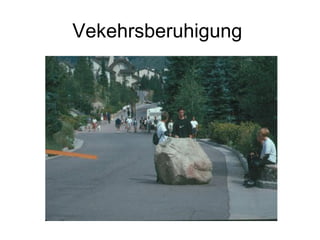
Vekehrsberuhigung
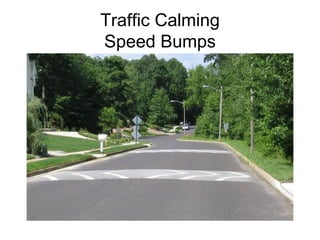
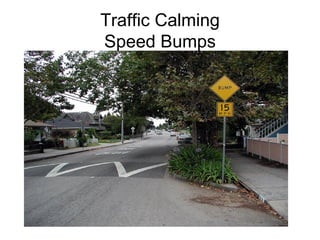
Traffic Calming Speed Bumps
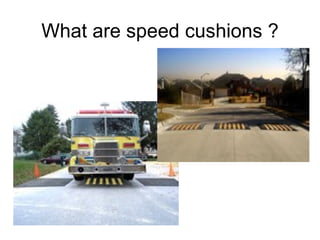
What are speed cushions ?                              
How do I have speed cushions installed on my street? 85 th  Percentile Speed must exceed 35 miles per hour. If the speeds of all motorists are ranked  from slowest to fastest, the "85th percentile  speed" separates the slower 85% from the  fastest 15%.  Must be included in a Neighborhood Traffic Management Plan (NTMP).  The  City does not install speed cushions on individual streets if a traffic speed or  volume problem is diverted to another street Traffic Plan must be approved by neighborhood, 25% of ballots must be returned  66% must be in favor of plan.  Resident volunteers must distribute and collect the ballots.
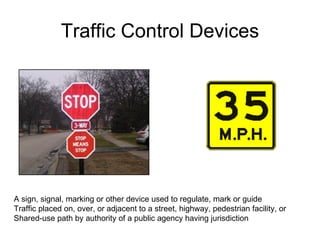
Traffic Control Devices A sign, signal, marking or other device used to regulate, mark or guide Traffic placed on, over, or adjacent to a street, highway, pedestrian facility, or  Shared-use path by authority of a public agency having jurisdiction                            
Stop Sign Warrants Because the STOP sign causes a substantial inconvenience to motorists, it should be used only where warranted.  A STOP sign may be warranted at an intersection where one or more of the following conditions exist:  Intersection of a less important road with a main road where application of the normal right-of-way rule is unduly hazardous.  2.  Street entering a through highway or street.  3. Unsignalized intersection in a signalized area.  4. Other intersections where a combination of high speed, restricted view, and serious accident record indicates a need for control by the STOP sign.  *2 Way to All Way Stop requires petition of residents. (600’ in both directions, of uncontrolled street.  Approach traffic must be distributed 60% and 40%.
Can we lower the speed limit in our neighborhood?  30 mph, unless reduced by local ordinance City Council may reduce the speed limit to 25 mph, in accordance with Transportation Code, Section 545.356  Street must be 35 feet or less in width Vehicular parking must not be prohibited.  Determination by local governing body that existing speed limit is unreasonable or unsafe. Must be posted at reduced speed
Traffic Calming in CFW Background - 1998 Speed Hump Program initiated.  - Original process required support of 2/3 of   respondents to petition, limited to residents  located on street where speed humps    were planned.  -  85 th  percentile speed had to exceed 33 mph.  -  2004 Administrative process to install    speed humps amended.
Traffic Calming in CFW 2004 Neighborhood Traffic Management Program (NTMP) process approved by City Council.   -  NTMP Process requires: Neighborhood 95% built-out Formation of Traffic Committee Coordinate with neighborhood associations 85 percentile traffic speed must be 35mph Development of Traffic Management Plan
Neighborhood Traffic Plans Existing Process -Developing the Traffic plan. T&PW & Neighborhood Traffic Committee hold meeting. Neighborhood workshop to develop plan. T&PW & Neighborhood Traffic Committee meet to review plan.  T&PW circulates preliminary plan to Fire and Police Department for review.  T&PW prepares ballot, distributed and collected by residents/volunteers. 25% of ballots must be returned and 66% must agree with the Plan  City Engineer gives final approval.
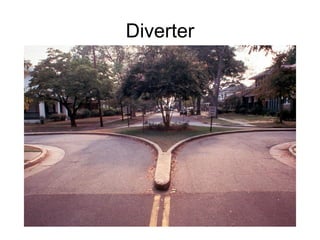
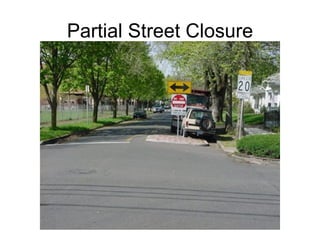
How does traffic calming work? vertical deflections horizontal shifts roadway narrowings   Are intended to reduce speed and enhance the street environment for non-motorists.  Closures  (diagonal diverters, half closures, full closures, and median barriers)  Are intended to reduce cut-through traffic by obstructing traffic movements in one or more directions
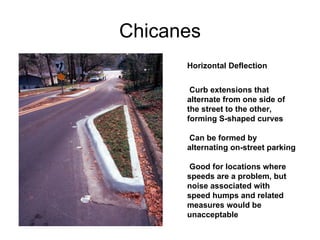
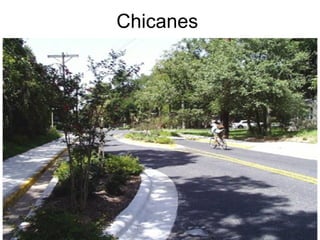
Chicanes Horizontal Deflection   Curb extensions that alternate from one side of the street to the other, forming S-shaped curves Can be formed by alternating on-street parking Good for locations where speeds are a problem, but noise associated with speed humps and related measures would be unacceptable
Chicanes
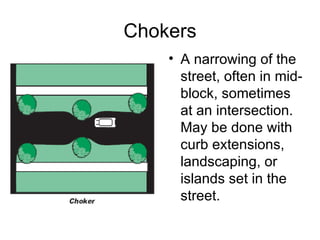
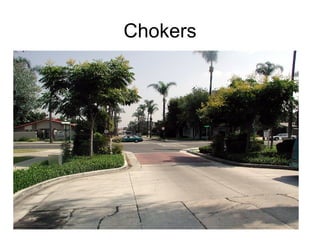
Chokers A narrowing of the street, often in mid-block, sometimes at an intersection. May be done with curb extensions, landscaping, or islands set in the street.
Chokers
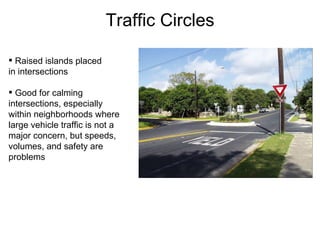
Traffic Circles Raised islands placed in intersections Good for calming intersections, especially within neighborhoods where large vehicle traffic is not a major concern, but speeds, volumes, and safety are problems
Diverter
Diverter
Partial Street Closure
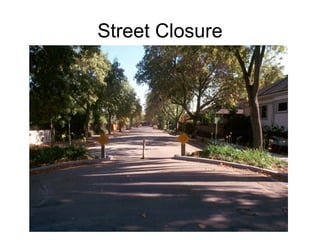
Street Closure
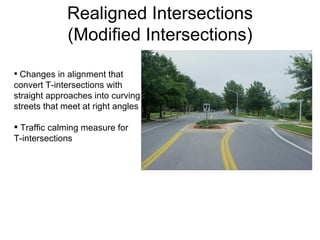
Realigned Intersections (Modified Intersections) Changes in alignment that convert T-intersections with straight approaches into curving streets that meet at right angles Traffic calming measure for T-intersections
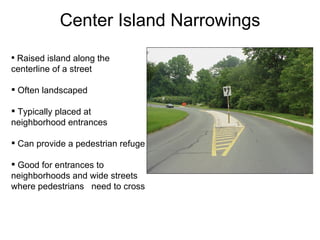
Center Island Narrowings Raised island along the centerline of a street Often landscaped Typically placed at neighborhood entrances Can provide a pedestrian refuge Good for entrances to  neighborhoods and wide streets where pedestrians  need to cross
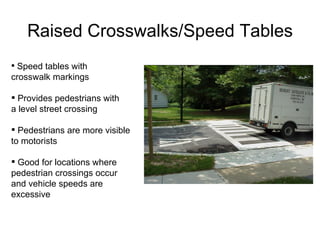
Raised Crosswalks/Speed Tables Speed tables with crosswalk markings Provides pedestrians with a level street crossing Pedestrians are more visible to motorists Good for locations where pedestrian crossings occur and vehicle speeds are excessive
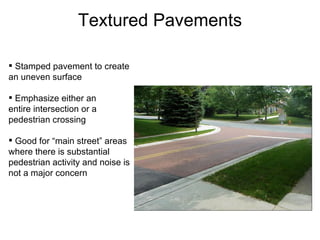
Textured Pavements Stamped pavement to create an uneven surface Emphasize either an entire intersection or a pedestrian crossing Good for “main street” areas where there is substantial pedestrian activity and noise is not a major concern
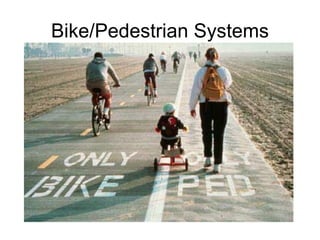
Bike/Pedestrian Systems
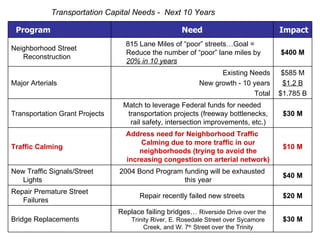
Transportation Capital Needs -  Next 10 Years $30 M Replace failing bridges…  Riverside Drive over the Trinity River, E. Rosedale Street over Sycamore Creek, and W. 7 th  Street over the Trinity Bridge Replacements $10 M Address need for Neighborhood Traffic Calming due to more traffic in our neighborhoods (trying to avoid the increasing congestion on arterial network) Traffic Calming $585 M $1.2 B $1.785 B Existing Needs New growth - 10 years Total Major Arterials $20 M Repair recently failed new streets Repair Premature Street Failures $40 M 2004 Bond Program funding will be exhausted this year New Traffic Signals/Street Lights $30 M Match to leverage Federal funds for needed transportation projects (freeway bottlenecks, rail safety, intersection improvements, etc.) Transportation Grant Projects  $400 M 815 Lane Miles of “poor” streets…Goal = Reduce the number of “poor” lane miles by  20% in 10 years Neighborhood Street Reconstruction Need Impact Program
Traffic Calming  Any questions? Rick Vasquez, NTMP Manager  817-3926151or rick.m.vasquez@fortworthgov.org

Traffic Calming In Fort Worth

  • 1.
    T&PW Traffic Engineering Division Neighborhood Traffic Management Program
  • 2.
  • 3.
  • 4.
  • 5.
    What are speedcushions ?                              
  • 6.
    How do Ihave speed cushions installed on my street? 85 th Percentile Speed must exceed 35 miles per hour. If the speeds of all motorists are ranked from slowest to fastest, the "85th percentile speed" separates the slower 85% from the fastest 15%. Must be included in a Neighborhood Traffic Management Plan (NTMP). The City does not install speed cushions on individual streets if a traffic speed or volume problem is diverted to another street Traffic Plan must be approved by neighborhood, 25% of ballots must be returned 66% must be in favor of plan. Resident volunteers must distribute and collect the ballots.
  • 7.
    Traffic Control DevicesA sign, signal, marking or other device used to regulate, mark or guide Traffic placed on, over, or adjacent to a street, highway, pedestrian facility, or Shared-use path by authority of a public agency having jurisdiction                            
  • 8.
    Stop Sign WarrantsBecause the STOP sign causes a substantial inconvenience to motorists, it should be used only where warranted. A STOP sign may be warranted at an intersection where one or more of the following conditions exist: Intersection of a less important road with a main road where application of the normal right-of-way rule is unduly hazardous. 2. Street entering a through highway or street. 3. Unsignalized intersection in a signalized area. 4. Other intersections where a combination of high speed, restricted view, and serious accident record indicates a need for control by the STOP sign. *2 Way to All Way Stop requires petition of residents. (600’ in both directions, of uncontrolled street. Approach traffic must be distributed 60% and 40%.
  • 9.
    Can we lowerthe speed limit in our neighborhood? 30 mph, unless reduced by local ordinance City Council may reduce the speed limit to 25 mph, in accordance with Transportation Code, Section 545.356 Street must be 35 feet or less in width Vehicular parking must not be prohibited. Determination by local governing body that existing speed limit is unreasonable or unsafe. Must be posted at reduced speed
  • 10.
    Traffic Calming inCFW Background - 1998 Speed Hump Program initiated. - Original process required support of 2/3 of respondents to petition, limited to residents located on street where speed humps were planned. - 85 th percentile speed had to exceed 33 mph. - 2004 Administrative process to install speed humps amended.
  • 11.
    Traffic Calming inCFW 2004 Neighborhood Traffic Management Program (NTMP) process approved by City Council. - NTMP Process requires: Neighborhood 95% built-out Formation of Traffic Committee Coordinate with neighborhood associations 85 percentile traffic speed must be 35mph Development of Traffic Management Plan
  • 12.
    Neighborhood Traffic PlansExisting Process -Developing the Traffic plan. T&PW & Neighborhood Traffic Committee hold meeting. Neighborhood workshop to develop plan. T&PW & Neighborhood Traffic Committee meet to review plan. T&PW circulates preliminary plan to Fire and Police Department for review. T&PW prepares ballot, distributed and collected by residents/volunteers. 25% of ballots must be returned and 66% must agree with the Plan City Engineer gives final approval.
  • 13.
    How does trafficcalming work? vertical deflections horizontal shifts roadway narrowings Are intended to reduce speed and enhance the street environment for non-motorists. Closures (diagonal diverters, half closures, full closures, and median barriers) Are intended to reduce cut-through traffic by obstructing traffic movements in one or more directions
  • 14.
    Chicanes Horizontal Deflection Curb extensions that alternate from one side of the street to the other, forming S-shaped curves Can be formed by alternating on-street parking Good for locations where speeds are a problem, but noise associated with speed humps and related measures would be unacceptable
  • 15.
  • 16.
    Chokers A narrowingof the street, often in mid-block, sometimes at an intersection. May be done with curb extensions, landscaping, or islands set in the street.
  • 17.
  • 18.
    Traffic Circles Raisedislands placed in intersections Good for calming intersections, especially within neighborhoods where large vehicle traffic is not a major concern, but speeds, volumes, and safety are problems
  • 19.
  • 20.
  • 21.
  • 22.
  • 23.
    Realigned Intersections (ModifiedIntersections) Changes in alignment that convert T-intersections with straight approaches into curving streets that meet at right angles Traffic calming measure for T-intersections
  • 24.
    Center Island NarrowingsRaised island along the centerline of a street Often landscaped Typically placed at neighborhood entrances Can provide a pedestrian refuge Good for entrances to neighborhoods and wide streets where pedestrians need to cross
  • 25.
    Raised Crosswalks/Speed TablesSpeed tables with crosswalk markings Provides pedestrians with a level street crossing Pedestrians are more visible to motorists Good for locations where pedestrian crossings occur and vehicle speeds are excessive
  • 26.
    Textured Pavements Stampedpavement to create an uneven surface Emphasize either an entire intersection or a pedestrian crossing Good for “main street” areas where there is substantial pedestrian activity and noise is not a major concern
  • 27.
  • 28.
    Transportation Capital Needs- Next 10 Years $30 M Replace failing bridges… Riverside Drive over the Trinity River, E. Rosedale Street over Sycamore Creek, and W. 7 th Street over the Trinity Bridge Replacements $10 M Address need for Neighborhood Traffic Calming due to more traffic in our neighborhoods (trying to avoid the increasing congestion on arterial network) Traffic Calming $585 M $1.2 B $1.785 B Existing Needs New growth - 10 years Total Major Arterials $20 M Repair recently failed new streets Repair Premature Street Failures $40 M 2004 Bond Program funding will be exhausted this year New Traffic Signals/Street Lights $30 M Match to leverage Federal funds for needed transportation projects (freeway bottlenecks, rail safety, intersection improvements, etc.) Transportation Grant Projects $400 M 815 Lane Miles of “poor” streets…Goal = Reduce the number of “poor” lane miles by 20% in 10 years Neighborhood Street Reconstruction Need Impact Program
  • 29.
    Traffic Calming Any questions? Rick Vasquez, NTMP Manager 817-3926151or rick.m.vasquez@fortworthgov.org