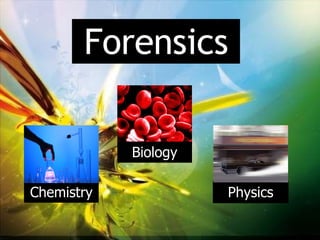
Chemistry Forensics Physics Biology
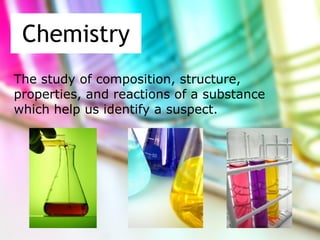
Chemistry The study of composition, structure, properties, and reactions of a substance which help us identify a suspect.
Table of Contents 2- Biology 2.1: Forensic Autopsies 2.2: Blood Testing 2.3: Biological Fingerprinting 1- Chemistry 1.1: Chemiluminescent Substrates 1.2: Latent Print Identification 1.3: Scanning Kelvin Probes 3- Physics 3.1: Ballistic Fingerprinting 3.2: Ballistic Microstamping 3.3: Firearm Identification
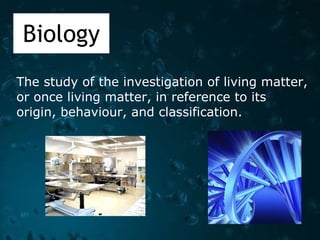
Biology The study of the investigation of living matter, or once living matter, in reference to its origin, behaviour, and classification.
Table of Contents 2- Biology 2.1: Forensic Autopsies 2.2: Blood Testing 2.3: Biological Fingerprinting 1- Chemistry 1.1: Chemiluminescent Substrates 1.2: Latent Print Identification 1.3: Scanning Kelvin Probes 3- Physics 3.1: Ballistic Fingerprinting 3.2: Ballistic Microstamping 3.3: Firearm Identification
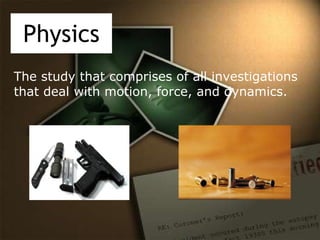
Physics The study that comprises of all investigations that deal with motion, force, and dynamics.
Table of Contents 2- Biology 2.1: Forensic Autopsies 2.2: Blood Testing 2.3: Biological Fingerprinting 1- Chemistry 1.1: Chemiluminescent Substrates 1.2: Latent Print Identification 3.2: Scanning Kelvin Probes 3- Physics 3.1: Ballistic Fingerprinting 3.2: Ballistic Microstamping 3.3: Firearm Identification
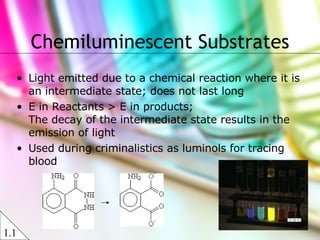
Chemiluminescent Substrates Light emitted due to a chemical reaction where it is an intermediate state; does not last long E in Reactants > E in products; The decay of the intermediate state results in the emission of light  Used during criminalistics as luminols for tracing blood 1.1
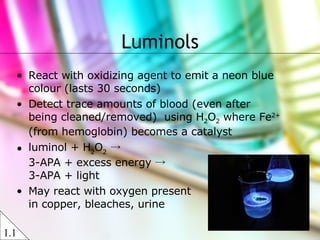
Luminols React with oxidizing agent to emit a neon blue colour (lasts 30 seconds) Detect trace amounts of blood (even after being cleaned/removed)  using H 2 O 2  where Fe 2+  (from hemoglobin) becomes a catalyst luminol + H 2 O 2  ->  3-APA + excess energy ->  3-APA + light  May react with oxygen present in copper, bleaches, urine 1.1
Latent fingerprints occur when natural secretions of the skin are deposited on a surface through contact; not readily visible Chemical reactions (reagents) are used to reveal hidden chemicals in fingerprints and increase visual contrast Iodine, like all halogens, is a good oxidizing agent. Oils from skin, which allow the fingerprint to be created in the first place, are the victims of oxidation Solid iodine sublimates (solid -> gas)when exposed to room temperature AgNO 3(aq)  + NaCl (aq)  ->  NaNO 3(aq)  + AgCl (s) Latent Print Identification 1.2
Latent Print Identification 1.2
Benazir Bhutto Medical report released with an open letter on inconclusiveness The amount of blood in the area prevented the FBI from a thorough crime scene investigation Law enforcement agencies cited Islamist Web sites as saying al-Qaida had claimed responsibility through an unauthorized official
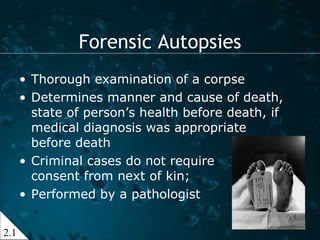
Forensic Autopsies Thorough examination of a corpse Determines manner and cause of death, state of person’s health before death, if medical diagnosis was appropriate before death Criminal cases do not require consent from next of kin;  Performed by a pathologist 2.1
View & Grant Procedure: Body photographed; samples of hair, nails taken; body searched using UV light or radiographic image; wounds examined; general description recorded Internal: Incisions are made down the chest, extended to navel; shears are used to open cavity; organs & major blood vessels are removed and examined and weighed Limbs and face not usually examined internally Body is reconstituted by sewing after being lined with cotton wool-like material Forensic Autopsies (Procedure) 2.1
Blood Testing Analysis of sample of blood extracted from crime scene Determine composition, organ function, and other biochemical and physiological properties Physical analyses include metabolic measures of chemicals usually present in blood Cellular analyses include blood typing, blood count, hematocrit, and DNA testing Reveal connection to victim, or crime scene May reveal cause/manner of death of victim depending on case 2.2
Blood Testing 2.2
Fingerprinting 2.3 Fingerprints are either patent or latent where the ridges of a fingertip are impressed on a surface Patent fingerprints are easily revealed; latent ones are harder to pinpoint Iodine can only be used for fresh fingerprints Other substances are not as effective, such as silver nitrate (AgNO 3 ) Scanning Kelvin Probes is a new technology that is non-contact; allows for the retention of all material; they are not currently is use
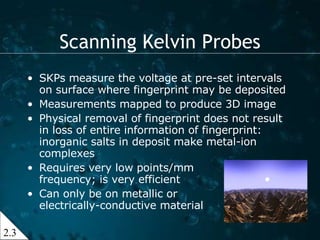
SKPs measure the voltage at pre-set intervals on surface where fingerprint may be deposited  Measurements mapped to produce 3D image Physical removal of fingerprint does not result in loss of entire information of fingerprint: inorganic salts in deposit make metal-ion complexes Requires very low points/mm frequency; is very efficient Can only be on metallic or  electrically-conductive material Scanning Kelvin Probes 2.3
Benazir Bhutto doctors had tried for 35 minutes to resuscitate Ms. Bhutto Dr. Mohamed Mussadik said she was clinically dead on arrival Apparently, no autopsy was done, because the “police chief prevented it” a medico-legal report based on a mandatory post-mortem examination is a must in a murder case The cause of death was reported as “Open head injury with depressed skull fracture”
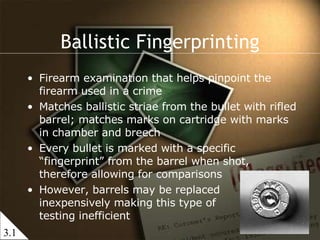
Ballistic Fingerprinting Firearm examination that helps pinpoint the firearm used in a crime Matches ballistic striae from the bullet with rifled barrel; matches marks on cartridge with marks in chamber and breech Every bullet is marked with a specific “fingerprint” from the barrel when shot, therefore allowing for comparisons However, barrels may be replaced  inexpensively making this type of  testing inefficient 3.1
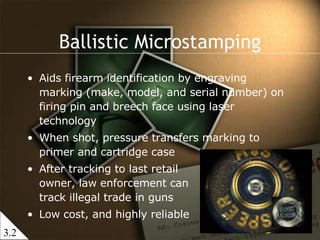
Aids firearm identification by engraving marking (make, model, and serial number) on firing pin and breech face using laser technology When shot, pressure transfers marking to primer and cartridge case After tracking to last retail  owner, law enforcement can track illegal trade in guns Low cost, and highly reliable Ballistic Microstamping 3.2
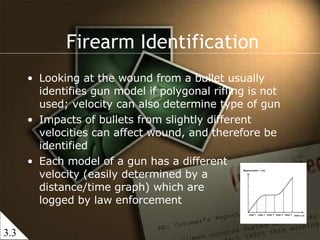
Looking at the wound from a bullet usually identifies gun model if polygonal rifling is not used; velocity can also determine type of gun Impacts of bullets from slightly different velocities can affect wound, and therefore be identified Each model of a gun has a different  velocity (easily determined by a  distance/time graph) which are  logged by law enforcement Firearm Identification 3.3
Firearm Identification 3.3
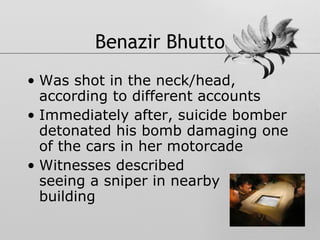
Benazir Bhutto Was shot in the neck/head, according to different accounts Immediately after, suicide bomber detonated his bomb damaging one of the cars in her motorcade Witnesses described  seeing a sniper in nearby  building
References NY Times: Bhutto Assassination Huffington Post: Bhutto Autopsy CSGV: Microstamping Foxnews: How Reliable is Ballistic Fingerprinting KelvinProveINFO: SKP Death Online: Autopsy Procedure
Forensics Chemistry Physics Biology

Chemistry

  • 1.
  • 2.
    Chemistry The studyof composition, structure, properties, and reactions of a substance which help us identify a suspect.
  • 3.
    Table of Contents2- Biology 2.1: Forensic Autopsies 2.2: Blood Testing 2.3: Biological Fingerprinting 1- Chemistry 1.1: Chemiluminescent Substrates 1.2: Latent Print Identification 1.3: Scanning Kelvin Probes 3- Physics 3.1: Ballistic Fingerprinting 3.2: Ballistic Microstamping 3.3: Firearm Identification
  • 4.
    Biology The studyof the investigation of living matter, or once living matter, in reference to its origin, behaviour, and classification.
  • 5.
    Table of Contents2- Biology 2.1: Forensic Autopsies 2.2: Blood Testing 2.3: Biological Fingerprinting 1- Chemistry 1.1: Chemiluminescent Substrates 1.2: Latent Print Identification 1.3: Scanning Kelvin Probes 3- Physics 3.1: Ballistic Fingerprinting 3.2: Ballistic Microstamping 3.3: Firearm Identification
  • 6.
    Physics The studythat comprises of all investigations that deal with motion, force, and dynamics.
  • 7.
    Table of Contents2- Biology 2.1: Forensic Autopsies 2.2: Blood Testing 2.3: Biological Fingerprinting 1- Chemistry 1.1: Chemiluminescent Substrates 1.2: Latent Print Identification 3.2: Scanning Kelvin Probes 3- Physics 3.1: Ballistic Fingerprinting 3.2: Ballistic Microstamping 3.3: Firearm Identification
  • 8.
    Chemiluminescent Substrates Lightemitted due to a chemical reaction where it is an intermediate state; does not last long E in Reactants > E in products; The decay of the intermediate state results in the emission of light Used during criminalistics as luminols for tracing blood 1.1
  • 9.
    Luminols React withoxidizing agent to emit a neon blue colour (lasts 30 seconds) Detect trace amounts of blood (even after being cleaned/removed) using H 2 O 2 where Fe 2+ (from hemoglobin) becomes a catalyst luminol + H 2 O 2 -> 3-APA + excess energy -> 3-APA + light May react with oxygen present in copper, bleaches, urine 1.1
  • 10.
    Latent fingerprints occurwhen natural secretions of the skin are deposited on a surface through contact; not readily visible Chemical reactions (reagents) are used to reveal hidden chemicals in fingerprints and increase visual contrast Iodine, like all halogens, is a good oxidizing agent. Oils from skin, which allow the fingerprint to be created in the first place, are the victims of oxidation Solid iodine sublimates (solid -> gas)when exposed to room temperature AgNO 3(aq) + NaCl (aq) -> NaNO 3(aq) + AgCl (s) Latent Print Identification 1.2
  • 11.
  • 12.
    Benazir Bhutto Medicalreport released with an open letter on inconclusiveness The amount of blood in the area prevented the FBI from a thorough crime scene investigation Law enforcement agencies cited Islamist Web sites as saying al-Qaida had claimed responsibility through an unauthorized official
  • 13.
    Forensic Autopsies Thoroughexamination of a corpse Determines manner and cause of death, state of person’s health before death, if medical diagnosis was appropriate before death Criminal cases do not require consent from next of kin; Performed by a pathologist 2.1
  • 14.
    View & GrantProcedure: Body photographed; samples of hair, nails taken; body searched using UV light or radiographic image; wounds examined; general description recorded Internal: Incisions are made down the chest, extended to navel; shears are used to open cavity; organs & major blood vessels are removed and examined and weighed Limbs and face not usually examined internally Body is reconstituted by sewing after being lined with cotton wool-like material Forensic Autopsies (Procedure) 2.1
  • 15.
    Blood Testing Analysisof sample of blood extracted from crime scene Determine composition, organ function, and other biochemical and physiological properties Physical analyses include metabolic measures of chemicals usually present in blood Cellular analyses include blood typing, blood count, hematocrit, and DNA testing Reveal connection to victim, or crime scene May reveal cause/manner of death of victim depending on case 2.2
  • 16.
  • 17.
    Fingerprinting 2.3 Fingerprintsare either patent or latent where the ridges of a fingertip are impressed on a surface Patent fingerprints are easily revealed; latent ones are harder to pinpoint Iodine can only be used for fresh fingerprints Other substances are not as effective, such as silver nitrate (AgNO 3 ) Scanning Kelvin Probes is a new technology that is non-contact; allows for the retention of all material; they are not currently is use
  • 18.
    SKPs measure thevoltage at pre-set intervals on surface where fingerprint may be deposited Measurements mapped to produce 3D image Physical removal of fingerprint does not result in loss of entire information of fingerprint: inorganic salts in deposit make metal-ion complexes Requires very low points/mm frequency; is very efficient Can only be on metallic or electrically-conductive material Scanning Kelvin Probes 2.3
  • 19.
    Benazir Bhutto doctorshad tried for 35 minutes to resuscitate Ms. Bhutto Dr. Mohamed Mussadik said she was clinically dead on arrival Apparently, no autopsy was done, because the “police chief prevented it” a medico-legal report based on a mandatory post-mortem examination is a must in a murder case The cause of death was reported as “Open head injury with depressed skull fracture”
  • 20.
    Ballistic Fingerprinting Firearmexamination that helps pinpoint the firearm used in a crime Matches ballistic striae from the bullet with rifled barrel; matches marks on cartridge with marks in chamber and breech Every bullet is marked with a specific “fingerprint” from the barrel when shot, therefore allowing for comparisons However, barrels may be replaced inexpensively making this type of testing inefficient 3.1
  • 21.
    Aids firearm identificationby engraving marking (make, model, and serial number) on firing pin and breech face using laser technology When shot, pressure transfers marking to primer and cartridge case After tracking to last retail owner, law enforcement can track illegal trade in guns Low cost, and highly reliable Ballistic Microstamping 3.2
  • 22.
    Looking at thewound from a bullet usually identifies gun model if polygonal rifling is not used; velocity can also determine type of gun Impacts of bullets from slightly different velocities can affect wound, and therefore be identified Each model of a gun has a different velocity (easily determined by a distance/time graph) which are logged by law enforcement Firearm Identification 3.3
  • 23.
  • 24.
    Benazir Bhutto Wasshot in the neck/head, according to different accounts Immediately after, suicide bomber detonated his bomb damaging one of the cars in her motorcade Witnesses described seeing a sniper in nearby building
  • 25.
    References NY Times:Bhutto Assassination Huffington Post: Bhutto Autopsy CSGV: Microstamping Foxnews: How Reliable is Ballistic Fingerprinting KelvinProveINFO: SKP Death Online: Autopsy Procedure
  • 26.