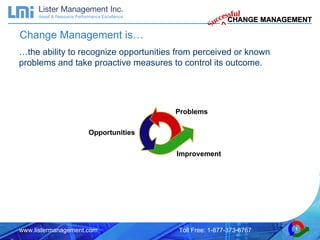
… the ability to recognize opportunities from perceived or known problems and take proactive measures to control its outcome. Change Management is… Problems Improvement Opportunities
Change is necessary to adapt, survive and improve. Adapt Improve Survive Why Change is Necessary…
… change is a result of a reactive need, necessity to adapt, or a proactive desire, all change can be managed to produce the desired performance outcome. Regardless of whether… The Desire to Change (wanting) The Need to Change (surviving) Must Adapt to Change (adapting)
Case for Change Vision Skills Incentives Resources Methodology Status Quo Results Vision Skills Incentives Resources Methodology Case for Change Confusion Skills Incentives Resources Methodology Case for Change Anxious Vision Incentives Resources Methodology Case for Change Moderate Change Vision Skills Resources Methodology Case for Change Frustration Vision Skills Incentives Methodology Case for Change Vision Skills Incentives Resources False Start Change Management
Performance and Change Management Change Management Model™ Design Identify PLANNING PHASE Establishment Methodology Roll-out Orientation and Training Continuous Improvement Control and Coaching DEVELOPMENT PHASE IMPLEMENTATION PHASE MANAGEMENT PHASE CHANGE MANAGEMENT PROCESS MODEL™
Performance and Change Management Business and Personal Performance Successful business and personal performance depends on how well you manage change A plan is required for personal change A strategic plan is required for business change Performance Management Change Management Project Management (Plan)
Performance and Change Management Establishing the Plan Performance Measures Responsibilities Checklists Vision Goal Mission Objectives and Strategies Task Responsibilities Performance Measures
Performance and Change Management Vision Dreams don’t come true, only visions do A vision is a picture in your mind where you want to be, what you want to have, what you desire in the future It can be for personal or business improvement A vision creates a focal point for one person, or a group of persons A vision is a guiding light A vision is a desire A vision keeps us moving in the right direction A vision has no defined time frame…for that you need a goal Vision Goal Mission Objectives and Strategies Task Responsibilities Performance Measures
Performance and Change Management Vision and Mission Strategies Goals Objectives Goals Objectives Change Duration Key Performance Targets for Continued Success VISION STATEMENT MISSION STATEMENT Actual Line of Compliance (Key Performance Indicators)
Performance and Change Management Goal A goal supports the vision by establishing a time frame A goal must be realistic and achievable A goal must be measurable A goal is a plateau that once obtained can be reset to a higher plateau You must support a goal with a mission  Vision Goal Mission Objectives and Strategies Task Responsibilities Performance Measures
Performance and Change Management Mission A mission is a promise to deliver A mission is personal or business A mission is measurable by performance reporting A mission is the transformation of performing a task, or series of tasks, for a specified and determined outcome A mission is about the passion and will-power of the individual or group of individuals to perform A mission is our promise to strive to achieve our vision and beyond Vision Goal Mission Objectives and Strategies Task Responsibilities Performance Measures
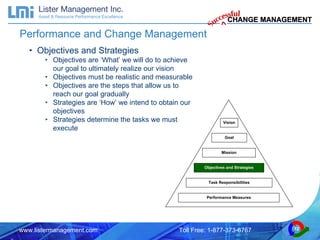
Performance and Change Management Objectives and Strategies Objectives are ‘What’ we will do to achieve our goal to ultimately realize our vision Objectives must be realistic and measurable Objectives are the steps that allow us to reach our goal gradually Strategies are ‘How’ we intend to obtain our objectives Strategies determine the tasks we must execute Vision Goal Mission Objectives and Strategies Task Responsibilities Performance Measures
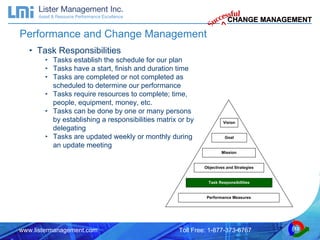
Performance and Change Management Task Responsibilities Tasks establish the schedule for our plan Tasks have a start, finish and duration time Tasks are completed or not completed as scheduled to determine our performance Tasks require resources to complete; time, people, equipment, money, etc. Tasks can be done by one or many persons by establishing a responsibilities matrix or by delegating Tasks are updated weekly or monthly during an update meeting Vision Goal Mission Objectives and Strategies Task Responsibilities Performance Measures
Performance and Change Management Task Responsibilities Output Input Task
Performance and Change Management Performance Measures Performance measures are the status of the tasks we execute Performance measures are used to track our progress and ultimately the status of our plan Performance measures are critical to the success in achieving our vision Performance measures are used to continually improve our performance Performance measures should be illustrated by visual charts and graphs Performance should be recognized for both compliance (achievement) and non-compliance Performance is measured to manage and control, not to punish or reward Performance is measured to determine if additional support is required Vision Goal Mission Objectives and Strategies Task Responsibilities Performance Measures
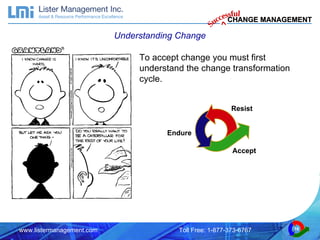
Understanding Change To accept change you must first understand the change transformation cycle. Resist Accept Endure
Understanding Change The Change Management Process is a route, which leads from a current position, to a desired position (Current Practice to Best Practice). The Change Management Process is supported by Project Management Techniques, followed by Performance Management Techniques (Continuous Improvement). Change Management Performance Management Project Management
Introduction Recognition Improvement Acceptance “ The symbol below represents a move away from the status quo. As you go about your daily routines remember this symbol for what it represents. Life will not permit you to circle in comfort forever, better  you  choose the direction you travel, than let life’s environment make the choice for you…for life’s environment may not always support your  desires.” E.J. Lister Successful Change Management
Change Management refers to the ability to control the outcome of a perceived problem, or known opportunity, to correct or improve the situation. Whether a reactive need, necessity to adapt, or a proactive desire, all change can be managed to produce the desired performance outcome. Problems Improvement Opportunities The Desire to Change (wanting) The Need to Change (surviving) Must Adapt to Change (adapting) Successful Change Management
Resist Accept Endure Successful Change Management
Design Identify PLANNING PHASE Establishment Methodology Roll-out Orientation and Training Continuous Improvement Control and Coaching DEVELOPMENT PHASE IMPLEMENATION PHASE MANAGEMENT PHASE CHANGE MANAGEMENT PROCESS MODEL™ Successful Change Management The Change Management Process Model
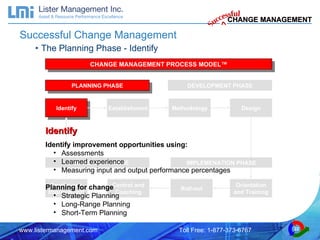
Design Identify PLANNING PHASE Establishment Methodology Roll-out Orientation and Training Continuous Improvement Control and Coaching DEVELOPMENT PHASE IMPLEMENATION PHASE MANAGEMENT PHASE CHANGE MANAGEMENT PROCESS MODEL™ Identify Identify improvement opportunities using: Assessments Learned experience Measuring input and output performance percentages Planning for change Strategic Planning Long-Range Planning Short-Term Planning Successful Change Management The Planning Phase - Identify
Design Identify PLANNING PHASE Establishment Methodology Roll-out Orientation and Training Continuous Improvement Control and Coaching DEVELOPMENT PHASE IMPLEMENATION PHASE MANAGEMENT PHASE CHANGE MANAGEMENT PROCESS MODEL™ Establishment Establish the Change Improvement Project Give the project a name Establish the Steering Committee Establish the Team Establish the Project Manager Establish the Goals and Objectives Establish the Roles and Responsibilities Successful Change Management The Planning Phase - Establishment
Design Identify PLANNING PHASE Establishment Methodology Roll-out Orientation and Training Continuous Improvement Control and Coaching DEVELOPMENT PHASE IMPLEMENATION PHASE MANAGEMENT PHASE CHANGE MANAGEMENT PROCESS MODEL™ The Development Phase - Methodology Methodology Define Goals / Objectives Strategies Assign Responsibility Control Project Management Techniques Project Management Software Successful Change Management The Development Phase - Methodology
Design Identify PLANNING PHASE Establishment Methodology Roll-out Orientation and Training Continuous Improvement Control and Coaching DEVELOPMENT PHASE IMPLEMENATION PHASE MANAGEMENT PHASE CHANGE MANAGEMENT PROCESS MODEL™ Design Workflows Detail Summary WFER’s (Workflow Event References) Guidelines Reference Manual Successful Change Management The Development Phase - Design
Design Identify PLANNING PHASE Establishment Methodology Roll-out Orientation and Training Continuous Improvement Control and Coaching DEVELOPMENT PHASE IMPLEMENATION PHASE MANAGEMENT PHASE CHANGE MANAGEMENT PROCESS MODEL™ The Implementation Phase – Orientation and Training Orientation and Training Orientation Orientation Plan Presentations Training Training Plan Courses Knowledge / Competency Matrix Successful Change Management The Implementation Phase – Orientation and Training
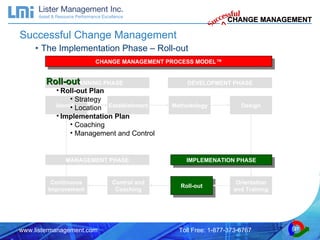
Design Identify PLANNING PHASE Establishment Methodology Roll-out Orientation and Training Continuous Improvement Control and Coaching DEVELOPMENT PHASE IMPLEMENATION PHASE MANAGEMENT PHASE CHANGE MANAGEMENT PROCESS MODEL™ Roll-out Roll-out Plan Strategy Location Implementation Plan Coaching Management and Control Successful Change Management The Implementation Phase – Roll-out
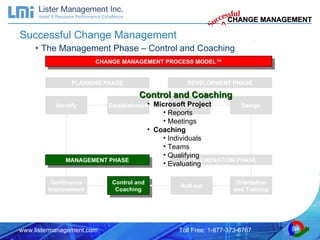
Design Identify PLANNING PHASE Establishment Methodology Roll-out Orientation and Training Continuous Improvement Control and Coaching DEVELOPMENT PHASE IMPLEMENATION PHASE MANAGEMENT PHASE CHANGE MANAGEMENT PROCESS MODEL™ Control and Coaching Microsoft Project Reports Meetings Coaching Individuals Teams Qualifying Evaluating The Management Phase – Control and Coaching Successful Change Management The Management Phase – Control and Coaching
Design Identify PLANNING PHASE Establishment Methodology Roll-out Orientation and Training Continuous Improvement Control and Coaching DEVELOPMENT PHASE IMPLEMENATION PHASE MANAGEMENT PHASE CHANGE MANAGEMENT PROCESS MODEL™ Continuous Improvement Continuous Improvement Plan Establish C/I Team Assessments / Audits Follow-up Assignments Measurements Distribution of Results Future Enhancements Future Changes Successful Change Management The Management Phase – Continuous Improvement
What to work on? Effort versus Impact Impact Effort High High Low Low
Talking Action Results Business Processes Workflow Activities Guidelines Procedures Schedules Measure Improve Getting Results

Change Management 2

  • 1.
    … the abilityto recognize opportunities from perceived or known problems and take proactive measures to control its outcome. Change Management is… Problems Improvement Opportunities
  • 2.
    Change is necessaryto adapt, survive and improve. Adapt Improve Survive Why Change is Necessary…
  • 3.
    … change isa result of a reactive need, necessity to adapt, or a proactive desire, all change can be managed to produce the desired performance outcome. Regardless of whether… The Desire to Change (wanting) The Need to Change (surviving) Must Adapt to Change (adapting)
  • 4.
    Case for ChangeVision Skills Incentives Resources Methodology Status Quo Results Vision Skills Incentives Resources Methodology Case for Change Confusion Skills Incentives Resources Methodology Case for Change Anxious Vision Incentives Resources Methodology Case for Change Moderate Change Vision Skills Resources Methodology Case for Change Frustration Vision Skills Incentives Methodology Case for Change Vision Skills Incentives Resources False Start Change Management
  • 5.
    Performance and ChangeManagement Change Management Model™ Design Identify PLANNING PHASE Establishment Methodology Roll-out Orientation and Training Continuous Improvement Control and Coaching DEVELOPMENT PHASE IMPLEMENTATION PHASE MANAGEMENT PHASE CHANGE MANAGEMENT PROCESS MODEL™
  • 6.
    Performance and ChangeManagement Business and Personal Performance Successful business and personal performance depends on how well you manage change A plan is required for personal change A strategic plan is required for business change Performance Management Change Management Project Management (Plan)
  • 7.
    Performance and ChangeManagement Establishing the Plan Performance Measures Responsibilities Checklists Vision Goal Mission Objectives and Strategies Task Responsibilities Performance Measures
  • 8.
    Performance and ChangeManagement Vision Dreams don’t come true, only visions do A vision is a picture in your mind where you want to be, what you want to have, what you desire in the future It can be for personal or business improvement A vision creates a focal point for one person, or a group of persons A vision is a guiding light A vision is a desire A vision keeps us moving in the right direction A vision has no defined time frame…for that you need a goal Vision Goal Mission Objectives and Strategies Task Responsibilities Performance Measures
  • 9.
    Performance and ChangeManagement Vision and Mission Strategies Goals Objectives Goals Objectives Change Duration Key Performance Targets for Continued Success VISION STATEMENT MISSION STATEMENT Actual Line of Compliance (Key Performance Indicators)
  • 10.
    Performance and ChangeManagement Goal A goal supports the vision by establishing a time frame A goal must be realistic and achievable A goal must be measurable A goal is a plateau that once obtained can be reset to a higher plateau You must support a goal with a mission Vision Goal Mission Objectives and Strategies Task Responsibilities Performance Measures
  • 11.
    Performance and ChangeManagement Mission A mission is a promise to deliver A mission is personal or business A mission is measurable by performance reporting A mission is the transformation of performing a task, or series of tasks, for a specified and determined outcome A mission is about the passion and will-power of the individual or group of individuals to perform A mission is our promise to strive to achieve our vision and beyond Vision Goal Mission Objectives and Strategies Task Responsibilities Performance Measures
  • 12.
    Performance and ChangeManagement Objectives and Strategies Objectives are ‘What’ we will do to achieve our goal to ultimately realize our vision Objectives must be realistic and measurable Objectives are the steps that allow us to reach our goal gradually Strategies are ‘How’ we intend to obtain our objectives Strategies determine the tasks we must execute Vision Goal Mission Objectives and Strategies Task Responsibilities Performance Measures
  • 13.
    Performance and ChangeManagement Task Responsibilities Tasks establish the schedule for our plan Tasks have a start, finish and duration time Tasks are completed or not completed as scheduled to determine our performance Tasks require resources to complete; time, people, equipment, money, etc. Tasks can be done by one or many persons by establishing a responsibilities matrix or by delegating Tasks are updated weekly or monthly during an update meeting Vision Goal Mission Objectives and Strategies Task Responsibilities Performance Measures
  • 14.
    Performance and ChangeManagement Task Responsibilities Output Input Task
  • 15.
    Performance and ChangeManagement Performance Measures Performance measures are the status of the tasks we execute Performance measures are used to track our progress and ultimately the status of our plan Performance measures are critical to the success in achieving our vision Performance measures are used to continually improve our performance Performance measures should be illustrated by visual charts and graphs Performance should be recognized for both compliance (achievement) and non-compliance Performance is measured to manage and control, not to punish or reward Performance is measured to determine if additional support is required Vision Goal Mission Objectives and Strategies Task Responsibilities Performance Measures
  • 16.
    Understanding Change Toaccept change you must first understand the change transformation cycle. Resist Accept Endure
  • 17.
    Understanding Change TheChange Management Process is a route, which leads from a current position, to a desired position (Current Practice to Best Practice). The Change Management Process is supported by Project Management Techniques, followed by Performance Management Techniques (Continuous Improvement). Change Management Performance Management Project Management
  • 18.
    Introduction Recognition ImprovementAcceptance “ The symbol below represents a move away from the status quo. As you go about your daily routines remember this symbol for what it represents. Life will not permit you to circle in comfort forever, better you choose the direction you travel, than let life’s environment make the choice for you…for life’s environment may not always support your desires.” E.J. Lister Successful Change Management
  • 19.
    Change Management refersto the ability to control the outcome of a perceived problem, or known opportunity, to correct or improve the situation. Whether a reactive need, necessity to adapt, or a proactive desire, all change can be managed to produce the desired performance outcome. Problems Improvement Opportunities The Desire to Change (wanting) The Need to Change (surviving) Must Adapt to Change (adapting) Successful Change Management
  • 20.
    Resist Accept EndureSuccessful Change Management
  • 21.
    Design Identify PLANNINGPHASE Establishment Methodology Roll-out Orientation and Training Continuous Improvement Control and Coaching DEVELOPMENT PHASE IMPLEMENATION PHASE MANAGEMENT PHASE CHANGE MANAGEMENT PROCESS MODEL™ Successful Change Management The Change Management Process Model
  • 22.
    Design Identify PLANNINGPHASE Establishment Methodology Roll-out Orientation and Training Continuous Improvement Control and Coaching DEVELOPMENT PHASE IMPLEMENATION PHASE MANAGEMENT PHASE CHANGE MANAGEMENT PROCESS MODEL™ Identify Identify improvement opportunities using: Assessments Learned experience Measuring input and output performance percentages Planning for change Strategic Planning Long-Range Planning Short-Term Planning Successful Change Management The Planning Phase - Identify
  • 23.
    Design Identify PLANNINGPHASE Establishment Methodology Roll-out Orientation and Training Continuous Improvement Control and Coaching DEVELOPMENT PHASE IMPLEMENATION PHASE MANAGEMENT PHASE CHANGE MANAGEMENT PROCESS MODEL™ Establishment Establish the Change Improvement Project Give the project a name Establish the Steering Committee Establish the Team Establish the Project Manager Establish the Goals and Objectives Establish the Roles and Responsibilities Successful Change Management The Planning Phase - Establishment
  • 24.
    Design Identify PLANNINGPHASE Establishment Methodology Roll-out Orientation and Training Continuous Improvement Control and Coaching DEVELOPMENT PHASE IMPLEMENATION PHASE MANAGEMENT PHASE CHANGE MANAGEMENT PROCESS MODEL™ The Development Phase - Methodology Methodology Define Goals / Objectives Strategies Assign Responsibility Control Project Management Techniques Project Management Software Successful Change Management The Development Phase - Methodology
  • 25.
    Design Identify PLANNINGPHASE Establishment Methodology Roll-out Orientation and Training Continuous Improvement Control and Coaching DEVELOPMENT PHASE IMPLEMENATION PHASE MANAGEMENT PHASE CHANGE MANAGEMENT PROCESS MODEL™ Design Workflows Detail Summary WFER’s (Workflow Event References) Guidelines Reference Manual Successful Change Management The Development Phase - Design
  • 26.
    Design Identify PLANNINGPHASE Establishment Methodology Roll-out Orientation and Training Continuous Improvement Control and Coaching DEVELOPMENT PHASE IMPLEMENATION PHASE MANAGEMENT PHASE CHANGE MANAGEMENT PROCESS MODEL™ The Implementation Phase – Orientation and Training Orientation and Training Orientation Orientation Plan Presentations Training Training Plan Courses Knowledge / Competency Matrix Successful Change Management The Implementation Phase – Orientation and Training
  • 27.
    Design Identify PLANNINGPHASE Establishment Methodology Roll-out Orientation and Training Continuous Improvement Control and Coaching DEVELOPMENT PHASE IMPLEMENATION PHASE MANAGEMENT PHASE CHANGE MANAGEMENT PROCESS MODEL™ Roll-out Roll-out Plan Strategy Location Implementation Plan Coaching Management and Control Successful Change Management The Implementation Phase – Roll-out
  • 28.
    Design Identify PLANNINGPHASE Establishment Methodology Roll-out Orientation and Training Continuous Improvement Control and Coaching DEVELOPMENT PHASE IMPLEMENATION PHASE MANAGEMENT PHASE CHANGE MANAGEMENT PROCESS MODEL™ Control and Coaching Microsoft Project Reports Meetings Coaching Individuals Teams Qualifying Evaluating The Management Phase – Control and Coaching Successful Change Management The Management Phase – Control and Coaching
  • 29.
    Design Identify PLANNINGPHASE Establishment Methodology Roll-out Orientation and Training Continuous Improvement Control and Coaching DEVELOPMENT PHASE IMPLEMENATION PHASE MANAGEMENT PHASE CHANGE MANAGEMENT PROCESS MODEL™ Continuous Improvement Continuous Improvement Plan Establish C/I Team Assessments / Audits Follow-up Assignments Measurements Distribution of Results Future Enhancements Future Changes Successful Change Management The Management Phase – Continuous Improvement
  • 30.
    What to workon? Effort versus Impact Impact Effort High High Low Low
  • 31.
    Talking Action ResultsBusiness Processes Workflow Activities Guidelines Procedures Schedules Measure Improve Getting Results

Editor's Notes

  • #2 __________________________________________________________________________________
  • #4 __________________________________________________________________________________
  • #17 Type text here
  • #18 Type text here