PERFORMANCE
APPRAISALS
Performers Appraisal Learning Objectives
• Explain Purposes of Performance
Management
• Identify Success Factors in Good Programs
• Identify Sources of Information for
Evaluation
• Explain Key Methods used in Managing
Performance
• Outline the Manager/Sub-Ordinate Interview
Purpose of Performance Appraisal Systems
• Goal: Maintain Organizational Productivity
• Results:
Organization Productivity Individual Performance
• Methods: Individual Performance Goals
Objectives
• Opportunity to Regularly Discuss
Results
• Supervisor Identifies Strengths and
Weaknesses
• Fair and Equitable Format
• Basis for Salary/Promotion
Recommendations
Main Purposes of Performance Management
• Individual Rewards (Base and Incentive)
• Feedback for Sub-Ordinate (Plus and Minus)
• Recognition of Superior Performance
• Documentation of Weak Performance
• Personnel Decision-Making
• Future Goal Commitments (Planned
Achievements)
Reasons for Appraisals
• Compensation "Pay for Performance"
• Job Performance Improvements
• Feedback to Subordinates
• Documentation for Decisions
• Goal Setting - Later Evaluation
• Promotion Decisions
• Identify Training Needs
• HR Planning
Primary Uses of Performance Appraisals
Small
Organizations
Large
Organizations
All
Organizations
Compensation 80.2% 66.7% 74.9%
Performance
improvement 46.3% 53.3% 48.4%
Feedback 40.3% 40.6% 40.4%
Documentation 29.0% 32.2% 30.2%
Promotion 26.1% 22.8% 24.8%
Training 5.1% 9.4% 7.3%
Transfer 8.1% 6.1% 7.3%
Discharge 4.9% 6.7% 5.6%
Layoff 2.1% 2.8% 2.4%
Personnel research 1.8% 2.8% 2.2%
Manpower planning 0.7% 2.8% 1.5%
Trends in Managing Performance
Superior Performance leads to Superior Rewards
Issue: How to objectively measure specific goals!
Appraising/Evaluating
Managing Performance
VERSUS
Who Performs the Appraisal?
• Immediate Supervisor
• Higher Management
• Self-Appraisals
• Peers (Co-Workers)
• Evaluation Teams
• Customers
• “360° Appraisals”
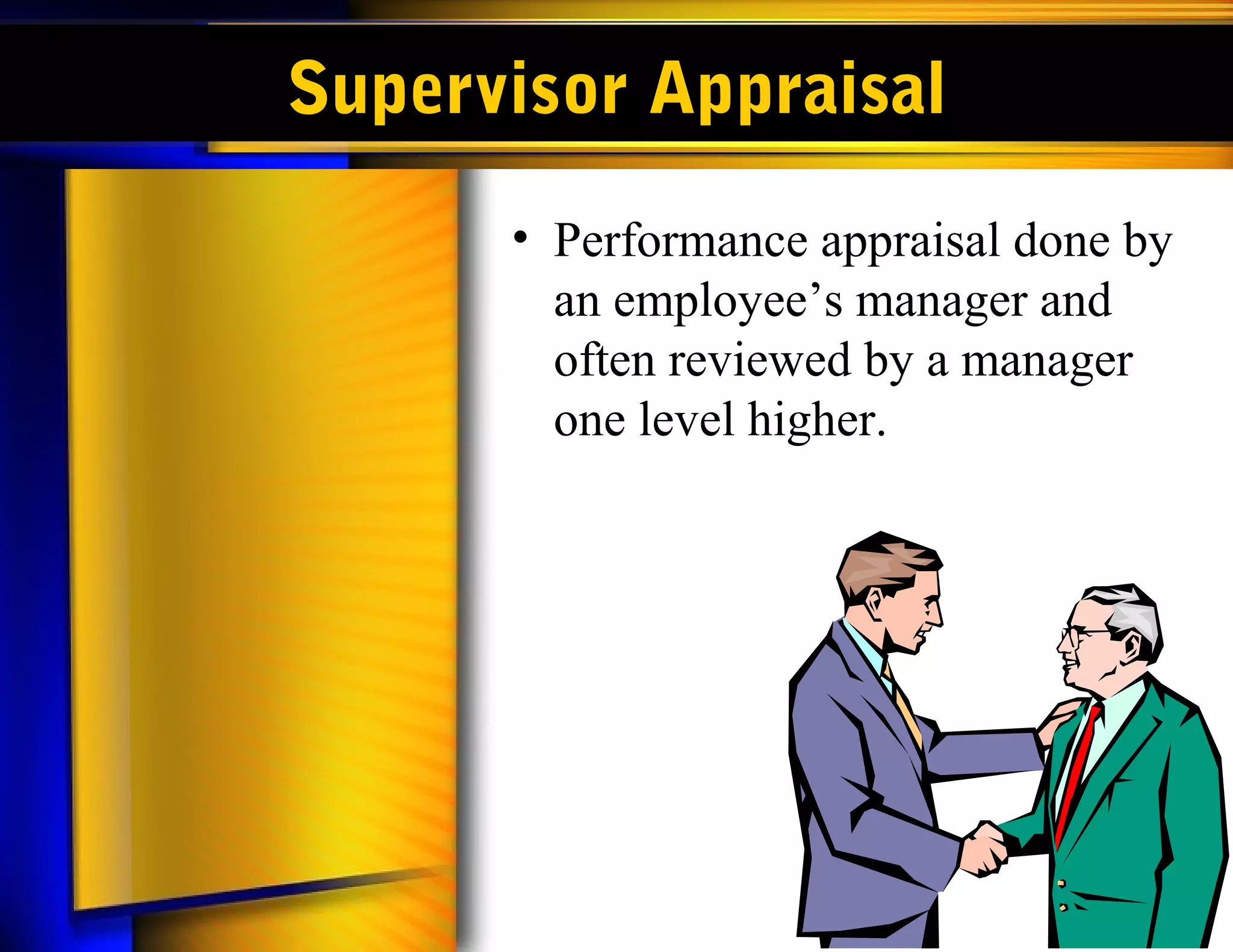
Supervisor Appraisal
• Performance appraisal done by
an employee’s manager and
often reviewed by a manager
one level higher.
Self-Appraisal
• Performance appraisal done by the
employee being evaluated, generally
on an appraisal form completed by
the employee prior to the
performance review.
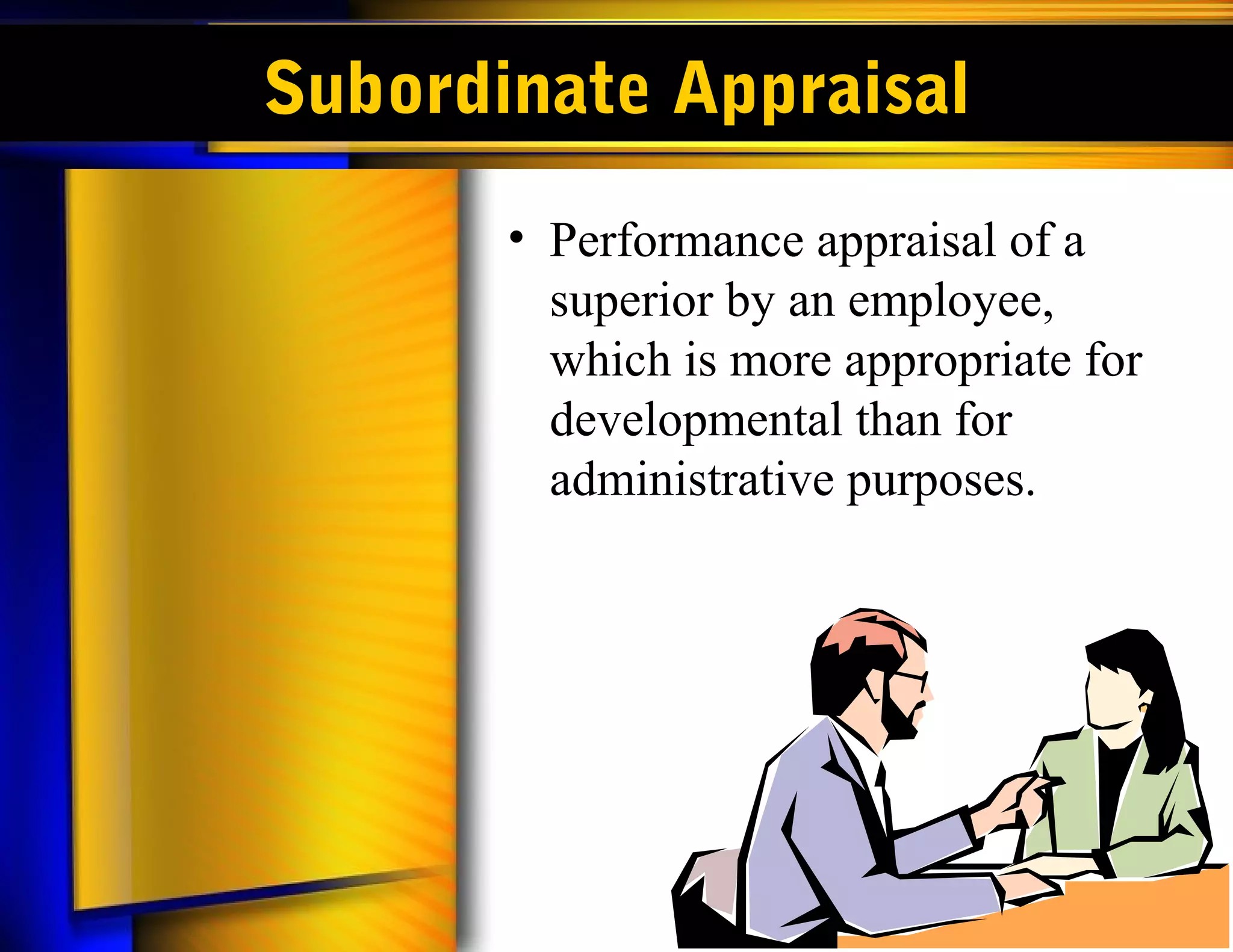
Subordinate Appraisal
• Performance appraisal of a
superior by an employee,
which is more appropriate for
developmental than for
administrative purposes.
Peer Appraisal
• Performance appraisal done by one’s
fellow employees, generally on forms
that are complied into a single profile
for use in the performance interview
conducted by the employee’s manager.
Team Appraisal
• Performance appraisal, based
on TQM concepts, that
recognizes team
accomplishment rather than
individual performance.
The 360º Appraisal Interview
Individual
Staff
Self-Assessment
Supervisor
Other Superiors
Peers
Teams
Sub-Ordinates
Teams
Customers
Other Superiors
Performance Appraisal Problems
• Popularity Contest
• Punitive Implications
• Control Relinquishment
• Stereotypes
• Poor Training of Raters
Peer Appraisal Concerns
• Disadvantages?
• Advantages?
Rating Errors Issues
• Carefully Developed Behavior
Descriptions Fair
• Evaluation Scales
• Factor Relatedness to the Job
Types of Rating Errors
• Leniency/Strictness Error
• Define Anchors (Dimensions)
• Force A Curve
• Central Tendency
• Reluctant to Give High/Low
• Explain Need for Variability
• Recency Error
• Last Action Halo
• Encourage Frequent Evaluation
Error of Central Tendency
• Performance-rating error in
which all employees are rated
about average.
Leniency or Strictness Error
• Performance-rating error in which
the appraiser tends to give employees
either unusually high or unusually
low ratings.
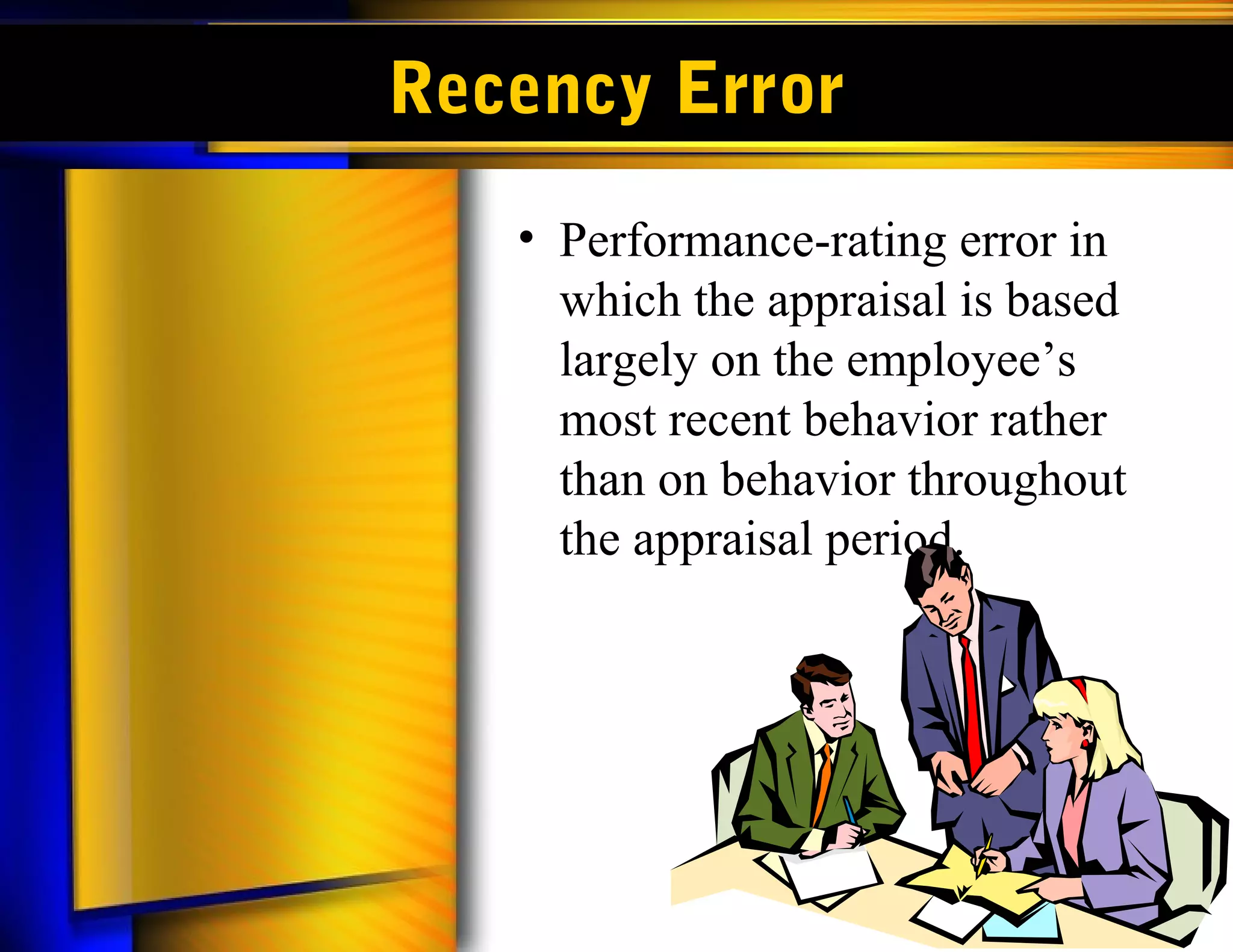
Recency Error
• Performance-rating error in
which the appraisal is based
largely on the employee’s
most recent behavior rather
than on behavior throughout
the appraisal period.
Rating Errors Example
Halo
Job Rating Scale
EXCELLENT
on all factors
Leniency
Job Rating Scale
Employee A
EXCELLENT
Job Rating Scale
Employee B
EXCELLENT
Job Rating Scale
Employee C
SUPERIOR
Job Rating Scale
Employee D
EXCELLENT
Central
Tendency
Job Rating Scale
Employee A
AVERAGE
Job Rating Scale
Employee B
AVERAGE
Job Rating Scale
Employee C
AVERAGE
Job Rating Scale
Employee D
AVERAGE
Recency
Bias
Job rating scale behavior during the
last month has been POOR.
Similar-To-Me Error
• Performance-rating error in
which an appraiser inflates the
evaluation of an employee
because of a mutual personal
connection.
Appraisal Training Programs Needs
1. Explain Objectives
2. Review the Instrument
3. Define the Performance Standards
4. Understand Typical Subjective
Errors
5. Teach Interviewing Skills
Scheduling the Performance Appraisal
1. Schedule the review and notify the
employee ten days or two weeks in
advance.
2. Ask the employee to prepare for the
session by reviewing his or her
performance, job objectives, and
development goals.
3. Clearly state that this will be the formal
annual performance appraisal.
Preparing for the Review
for the Performance Appraisal
1. Review the performance documentation collected
throughout the year. Concentrate on work patterns
that have developed.
2. Be prepared to give specific examples of above- or
below-average performance.
3. When performance falls short of expectations,
determine what changes need to be made. If
performance meets or exceeds expectations, discuss
this and plan how to reinforce it.
4. After the appraisal is written, set it aside for a few
days and then review it again.
5. Follow whatever steps are required by your
organization’s performance appraisal system.
Appraisal Interviews
• Schedule the interview 10 to 14 days in
advance.
• Provide subordinates with a “guide” to
follow in planning for the interview.
• Consider which of the following approaches
to use:
– Tell-and-sell method
– Tell-and-listen method
– Problem-solving method (generally preferable)
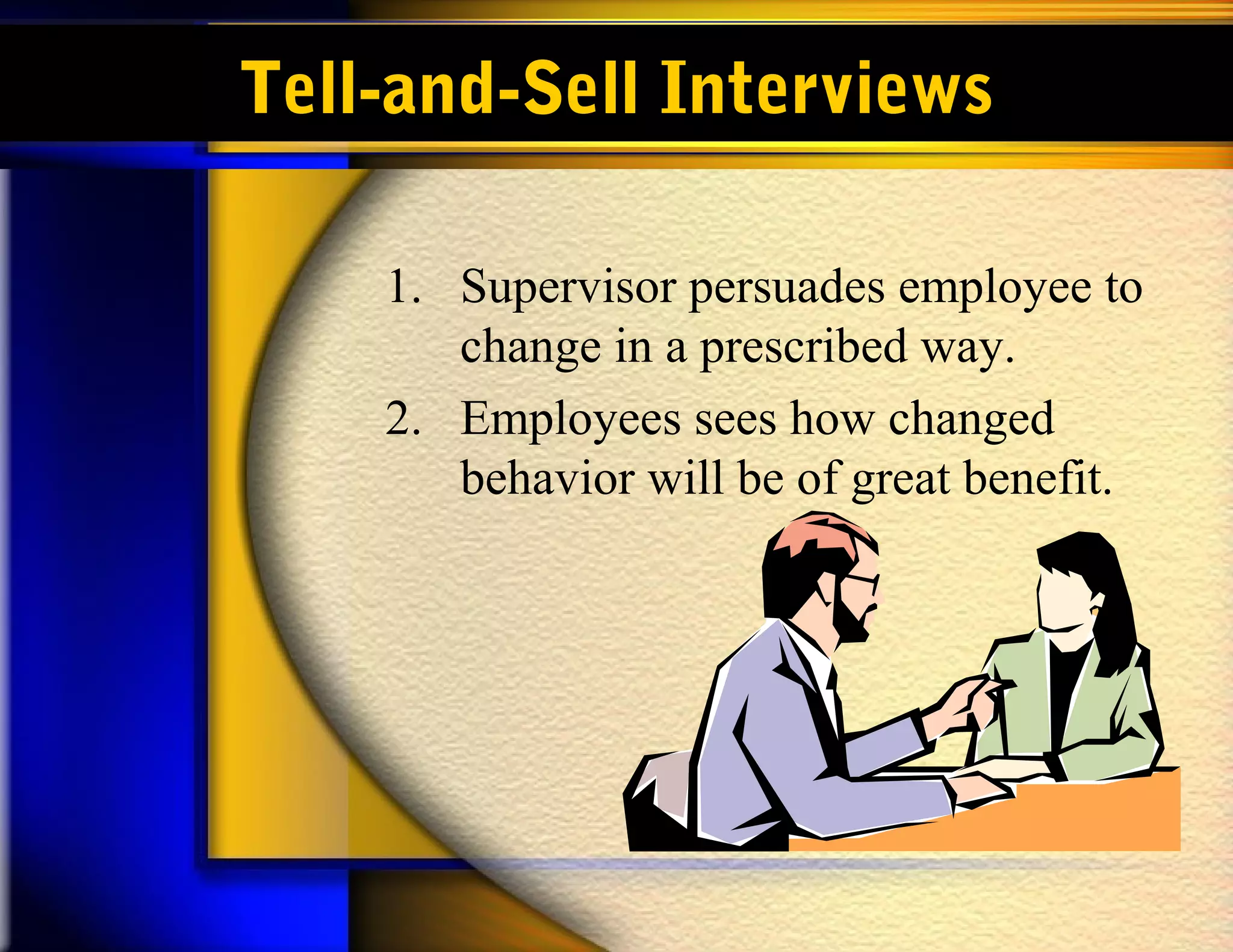
Tell-and-Sell Interviews
1. Supervisor persuades employee to
change in a prescribed way.
2. Employees sees how changed
behavior will be of great benefit.
Tell-and-Listen Interviews
1. Supervisor covers strengths/weaknesses
for first half
2. Solicits employee’s feelings about
comments
3. Deal with disagreement, non-defensively
4. Negotiate future concrete objectives
The Problem Solving Interview
1. Discuss strengths and weaknesses since last
review
2. Explore feelings of sub-ordinate
3. Listening, accepting, and responding are essential
4. Stimulate growth (performance) job
5. Discuss problems, needs, innovations,
satisfactions and dissatisfactions since last review
6. Listen and respond with goal of helping person
and productivity.
Appraisal Interviews
• During the Interview:
– Emphasize strengths to build on.
– Suggest more acceptable ways of acting.
– Concentrate on present opportunities for growth.
• Techniques:
– Listen more than you talk.
– Use a variety of types of questions.
– Avoid the sandwich technique.
Establishing Job Related
Performance Standards
1. Relevant
2. Free From Contamination
3. Reliable - Inter Rater
Consistency
Appraisal Program Failure Concerns
1. Little Benefit Relative to Time
Commitment
2. Face to Face Confrontation
3. Unskilled Appraisers
4. Role Conflict: Judge or Teacher
Appraisal Methods
• Rating Scales
• Essay
• Management by Objectives
• Check Lists by Key Words
• Forced Choice Statements
• Ranking of Employees
Rating Scale Methods
(most popular)
(Check each trait being evaluated)
1. Global Scale (Total Performance)
2. Mixed Standard Scale (Choose from Different
Statements)
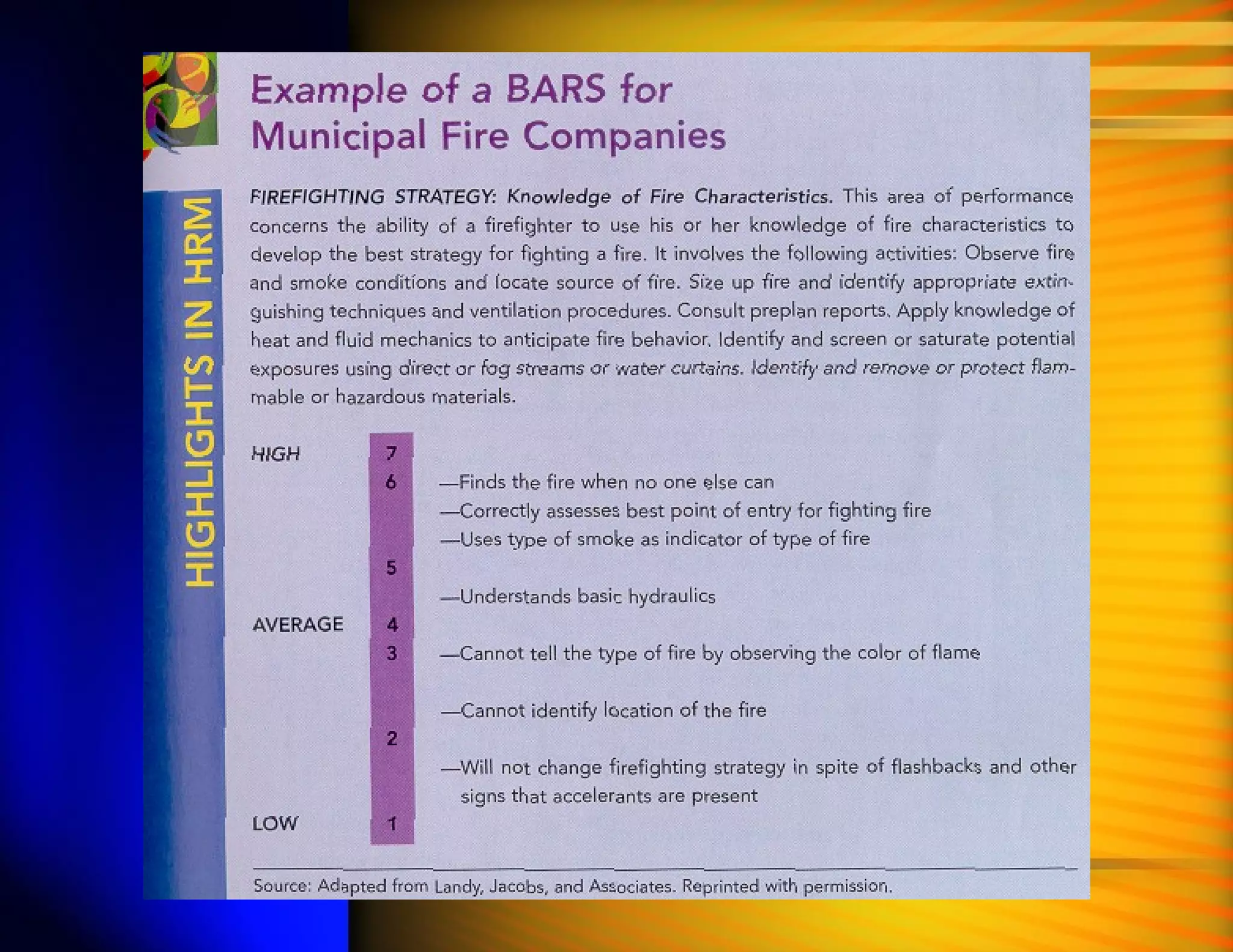
3. Behaviorally Anchored Rating Scale
(Descriptions along the scale to define)
Behaviorally Anchored Rating Scale
(BARS)
• A behavioral approach to
performance appraisal that
consists of a series of vertical
scales, one for each important
dimension of job
performance.
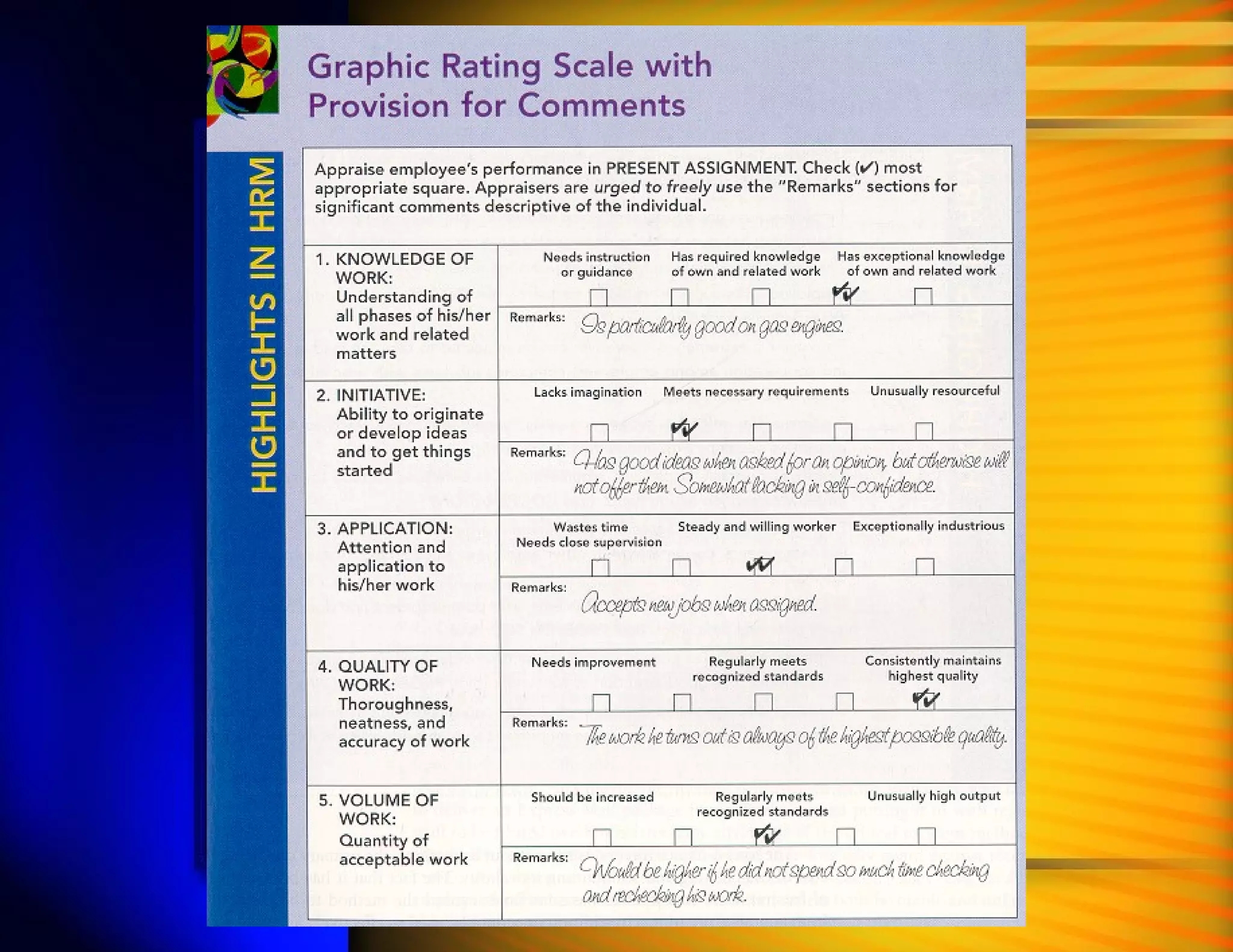
Graphic Rating-Scale Method
• Performance appraisal whereby each
employee is rated according to a
scale of pre-defined characteristics
that are job performance related.
Forced-Choice Method
• A trait approach to
performance appraisal that
requires the rater to choose
from statements designed to
distinguish between successful
and unsuccessful performance.
Essay Method
• A trait approach to performance
appraisal that requires the rater to
compose a statement describing
employee behavior.
Essay Method
• Write a Behavioral Statement
• Strengths versus Weaknesses
• Describe Selected Traits
• Evaluate Performance
Advantages Disadvantages
Critical Incident
• Unusual event that denotes
superior or inferior employee
performance in some part of
the job.
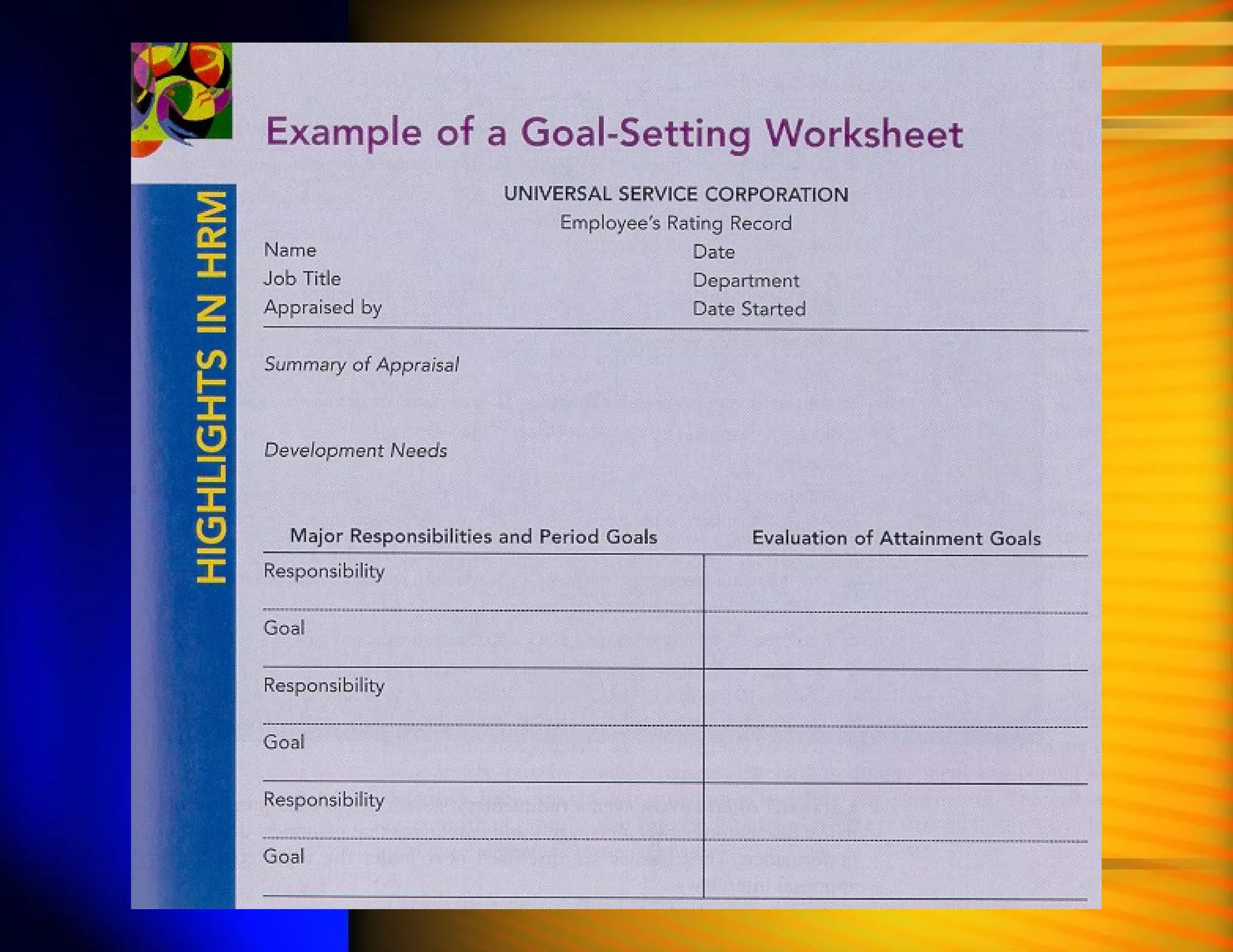
Management By Objective (MBO)
• Philosophy of management that rates
performance on the basis of employee
achievement of goals set by mutual
agreement of employee and manager.
Management by Objectives
(Peter Drucker)
• Integrates performance and goal
setting
• Frequent intervals
• Record maintenance
• Objective review jointly
• Mutual buy-in
Advantages of MBO
• Employees Can Measure
Performance
• Quantifiable Goals
• Joint Effort
• Employee Satisfaction in
Participation
Disadvantages of MBO
• Success Not Validates by Research
Studies
• Easy to Set Unrealistic Goals
• Hard to Get Full Commitment to
Process
• Difficult to Define Some Goals
Performance Appraisal
Interview Needs
• Trained Interview Techniques
• Honesty in Appraisal
• Well Planned Structure
• Carefully Conducted
• Feedback Openness
• Adequate Time (more than one session
occasionally)
Procedural Guidelines
1. Listen More Than Talk (1/3 rule)
2. Vary the Questions (Open ended/elaboration)
3. Follow-up Questions (force through responses)
4. Reflect Feelings (clarify-sincerity)
5. Avoid Sandwich Technique (Positive-Negative-
Positive)
• Why? Signals Bad News
• No More Bad News
• Discourages Real Communication
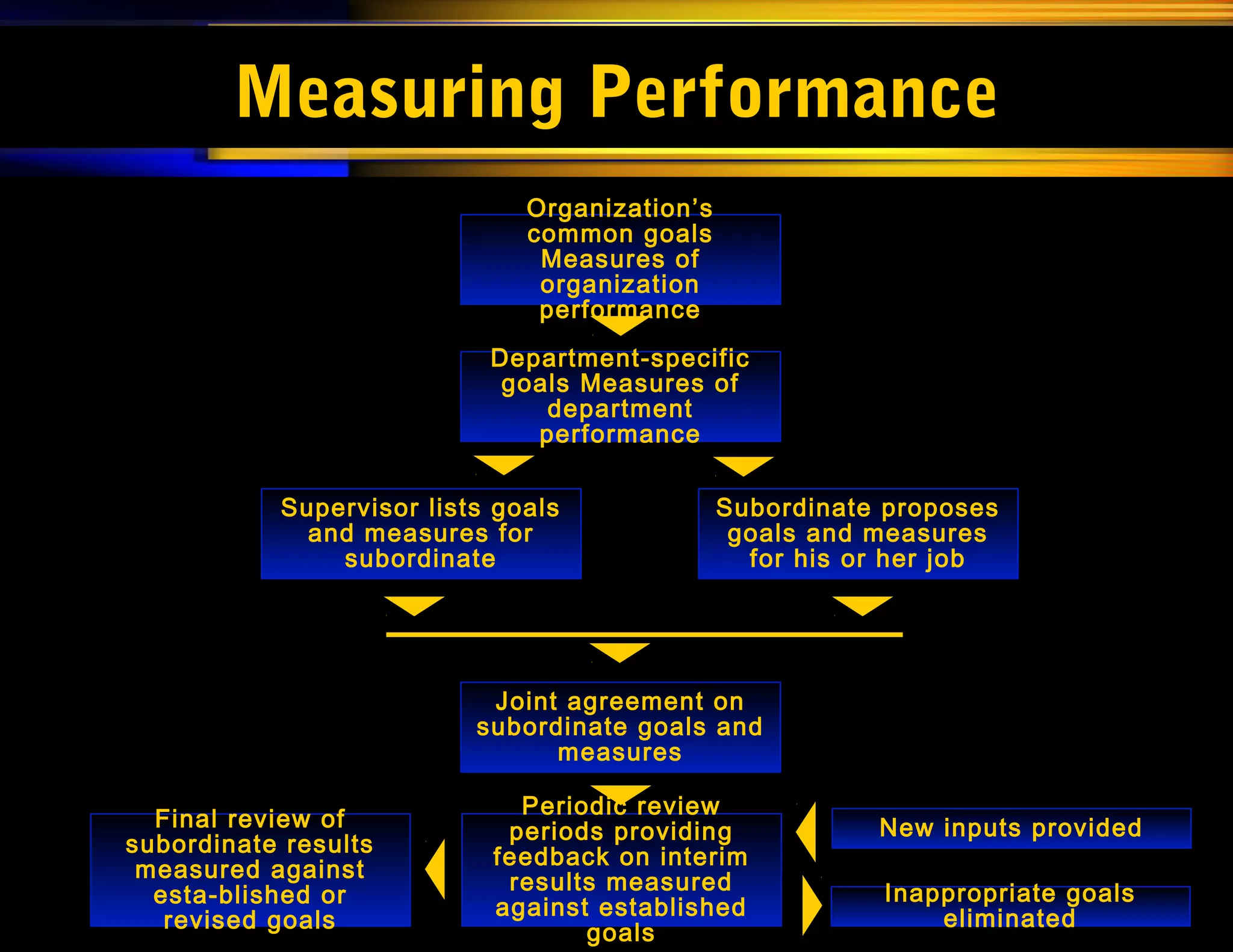
Measuring Performance
Final review of
subordinate results
measured against
esta-blished or
revised goals
Periodic review
periods providing
feedback on interim
results measured
against established
goals
Joint agreement on
subordinate goals and
measures
Department-specific
goals Measures of
department
performance
Organization’s
common goals
Measures of
organization
performance
Supervisor lists goals
and measures for
subordinate
Subordinate proposes
goals and measures
for his or her job
New inputs provided
Inappropriate goals
eliminated
Performance Appraisal
• Amoco Performance
Management
–Description
–Process
–Developing
–Reviewing
–Pay Decision
–Skills Assessment
–Appraisal
Performance Appraisal Examples
Performance Appraisal Form
Performance Management Form
Self-Evaluation
Critical Success Factors
Professional Staff Evaluation Proce
08 performanceappraisals (1)

08 performanceappraisals (1)

  • 1.
  • 2.
    Performers Appraisal LearningObjectives • Explain Purposes of Performance Management • Identify Success Factors in Good Programs • Identify Sources of Information for Evaluation • Explain Key Methods used in Managing Performance • Outline the Manager/Sub-Ordinate Interview
  • 3.
    Purpose of PerformanceAppraisal Systems • Goal: Maintain Organizational Productivity • Results: Organization Productivity Individual Performance • Methods: Individual Performance Goals
  • 4.
    Objectives • Opportunity toRegularly Discuss Results • Supervisor Identifies Strengths and Weaknesses • Fair and Equitable Format • Basis for Salary/Promotion Recommendations
  • 5.
    Main Purposes ofPerformance Management • Individual Rewards (Base and Incentive) • Feedback for Sub-Ordinate (Plus and Minus) • Recognition of Superior Performance • Documentation of Weak Performance • Personnel Decision-Making • Future Goal Commitments (Planned Achievements)
  • 6.
    Reasons for Appraisals •Compensation "Pay for Performance" • Job Performance Improvements • Feedback to Subordinates • Documentation for Decisions • Goal Setting - Later Evaluation • Promotion Decisions • Identify Training Needs • HR Planning
  • 7.
    Primary Uses ofPerformance Appraisals Small Organizations Large Organizations All Organizations Compensation 80.2% 66.7% 74.9% Performance improvement 46.3% 53.3% 48.4% Feedback 40.3% 40.6% 40.4% Documentation 29.0% 32.2% 30.2% Promotion 26.1% 22.8% 24.8% Training 5.1% 9.4% 7.3% Transfer 8.1% 6.1% 7.3% Discharge 4.9% 6.7% 5.6% Layoff 2.1% 2.8% 2.4% Personnel research 1.8% 2.8% 2.2% Manpower planning 0.7% 2.8% 1.5%
  • 8.
    Trends in ManagingPerformance Superior Performance leads to Superior Rewards Issue: How to objectively measure specific goals! Appraising/Evaluating Managing Performance VERSUS
  • 9.
    Who Performs theAppraisal? • Immediate Supervisor • Higher Management • Self-Appraisals • Peers (Co-Workers) • Evaluation Teams • Customers • “360° Appraisals”
  • 10.
    Supervisor Appraisal • Performanceappraisal done by an employee’s manager and often reviewed by a manager one level higher.
  • 11.
    Self-Appraisal • Performance appraisaldone by the employee being evaluated, generally on an appraisal form completed by the employee prior to the performance review.
  • 12.
    Subordinate Appraisal • Performanceappraisal of a superior by an employee, which is more appropriate for developmental than for administrative purposes.
  • 13.
    Peer Appraisal • Performanceappraisal done by one’s fellow employees, generally on forms that are complied into a single profile for use in the performance interview conducted by the employee’s manager.
  • 14.
    Team Appraisal • Performanceappraisal, based on TQM concepts, that recognizes team accomplishment rather than individual performance.
  • 15.
    The 360º AppraisalInterview Individual Staff Self-Assessment Supervisor Other Superiors Peers Teams Sub-Ordinates Teams Customers Other Superiors
  • 16.
    Performance Appraisal Problems •Popularity Contest • Punitive Implications • Control Relinquishment • Stereotypes • Poor Training of Raters
  • 17.
    Peer Appraisal Concerns •Disadvantages? • Advantages?
  • 18.
    Rating Errors Issues •Carefully Developed Behavior Descriptions Fair • Evaluation Scales • Factor Relatedness to the Job
  • 19.
    Types of RatingErrors • Leniency/Strictness Error • Define Anchors (Dimensions) • Force A Curve • Central Tendency • Reluctant to Give High/Low • Explain Need for Variability • Recency Error • Last Action Halo • Encourage Frequent Evaluation
  • 20.
    Error of CentralTendency • Performance-rating error in which all employees are rated about average.
  • 21.
    Leniency or StrictnessError • Performance-rating error in which the appraiser tends to give employees either unusually high or unusually low ratings.
  • 22.
    Recency Error • Performance-ratingerror in which the appraisal is based largely on the employee’s most recent behavior rather than on behavior throughout the appraisal period.
  • 23.
    Rating Errors Example Halo JobRating Scale EXCELLENT on all factors Leniency Job Rating Scale Employee A EXCELLENT Job Rating Scale Employee B EXCELLENT Job Rating Scale Employee C SUPERIOR Job Rating Scale Employee D EXCELLENT Central Tendency Job Rating Scale Employee A AVERAGE Job Rating Scale Employee B AVERAGE Job Rating Scale Employee C AVERAGE Job Rating Scale Employee D AVERAGE Recency Bias Job rating scale behavior during the last month has been POOR.
  • 24.
    Similar-To-Me Error • Performance-ratingerror in which an appraiser inflates the evaluation of an employee because of a mutual personal connection.
  • 25.
    Appraisal Training ProgramsNeeds 1. Explain Objectives 2. Review the Instrument 3. Define the Performance Standards 4. Understand Typical Subjective Errors 5. Teach Interviewing Skills
  • 26.
    Scheduling the PerformanceAppraisal 1. Schedule the review and notify the employee ten days or two weeks in advance. 2. Ask the employee to prepare for the session by reviewing his or her performance, job objectives, and development goals. 3. Clearly state that this will be the formal annual performance appraisal.
  • 27.
    Preparing for theReview for the Performance Appraisal 1. Review the performance documentation collected throughout the year. Concentrate on work patterns that have developed. 2. Be prepared to give specific examples of above- or below-average performance. 3. When performance falls short of expectations, determine what changes need to be made. If performance meets or exceeds expectations, discuss this and plan how to reinforce it. 4. After the appraisal is written, set it aside for a few days and then review it again. 5. Follow whatever steps are required by your organization’s performance appraisal system.
  • 28.
    Appraisal Interviews • Schedulethe interview 10 to 14 days in advance. • Provide subordinates with a “guide” to follow in planning for the interview. • Consider which of the following approaches to use: – Tell-and-sell method – Tell-and-listen method – Problem-solving method (generally preferable)
  • 29.
    Tell-and-Sell Interviews 1. Supervisorpersuades employee to change in a prescribed way. 2. Employees sees how changed behavior will be of great benefit.
  • 30.
    Tell-and-Listen Interviews 1. Supervisorcovers strengths/weaknesses for first half 2. Solicits employee’s feelings about comments 3. Deal with disagreement, non-defensively 4. Negotiate future concrete objectives
  • 31.
    The Problem SolvingInterview 1. Discuss strengths and weaknesses since last review 2. Explore feelings of sub-ordinate 3. Listening, accepting, and responding are essential 4. Stimulate growth (performance) job 5. Discuss problems, needs, innovations, satisfactions and dissatisfactions since last review 6. Listen and respond with goal of helping person and productivity.
  • 32.
    Appraisal Interviews • Duringthe Interview: – Emphasize strengths to build on. – Suggest more acceptable ways of acting. – Concentrate on present opportunities for growth. • Techniques: – Listen more than you talk. – Use a variety of types of questions. – Avoid the sandwich technique.
  • 33.
    Establishing Job Related PerformanceStandards 1. Relevant 2. Free From Contamination 3. Reliable - Inter Rater Consistency
  • 34.
    Appraisal Program FailureConcerns 1. Little Benefit Relative to Time Commitment 2. Face to Face Confrontation 3. Unskilled Appraisers 4. Role Conflict: Judge or Teacher
  • 35.
    Appraisal Methods • RatingScales • Essay • Management by Objectives • Check Lists by Key Words • Forced Choice Statements • Ranking of Employees
  • 36.
    Rating Scale Methods (mostpopular) (Check each trait being evaluated) 1. Global Scale (Total Performance) 2. Mixed Standard Scale (Choose from Different Statements) 3. Behaviorally Anchored Rating Scale (Descriptions along the scale to define)
  • 37.
    Behaviorally Anchored RatingScale (BARS) • A behavioral approach to performance appraisal that consists of a series of vertical scales, one for each important dimension of job performance.
  • 39.
    Graphic Rating-Scale Method •Performance appraisal whereby each employee is rated according to a scale of pre-defined characteristics that are job performance related.
  • 41.
    Forced-Choice Method • Atrait approach to performance appraisal that requires the rater to choose from statements designed to distinguish between successful and unsuccessful performance.
  • 42.
    Essay Method • Atrait approach to performance appraisal that requires the rater to compose a statement describing employee behavior.
  • 43.
    Essay Method • Writea Behavioral Statement • Strengths versus Weaknesses • Describe Selected Traits • Evaluate Performance Advantages Disadvantages
  • 46.
    Critical Incident • Unusualevent that denotes superior or inferior employee performance in some part of the job.
  • 47.
    Management By Objective(MBO) • Philosophy of management that rates performance on the basis of employee achievement of goals set by mutual agreement of employee and manager.
  • 48.
    Management by Objectives (PeterDrucker) • Integrates performance and goal setting • Frequent intervals • Record maintenance • Objective review jointly • Mutual buy-in
  • 49.
    Advantages of MBO •Employees Can Measure Performance • Quantifiable Goals • Joint Effort • Employee Satisfaction in Participation
  • 50.
    Disadvantages of MBO •Success Not Validates by Research Studies • Easy to Set Unrealistic Goals • Hard to Get Full Commitment to Process • Difficult to Define Some Goals
  • 51.
    Performance Appraisal Interview Needs •Trained Interview Techniques • Honesty in Appraisal • Well Planned Structure • Carefully Conducted • Feedback Openness • Adequate Time (more than one session occasionally)
  • 52.
    Procedural Guidelines 1. ListenMore Than Talk (1/3 rule) 2. Vary the Questions (Open ended/elaboration) 3. Follow-up Questions (force through responses) 4. Reflect Feelings (clarify-sincerity) 5. Avoid Sandwich Technique (Positive-Negative- Positive) • Why? Signals Bad News • No More Bad News • Discourages Real Communication
  • 53.
    Measuring Performance Final reviewof subordinate results measured against esta-blished or revised goals Periodic review periods providing feedback on interim results measured against established goals Joint agreement on subordinate goals and measures Department-specific goals Measures of department performance Organization’s common goals Measures of organization performance Supervisor lists goals and measures for subordinate Subordinate proposes goals and measures for his or her job New inputs provided Inappropriate goals eliminated
  • 54.
    Performance Appraisal • AmocoPerformance Management –Description –Process –Developing –Reviewing –Pay Decision –Skills Assessment –Appraisal
  • 55.
    Performance Appraisal Examples PerformanceAppraisal Form Performance Management Form Self-Evaluation Critical Success Factors Professional Staff Evaluation Proce