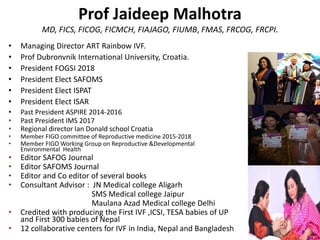
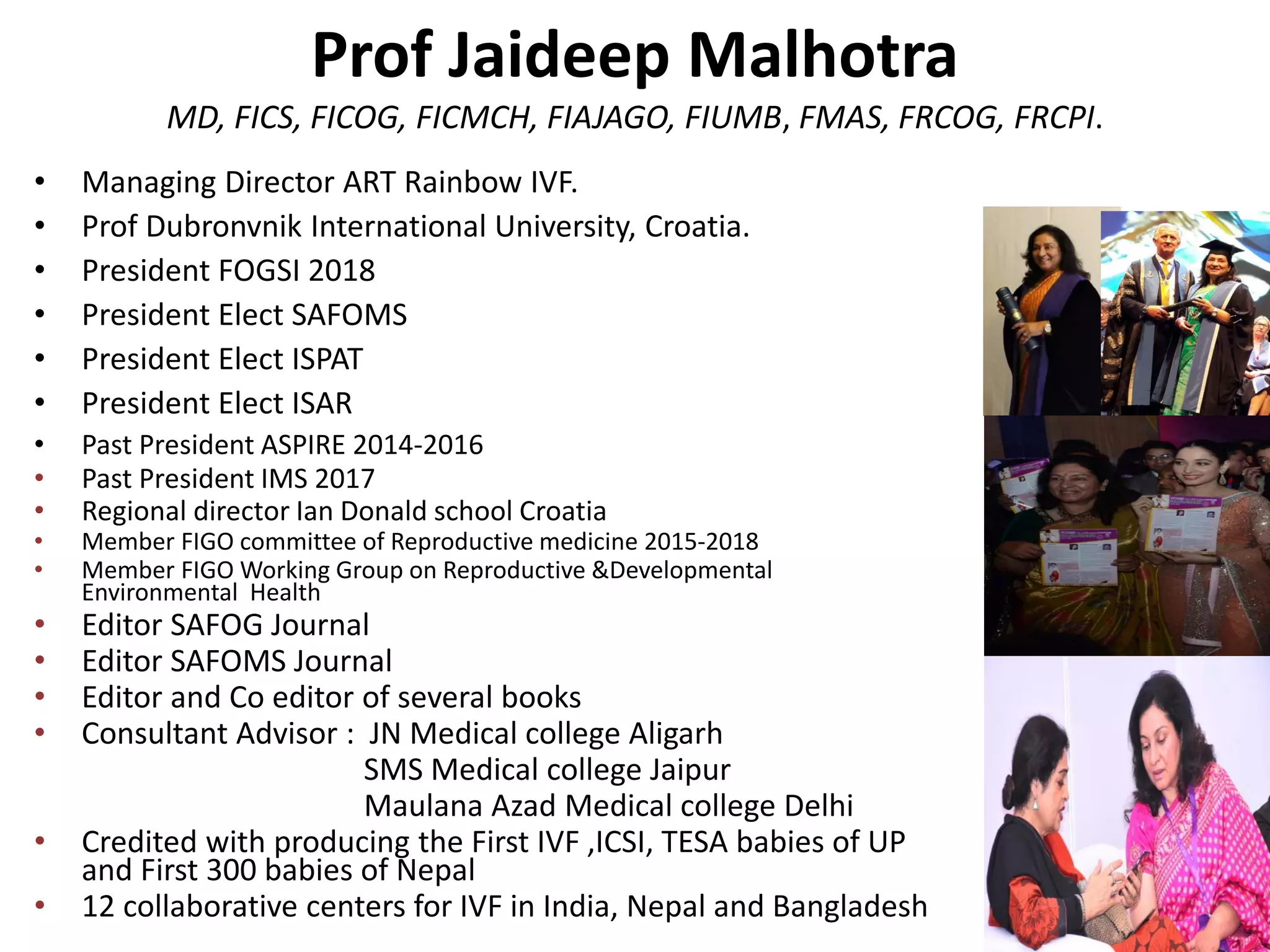
Prof Jaideep Malhotra
MD, FICS, FICOG, FICMCH, FIAJAGO, FIUMB, FMAS, FRCOG, FRCPI.
• Managing Director ART Rainbow IVF.
• Prof Dubronvnik International University, Croatia.
• President FOGSI 2018
• President Elect SAFOMS
• President Elect ISPAT
• President Elect ISAR
• Past President ASPIRE 2014-2016
• Past President IMS 2017
• Regional director Ian Donald school Croatia
• Member FIGO committee of Reproductive medicine 2015-2018
• Member FIGO Working Group on Reproductive &Developmental
Environmental Health
• Editor SAFOG Journal
• Editor SAFOMS Journal
• Editor and Co editor of several books
• Consultant Advisor : JN Medical college Aligarh
SMS Medical college Jaipur
Maulana Azad Medical college Delhi
• Credited with producing the First IVF ,ICSI, TESA babies of UP
and First 300 babies of Nepal
• 12 collaborative centers for IVF in India, Nepal and Bangladesh
Challenging scenarios in
infertility practice.
Prof Jaideep Malhotra
President FOGSI 2018
• No disclosures
India is a great democratic country and I love my
country unconditionally and I am a proud Indian.
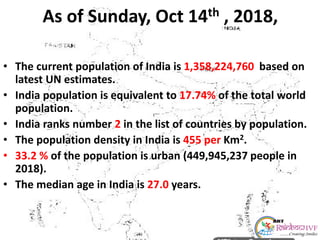
As of Sunday, Oct 14th , 2018,
• The current population of India is 1,358,224,760 based on
latest UN estimates.
• India population is equivalent to 17.74% of the total world
population.
• India ranks number 2 in the list of countries by population.
• The population density in India is 455 per Km2.
• 33.2 % of the population is urban (449,945,237 people in
2018).
• The median age in India is 27.0 years.
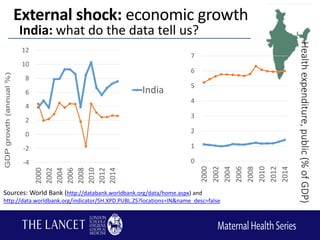
India: what do the data tell us?
External shock: economic growth
Sources: World Bank (http://databank.worldbank.org/data/home.aspx) and
http://data.worldbank.org/indicator/SH.XPD.PUBL.ZS?locations=IN&name_desc=false
-4
-2
0
2
4
6
8
10
12
2000
2002
2004
2006
2008
2010
2012
2014
India
Healthexpenditure,public(%ofGDP)
0
1
2
3
4
5
6
7
2000
2002
2004
2006
2008
2010
2012
2014
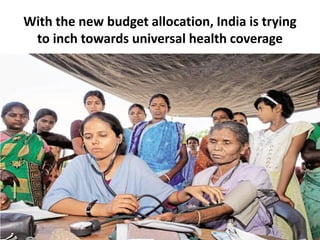
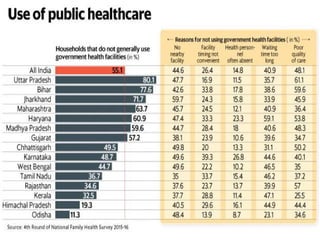
With the new budget allocation, India is trying
to inch towards universal health coverage
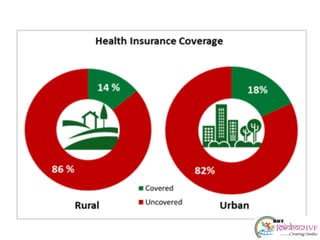
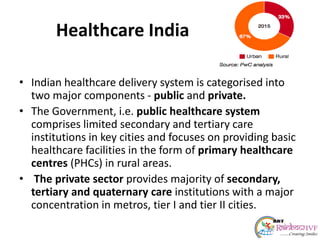
Healthcare India
• Indian healthcare delivery system is categorised into
two major components - public and private.
• The Government, i.e. public healthcare system
comprises limited secondary and tertiary care
institutions in key cities and focuses on providing basic
healthcare facilities in the form of primary healthcare
centres (PHCs) in rural areas.
• The private sector provides majority of secondary,
tertiary and quaternary care institutions with a major
concentration in metros, tier I and tier II cities.
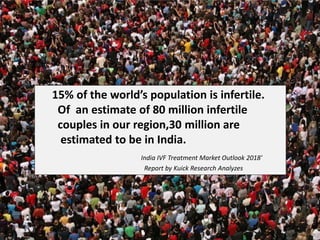
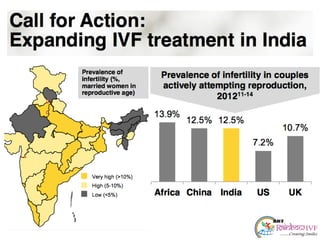
15% of the world’s population is infertile.
Of an estimate of 80 million infertile
couples in our region,30 million are
estimated to be in India.
India IVF Treatment Market Outlook 2018'
Report by Kuick Research Analyzes
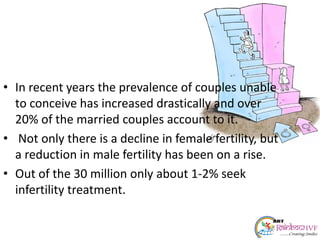
• In recent years the prevalence of couples unable
to conceive has increased drastically and over
20% of the married couples account to it.
• Not only there is a decline in female fertility, but
a reduction in male fertility has been on a rise.
• Out of the 30 million only about 1-2% seek
infertility treatment.
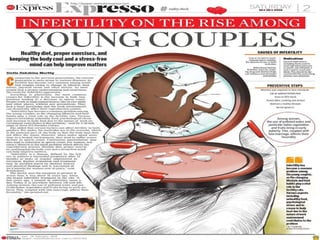
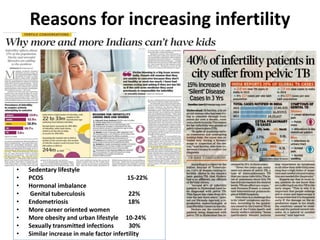
• Sedentary lifestyle
• PCOS 15-22%
• Hormonal imbalance
• Genital tuberculosis 22%
• Endometriosis 18%
• More career oriented women
• More obesity and urban lifestyle 10-24%
• Sexually transmitted infections 30%
• Similar increase in male factor infertility
Reasons for increasing infertility
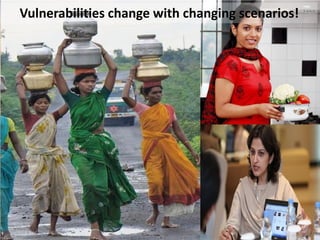
Vulnerabilities change with changing scenarios!
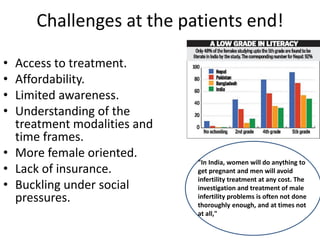
Challenges at the patients end!
• Access to treatment.
• Affordability.
• Limited awareness.
• Understanding of the
treatment modalities and
time frames.
• More female oriented.
• Lack of insurance.
• Buckling under social
pressures.
"In India, women will do anything to
get pregnant and men will avoid
infertility treatment at any cost. The
investigation and treatment of male
infertility problems is often not done
thoroughly enough, and at times not
at all,"
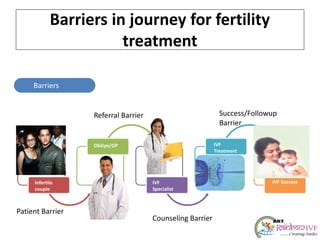
Barriers in journey for fertility
treatment
ObGyn/GP
Patient Barrier
Counseling Barrier
Success/Followup
Barrier
IVF
Specialist
IVF
Treatment
Infertile
couple
IVF Success
Referral Barrier
Barriers
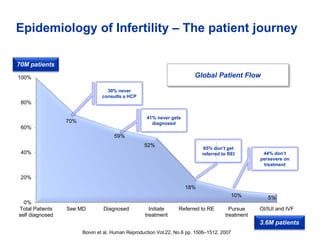
Epidemiology of Infertility – The patient journey
70%
59%
52%
18%
10% 5%
0%
20%
40%
60%
80%
100%
Total Patients
self diagnosed
See MD Diagnosed Initiate
treatment
Referred to RE Pursue
treatment
OI/IUI and IVF
70M patients
30% never
consults a HCP
41% never gets
diagnosed
44% don’t
persevere on
treatment
3.6M patients
65% don’t get
referred to REI
Boivin et al, Human Reproduction Vol.22, No.6 pp. 1506–1512, 2007
Global Patient Flow
Flourishing quackery
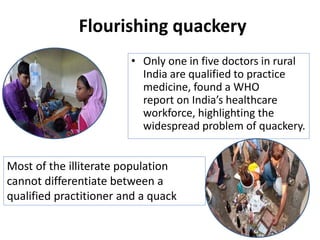
• Only one in five doctors in rural
India are qualified to practice
medicine, found a WHO
report on India’s healthcare
workforce, highlighting the
widespread problem of quackery.
Most of the illiterate population
cannot differentiate between a
qualified practitioner and a quack
Fertility Gods and Messiahs
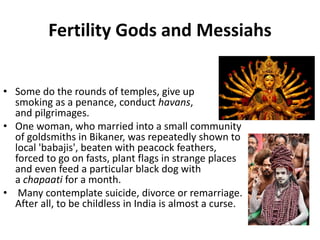
• Some do the rounds of temples, give up
smoking as a penance, conduct havans, pujas
and pilgrimages.
• One woman, who married into a small community
of goldsmiths in Bikaner, was repeatedly shown to
local 'babajis', beaten with peacock feathers,
forced to go on fasts, plant flags in strange places
and even feed a particular black dog with
a chapaati for a month.
• Many contemplate suicide, divorce or remarriage.
After all, to be childless in India is almost a curse.
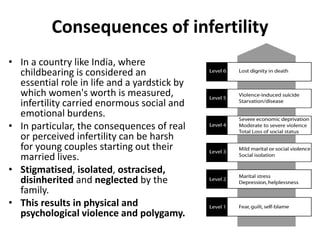
Consequences of infertility
• In a country like India, where
childbearing is considered an
essential role in life and a yardstick by
which women's worth is measured,
infertility carried enormous social and
emotional burdens.
• In particular, the consequences of real
or perceived infertility can be harsh
for young couples starting out their
married lives.
• Stigmatised, isolated, ostracised,
disinherited and neglected by the
family.
• This results in physical and
psychological violence and polygamy.
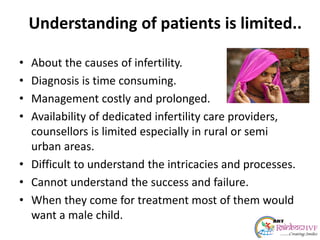
Understanding of patients is limited..
• About the causes of infertility.
• Diagnosis is time consuming.
• Management costly and prolonged.
• Availability of dedicated infertility care providers,
counsellors is limited especially in rural or semi
urban areas.
• Difficult to understand the intricacies and processes.
• Cannot understand the success and failure.
• When they come for treatment most of them would
want a male child.
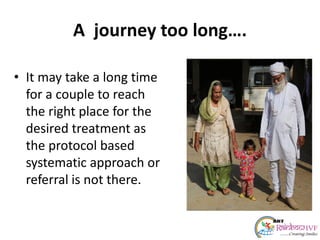
A journey too long….
• It may take a long time
for a couple to reach
the right place for the
desired treatment as
the protocol based
systematic approach or
referral is not there.
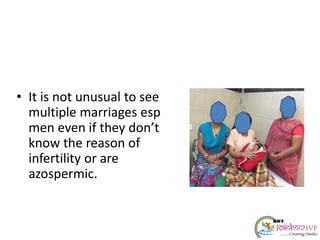
• It is not unusual to see
multiple marriages esp
men even if they don’t
know the reason of
infertility or are
azospermic.
RIGHTS OF PEOPLE OF HIV?
The WHO states that:
"All women, including those with HIV, have the right “to decide freely
and responsibly on the number and spacing of their children and to
have access to the information, education and means to enable them to
exercise these rights”
The reproductive rights of people living with HIV, and their
health, are very important. The link between HIV and reproductive
rights exists in regard to four main issues:
• prevention of unwanted pregnancy
• help to plan wanted pregnancy
• healthcare during and after pregnancy
• access to abortion services if the woman asks to
"WHO | Reproductive choices for women with HIV". Who.int. Retrieved 2015.
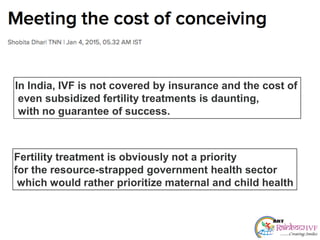
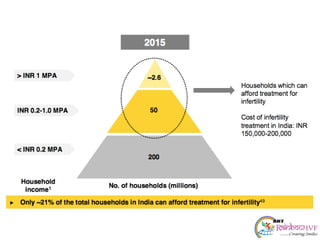
In India, IVF is not covered by insurance and the cost of
even subsidized fertility treatments is daunting,
with no guarantee of success.
Fertility treatment is obviously not a priority
for the resource-strapped government health sector
which would rather prioritize maternal and child health
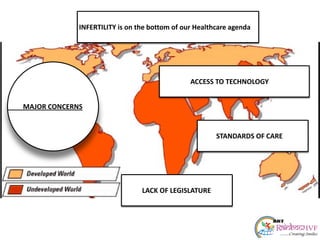
MAJOR CONCERNS
INFERTILITY is on the bottom of our Healthcare agenda
STANDARDS OF CARE
LACK OF LEGISLATURE
ACCESS TO TECHNOLOGY
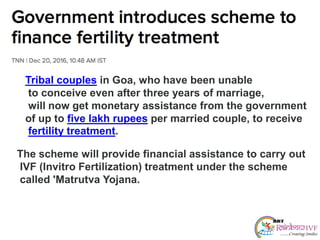
Tribal couples in Goa, who have been unable
to conceive even after three years of marriage,
will now get monetary assistance from the government
of up to five lakh rupees per married couple, to receive
fertility treatment.
The scheme will provide financial assistance to carry out
IVF (Invitro Fertilization) treatment under the scheme
called 'Matrutva Yojana.
It is not easy for fertility care
providers
• Huge gap between rural and urban setups.
• Infrastructure, technology and support staff
lacking.
• No clear protocol based management.
• Facilities and framework lacking especially in
peripheral areas.
• Understanding of the patients is limited.
• No preventive strategies.
• Safety issues?
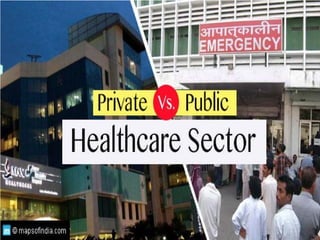
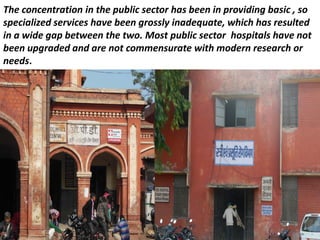
The concentration in the public sector has been in providing basic , so
specialized services have been grossly inadequate, which has resulted
in a wide gap between the two. Most public sector hospitals have not
been upgraded and are not commensurate with modern research or
needs.
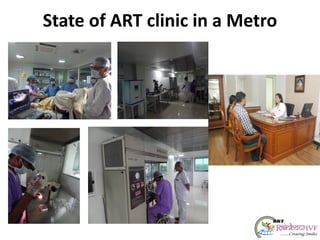
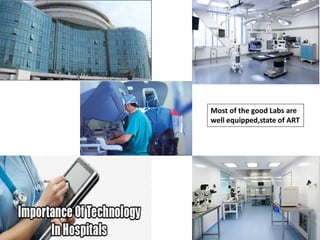
State of ART clinic in a Metro
Public sector challenges…
• The role of the public sector in infertility management is
weak as even basic investigations and services are limited
or incomplete.
• Inadequate infrastructure, inappropriate management
including time management, lack of information and
training, absence of clear protocols at all levels, private
practice by public health doctors, pre-occupation with
other health issues and lack of regulation were the main
problems mentioned by providers.
• Amongst key recommendations are realistic and low-cost
management, streamlining and regulating services,
counselling of couples, providing information and raising
awareness of patients, health personnel and policy
makers.
Challenges of private sector
• Normally a medical professional studies for 10 long years
and is still on the road struggling to make both ends meet if
no job.
• Most of the infertility practitioners have been self trained.
• No support from the Government in setting up of
private care hospitals.
• Certification and licensing cumbersome.
• Paramedical staff untrained or semi trained.
• Private hospital Management skills are not imparted.
• No relief on taxation and all charges are commercial
(Electricity,water tax etc).
• Loans unfriendly at commercial rates.
Vulnerabilities of providers with
repercussions on the beneficiaries..
• No parity in practice
• Lack of regulations
• Number of embryos transferred
• No registry of clinics,donors or agencies
• Follow up of children born lacking
• Self funded
• Limited external quality control
• No declaration of results
• Lack of standardised guidelines
• Mostly private clinics
• Lack of structured training
• Insurance cover?
• Counselling is lacking
Provision of services limited to urban
areas
• Ancillary services like:
• Good anaesthetists,
• Endoscopy facilities,
• Interventional ultrasound,
• Semen banks,
• ART banks,
• Registered donors,
• Gases for storage facilities,
• In house embryologists,
• Trained counsellors, nurses and other paramedics.
Ethical vs unethical practices
• Lack of regulations and code of conduct
implementation makes it difficult for ethical
practitioners to survive.
• Advertisement war between many players can
have repercussions on the patients.
• Many multinational ART players in the market
with corporatisation is leading to
mushrooming of the clinics with quality
controls not easy.
Travelling embryologists..
• Many clinics do not have in house embryologists
and there is too much stress of doing batch IVF
and restricted to only ICSI batches.
• Thus doing day three or day five transfers,
cryopreservation or individualising
becomes a problem.
• Many clinicians have learnt to do
embryology and especially embryo
loading for transfer themselves.
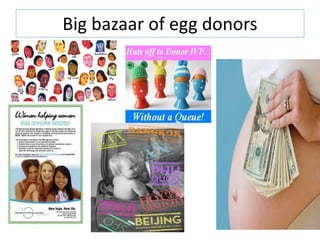
Big bazaar of egg donors
Needs a lot of work..
• Floating population of patients, donors and
surrogates.
• Lack of semen and egg donor registries.
• Lack of regulations, though guidelines are
there, but no law as yet.
• Implementation also will be a task.
Third party
• There are shortages of sperm donors and
banks struggle to access donors (National
Gamete Donation Trust, 2008).
• Screening of donors according to guidelines
only restricted to few accredited banks.
• Similarly egg donors cannot be from family or
known, which has led too much
commercialisation.
Guidelines being firmed up into law..
• Concerns about the unregulated use of gametes, embryos
and stem cells, lack of or incomplete informed consent,
record keeping and documentation.
• A strong regulatory mechanism to monitor and discourage
unethical practices, but some felt that providers should
practice self-regulation.
• The need for a national law on sperm banking was expressed
and some disapproved of the guidelines regarding keeping
DNA records for 40 years and access to donor information to
the child after 18 years of age.
• Record-keeping is cumbersome and revealing the identity to
the child maybe difficult in Indian society as children may find
it socially unacceptable that they have two parents.
Third party regulations
• Screening of donors and recipients lacking.
• Guidelines for both not carried out as there is
no law.
• Loopholes in guidelines need to be plugged.
• Implementation needs reinforcement.
• Self regulation ?
• Lack of time and mind set need change.
Buckling under pressure
• To any demands of the family or society.
• Coerced into using gametes from friends,
family or relatives if male factor.
• In treatment unaffordability can lead to
accepting any modality of treatment to cut
the cost down.
• May land up asking for gamete donation of
any kind.
Negotiating boundaries: Accessing donor
gametes in India
• The proper recruitment and screening of
donors could avoid transmission of genetic
diseases and HIV to recipients and offspring.
• Increased risks of consangunity.
Anita Widge and j. Cleland 2011
Vulnerabilities of all associated?
• Exploitation of/by the donors and surrogates.
• Exploitation of/by the patients.
• Exploitation of health professionals.
• No implementations of rules and regulations.
• Difficulties in certification, licensing, running
costs.
• Huge personal loans of doctors and patients.
• High litigation rates.
Post failure counselling needs to be
refined..
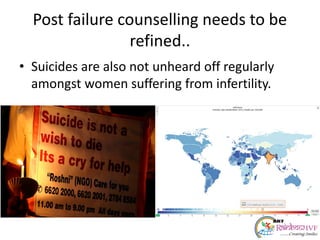
• Suicides are also not unheard off regularly
amongst women suffering from infertility.
What can be done?
• Providing information on causes and treatment of infertility is critical, as is a
progressive change in the attitude of doctors.
• Awareness of unsafe abortions as a likely cause of infertility, and triple
protection, i.e. STI/RTIs and HIV prevention and infertility prevention, could be
emphasized amongst adolescents and couples.
• Encouraging adoption by providing incentives, collaboration with adoption
agencies and prevalence studies to understand the extent of primary and
secondary infertility in India were amongst other suggestions from providers.
• Integrating infertility in the larger reproductive health agenda and training
was considered important, including messages in safe motherhood
programmes.
• NGOs, media, consumer and patient groups could play a supportive role in
creating awareness and providing services.
• Public-private partnerships with thoughtful application could be considered in
this context.
Bhatia and Cleland 2001
Education is the crux
• Reproductive health programmes can be an entry point for
couples with infertility problems.
• Prevention and treatment of infertility is possible on a
small scale.
• In Nigeria, where the service options are similarly limited
and the prevalence of infertility is now rising above 20%,
the ‘Women's Health and Action Research Centre’ offers
comprehensive reproductive health care, including
management of infertility.
• Both programmes combine education, counselling, careful
history taking, laboratory testing, minor pharmacological
and surgical therapies, and referral
Okonofua 2002.
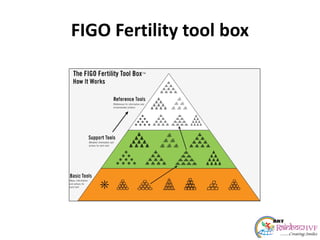
FIGO Fertility tool box
Education is the crux
• Communication strategies to disseminate information on
preventive and curative aspects of infertility, increase
public awareness to improve preventive behaviour and
provide information on adoption agencies and legal
procedures.
• Awareness raising of health staff and policy makers and
elaboration of a policy on infertility care as part of an
integrated reproductive health care programme.Van
Zandvoort 2000.
• Considerations of priorities in health resource allocation,
costs, feasibility, quality control, sustainability, and equity
and access to health care are important.
Rowe 1999.
Prevention of infertility needs focus
• Promote Family Planning.
• Improve Maternal and Perinatal Health.
• Preventing Unsafe Abortion.
• Control Sexually Transmitted and Reproductive
Tract Infections.
• Promote Adolescent and Adult Reproductive and
Sexual Health.
• Gender Issues and Reproductive Rights in
Reproductive Health.
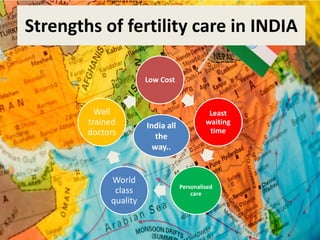
Strengths of fertility care in INDIA
Low Cost
Least
waiting
time
Personalised
care
World
class
quality
Well
trained
doctors
India all
the
way..
Rising India- Shining India
• India has one of the largest and fastest
growing private health sectors in the world.
• Its private hospitals are modern with all of the
latest technology and facilities and the
hundreds of private fertility clinics in the
country are no exception.
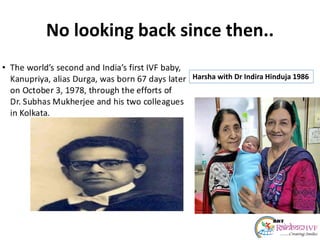
No looking back since then..
Harsha with Dr Indira Hinduja 1986
Today India boasts of …
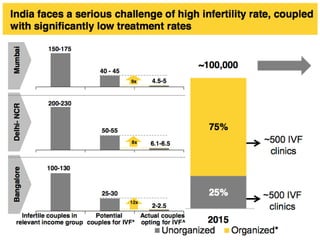
• 3000 plus ART centers with 100,000 cycles/year
and many more basic infertility management
centers.
• Most have facilities for ultrasonography,
endoscopy and basic Infertility treatment eg IUI.
• Has many sperm banks and few Oocyte banks.
• Good number of female infertility practitioners.
Male infertility largely treated by urologists and
few andrologists.
Indian fertility care providers
• 90% Private care
• Acclaimed all over the world
• Self trained and self made
• Multi taskers (clinicians, sonologists,
endoscopic surgeons, embryologists,
Counsellors).
• Capable
• Hard working
Most of the good Labs are
well equipped,state of ART
All modalities of treatment available!
• Basic investigations
• Diagnosis/Ultrasonography
• Management:
• Endoscopy
• IVF
• ICSI
• Laser assisted hatching
• Cryopreservation of gametes
• Third party reproduction
• ART banks
• Surrogate homes
Strengths
• Lower costs.
• Equivalent quality due to innovations.
• Patient has option on choice of clinic and doctor.
• Not much regulations giving more clinical freedom.
• Third party reproduction easily available.
• Vitrification of eggs, embryos.
• Individualised protocols.
• Easily accessible consultants.
• Huge difference in the standard of care providers in
tier one to three cities.
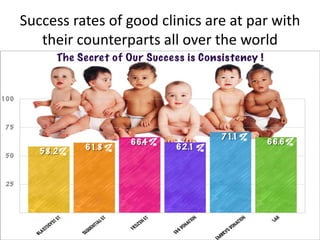
Success rates of good clinics are at par with
their counterparts all over the world
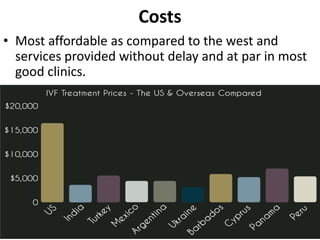
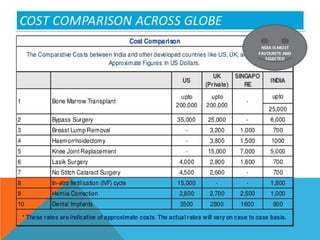
Costs
• Most affordable as compared to the west and
services provided without delay and at par in most
good clinics.
Medication costs much lower
Strengths
• Fertility clinics occupied the largest share in
the India IVF services market owing to the
availability and accessibility of different
services related to IVF such as infertility
treatment, IVF programs, egg donation,
intracytoplasmic sperm injection (ICSI), intra-
cytoplasmic morphologically selected sperm
injection (IMSI), and others in these clinics.
Consultants
• Accessibility of skilled and experienced
consultants
• No waiting time.
• Most of the centers offer all treatments under
one roof.
• Less time consuming management.
• Technologically advanced clinics and clinicians.
• Ultrasound and endoscopy is forte.
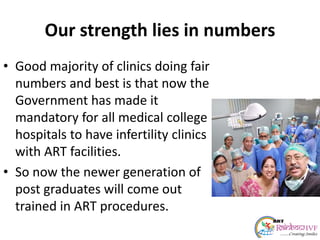
Our strength lies in numbers
• Good majority of clinics doing fair
numbers and best is that now the
Government has made it
mandatory for all medical college
hospitals to have infertility clinics
with ART facilities.
• So now the newer generation of
post graduates will come out
trained in ART procedures.
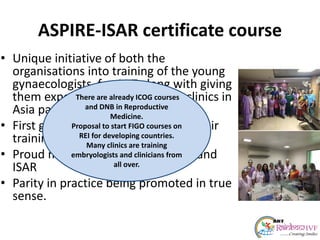
ASPIRE-ISAR certificate course
• Unique initiative of both the
organisations into training of the young
gynaecologists for ART along with giving
them exposure to various other clinics in
Asia pacific.
• First group of 5 students finished their
training and sat for the exam.
• Proud moment indeed for ASPIRE and
ISAR
• Parity in practice being promoted in true
sense.
There are already ICOG courses
and DNB in Reproductive
Medicine.
Proposal to start FIGO courses on
REI for developing countries.
Many clinics are training
embryologists and clinicians from
all over.
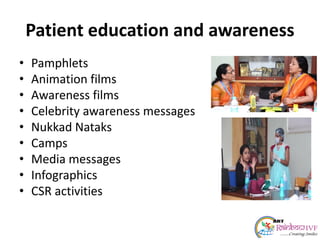
Patient education and awareness
• Pamphlets
• Animation films
• Awareness films
• Celebrity awareness messages
• Nukkad Nataks
• Camps
• Media messages
• Infographics
• CSR activities
Touch as many lives and hearts as possible
Accreditation and software based
documentation.
• ISAR has started accreditation of the ART
clinics and this will be preparing them for
entry point of NABH or ISO.
• Along with this a free software is being
provided to all clinics for documentation so
that data analysis, registries will become a
reality.
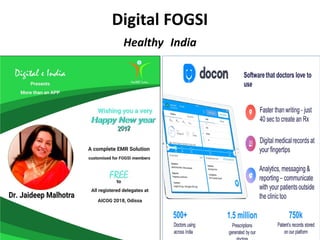
Digital FOGSI
Healthy India
Transparency in management
• Transparency in healthcare will drive positive
patient outcomes and greater satisfaction. The
patients can provide their identifications like
Aadhaar number to check information online
such as prescribed medicines, tests and doctor's
information all at one place from anywhere.
• They can also contact doctors and physicians
through video call to ensure that the correct
procedures are carried out.
FOGSI JHPEIGO Samarth initiative
• 70% healthcare in private
• Private dependent on semi trained or
untrained paramedical staff.
• Private nursing colleges churning out para
medics without practical training.
• Samarth initiative will help in skill assessment
before employing and the ones employed can
undergo a two week structured skill
enhancement programme .
Challenges are what make life interesting
Overcoming them is what makes life meaningful!
I don't want to get to the end of my life and find that I lived just the
length of it. I want to have lived the width of it as well."
Diane Ackerman
Rainbow Hospitals, National
Highway 2, Near Guru Ka Tal
Gurudwara, Sikandra, Agra Uttar
Pradesh - 282 007
Contact no- 0562-2600531/32/33-
37
B-13 Derawal Nagar, Near Model
Town Metro Station, Next to RG
Stone Clinic, Model Town, Delhi
Contact no :011-
45096781,45096782
www.rainbowivf.in
rainbowivf@gmail.com
Thank you

Challenging scenarios in infertility practice

  • 1.
    Prof Jaideep Malhotra MD,FICS, FICOG, FICMCH, FIAJAGO, FIUMB, FMAS, FRCOG, FRCPI. • Managing Director ART Rainbow IVF. • Prof Dubronvnik International University, Croatia. • President FOGSI 2018 • President Elect SAFOMS • President Elect ISPAT • President Elect ISAR • Past President ASPIRE 2014-2016 • Past President IMS 2017 • Regional director Ian Donald school Croatia • Member FIGO committee of Reproductive medicine 2015-2018 • Member FIGO Working Group on Reproductive &Developmental Environmental Health • Editor SAFOG Journal • Editor SAFOMS Journal • Editor and Co editor of several books • Consultant Advisor : JN Medical college Aligarh SMS Medical college Jaipur Maulana Azad Medical college Delhi • Credited with producing the First IVF ,ICSI, TESA babies of UP and First 300 babies of Nepal • 12 collaborative centers for IVF in India, Nepal and Bangladesh
  • 2.
    Challenging scenarios in infertilitypractice. Prof Jaideep Malhotra President FOGSI 2018
  • 3.
    • No disclosures Indiais a great democratic country and I love my country unconditionally and I am a proud Indian.
  • 4.
    As of Sunday,Oct 14th , 2018, • The current population of India is 1,358,224,760 based on latest UN estimates. • India population is equivalent to 17.74% of the total world population. • India ranks number 2 in the list of countries by population. • The population density in India is 455 per Km2. • 33.2 % of the population is urban (449,945,237 people in 2018). • The median age in India is 27.0 years.
  • 6.
    India: what dothe data tell us? External shock: economic growth Sources: World Bank (http://databank.worldbank.org/data/home.aspx) and http://data.worldbank.org/indicator/SH.XPD.PUBL.ZS?locations=IN&name_desc=false -4 -2 0 2 4 6 8 10 12 2000 2002 2004 2006 2008 2010 2012 2014 India Healthexpenditure,public(%ofGDP) 0 1 2 3 4 5 6 7 2000 2002 2004 2006 2008 2010 2012 2014
  • 9.
    With the newbudget allocation, India is trying to inch towards universal health coverage
  • 10.
    Healthcare India • Indianhealthcare delivery system is categorised into two major components - public and private. • The Government, i.e. public healthcare system comprises limited secondary and tertiary care institutions in key cities and focuses on providing basic healthcare facilities in the form of primary healthcare centres (PHCs) in rural areas. • The private sector provides majority of secondary, tertiary and quaternary care institutions with a major concentration in metros, tier I and tier II cities.
  • 13.
    15% of theworld’s population is infertile. Of an estimate of 80 million infertile couples in our region,30 million are estimated to be in India. India IVF Treatment Market Outlook 2018' Report by Kuick Research Analyzes
  • 14.
    • In recentyears the prevalence of couples unable to conceive has increased drastically and over 20% of the married couples account to it. • Not only there is a decline in female fertility, but a reduction in male fertility has been on a rise. • Out of the 30 million only about 1-2% seek infertility treatment.
  • 16.
    • Sedentary lifestyle •PCOS 15-22% • Hormonal imbalance • Genital tuberculosis 22% • Endometriosis 18% • More career oriented women • More obesity and urban lifestyle 10-24% • Sexually transmitted infections 30% • Similar increase in male factor infertility Reasons for increasing infertility
  • 17.
    Vulnerabilities change withchanging scenarios!
  • 18.
    Challenges at thepatients end! • Access to treatment. • Affordability. • Limited awareness. • Understanding of the treatment modalities and time frames. • More female oriented. • Lack of insurance. • Buckling under social pressures. "In India, women will do anything to get pregnant and men will avoid infertility treatment at any cost. The investigation and treatment of male infertility problems is often not done thoroughly enough, and at times not at all,"
  • 19.
    Barriers in journeyfor fertility treatment ObGyn/GP Patient Barrier Counseling Barrier Success/Followup Barrier IVF Specialist IVF Treatment Infertile couple IVF Success Referral Barrier Barriers
  • 20.
    Epidemiology of Infertility– The patient journey 70% 59% 52% 18% 10% 5% 0% 20% 40% 60% 80% 100% Total Patients self diagnosed See MD Diagnosed Initiate treatment Referred to RE Pursue treatment OI/IUI and IVF 70M patients 30% never consults a HCP 41% never gets diagnosed 44% don’t persevere on treatment 3.6M patients 65% don’t get referred to REI Boivin et al, Human Reproduction Vol.22, No.6 pp. 1506–1512, 2007 Global Patient Flow
  • 21.
    Flourishing quackery • Onlyone in five doctors in rural India are qualified to practice medicine, found a WHO report on India’s healthcare workforce, highlighting the widespread problem of quackery. Most of the illiterate population cannot differentiate between a qualified practitioner and a quack
  • 22.
    Fertility Gods andMessiahs • Some do the rounds of temples, give up smoking as a penance, conduct havans, pujas and pilgrimages. • One woman, who married into a small community of goldsmiths in Bikaner, was repeatedly shown to local 'babajis', beaten with peacock feathers, forced to go on fasts, plant flags in strange places and even feed a particular black dog with a chapaati for a month. • Many contemplate suicide, divorce or remarriage. After all, to be childless in India is almost a curse.
  • 23.
    Consequences of infertility •In a country like India, where childbearing is considered an essential role in life and a yardstick by which women's worth is measured, infertility carried enormous social and emotional burdens. • In particular, the consequences of real or perceived infertility can be harsh for young couples starting out their married lives. • Stigmatised, isolated, ostracised, disinherited and neglected by the family. • This results in physical and psychological violence and polygamy.
  • 24.
    Understanding of patientsis limited.. • About the causes of infertility. • Diagnosis is time consuming. • Management costly and prolonged. • Availability of dedicated infertility care providers, counsellors is limited especially in rural or semi urban areas. • Difficult to understand the intricacies and processes. • Cannot understand the success and failure. • When they come for treatment most of them would want a male child.
  • 25.
    A journey toolong…. • It may take a long time for a couple to reach the right place for the desired treatment as the protocol based systematic approach or referral is not there.
  • 26.
    • It isnot unusual to see multiple marriages esp men even if they don’t know the reason of infertility or are azospermic.
  • 27.
    RIGHTS OF PEOPLEOF HIV? The WHO states that: "All women, including those with HIV, have the right “to decide freely and responsibly on the number and spacing of their children and to have access to the information, education and means to enable them to exercise these rights” The reproductive rights of people living with HIV, and their health, are very important. The link between HIV and reproductive rights exists in regard to four main issues: • prevention of unwanted pregnancy • help to plan wanted pregnancy • healthcare during and after pregnancy • access to abortion services if the woman asks to "WHO | Reproductive choices for women with HIV". Who.int. Retrieved 2015.
  • 28.
    In India, IVFis not covered by insurance and the cost of even subsidized fertility treatments is daunting, with no guarantee of success. Fertility treatment is obviously not a priority for the resource-strapped government health sector which would rather prioritize maternal and child health
  • 32.
    MAJOR CONCERNS INFERTILITY ison the bottom of our Healthcare agenda STANDARDS OF CARE LACK OF LEGISLATURE ACCESS TO TECHNOLOGY
  • 33.
    Tribal couples inGoa, who have been unable to conceive even after three years of marriage, will now get monetary assistance from the government of up to five lakh rupees per married couple, to receive fertility treatment. The scheme will provide financial assistance to carry out IVF (Invitro Fertilization) treatment under the scheme called 'Matrutva Yojana.
  • 34.
    It is noteasy for fertility care providers • Huge gap between rural and urban setups. • Infrastructure, technology and support staff lacking. • No clear protocol based management. • Facilities and framework lacking especially in peripheral areas. • Understanding of the patients is limited. • No preventive strategies. • Safety issues?
  • 35.
    The concentration inthe public sector has been in providing basic , so specialized services have been grossly inadequate, which has resulted in a wide gap between the two. Most public sector hospitals have not been upgraded and are not commensurate with modern research or needs.
  • 36.
    State of ARTclinic in a Metro
  • 37.
    Public sector challenges… •The role of the public sector in infertility management is weak as even basic investigations and services are limited or incomplete. • Inadequate infrastructure, inappropriate management including time management, lack of information and training, absence of clear protocols at all levels, private practice by public health doctors, pre-occupation with other health issues and lack of regulation were the main problems mentioned by providers. • Amongst key recommendations are realistic and low-cost management, streamlining and regulating services, counselling of couples, providing information and raising awareness of patients, health personnel and policy makers.
  • 38.
    Challenges of privatesector • Normally a medical professional studies for 10 long years and is still on the road struggling to make both ends meet if no job. • Most of the infertility practitioners have been self trained. • No support from the Government in setting up of private care hospitals. • Certification and licensing cumbersome. • Paramedical staff untrained or semi trained. • Private hospital Management skills are not imparted. • No relief on taxation and all charges are commercial (Electricity,water tax etc). • Loans unfriendly at commercial rates.
  • 39.
    Vulnerabilities of providerswith repercussions on the beneficiaries.. • No parity in practice • Lack of regulations • Number of embryos transferred • No registry of clinics,donors or agencies • Follow up of children born lacking • Self funded • Limited external quality control • No declaration of results • Lack of standardised guidelines • Mostly private clinics • Lack of structured training • Insurance cover? • Counselling is lacking
  • 40.
    Provision of serviceslimited to urban areas • Ancillary services like: • Good anaesthetists, • Endoscopy facilities, • Interventional ultrasound, • Semen banks, • ART banks, • Registered donors, • Gases for storage facilities, • In house embryologists, • Trained counsellors, nurses and other paramedics.
  • 41.
    Ethical vs unethicalpractices • Lack of regulations and code of conduct implementation makes it difficult for ethical practitioners to survive. • Advertisement war between many players can have repercussions on the patients. • Many multinational ART players in the market with corporatisation is leading to mushrooming of the clinics with quality controls not easy.
  • 42.
    Travelling embryologists.. • Manyclinics do not have in house embryologists and there is too much stress of doing batch IVF and restricted to only ICSI batches. • Thus doing day three or day five transfers, cryopreservation or individualising becomes a problem. • Many clinicians have learnt to do embryology and especially embryo loading for transfer themselves.
  • 43.
    Big bazaar ofegg donors
  • 44.
    Needs a lotof work.. • Floating population of patients, donors and surrogates. • Lack of semen and egg donor registries. • Lack of regulations, though guidelines are there, but no law as yet. • Implementation also will be a task.
  • 45.
    Third party • Thereare shortages of sperm donors and banks struggle to access donors (National Gamete Donation Trust, 2008). • Screening of donors according to guidelines only restricted to few accredited banks. • Similarly egg donors cannot be from family or known, which has led too much commercialisation.
  • 46.
    Guidelines being firmedup into law.. • Concerns about the unregulated use of gametes, embryos and stem cells, lack of or incomplete informed consent, record keeping and documentation. • A strong regulatory mechanism to monitor and discourage unethical practices, but some felt that providers should practice self-regulation. • The need for a national law on sperm banking was expressed and some disapproved of the guidelines regarding keeping DNA records for 40 years and access to donor information to the child after 18 years of age. • Record-keeping is cumbersome and revealing the identity to the child maybe difficult in Indian society as children may find it socially unacceptable that they have two parents.
  • 47.
    Third party regulations •Screening of donors and recipients lacking. • Guidelines for both not carried out as there is no law. • Loopholes in guidelines need to be plugged. • Implementation needs reinforcement. • Self regulation ? • Lack of time and mind set need change.
  • 48.
    Buckling under pressure •To any demands of the family or society. • Coerced into using gametes from friends, family or relatives if male factor. • In treatment unaffordability can lead to accepting any modality of treatment to cut the cost down. • May land up asking for gamete donation of any kind.
  • 49.
    Negotiating boundaries: Accessingdonor gametes in India • The proper recruitment and screening of donors could avoid transmission of genetic diseases and HIV to recipients and offspring. • Increased risks of consangunity. Anita Widge and j. Cleland 2011
  • 50.
    Vulnerabilities of allassociated? • Exploitation of/by the donors and surrogates. • Exploitation of/by the patients. • Exploitation of health professionals. • No implementations of rules and regulations. • Difficulties in certification, licensing, running costs. • Huge personal loans of doctors and patients. • High litigation rates.
  • 51.
    Post failure counsellingneeds to be refined.. • Suicides are also not unheard off regularly amongst women suffering from infertility.
  • 52.
    What can bedone? • Providing information on causes and treatment of infertility is critical, as is a progressive change in the attitude of doctors. • Awareness of unsafe abortions as a likely cause of infertility, and triple protection, i.e. STI/RTIs and HIV prevention and infertility prevention, could be emphasized amongst adolescents and couples. • Encouraging adoption by providing incentives, collaboration with adoption agencies and prevalence studies to understand the extent of primary and secondary infertility in India were amongst other suggestions from providers. • Integrating infertility in the larger reproductive health agenda and training was considered important, including messages in safe motherhood programmes. • NGOs, media, consumer and patient groups could play a supportive role in creating awareness and providing services. • Public-private partnerships with thoughtful application could be considered in this context. Bhatia and Cleland 2001
  • 53.
    Education is thecrux • Reproductive health programmes can be an entry point for couples with infertility problems. • Prevention and treatment of infertility is possible on a small scale. • In Nigeria, where the service options are similarly limited and the prevalence of infertility is now rising above 20%, the ‘Women's Health and Action Research Centre’ offers comprehensive reproductive health care, including management of infertility. • Both programmes combine education, counselling, careful history taking, laboratory testing, minor pharmacological and surgical therapies, and referral Okonofua 2002.
  • 54.
  • 55.
    Education is thecrux • Communication strategies to disseminate information on preventive and curative aspects of infertility, increase public awareness to improve preventive behaviour and provide information on adoption agencies and legal procedures. • Awareness raising of health staff and policy makers and elaboration of a policy on infertility care as part of an integrated reproductive health care programme.Van Zandvoort 2000. • Considerations of priorities in health resource allocation, costs, feasibility, quality control, sustainability, and equity and access to health care are important. Rowe 1999.
  • 56.
    Prevention of infertilityneeds focus • Promote Family Planning. • Improve Maternal and Perinatal Health. • Preventing Unsafe Abortion. • Control Sexually Transmitted and Reproductive Tract Infections. • Promote Adolescent and Adult Reproductive and Sexual Health. • Gender Issues and Reproductive Rights in Reproductive Health.
  • 58.
    Strengths of fertilitycare in INDIA Low Cost Least waiting time Personalised care World class quality Well trained doctors India all the way..
  • 59.
    Rising India- ShiningIndia • India has one of the largest and fastest growing private health sectors in the world. • Its private hospitals are modern with all of the latest technology and facilities and the hundreds of private fertility clinics in the country are no exception.
  • 60.
    No looking backsince then.. Harsha with Dr Indira Hinduja 1986
  • 61.
    Today India boastsof … • 3000 plus ART centers with 100,000 cycles/year and many more basic infertility management centers. • Most have facilities for ultrasonography, endoscopy and basic Infertility treatment eg IUI. • Has many sperm banks and few Oocyte banks. • Good number of female infertility practitioners. Male infertility largely treated by urologists and few andrologists.
  • 64.
    Indian fertility careproviders • 90% Private care • Acclaimed all over the world • Self trained and self made • Multi taskers (clinicians, sonologists, endoscopic surgeons, embryologists, Counsellors). • Capable • Hard working
  • 65.
    Most of thegood Labs are well equipped,state of ART
  • 66.
    All modalities oftreatment available! • Basic investigations • Diagnosis/Ultrasonography • Management: • Endoscopy • IVF • ICSI • Laser assisted hatching • Cryopreservation of gametes • Third party reproduction • ART banks • Surrogate homes
  • 67.
    Strengths • Lower costs. •Equivalent quality due to innovations. • Patient has option on choice of clinic and doctor. • Not much regulations giving more clinical freedom. • Third party reproduction easily available. • Vitrification of eggs, embryos. • Individualised protocols. • Easily accessible consultants. • Huge difference in the standard of care providers in tier one to three cities.
  • 68.
    Success rates ofgood clinics are at par with their counterparts all over the world
  • 69.
    Costs • Most affordableas compared to the west and services provided without delay and at par in most good clinics.
  • 70.
  • 71.
    Strengths • Fertility clinicsoccupied the largest share in the India IVF services market owing to the availability and accessibility of different services related to IVF such as infertility treatment, IVF programs, egg donation, intracytoplasmic sperm injection (ICSI), intra- cytoplasmic morphologically selected sperm injection (IMSI), and others in these clinics.
  • 72.
    Consultants • Accessibility ofskilled and experienced consultants • No waiting time. • Most of the centers offer all treatments under one roof. • Less time consuming management. • Technologically advanced clinics and clinicians. • Ultrasound and endoscopy is forte.
  • 73.
    Our strength liesin numbers • Good majority of clinics doing fair numbers and best is that now the Government has made it mandatory for all medical college hospitals to have infertility clinics with ART facilities. • So now the newer generation of post graduates will come out trained in ART procedures.
  • 75.
    ASPIRE-ISAR certificate course •Unique initiative of both the organisations into training of the young gynaecologists for ART along with giving them exposure to various other clinics in Asia pacific. • First group of 5 students finished their training and sat for the exam. • Proud moment indeed for ASPIRE and ISAR • Parity in practice being promoted in true sense. There are already ICOG courses and DNB in Reproductive Medicine. Proposal to start FIGO courses on REI for developing countries. Many clinics are training embryologists and clinicians from all over.
  • 76.
    Patient education andawareness • Pamphlets • Animation films • Awareness films • Celebrity awareness messages • Nukkad Nataks • Camps • Media messages • Infographics • CSR activities
  • 77.
    Touch as manylives and hearts as possible
  • 78.
    Accreditation and softwarebased documentation. • ISAR has started accreditation of the ART clinics and this will be preparing them for entry point of NABH or ISO. • Along with this a free software is being provided to all clinics for documentation so that data analysis, registries will become a reality.
  • 79.
  • 80.
    Transparency in management •Transparency in healthcare will drive positive patient outcomes and greater satisfaction. The patients can provide their identifications like Aadhaar number to check information online such as prescribed medicines, tests and doctor's information all at one place from anywhere. • They can also contact doctors and physicians through video call to ensure that the correct procedures are carried out.
  • 81.
    FOGSI JHPEIGO Samarthinitiative • 70% healthcare in private • Private dependent on semi trained or untrained paramedical staff. • Private nursing colleges churning out para medics without practical training. • Samarth initiative will help in skill assessment before employing and the ones employed can undergo a two week structured skill enhancement programme .
  • 82.
    Challenges are whatmake life interesting Overcoming them is what makes life meaningful!
  • 83.
    I don't wantto get to the end of my life and find that I lived just the length of it. I want to have lived the width of it as well." Diane Ackerman
  • 84.
    Rainbow Hospitals, National Highway2, Near Guru Ka Tal Gurudwara, Sikandra, Agra Uttar Pradesh - 282 007 Contact no- 0562-2600531/32/33- 37 B-13 Derawal Nagar, Near Model Town Metro Station, Next to RG Stone Clinic, Model Town, Delhi Contact no :011- 45096781,45096782 www.rainbowivf.in rainbowivf@gmail.com
  • 85.