Using Available Data Chapter 12
Introduction Social scientists often use  available data Available data  is data that is easily accessible by the researcher Available data can come in the form of raw data, actual statistics, or summaries of data
Introduction Existing statistics Summaries of data collected by large organizations
Introduction Examples of existing statistics –  www.fedstats.gov   Available data which is actual data instead of statistics allows researchers to perform their own analysis
Introduction Secondary date Research data that have been collected by someone else
Introduction Secondary data  is often contrasted with  primary data Primary data  Data that the same researcher collects and uses
Introduction Ecological fallacy  The fallacy of making inferences about certain types of individuals from information about groups that might not be exclusively composed of those individuals
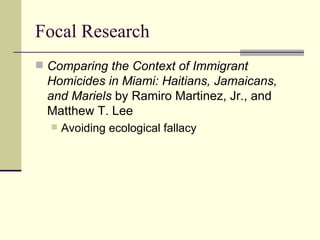
Focal Research Comparing the Context of Immigrant Homicides in Miami: Haitians, Jamaicans, and Mariels  by Ramiro Martinez, Jr., and Matthew T. Lee  Avoiding ecological fallacy
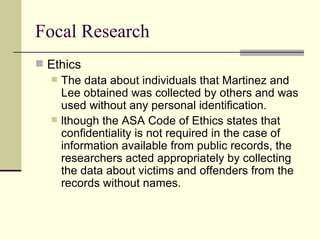
Focal Research Ethics The data about individuals that Martinez and Lee obtained was collected by others and was used without any personal identification.  lthough the ASA Code of Ethics states that confidentiality is not required in the case of information available from public records, the researchers acted appropriately by collecting the data about victims and offenders from the records without names.
Quiz – Question 1 What was Martinez and Lee’s unit of analysis?
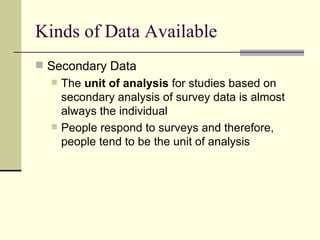
Kinds of Data Available Secondary Data The  unit of analysis  for studies based on secondary analysis of survey data is almost always the individual People respond to surveys and therefore, people tend to be the unit of analysis
Kinds of Data Available Existing Statistics Existing statistics are statistics provided by large organizations.  The U.S. Bureau of the Census is one of the most commonly used sources of existing statistics The  unit of analysis  in studies based on existing statistics  is not  the individual. Statistics summarize information about aggregates of people, such as countries, regions, states, cities, counties, organizations, etc.  When using existing statistics you must find sources of data which use the same unit of analysis as your research question
Kinds of Available Data Other Kinds of Available Data Physical traces Include all kinds of physical evidence left by humans in the course of their everyday lives and can generally be divided into  erosion measures  and  accretion measures .
Kinds of Available Data Other kinds of available data Erosion measures Indicators of a population’s activities created by its selective wear on its physical environment A study of the amount of use particular objects receive
Kinds of Available Data Other kinds of available data Accretion measures Indicators of a population’s activities created by its deposits of materials “The Garbage Project” at the University of Arizona has studied garbage since 1973, by sorting and coding random samples of household garbage
Kinds of Available Data Other Kinds of Available Data The great advantage of physical traces, like garbage, is the collection of data is  unobtrusive  or unlikely to affect the interactions, events, or behavior under consideration
Kinds of Available Data Other Kinds of Available Data Personal records  are records of private lives, such as biographies, letters, diaries, and essays. Personal records  are more difficult to gain access to than public records
Advantages and Disadvantages of Using Available Data Advantages Collection is unobtrusive Available and inexpensive Savings in time, money, and effort
Advantages and Disadvantages of Using Available Data Disadvantages Never quite sure about reliability Underreporting Ecological fallacy
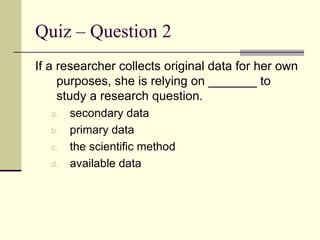
Quiz – Question 2 If a researcher collects original data for her own purposes, she is relying on _______ to study a research question. secondary data primary data the scientific method available data
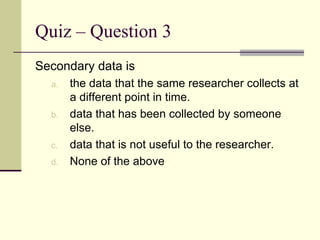
Quiz – Question 3 Secondary data is the data that the same researcher collects at a different point in time. data that has been collected by someone else. data that is not useful to the researcher. None of the above

Adler clark 4e ppt 12

  • 1.
  • 2.
    Introduction Social scientistsoften use available data Available data is data that is easily accessible by the researcher Available data can come in the form of raw data, actual statistics, or summaries of data
  • 3.
    Introduction Existing statisticsSummaries of data collected by large organizations
  • 4.
    Introduction Examples ofexisting statistics – www.fedstats.gov Available data which is actual data instead of statistics allows researchers to perform their own analysis
  • 5.
    Introduction Secondary dateResearch data that have been collected by someone else
  • 6.
    Introduction Secondary data is often contrasted with primary data Primary data Data that the same researcher collects and uses
  • 7.
    Introduction Ecological fallacy The fallacy of making inferences about certain types of individuals from information about groups that might not be exclusively composed of those individuals
  • 8.
    Focal Research Comparingthe Context of Immigrant Homicides in Miami: Haitians, Jamaicans, and Mariels by Ramiro Martinez, Jr., and Matthew T. Lee Avoiding ecological fallacy
  • 9.
    Focal Research EthicsThe data about individuals that Martinez and Lee obtained was collected by others and was used without any personal identification. lthough the ASA Code of Ethics states that confidentiality is not required in the case of information available from public records, the researchers acted appropriately by collecting the data about victims and offenders from the records without names.
  • 10.
    Quiz – Question1 What was Martinez and Lee’s unit of analysis?
  • 11.
    Kinds of DataAvailable Secondary Data The unit of analysis for studies based on secondary analysis of survey data is almost always the individual People respond to surveys and therefore, people tend to be the unit of analysis
  • 12.
    Kinds of DataAvailable Existing Statistics Existing statistics are statistics provided by large organizations. The U.S. Bureau of the Census is one of the most commonly used sources of existing statistics The unit of analysis in studies based on existing statistics is not the individual. Statistics summarize information about aggregates of people, such as countries, regions, states, cities, counties, organizations, etc. When using existing statistics you must find sources of data which use the same unit of analysis as your research question
  • 13.
    Kinds of AvailableData Other Kinds of Available Data Physical traces Include all kinds of physical evidence left by humans in the course of their everyday lives and can generally be divided into erosion measures and accretion measures .
  • 14.
    Kinds of AvailableData Other kinds of available data Erosion measures Indicators of a population’s activities created by its selective wear on its physical environment A study of the amount of use particular objects receive
  • 15.
    Kinds of AvailableData Other kinds of available data Accretion measures Indicators of a population’s activities created by its deposits of materials “The Garbage Project” at the University of Arizona has studied garbage since 1973, by sorting and coding random samples of household garbage
  • 16.
    Kinds of AvailableData Other Kinds of Available Data The great advantage of physical traces, like garbage, is the collection of data is unobtrusive or unlikely to affect the interactions, events, or behavior under consideration
  • 17.
    Kinds of AvailableData Other Kinds of Available Data Personal records are records of private lives, such as biographies, letters, diaries, and essays. Personal records are more difficult to gain access to than public records
  • 18.
    Advantages and Disadvantagesof Using Available Data Advantages Collection is unobtrusive Available and inexpensive Savings in time, money, and effort
  • 19.
    Advantages and Disadvantagesof Using Available Data Disadvantages Never quite sure about reliability Underreporting Ecological fallacy
  • 20.
    Quiz – Question2 If a researcher collects original data for her own purposes, she is relying on _______ to study a research question. secondary data primary data the scientific method available data
  • 21.
    Quiz – Question3 Secondary data is the data that the same researcher collects at a different point in time. data that has been collected by someone else. data that is not useful to the researcher. None of the above