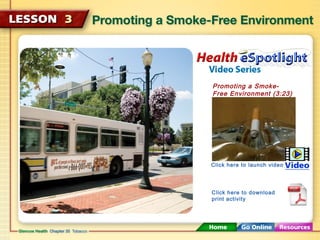
Promoting a Smoke-
Free Environment (3:23)
Click here to launch video
Click here to download
print activity
Secondhand smoke is harmful, but
there are ways to reduce exposure.
environmental tobacco smoke (ETS)
mainstream smoke
sidestream smoke
Healthy People
Health Risks of Tobacco Smoke
Tobacco smoke can harm nonsmokers.
Nonsmokers who breathe air containing tobacco
smoke are also at risk for health problems.
Health Risks of Tobacco Smoke
Environmental tobacco smoke (ETS) is also
called secondhand smoke.
Environmental tobacco smoke (ETS)
Air that has been contaminated by
tobacco smoke
Health Risks of Tobacco Smoke
Environmental tobacco smoke is composed of
mainstream smoke and
sidestream smoke.
Health Risks of Tobacco Smoke
Because mainstream smoke has been exhaled
by a smoker, it contains lower concentrations of
carcinogens, nicotine, and tar.
Mainstream smoke
The smoke exhaled from the lungs
of a smoker
Health Risks of Tobacco Smoke
Sidestream smoke is more dangerous than
mainstream smoke.
Sidestream smoke
The smoke from the burning end
of a cigarette, pipe, or cigar
Health Risks of Tobacco Smoke
ETS from cigarettes, cigars, and pipes contains
more than 4,000 chemical compounds.
More than 50 of those chemicals are cancer-
causing carcinogens.
Health Risks to Nonsmokers
ETS causes eye irritation, headaches, ear
infections, and coughing.
It worsens asthma and other respiratory problems,
and it increases the risk of lung cancer and
coronary heart disease.
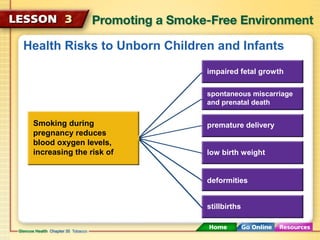
Health Risks to Unborn Children and Infants
Smoking during
pregnancy reduces
blood oxygen levels,
increasing the risk of
impaired fetal growth
spontaneous miscarriage
and prenatal death
premature delivery
low birth weight
deformities
stillbirths
Health Risks to Unborn Children and Infants
Infants exposed to ETS after birth are twice as
likely to die of SIDS.
They may have severe asthma attacks, ear
infections, or respiratory tract infections.
Health Risks to Young Children
The children of smokers are more than twice as
likely to smoke themselves.
They also have a higher incidence of
sore throats
ear infections
upper respiratory problems
Health Risks to Young Children
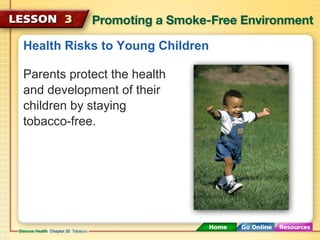
Parents protect the health
and development of their
children by staying
tobacco-free.
Reducing Your Risks
You can take action to reduce the effects
of ETS.
Express your preference wherever you can for a
smoke-free environment.
Reducing Your Risks
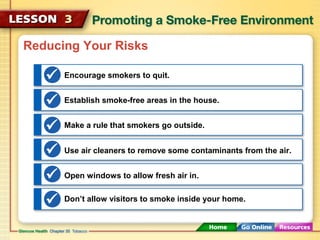
 Encourage smokers to quit.
Establish smoke-free areas in the house.
Make a rule that smokers go outside.
Use air cleaners to remove some contaminants from the air.
Open windows to allow fresh air in.
Don’t allow visitors to smoke inside your home.
Reducing Your Risks
When visiting a
home in which
someone
smokes:
stay outside or in a
different room as much
as possible.
ask to open the windows
to provide fresh air.
suggest meeting
elsewhere, such as in
your home or at a library.
Creating a Smoke-Free Society
In most states, it is illegal to sell tobacco
to teens under the age of 18, and it is
illegal to smoke in public places.
In the United States, efforts to create a smoke-
free society continue to grow.
Creating a Smoke-Free Society
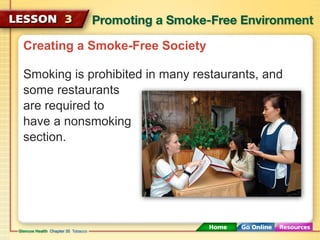
Smoking is prohibited in many restaurants, and
some restaurants
are required to
have a nonsmoking
section.
Supporting National Health Goals
One of the goals of Healthy People 2010 is to
reduce tobacco use and the number of tobacco-
related deaths.
States and local communities are also supporting
the efforts to create a smoke-free society.
Supporting National Health Goals
Laws restrict where
people may smoke, as
well as who can buy
tobacco products.
Supporting National Health Goals
Laws prohibiting the sale of tobacco to minors
have been enacted.
Some states have successfully sued tobacco
companies to recover the costs of treating
tobacco-related illnesses.
Community activities that promote a healthy
lifestyle provide everyone with the opportunity to
practice healthful behaviors.
After You Read
Reviewing Facts and Vocabulary
Air that has been contaminated with tobacco
smoke; mainstream smoke and sidestream
smoke contain more than 4,000 chemicals.
1. What is environmental tobacco smoke,
and what chemical does it contain?
After You Read
Reviewing Facts and Vocabulary
2. List three ways that ETS affects children.
Sample answer: It increases a child’s risk
of ear infections, respiratory problems, and
sore throats.
After You Read
Reviewing Facts and Vocabulary
3. What are two public policies aimed at
reducing ETS?
Sample answer: Prohibiting smoking in
public places and banning smoking on flights
Ch20 03

Ch20 03

  • 1.
    Promoting a Smoke- FreeEnvironment (3:23) Click here to launch video Click here to download print activity
  • 2.
    Secondhand smoke isharmful, but there are ways to reduce exposure.
  • 3.
    environmental tobacco smoke(ETS) mainstream smoke sidestream smoke Healthy People
  • 4.
    Health Risks ofTobacco Smoke Tobacco smoke can harm nonsmokers. Nonsmokers who breathe air containing tobacco smoke are also at risk for health problems.
  • 5.
    Health Risks ofTobacco Smoke Environmental tobacco smoke (ETS) is also called secondhand smoke. Environmental tobacco smoke (ETS) Air that has been contaminated by tobacco smoke
  • 6.
    Health Risks ofTobacco Smoke Environmental tobacco smoke is composed of mainstream smoke and sidestream smoke.
  • 7.
    Health Risks ofTobacco Smoke Because mainstream smoke has been exhaled by a smoker, it contains lower concentrations of carcinogens, nicotine, and tar. Mainstream smoke The smoke exhaled from the lungs of a smoker
  • 8.
    Health Risks ofTobacco Smoke Sidestream smoke is more dangerous than mainstream smoke. Sidestream smoke The smoke from the burning end of a cigarette, pipe, or cigar
  • 9.
    Health Risks ofTobacco Smoke ETS from cigarettes, cigars, and pipes contains more than 4,000 chemical compounds. More than 50 of those chemicals are cancer- causing carcinogens.
  • 10.
    Health Risks toNonsmokers ETS causes eye irritation, headaches, ear infections, and coughing. It worsens asthma and other respiratory problems, and it increases the risk of lung cancer and coronary heart disease.
  • 11.
    Health Risks toUnborn Children and Infants Smoking during pregnancy reduces blood oxygen levels, increasing the risk of impaired fetal growth spontaneous miscarriage and prenatal death premature delivery low birth weight deformities stillbirths
  • 12.
    Health Risks toUnborn Children and Infants Infants exposed to ETS after birth are twice as likely to die of SIDS. They may have severe asthma attacks, ear infections, or respiratory tract infections.
  • 13.
    Health Risks toYoung Children The children of smokers are more than twice as likely to smoke themselves. They also have a higher incidence of sore throats ear infections upper respiratory problems
  • 14.
    Health Risks toYoung Children Parents protect the health and development of their children by staying tobacco-free.
  • 15.
    Reducing Your Risks Youcan take action to reduce the effects of ETS. Express your preference wherever you can for a smoke-free environment.
  • 16.
    Reducing Your Risks Encourage smokers to quit. Establish smoke-free areas in the house. Make a rule that smokers go outside. Use air cleaners to remove some contaminants from the air. Open windows to allow fresh air in. Don’t allow visitors to smoke inside your home.
  • 17.
    Reducing Your Risks Whenvisiting a home in which someone smokes: stay outside or in a different room as much as possible. ask to open the windows to provide fresh air. suggest meeting elsewhere, such as in your home or at a library.
  • 18.
    Creating a Smoke-FreeSociety In most states, it is illegal to sell tobacco to teens under the age of 18, and it is illegal to smoke in public places. In the United States, efforts to create a smoke- free society continue to grow.
  • 19.
    Creating a Smoke-FreeSociety Smoking is prohibited in many restaurants, and some restaurants are required to have a nonsmoking section.
  • 20.
    Supporting National HealthGoals One of the goals of Healthy People 2010 is to reduce tobacco use and the number of tobacco- related deaths. States and local communities are also supporting the efforts to create a smoke-free society.
  • 21.
    Supporting National HealthGoals Laws restrict where people may smoke, as well as who can buy tobacco products.
  • 22.
    Supporting National HealthGoals Laws prohibiting the sale of tobacco to minors have been enacted. Some states have successfully sued tobacco companies to recover the costs of treating tobacco-related illnesses. Community activities that promote a healthy lifestyle provide everyone with the opportunity to practice healthful behaviors.
  • 23.
    After You Read ReviewingFacts and Vocabulary Air that has been contaminated with tobacco smoke; mainstream smoke and sidestream smoke contain more than 4,000 chemicals. 1. What is environmental tobacco smoke, and what chemical does it contain?
  • 24.
    After You Read ReviewingFacts and Vocabulary 2. List three ways that ETS affects children. Sample answer: It increases a child’s risk of ear infections, respiratory problems, and sore throats.
  • 25.
    After You Read ReviewingFacts and Vocabulary 3. What are two public policies aimed at reducing ETS? Sample answer: Prohibiting smoking in public places and banning smoking on flights