Welcome
Topic 2: Management Process
Presented By
Mr. J.B.Shirote
Lecturer in Mechanical Engineering Department
Latthe Education Society’s Polytechnic
P-41,M.I.D.C.,Kupwad,Sangli.
Topic 2: Management Process
Specific Objectives
• State various management principles
• Describe different management functions
What is Management?
What is Management?
• It is an art of getting work done from others
with the help of optimum recourses to
achieve desired goals
• It is called an art because managing requires
certain skills which are personal possessions
of managers.
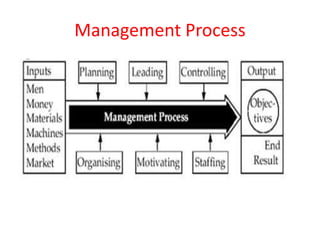
Management Process
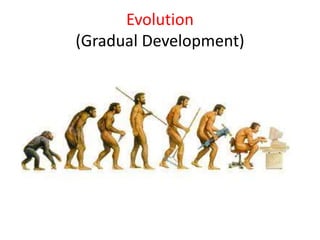
Evolution
(Gradual Development)
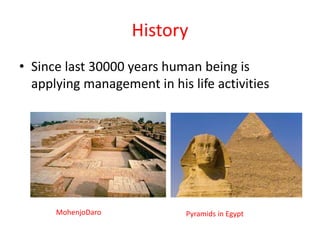
History
• Since last 30000 years human being is
applying management in his life activities
MohenjoDaro Pyramids in Egypt
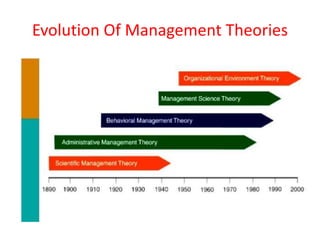
Evolution Of Management Theories
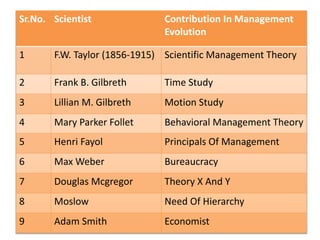
Sr.No. Scientist Contribution In Management
Evolution
1 F.W. Taylor (1856-1915) Scientific Management Theory
2 Frank B. Gilbreth Time Study
3 Lillian M. Gilbreth Motion Study
4 Mary Parker Follet Behavioral Management Theory
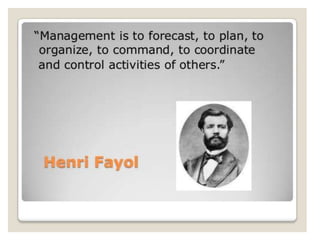
5 Henri Fayol Principals Of Management
6 Max Weber Bureaucracy
7 Douglas Mcgregor Theory X And Y
8 Moslow Need Of Hierarchy
9 Adam Smith Economist
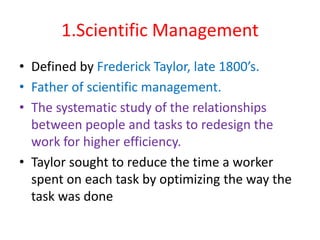
1.Scientific Management
• Defined by Frederick Taylor, late 1800’s.
• Father of scientific management.
• The systematic study of the relationships
between people and tasks to redesign the
work for higher efficiency.
• Taylor sought to reduce the time a worker
spent on each task by optimizing the way the
task was done
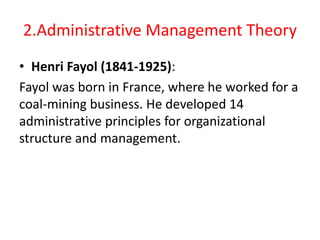
2.Administrative Management Theory
• Henri Fayol (1841-1925):
Fayol was born in France, where he worked for a
coal-mining business. He developed 14
administrative principles for organizational
structure and management.
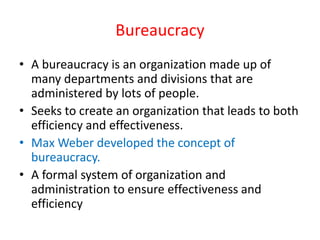
Bureaucracy
• A bureaucracy is an organization made up of
many departments and divisions that are
administered by lots of people.
• Seeks to create an organization that leads to both
efficiency and effectiveness.
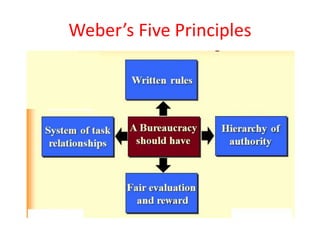
• Max Weber developed the concept of
bureaucracy.
• A formal system of organization and
administration to ensure effectiveness and
efficiency
Weber’s Five Principles
3.Behavioral Management
• Focuses on the way a manager should personally
manage to motivate employees.
Mary Parker Follett
an influential leader in early managerial theory.
• Suggested workers help in analyzing their jobs for
improvements.
• The worker knows the best way to improve the
job.
• If workers have the knowledge of the task, then
they should control the task
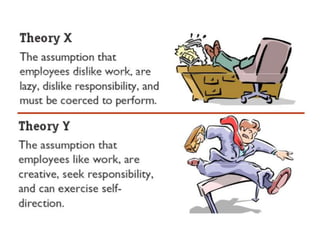
Theory X and Y
• Social psychologist Douglas McGregor of MIT
expounded two contrasting theories on
human motivation and management in the
1960s:
The X Theory and the Y Theory.
4.Management Science
• Management Science is concerned with
developing and applying models and concepts
that help to illuminate management issues
and solve managerial problems.
• The models used can often be represented
mathematically, but sometimes computer-
based, visual or verbal representations are
used.
4.Management Science
• Quantitative management: utilizes linear
programming, modeling, simulation systems.
• Operations management: techniques to
analyze all aspects of the production system.
• Total Quality Management (TQM): focuses on
improved quality.
• Management Information Systems (MIS):
provides information about the organization.
5.Organization-Environment Theory
• Considers relationships inside and outside the
organization.
• The environment consists of forces, conditions,
and influences outside the organization.
Systems theory considers the impact of stages:
• Input: acquire external resources.
• Conversion: inputs are processed into goods and
services.
• Output: finished goods are released into the
environment.
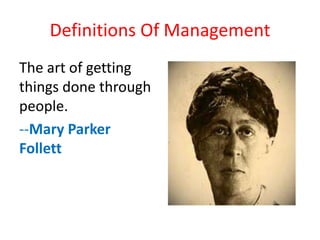
Definitions Of Management
The art of getting
things done through
people.
--Mary Parker
Follett
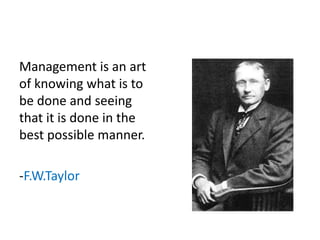
Management is an art
of knowing what is to
be done and seeing
that it is done in the
best possible manner.
-F.W.Taylor
Concept of management
• Harbison and Myers offered a classic threefold
concept for emphasizing a broader scope for
the viewpoint of management.
They observe management as
(1) an economic resource
(2) a system of authority
(3) a class or elite(a select group that is superior
in terms of ability or qualities to the rest of a
group or society.)
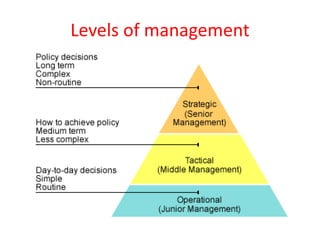
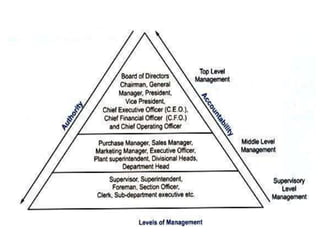
Levels of management
Principles of Management
(14 principles of Henry Fayol)
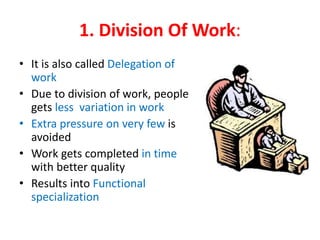
1. Division Of Work:
• It is also called Delegation of
work
• Due to division of work, people
gets less variation in work
• Extra pressure on very few is
avoided
• Work gets completed in time
with better quality
• Results into Functional
specialization
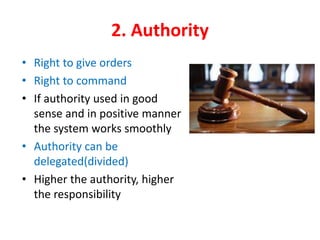
2. Authority
• Right to give orders
• Right to command
• If authority used in good
sense and in positive manner
the system works smoothly
• Authority can be
delegated(divided)
• Higher the authority, higher
the responsibility
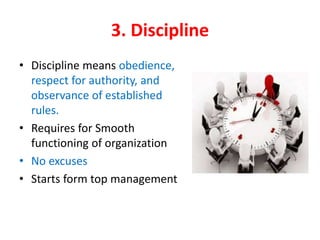
3. Discipline
• Discipline means obedience,
respect for authority, and
observance of established
rules.
• Requires for Smooth
functioning of organization
• No excuses
• Starts form top management
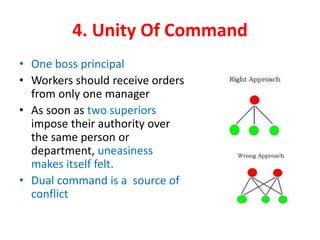
4. Unity Of Command
• One boss principal
• Workers should receive orders
from only one manager
• As soon as two superiors
impose their authority over
the same person or
department, uneasiness
makes itself felt.
• Dual command is a source of
conflict
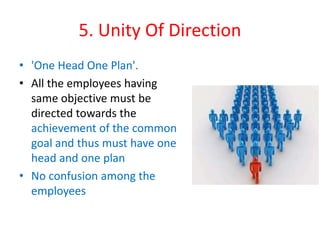
5. Unity Of Direction
• 'One Head One Plan'.
• All the employees having
same objective must be
directed towards the
achievement of the common
goal and thus must have one
head and one plan
• No confusion among the
employees
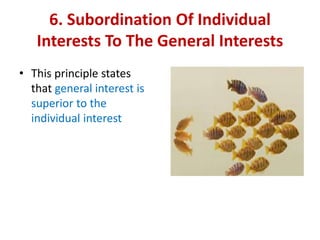
6. Subordination Of Individual
Interests To The General Interests
• This principle states
that general interest is
superior to the
individual interest
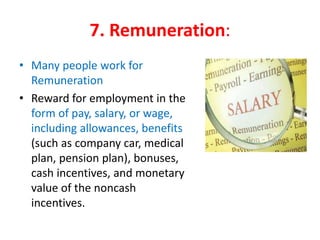
7. Remuneration:
• Many people work for
Remuneration
• Reward for employment in the
form of pay, salary, or wage,
including allowances, benefits
(such as company car, medical
plan, pension plan), bonuses,
cash incentives, and monetary
value of the noncash
incentives.
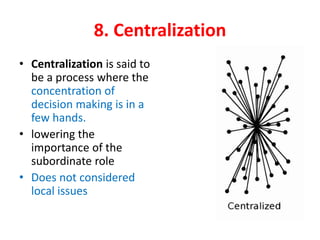
8. Centralization
• Centralization is said to
be a process where the
concentration of
decision making is in a
few hands.
• lowering the
importance of the
subordinate role
• Does not considered
local issues
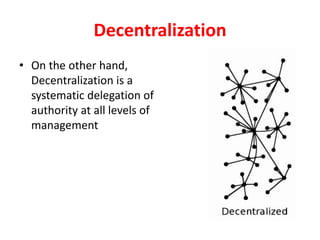
Decentralization
• On the other hand,
Decentralization is a
systematic delegation of
authority at all levels of
management
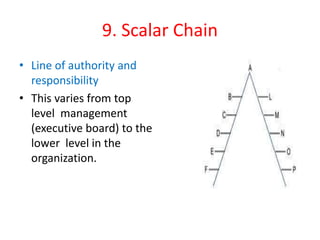
9. Scalar Chain
• Line of authority and
responsibility
• This varies from top
level management
(executive board) to the
lower level in the
organization.
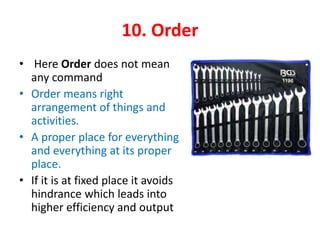
10. Order
• Here Order does not mean
any command
• Order means right
arrangement of things and
activities.
• A proper place for everything
and everything at its proper
place.
• If it is at fixed place it avoids
hindrance which leads into
higher efficiency and output
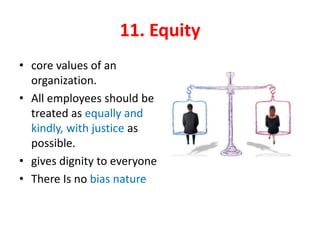
11. Equity
• core values of an
organization.
• All employees should be
treated as equally and
kindly, with justice as
possible.
• gives dignity to everyone
• There Is no bias nature
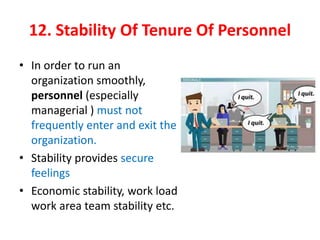
12. Stability Of Tenure Of Personnel
• In order to run an
organization smoothly,
personnel (especially
managerial ) must not
frequently enter and exit the
organization.
• Stability provides secure
feelings
• Economic stability, work load
work area team stability etc.
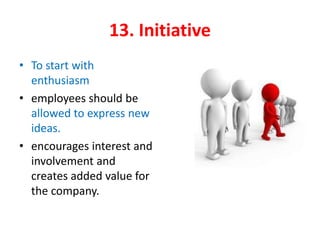
13. Initiative
• To start with
enthusiasm
• employees should be
allowed to express new
ideas.
• encourages interest and
involvement and
creates added value for
the company.
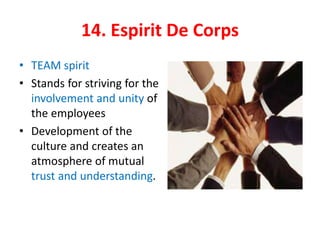
14. Espirit De Corps
• TEAM spirit
• Stands for striving for the
involvement and unity of
the employees
• Development of the
culture and creates an
atmosphere of mutual
trust and understanding.
Scientific Management by F. W. Taylor
• application of a scientific approach to
managerial decision making consisting of-
collection of data, an analysis of data and
basing decisions on the outcome of such
analyses and discarding at the same time, all
unscientific approaches, like – rule of the
thumb, a hit or miss approach and a trial and
error approach.
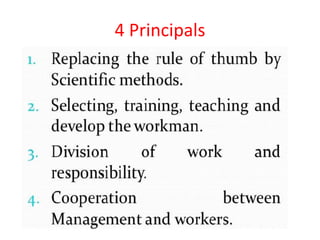
4 Principals
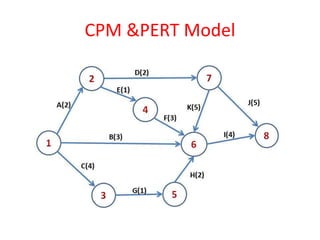
Network Techniques
• CPM-Critical Path Method
• PERT-
PERT is a method of analyzing the tasks involved
in completing a given project, especially the
time needed to complete each task, and to
identify the minimum time needed to complete
the total project
CPM &PERT Model
Advantages Of Scientific Management
Over The Traditional Management
• Plan is more optimistic
• Idle time is reduced
• Suitable men for suitable job
• Effective assignment avoids overlapping of work
• Cost reduction
• Material wastages reduced
• Unnecessary delays avoided
• Directs best method of work
Functions of Management
Planning
Organizing
Staffing
Directing
Controlling
Decision Making
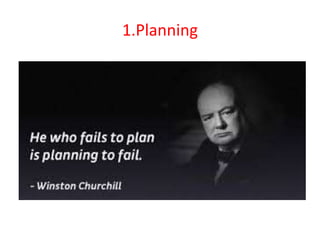
1.Planning
Planning
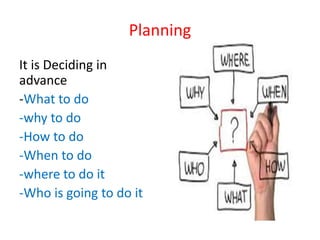
It is Deciding in
advance
-What to do
-why to do
-How to do
-When to do
-where to do it
-Who is going to do it
• Bridges a gap between where we are today
and where we want to reach.
• Planning is necessary to ensure proper
utilization of human & non-human resources.
Why Planning Is Required??
• To reduce effects of uncertainty
• To find out the risks involved
• To focus the objectives of work
• To make process more economical
• To improve the efficiency and effectiveness
• To avoid repetitions of work
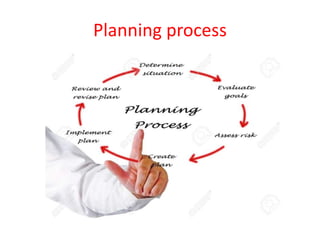
Planning process
Why plan fails??
• No adequate information
• Improper and insufficient actions
• Unrealistic goals
• Planning is done only for plan sake
• Partial commitment
• inadequate resources
2.Organizing
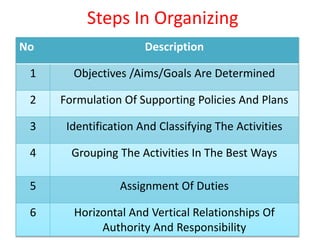
Steps In Organizing
No Description
1 Objectives /Aims/Goals Are Determined
2 Formulation Of Supporting Policies And Plans
3 Identification And Classifying The Activities
4 Grouping The Activities In The Best Ways
5 Assignment Of Duties
6 Horizontal And Vertical Relationships Of
Authority And Responsibility
Importance Of Organizing
• Benefit of specialization
• Provides optimum utilization of recourses
• Effective administration
• Channels expansion and growth
• Co-ordination among different departments
• Scope for new change
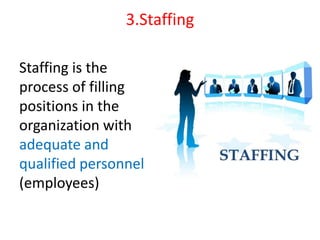
3.Staffing
Staffing is the
process of filling
positions in the
organization with
adequate and
qualified personnel
(employees)
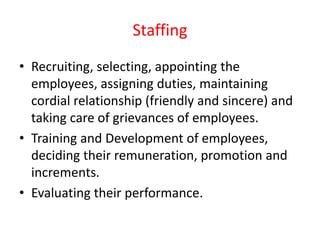
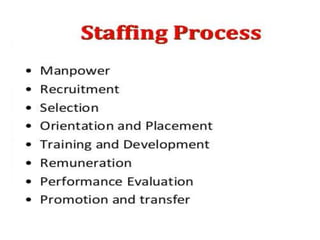
Staffing
• Recruiting, selecting, appointing the
employees, assigning duties, maintaining
cordial relationship (friendly and sincere) and
taking care of grievances of employees.
• Training and Development of employees,
deciding their remuneration, promotion and
increments.
• Evaluating their performance.
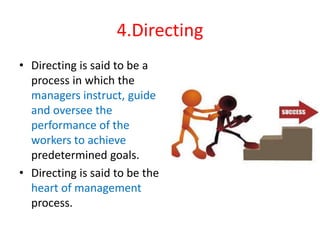
4.Directing
• Directing is said to be a
process in which the
managers instruct, guide
and oversee the
performance of the
workers to achieve
predetermined goals.
• Directing is said to be the
heart of management
process.
Directing
• Giving direction or instruction to employees to
get the job done.
• Leadership qualities are required.
• Communicating with them at regular intervals.
Aspects Of Directing
It deals directly with-
• Supervision
• Leadership
• Motivation
• Communication
• Co-ordination
Of workers to achieve predetermined goals.
Importance Of Directing
• Joins the management and subordinates
• Guidelines to juniors from seniors
• Experience is always gives better in doing
work
• Success rate is more due to valid and correct
direction
• It removes confusion among team members
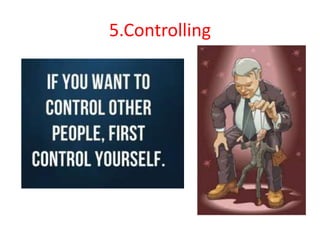
5.Controlling
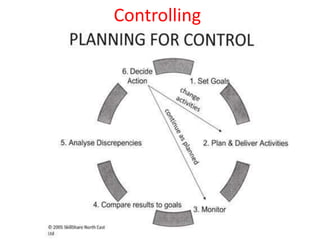
Controlling
Controlling
• Planning is a process by which an
organization's objectives and the methods to
achieve the objectives are established
• Controlling is a process which measures and
directs the actual performance against the
planned goals of the organization.
Controlling
• Main purpose is to avoid deviation in the work
• It primarily needs standards, objectives and
goals
• It decide Criterion Of Performance
• Work on correct track with correct speed is
possible by controlling
Techniques Used For Controlling
• Statically reports
• Audit
• Personal observations
• Budgetary control
• CPM
• PERT
• Breakeven Analysis
Advantages
1. Efficient Execution:
System runs as per rule, as per plan
2. Helps Delegation
3. Simplifies Supervision
4. Aids to Efficiency
• Losses are avoided
• Wastes is minimized
• Proper utilization of Recourses
• Deviation in executed process is reduced
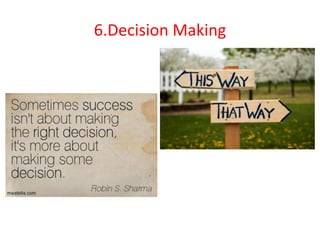
6.Decision Making
Meaning
• Decision-making is
the act of
choosing between
two or more
courses of action.
• In the wider
process of problem-
solving, decision-
making involves
choosing between
possible solutions
to a problem.
Importance
• Correct decisions provide opportunities of
growth while wrong decisions lead to loss and
instability
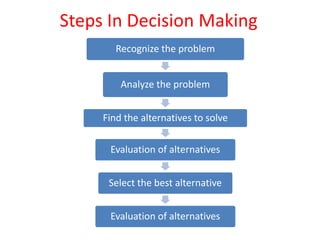
Steps In Decision Making
Recognize the problem
Analyze the problem
Find the alternatives to solve
Evaluation of alternatives
Select the best alternative
Evaluation of alternatives
Types Of Decision
1. Programmed and non-programmed decisions
concerned with the problems of repetitive
nature or routine type matters
2. Routine and strategic decisions
related to the general functioning of the
organization.
3. Strategical (Policy) and operational decisions
• Decisions pertaining to various policy matters
of the organization are policy decisions.
4. Organizational and personal decisions
• When an individual takes decision as an
executive in the official capacity, it is known as
organizational decision.
• Major and minor decisions
• Individual and group decisions
Techniques Used In Decision Making
1. Brainstorming
2. Nominal group technique
3. Multi-voting
4. Delphi method
• brainstorm and submit their ideas anonymously.
Other team members do not know the owner of
the ideas.
• circulates them among others for modifying or
improving them
Advantages Of Decision Making
• actions will not be possible and the resources
will not be put to use.
• Is necessary for planning, organizing, staffing,
coordinating and communicating.
• Follow-up actions are not possible
• To face new problems and challenges.
7.Motivating
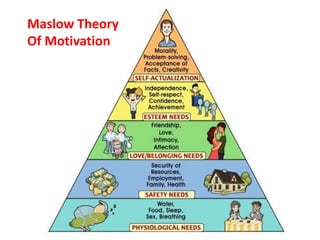
• Motivation in management describes ways in
which managers promote productivity in their
employees
• Energizes people to work more
• Is to increase the will power and encourage to
employee
• Its related with inspiring to do work better
Maslow Theory
Of Motivation
Administration And Management
• Administration means overall determination
of policies, setting of major objectives, the
identification of general purposes and laying
down of broad programs and projects
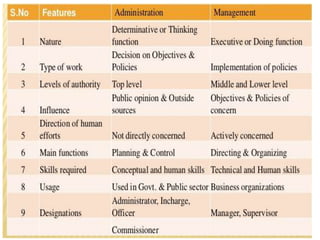
Difference
• Management is all about plans and actions,
but the administration is concerned with
framing policies and setting objectives.
Ch.2 management process

Ch.2 management process

  • 1.
    Welcome Topic 2: ManagementProcess Presented By Mr. J.B.Shirote Lecturer in Mechanical Engineering Department Latthe Education Society’s Polytechnic P-41,M.I.D.C.,Kupwad,Sangli.
  • 2.
    Topic 2: ManagementProcess Specific Objectives • State various management principles • Describe different management functions
  • 3.
    What is Management? Whatis Management? • It is an art of getting work done from others with the help of optimum recourses to achieve desired goals • It is called an art because managing requires certain skills which are personal possessions of managers.
  • 4.
  • 5.
  • 6.
    History • Since last30000 years human being is applying management in his life activities MohenjoDaro Pyramids in Egypt
  • 7.
  • 8.
    Sr.No. Scientist ContributionIn Management Evolution 1 F.W. Taylor (1856-1915) Scientific Management Theory 2 Frank B. Gilbreth Time Study 3 Lillian M. Gilbreth Motion Study 4 Mary Parker Follet Behavioral Management Theory 5 Henri Fayol Principals Of Management 6 Max Weber Bureaucracy 7 Douglas Mcgregor Theory X And Y 8 Moslow Need Of Hierarchy 9 Adam Smith Economist
  • 9.
    1.Scientific Management • Definedby Frederick Taylor, late 1800’s. • Father of scientific management. • The systematic study of the relationships between people and tasks to redesign the work for higher efficiency. • Taylor sought to reduce the time a worker spent on each task by optimizing the way the task was done
  • 10.
    2.Administrative Management Theory •Henri Fayol (1841-1925): Fayol was born in France, where he worked for a coal-mining business. He developed 14 administrative principles for organizational structure and management.
  • 11.
    Bureaucracy • A bureaucracyis an organization made up of many departments and divisions that are administered by lots of people. • Seeks to create an organization that leads to both efficiency and effectiveness. • Max Weber developed the concept of bureaucracy. • A formal system of organization and administration to ensure effectiveness and efficiency
  • 12.
  • 13.
    3.Behavioral Management • Focuseson the way a manager should personally manage to motivate employees. Mary Parker Follett an influential leader in early managerial theory. • Suggested workers help in analyzing their jobs for improvements. • The worker knows the best way to improve the job. • If workers have the knowledge of the task, then they should control the task
  • 14.
    Theory X andY • Social psychologist Douglas McGregor of MIT expounded two contrasting theories on human motivation and management in the 1960s: The X Theory and the Y Theory.
  • 16.
    4.Management Science • ManagementScience is concerned with developing and applying models and concepts that help to illuminate management issues and solve managerial problems. • The models used can often be represented mathematically, but sometimes computer- based, visual or verbal representations are used.
  • 17.
    4.Management Science • Quantitativemanagement: utilizes linear programming, modeling, simulation systems. • Operations management: techniques to analyze all aspects of the production system. • Total Quality Management (TQM): focuses on improved quality. • Management Information Systems (MIS): provides information about the organization.
  • 18.
    5.Organization-Environment Theory • Considersrelationships inside and outside the organization. • The environment consists of forces, conditions, and influences outside the organization. Systems theory considers the impact of stages: • Input: acquire external resources. • Conversion: inputs are processed into goods and services. • Output: finished goods are released into the environment.
  • 19.
    Definitions Of Management Theart of getting things done through people. --Mary Parker Follett
  • 24.
    Management is anart of knowing what is to be done and seeing that it is done in the best possible manner. -F.W.Taylor
  • 25.
    Concept of management •Harbison and Myers offered a classic threefold concept for emphasizing a broader scope for the viewpoint of management. They observe management as (1) an economic resource (2) a system of authority (3) a class or elite(a select group that is superior in terms of ability or qualities to the rest of a group or society.)
  • 27.
  • 29.
    Principles of Management (14principles of Henry Fayol)
  • 30.
    1. Division OfWork: • It is also called Delegation of work • Due to division of work, people gets less variation in work • Extra pressure on very few is avoided • Work gets completed in time with better quality • Results into Functional specialization
  • 31.
    2. Authority • Rightto give orders • Right to command • If authority used in good sense and in positive manner the system works smoothly • Authority can be delegated(divided) • Higher the authority, higher the responsibility
  • 32.
    3. Discipline • Disciplinemeans obedience, respect for authority, and observance of established rules. • Requires for Smooth functioning of organization • No excuses • Starts form top management
  • 33.
    4. Unity OfCommand • One boss principal • Workers should receive orders from only one manager • As soon as two superiors impose their authority over the same person or department, uneasiness makes itself felt. • Dual command is a source of conflict
  • 34.
    5. Unity OfDirection • 'One Head One Plan'. • All the employees having same objective must be directed towards the achievement of the common goal and thus must have one head and one plan • No confusion among the employees
  • 35.
    6. Subordination OfIndividual Interests To The General Interests • This principle states that general interest is superior to the individual interest
  • 36.
    7. Remuneration: • Manypeople work for Remuneration • Reward for employment in the form of pay, salary, or wage, including allowances, benefits (such as company car, medical plan, pension plan), bonuses, cash incentives, and monetary value of the noncash incentives.
  • 37.
    8. Centralization • Centralizationis said to be a process where the concentration of decision making is in a few hands. • lowering the importance of the subordinate role • Does not considered local issues
  • 38.
    Decentralization • On theother hand, Decentralization is a systematic delegation of authority at all levels of management
  • 39.
    9. Scalar Chain •Line of authority and responsibility • This varies from top level management (executive board) to the lower level in the organization.
  • 40.
    10. Order • HereOrder does not mean any command • Order means right arrangement of things and activities. • A proper place for everything and everything at its proper place. • If it is at fixed place it avoids hindrance which leads into higher efficiency and output
  • 41.
    11. Equity • corevalues of an organization. • All employees should be treated as equally and kindly, with justice as possible. • gives dignity to everyone • There Is no bias nature
  • 42.
    12. Stability OfTenure Of Personnel • In order to run an organization smoothly, personnel (especially managerial ) must not frequently enter and exit the organization. • Stability provides secure feelings • Economic stability, work load work area team stability etc.
  • 43.
    13. Initiative • Tostart with enthusiasm • employees should be allowed to express new ideas. • encourages interest and involvement and creates added value for the company.
  • 44.
    14. Espirit DeCorps • TEAM spirit • Stands for striving for the involvement and unity of the employees • Development of the culture and creates an atmosphere of mutual trust and understanding.
  • 45.
    Scientific Management byF. W. Taylor • application of a scientific approach to managerial decision making consisting of- collection of data, an analysis of data and basing decisions on the outcome of such analyses and discarding at the same time, all unscientific approaches, like – rule of the thumb, a hit or miss approach and a trial and error approach.
  • 46.
  • 47.
    Network Techniques • CPM-CriticalPath Method • PERT- PERT is a method of analyzing the tasks involved in completing a given project, especially the time needed to complete each task, and to identify the minimum time needed to complete the total project
  • 48.
  • 49.
    Advantages Of ScientificManagement Over The Traditional Management • Plan is more optimistic • Idle time is reduced • Suitable men for suitable job • Effective assignment avoids overlapping of work • Cost reduction • Material wastages reduced • Unnecessary delays avoided • Directs best method of work
  • 50.
  • 51.
  • 52.
    Planning It is Decidingin advance -What to do -why to do -How to do -When to do -where to do it -Who is going to do it
  • 53.
    • Bridges agap between where we are today and where we want to reach. • Planning is necessary to ensure proper utilization of human & non-human resources.
  • 54.
    Why Planning IsRequired?? • To reduce effects of uncertainty • To find out the risks involved • To focus the objectives of work • To make process more economical • To improve the efficiency and effectiveness • To avoid repetitions of work
  • 55.
  • 56.
    Why plan fails?? •No adequate information • Improper and insufficient actions • Unrealistic goals • Planning is done only for plan sake • Partial commitment • inadequate resources
  • 57.
  • 58.
    Steps In Organizing NoDescription 1 Objectives /Aims/Goals Are Determined 2 Formulation Of Supporting Policies And Plans 3 Identification And Classifying The Activities 4 Grouping The Activities In The Best Ways 5 Assignment Of Duties 6 Horizontal And Vertical Relationships Of Authority And Responsibility
  • 59.
    Importance Of Organizing •Benefit of specialization • Provides optimum utilization of recourses • Effective administration • Channels expansion and growth • Co-ordination among different departments • Scope for new change
  • 60.
    3.Staffing Staffing is the processof filling positions in the organization with adequate and qualified personnel (employees)
  • 61.
    Staffing • Recruiting, selecting,appointing the employees, assigning duties, maintaining cordial relationship (friendly and sincere) and taking care of grievances of employees. • Training and Development of employees, deciding their remuneration, promotion and increments. • Evaluating their performance.
  • 63.
    4.Directing • Directing issaid to be a process in which the managers instruct, guide and oversee the performance of the workers to achieve predetermined goals. • Directing is said to be the heart of management process.
  • 64.
    Directing • Giving directionor instruction to employees to get the job done. • Leadership qualities are required. • Communicating with them at regular intervals.
  • 65.
    Aspects Of Directing Itdeals directly with- • Supervision • Leadership • Motivation • Communication • Co-ordination Of workers to achieve predetermined goals.
  • 67.
    Importance Of Directing •Joins the management and subordinates • Guidelines to juniors from seniors • Experience is always gives better in doing work • Success rate is more due to valid and correct direction • It removes confusion among team members
  • 68.
  • 69.
  • 70.
    Controlling • Planning isa process by which an organization's objectives and the methods to achieve the objectives are established • Controlling is a process which measures and directs the actual performance against the planned goals of the organization.
  • 71.
    Controlling • Main purposeis to avoid deviation in the work • It primarily needs standards, objectives and goals • It decide Criterion Of Performance • Work on correct track with correct speed is possible by controlling
  • 72.
    Techniques Used ForControlling • Statically reports • Audit • Personal observations • Budgetary control • CPM • PERT • Breakeven Analysis
  • 73.
    Advantages 1. Efficient Execution: Systemruns as per rule, as per plan 2. Helps Delegation 3. Simplifies Supervision 4. Aids to Efficiency • Losses are avoided • Wastes is minimized • Proper utilization of Recourses • Deviation in executed process is reduced
  • 74.
  • 75.
    Meaning • Decision-making is theact of choosing between two or more courses of action. • In the wider process of problem- solving, decision- making involves choosing between possible solutions to a problem.
  • 76.
    Importance • Correct decisionsprovide opportunities of growth while wrong decisions lead to loss and instability
  • 77.
    Steps In DecisionMaking Recognize the problem Analyze the problem Find the alternatives to solve Evaluation of alternatives Select the best alternative Evaluation of alternatives
  • 78.
    Types Of Decision 1.Programmed and non-programmed decisions concerned with the problems of repetitive nature or routine type matters 2. Routine and strategic decisions related to the general functioning of the organization.
  • 79.
    3. Strategical (Policy)and operational decisions • Decisions pertaining to various policy matters of the organization are policy decisions. 4. Organizational and personal decisions • When an individual takes decision as an executive in the official capacity, it is known as organizational decision.
  • 80.
    • Major andminor decisions • Individual and group decisions
  • 81.
    Techniques Used InDecision Making 1. Brainstorming 2. Nominal group technique 3. Multi-voting 4. Delphi method • brainstorm and submit their ideas anonymously. Other team members do not know the owner of the ideas. • circulates them among others for modifying or improving them
  • 82.
    Advantages Of DecisionMaking • actions will not be possible and the resources will not be put to use. • Is necessary for planning, organizing, staffing, coordinating and communicating. • Follow-up actions are not possible • To face new problems and challenges.
  • 83.
    7.Motivating • Motivation inmanagement describes ways in which managers promote productivity in their employees • Energizes people to work more • Is to increase the will power and encourage to employee • Its related with inspiring to do work better
  • 85.
  • 86.
    Administration And Management •Administration means overall determination of policies, setting of major objectives, the identification of general purposes and laying down of broad programs and projects
  • 87.
    Difference • Management isall about plans and actions, but the administration is concerned with framing policies and setting objectives.