Software Project Management
Lecture # 2
Outline
 Chapter 21- Project Management
 The Management Spectrum (4 Ps in
Project Management)
 Detailed discussion on each P
 W5
HH Principle
4P’s in Project Management
Spectrum
 People
 Product
 Process
 Project
The People
People…
 …the most important factor in success of
software project.
 “Companies That sensibly manage their
investment in people will prosper in the long
run” Tim & Tom.
 Cultivation of motivated and highly skilled
software people has always been important
for software organizations.
 The “people-factor” is so important that SEI
has developed People Management
Capability Maturity Model (PM-CMM).
PM-CMM
 Developed by SEI
 “to enhance the readiness of s/w organizations
to undertake increasingly complex applications
by helping to attract, grow, motivate, deploy, and
retain the talent needed to improve their
software development capability”
 In simple words - to enhance the people’s
capabilities through personnel development
 Organizations that achieve high levels of maturity in
PM-CMM have a higher likelihood of implementing
effective software engineering practices
PM-CMM (Contd.)
 Key Practice Areas of PM-CMM
 Recruiting
 Selection
 Performance Management
 Training
 Compensation
 Career development
 Organization and work design
 Team/culture development
People Involved in Software
Process
 Stakeholders
 Team Leaders
 Software Team
 Agile Teams
People Involved in Software
Process
 The Stakeholders
 They can be categorized into one of the following
 Senior Managers
 they define business issues that often have significant influence on
business
 Project (technical) managers
 they must plan, motivate, organize and control the practitioners who
do software work
 Practitioners
 They deliver the technical skills necessary to engineer a product or
application
 Customers
 They specify the requirements for the software to be engineered
 End Users
 They interact with the software after it is released for production use
People Involved in Software
Process
 The Team Leaders
 Competent Practitioners often make poor team
leaders as they lack the right mix of skills
 In his excellent book of technical leadership,
Jerry Weinberg suggests a MOI model of
leadership MOI Model of Leadership
 Motivation
 encourage technical people (by “push” or “pull” ) to
produce
 Organization
 Apply , improve processes efficiently
 Ideas or Innovation
 Make people feel creative
 Be Creative
People Involved in Software
Process
 The Team Leaders (Contd.) - Characteristics of a
effective project managers:
 Problem Solving
 Diagnostic
 Skill to solve
 Ability to design solution
 Managerial Identity
 Control the project
 Achievement
 Reward Initiative
 Encourage Controlled risk taking
 Influence and team building
 Influence the team
 Read people’s mind and respond according to their needs
 Be controlled in stress situations
People Involved in Software
Process
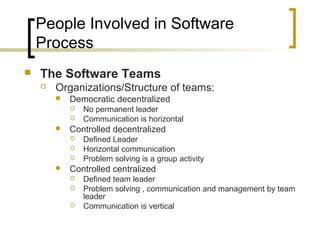
 The Software Teams
 Organizations/Structure of teams:
 Democratic decentralized
 No permanent leader
 Communication is horizontal
 Controlled decentralized
 Defined Leader
 Horizontal communication
 Problem solving is a group activity
 Controlled centralized
 Defined team leader
 Problem solving , communication and management by team
leader
 Communication is vertical
People Involved in Software
Process
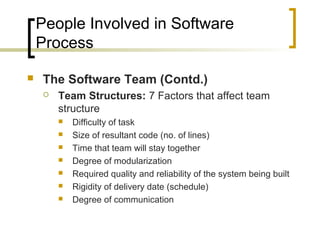
 The Software Team (Contd.)
 Team Structures: 7 Factors that affect team
structure
 Difficulty of task
 Size of resultant code (no. of lines)
 Time that team will stay together
 Degree of modularization
 Required quality and reliability of the system being built
 Rigidity of delivery date (schedule)
 Degree of communication
Reading assignment
 Pg. 634 (6th
edition)
 Organizational paradigms suggested by
Constantine
 Pg. 636(6th
edition)
 Agile Teams
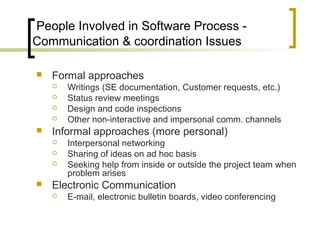
People Involved in Software Process -
Communication & coordination Issues
 Formal approaches
 Writings (SE documentation, Customer requests, etc.)
 Status review meetings
 Design and code inspections
 Other non-interactive and impersonal comm. channels
 Informal approaches (more personal)
 Interpersonal networking
 Sharing of ideas on ad hoc basis
 Seeking help from inside or outside the project team when
problem arises
 Electronic Communication
 E-mail, electronic bulletin boards, video conferencing
The Product
The Product
 The product and the problem it is intended
to solve must be examined at very
beginning of the software project.
 The scope of product must be established
and bounded.
 Bounded scope means
 establishing quantitative data like no. of simultaneous
users, max. allowable response time. etc.
 Constraints and limitations
 The problem that the product is addressing
must be decomposed
Software scope
 Scope is defined by
 Context (1st
step in scope determination)
 Functional location of the software product into a large
system, product or business context
 Constraints involved
 Information Objectives (2nd step)
 What data objects are required as i/p or o/p
 Function and Performance (3rd step)
 What function does the software system perform on i/p to
produce o/p
 What level of performance is required
Problem Decomposition
 Also called partitioning OR problem
elaboration
 This activity is at core of requirements
analysis
 Divide and conquer policy for complex
problems
 Decompose problem in tasks
 Decomposition in 2 major areas
 Functionality that must be delivered
 Process that will be used to deliver product
Problem Decomposition (Contd.)
 A complex problem is partitioned into
smaller problems that are more
manageable.
 Decomposition make planning easier.
 Software functions, defined in scope, are
evaluated and refined to provide more detail
before estimation (part of planning) begins.
The Process
Common Process Framework
Activities
 These characterize a software process and
are applicable to all software projects
 Communication
 Planning
 Modeling
 Construction
 Deployment
 These are applied to software engineering
work tasks (e.g., different product functions)
 Refer to book page 640 – fig. 21.1
The Process Models
 Different process models:
 Linear sequential, Prototyping, RAD, Spiral,
Formal …
 Project manager must decide about which
model to use depending on
 Customers who have requested the product
 People who would work on project
 Product characteristics
 Project environment
 Project planning begins once model is
selected
Process decomposition
 The way a process is decomposed
depends on project complexity
 Decomposition involves outlining of
work tasks involved in each process
framework activity
The Project
Signs of Projects Risk
 Software people don’t understand
customer needs
 Product scope is poorly defined
 Changes are managed poorly
 The chosen technology changes
 Business needs change
 Deadlines are unrealistic
Signs of Projects Risk
(Cont…)
 Users are resistant
 Sponsorship is lost
 Team lacks skills
 Managers avoid best practices
How to avoid problems?
 Start on the right foot
 Involves detailed understanding of project
 setting realistic objectives & expectations
 Selecting the right team
 Facilitating the team
 Maintain Momentum
 Provide incentives
 Reduce bureaucracy and give autonomy to team
members but with supervision
 Track Progress
 Assess progress as work products are produced
How to avoid problems? (Contd..)
 Make smart decisions
 When possible, use existing software components / COTS
software
 Choose standard approaches and keep it simple
 Avoid risks and allocate more time than needed for
complex/risky tasks
 Conduct a postmortem analysis
 Compare planned and actual schedule
 Collect and analyze project metrics (standards)
 Get feedback from team and customers
 Establish record of lessons learnt for each project
W5
HH Principle
About the principle
 Suggested by Barry Boehm in one of his papers
 Excellent planning outline for project managers
and software team
 Applicable to all sizes of software projects
 It is an approach to address
 project objectives
 Milestones & schedule
 Responsibilities
 Management & technical approaches
 Required resources
W5
HH principle
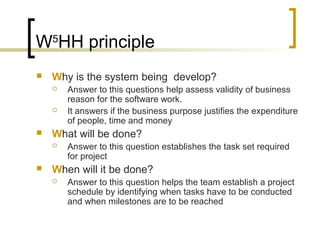
 Why is the system being develop?
 Answer to this questions help assess validity of business
reason for the software work.
 It answers if the business purpose justifies the expenditure
of people, time and money
 What will be done?
 Answer to this question establishes the task set required
for project
 When will it be done?
 Answer to this question helps the team establish a project
schedule by identifying when tasks have to be conducted
and when milestones are to be reached
W5
HH principle (Contd.)
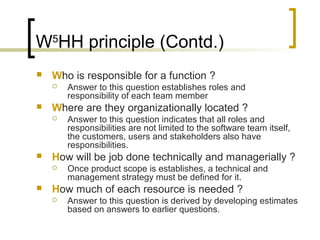
 Who is responsible for a function ?
 Answer to this question establishes roles and
responsibility of each team member
 Where are they organizationally located ?
 Answer to this question indicates that all roles and
responsibilities are not limited to the software team itself,
the customers, users and stakeholders also have
responsibilities.
 How will be job done technically and managerially ?
 Once product scope is establishes, a technical and
management strategy must be defined for it.
 How much of each resource is needed ?
 Answer to this question is derived by developing estimates
based on answers to earlier questions.
THE END

Lecture2 2

  • 1.
  • 2.
    Outline  Chapter 21-Project Management  The Management Spectrum (4 Ps in Project Management)  Detailed discussion on each P  W5 HH Principle
  • 3.
    4P’s in ProjectManagement Spectrum  People  Product  Process  Project
  • 4.
  • 5.
    People…  …the mostimportant factor in success of software project.  “Companies That sensibly manage their investment in people will prosper in the long run” Tim & Tom.  Cultivation of motivated and highly skilled software people has always been important for software organizations.  The “people-factor” is so important that SEI has developed People Management Capability Maturity Model (PM-CMM).
  • 6.
    PM-CMM  Developed bySEI  “to enhance the readiness of s/w organizations to undertake increasingly complex applications by helping to attract, grow, motivate, deploy, and retain the talent needed to improve their software development capability”  In simple words - to enhance the people’s capabilities through personnel development  Organizations that achieve high levels of maturity in PM-CMM have a higher likelihood of implementing effective software engineering practices
  • 7.
    PM-CMM (Contd.)  KeyPractice Areas of PM-CMM  Recruiting  Selection  Performance Management  Training  Compensation  Career development  Organization and work design  Team/culture development
  • 8.
    People Involved inSoftware Process  Stakeholders  Team Leaders  Software Team  Agile Teams
  • 9.
    People Involved inSoftware Process  The Stakeholders  They can be categorized into one of the following  Senior Managers  they define business issues that often have significant influence on business  Project (technical) managers  they must plan, motivate, organize and control the practitioners who do software work  Practitioners  They deliver the technical skills necessary to engineer a product or application  Customers  They specify the requirements for the software to be engineered  End Users  They interact with the software after it is released for production use
  • 10.
    People Involved inSoftware Process  The Team Leaders  Competent Practitioners often make poor team leaders as they lack the right mix of skills  In his excellent book of technical leadership, Jerry Weinberg suggests a MOI model of leadership MOI Model of Leadership  Motivation  encourage technical people (by “push” or “pull” ) to produce  Organization  Apply , improve processes efficiently  Ideas or Innovation  Make people feel creative  Be Creative
  • 11.
    People Involved inSoftware Process  The Team Leaders (Contd.) - Characteristics of a effective project managers:  Problem Solving  Diagnostic  Skill to solve  Ability to design solution  Managerial Identity  Control the project  Achievement  Reward Initiative  Encourage Controlled risk taking  Influence and team building  Influence the team  Read people’s mind and respond according to their needs  Be controlled in stress situations
  • 12.
    People Involved inSoftware Process  The Software Teams  Organizations/Structure of teams:  Democratic decentralized  No permanent leader  Communication is horizontal  Controlled decentralized  Defined Leader  Horizontal communication  Problem solving is a group activity  Controlled centralized  Defined team leader  Problem solving , communication and management by team leader  Communication is vertical
  • 13.
    People Involved inSoftware Process  The Software Team (Contd.)  Team Structures: 7 Factors that affect team structure  Difficulty of task  Size of resultant code (no. of lines)  Time that team will stay together  Degree of modularization  Required quality and reliability of the system being built  Rigidity of delivery date (schedule)  Degree of communication
  • 14.
    Reading assignment  Pg.634 (6th edition)  Organizational paradigms suggested by Constantine  Pg. 636(6th edition)  Agile Teams
  • 15.
    People Involved inSoftware Process - Communication & coordination Issues  Formal approaches  Writings (SE documentation, Customer requests, etc.)  Status review meetings  Design and code inspections  Other non-interactive and impersonal comm. channels  Informal approaches (more personal)  Interpersonal networking  Sharing of ideas on ad hoc basis  Seeking help from inside or outside the project team when problem arises  Electronic Communication  E-mail, electronic bulletin boards, video conferencing
  • 16.
  • 17.
    The Product  Theproduct and the problem it is intended to solve must be examined at very beginning of the software project.  The scope of product must be established and bounded.  Bounded scope means  establishing quantitative data like no. of simultaneous users, max. allowable response time. etc.  Constraints and limitations  The problem that the product is addressing must be decomposed
  • 18.
    Software scope  Scopeis defined by  Context (1st step in scope determination)  Functional location of the software product into a large system, product or business context  Constraints involved  Information Objectives (2nd step)  What data objects are required as i/p or o/p  Function and Performance (3rd step)  What function does the software system perform on i/p to produce o/p  What level of performance is required
  • 19.
    Problem Decomposition  Alsocalled partitioning OR problem elaboration  This activity is at core of requirements analysis  Divide and conquer policy for complex problems  Decompose problem in tasks  Decomposition in 2 major areas  Functionality that must be delivered  Process that will be used to deliver product
  • 20.
    Problem Decomposition (Contd.) A complex problem is partitioned into smaller problems that are more manageable.  Decomposition make planning easier.  Software functions, defined in scope, are evaluated and refined to provide more detail before estimation (part of planning) begins.
  • 21.
  • 22.
    Common Process Framework Activities These characterize a software process and are applicable to all software projects  Communication  Planning  Modeling  Construction  Deployment  These are applied to software engineering work tasks (e.g., different product functions)  Refer to book page 640 – fig. 21.1
  • 23.
    The Process Models Different process models:  Linear sequential, Prototyping, RAD, Spiral, Formal …  Project manager must decide about which model to use depending on  Customers who have requested the product  People who would work on project  Product characteristics  Project environment  Project planning begins once model is selected
  • 24.
    Process decomposition  Theway a process is decomposed depends on project complexity  Decomposition involves outlining of work tasks involved in each process framework activity
  • 25.
  • 26.
    Signs of ProjectsRisk  Software people don’t understand customer needs  Product scope is poorly defined  Changes are managed poorly  The chosen technology changes  Business needs change  Deadlines are unrealistic
  • 27.
    Signs of ProjectsRisk (Cont…)  Users are resistant  Sponsorship is lost  Team lacks skills  Managers avoid best practices
  • 28.
    How to avoidproblems?  Start on the right foot  Involves detailed understanding of project  setting realistic objectives & expectations  Selecting the right team  Facilitating the team  Maintain Momentum  Provide incentives  Reduce bureaucracy and give autonomy to team members but with supervision  Track Progress  Assess progress as work products are produced
  • 29.
    How to avoidproblems? (Contd..)  Make smart decisions  When possible, use existing software components / COTS software  Choose standard approaches and keep it simple  Avoid risks and allocate more time than needed for complex/risky tasks  Conduct a postmortem analysis  Compare planned and actual schedule  Collect and analyze project metrics (standards)  Get feedback from team and customers  Establish record of lessons learnt for each project
  • 30.
  • 31.
    About the principle Suggested by Barry Boehm in one of his papers  Excellent planning outline for project managers and software team  Applicable to all sizes of software projects  It is an approach to address  project objectives  Milestones & schedule  Responsibilities  Management & technical approaches  Required resources
  • 32.
    W5 HH principle  Whyis the system being develop?  Answer to this questions help assess validity of business reason for the software work.  It answers if the business purpose justifies the expenditure of people, time and money  What will be done?  Answer to this question establishes the task set required for project  When will it be done?  Answer to this question helps the team establish a project schedule by identifying when tasks have to be conducted and when milestones are to be reached
  • 33.
    W5 HH principle (Contd.) Who is responsible for a function ?  Answer to this question establishes roles and responsibility of each team member  Where are they organizationally located ?  Answer to this question indicates that all roles and responsibilities are not limited to the software team itself, the customers, users and stakeholders also have responsibilities.  How will be job done technically and managerially ?  Once product scope is establishes, a technical and management strategy must be defined for it.  How much of each resource is needed ?  Answer to this question is derived by developing estimates based on answers to earlier questions.
  • 34.