Chapter 14 – Security Engineering
Lecture 1
Chapter 14 Security Engineering 1
Topics covered
 Security engineering and security management
 Security engineering concerned with applications; security
management with infrastructure.
 Security risk assessment
 Designing a system based on the assessment of security risks.
 Design for security
 How system architectures have to be designed for security.
Chapter 14 Security Engineering 2
Security engineering
 Tools, techniques and methods to support the
development and maintenance of systems that can resist
malicious attacks that are intended to damage a
computer-based system or its data.
 A sub-field of the broader field of computer security.
 Assumes background knowledge of dependability and
security concepts (Chapter 10) and security
requirements specification (Chapter 12)
Chapter 14 Security Engineering 3
Application/infrastructure security
 Application security is a software engineering problem
where the system is designed to resist attacks.
 Infrastructure security is a systems management
problem where the infrastructure is configured to resist
attacks.
 The focus of this chapter is application security.
Chapter 14 Security Engineering 4
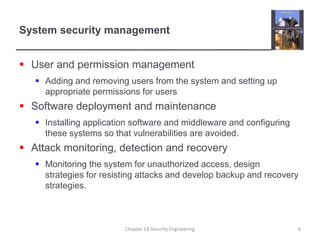
System layers where security may be
compromised
Chapter 14 Security Engineering 5
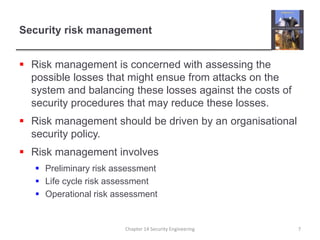
System security management
 User and permission management
 Adding and removing users from the system and setting up
appropriate permissions for users
 Software deployment and maintenance
 Installing application software and middleware and configuring
these systems so that vulnerabilities are avoided.
 Attack monitoring, detection and recovery
 Monitoring the system for unauthorized access, design
strategies for resisting attacks and develop backup and recovery
strategies.
Chapter 14 Security Engineering 6
Security risk management
 Risk management is concerned with assessing the
possible losses that might ensue from attacks on the
system and balancing these losses against the costs of
security procedures that may reduce these losses.
 Risk management should be driven by an organisational
security policy.
 Risk management involves
 Preliminary risk assessment
 Life cycle risk assessment
 Operational risk assessment
Chapter 14 Security Engineering 7
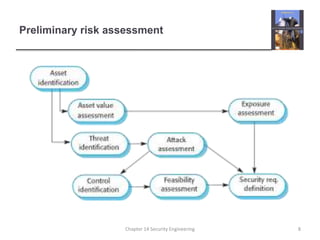
Preliminary risk assessment
Chapter 14 Security Engineering 8
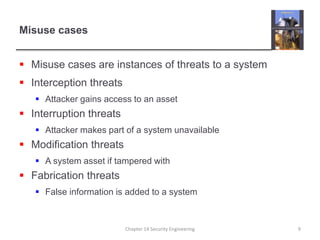
Misuse cases
 Misuse cases are instances of threats to a system
 Interception threats
 Attacker gains access to an asset
 Interruption threats
 Attacker makes part of a system unavailable
 Modification threats
 A system asset if tampered with
 Fabrication threats
 False information is added to a system
Chapter 14 Security Engineering 9
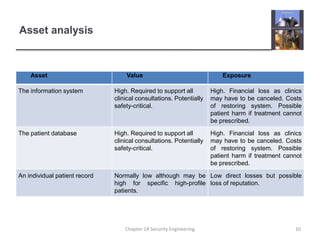
Asset analysis
Chapter 14 Security Engineering 10
Asset Value Exposure
The information system High. Required to support all
clinical consultations. Potentially
safety-critical.
High. Financial loss as clinics
may have to be canceled. Costs
of restoring system. Possible
patient harm if treatment cannot
be prescribed.
The patient database High. Required to support all
clinical consultations. Potentially
safety-critical.
High. Financial loss as clinics
may have to be canceled. Costs
of restoring system. Possible
patient harm if treatment cannot
be prescribed.
An individual patient record Normally low although may be
high for specific high-profile
patients.
Low direct losses but possible
loss of reputation.
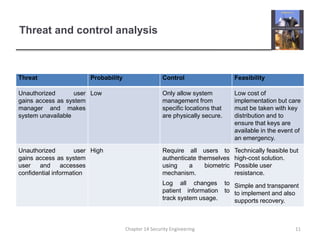
Threat and control analysis
Chapter 14 Security Engineering 11
Threat Probability Control Feasibility
Unauthorized user
gains access as system
manager and makes
system unavailable
Low Only allow system
management from
specific locations that
are physically secure.
Low cost of
implementation but care
must be taken with key
distribution and to
ensure that keys are
available in the event of
an emergency.
Unauthorized user
gains access as system
user and accesses
confidential information
High Require all users to
authenticate themselves
using a biometric
mechanism.
Log all changes to
patient information to
track system usage.
Technically feasible but
high-cost solution.
Possible user
resistance.
Simple and transparent
to implement and also
supports recovery.
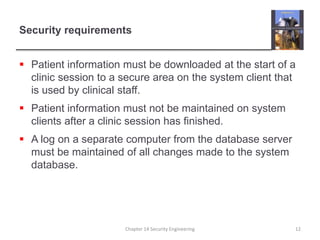
Security requirements
 Patient information must be downloaded at the start of a
clinic session to a secure area on the system client that
is used by clinical staff.
 Patient information must not be maintained on system
clients after a clinic session has finished.
 A log on a separate computer from the database server
must be maintained of all changes made to the system
database.
Chapter 14 Security Engineering 12
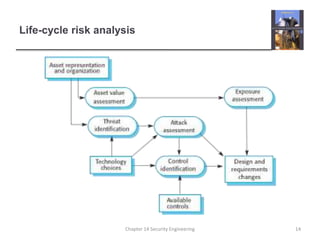
Life cycle risk assessment
 Risk assessment while the system is being developed
and after it has been deployed
 More information is available - system platform,
middleware and the system architecture and data
organisation.
 Vulnerabilities that arise from design choices may
therefore be identified.
Chapter 14 Security Engineering 13
Life-cycle risk analysis
Chapter 14 Security Engineering 14
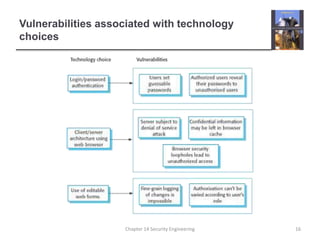
Design decisions from use of COTS
 System users authenticated using a name/password
combination.
 The system architecture is client-server with clients
accessing the system through a standard web browser.
 Information is presented as an editable web form.
Chapter 14 Security Engineering 15
Vulnerabilities associated with technology
choices
Chapter 14 Security Engineering 16
Security requirements
 A password checker shall be made available and shall
be run daily. Weak passwords shall be reported to
system administrators.
 Access to the system shall only be allowed by approved
client computers.
 All client computers shall have a single, approved web
browser installed by system administrators.
Chapter 14 Security Engineering 17
Operational risk assessment
 Continuation of life cycle risk assessment but with
additional information about the environment where the
system is used.
 Environment characteristics can lead to new system
risks
 Risk of interruption means that logged in computers are left
unattended.
Chapter 14 Security Engineering 18
Design for security
 Architectural design
 how do architectural design decisions affect the security of a
system?
 Good practice
 what is accepted good practice when designing secure systems?
 Design for deployment
 what support should be designed into a system to avoid the
introduction of vulnerabilities when a system is deployed for
use?
Chapter 14 Security Engineering 19
Architectural design
 Two fundamental issues have to be considered when
designing an architecture for security.
 Protection
• How should the system be organised so that critical assets can be
protected against external attack?
 Distribution
• How should system assets be distributed so that the effects of a
successful attack are minimized?
 These are potentially conflicting
 If assets are distributed, then they are more expensive to protect.
If assets are protected, then usability and performance
requirements may be compromised.
Chapter 14 Security Engineering 20
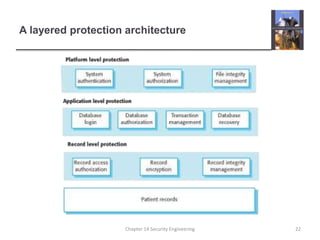
Protection
 Platform-level protection
 Top-level controls on the platform on which a system runs.
 Application-level protection
 Specific protection mechanisms built into the application itself
e.g. additional password protection.
 Record-level protection
 Protection that is invoked when access to specific information is
requested
 These lead to a layered protection architecture
Chapter 14 Security Engineering 21
A layered protection architecture
Chapter 14 Security Engineering 22
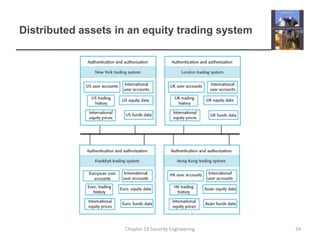
Distribution
 Distributing assets means that attacks on one system do
not necessarily lead to complete loss of system service
 Each platform has separate protection features and may
be different from other platforms so that they do not
share a common vulnerability
 Distribution is particularly important if the risk of denial of
service attacks is high
Chapter 14 Security Engineering 23
Distributed assets in an equity trading system
Chapter 14 Security Engineering 24
Key points
 Security engineering is concerned with how to develop
systems that can resist malicious attacks
 Security threats can be threats to confidentiality, integrity
or availability of a system or its data
 Security risk management is concerned with assessing
possible losses from attacks and deriving security
requirements to minimise losses
 Design for security involves architectural design,
following good design practice and minimising the
introduction of system vulnerabilities
Chapter 14 Security Engineering 25
Chapter 14 – Security Engineering
Lecture 2
Chapter 14 Security Engineering 26
Topics covered
 Design guidelines for security
 Guidelines that help you design a secure system
 Design for deployment
 Design so that deployment problems that may introduce
vulnerabilities are minimized
 System survivability
 Allow the system to deliver essential services when under attack
Chapter 14 Security Engineering 27
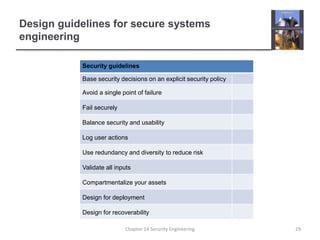
Design guidelines for security engineering
 Design guidelines encapsulate good practice in secure
systems design
 Design guidelines serve two purposes:
 They raise awareness of security issues in a software
engineering team. Security is considered when design decisions
are made.
 They can be used as the basis of a review checklist that is
applied during the system validation process.
 Design guidelines here are applicable during software
specification and design
Chapter 14 Security Engineering 28
Design guidelines for secure systems
engineering
Security guidelines
Base security decisions on an explicit security policy
Avoid a single point of failure
Fail securely
Balance security and usability
Log user actions
Use redundancy and diversity to reduce risk
Validate all inputs
Compartmentalize your assets
Design for deployment
Design for recoverability
Chapter 14 Security Engineering 29
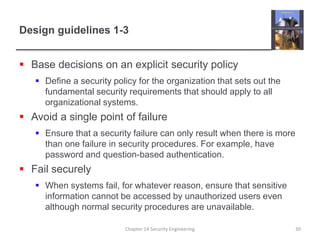
Design guidelines 1-3
 Base decisions on an explicit security policy
 Define a security policy for the organization that sets out the
fundamental security requirements that should apply to all
organizational systems.
 Avoid a single point of failure
 Ensure that a security failure can only result when there is more
than one failure in security procedures. For example, have
password and question-based authentication.
 Fail securely
 When systems fail, for whatever reason, ensure that sensitive
information cannot be accessed by unauthorized users even
although normal security procedures are unavailable.
Chapter 14 Security Engineering 30
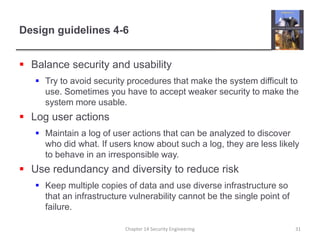
Design guidelines 4-6
 Balance security and usability
 Try to avoid security procedures that make the system difficult to
use. Sometimes you have to accept weaker security to make the
system more usable.
 Log user actions
 Maintain a log of user actions that can be analyzed to discover
who did what. If users know about such a log, they are less likely
to behave in an irresponsible way.
 Use redundancy and diversity to reduce risk
 Keep multiple copies of data and use diverse infrastructure so
that an infrastructure vulnerability cannot be the single point of
failure.
Chapter 14 Security Engineering 31
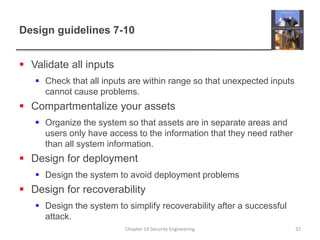
Design guidelines 7-10
 Validate all inputs
 Check that all inputs are within range so that unexpected inputs
cannot cause problems.
 Compartmentalize your assets
 Organize the system so that assets are in separate areas and
users only have access to the information that they need rather
than all system information.
 Design for deployment
 Design the system to avoid deployment problems
 Design for recoverability
 Design the system to simplify recoverability after a successful
attack.
Chapter 14 Security Engineering 32
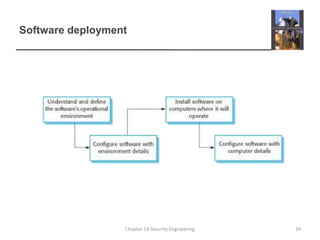
Design for deployment
 Deployment involves configuring software to operate in
its working environment, installing the system and
configuring it for the operational platform.
 Vulnerabilities may be introduced at this stage as a result
of configuration mistakes.
 Designing deployment support into the system can
reduce the probability that vulnerabilities will be
introduced.
Chapter 14 Security Engineering 33
Software deployment
Chapter 14 Security Engineering 34
Configuration vulnerabilities
 Vulnerable default settings
 Attackers can find out the default settings for software. If these
are weak (often to increase usability) then they can be exploited
by users when attacking a system.
 Development rather than deployment
 Some configuration settings in systems are designed to support
development and debugging. If these are not turned off, they can
be a vulnerability that can be exploited by attackers.
Chapter 14 Security Engineering 35
Deployment support 1
 Include support for viewing and analyzing configurations
 Make sure that the system administrator responsible for
deployment can easily view the entire configuration. This makes
it easier to spot omissions and errors that have been made.
 Minimize default privileges and thus limit the damage
that might be caused
 Design the system so that the default privileges for an
administrator are minimized. This means that if someone gains
admin access, they do not have immediate access to the
features of the system.
Chapter 14 Security Engineering 36
Deployment support 2
 Localize configuration settings
 When setting up a system, all information that is relevant to the
same part or component of a system should be localized so that
it is all set up at once. Otherwise, it is easy to forget to set up
related security features.
 Provide easy ways to fix security vulnerabilities
 When problems are detected, provide easy ways, such as auto-
updating, to repair security vulnerabilities in the deployed
systems.
Chapter 14 Security Engineering 37
System survivability
 Survivability is an emergent system property that reflects
the systems ability to deliver essential services whilst it is
under attack or after part of the system has been
damaged
 Survivability analysis and design should be part of the
security engineering process
Chapter 14 Security Engineering 38
Importance of survivability
 Our economic and social lives are dependent on
computer systems
 Critical infrastructure – electricity, gas, telecommunications,
transport
 Healthcare
 Government
 Loss of business systems for even a short time can have
very severe economic effects
 Airline reservation systems
 E-commerce systems
 Payment systems
Chapter 14 Security Engineering 39
Service availability
 Which system services are the most critical for a
business?
 How might these services be compromised?
 What is the minimal quality of service that must be
maintained?
 How can these services be protected?
 If a service becomes unavailable, how quickly can it be
recovered?
Chapter 14 Security Engineering 40
Survivability strategies
 Resistance
 Avoiding problems by building capabilities into the system to
resist attacks
 Recognition
 Detecting problems by building capabilities into the system to
detect attacks and failures and assess the resultant damage
 Recovery
 Tolerating problems by building capabilities into the system to
deliver services whilst under attack
Chapter 14 Security Engineering 41
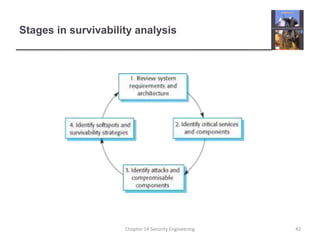
Stages in survivability analysis
Chapter 14 Security Engineering 42
Key activities
 System understanding
 Review golas, requirements and architecture
 Critical service identification
 Identify services that must be maintained
 Attack simulation
 Devise attack scenarios and identify components affected
 Survivability analysis
 Identify survivability strategies to be applied
Chapter 14 Security Engineering 43
Trading system survivability
 User accounts and equity prices replicated across
servers so some provision for survivability made
 Key capability to be maintained is the ability to place
orders for stock
 Orders must be accurate and reflect the actual
sales/purchases made by a trader
Chapter 14 Security Engineering 44
Survivable ordering service
 The critical service that must survive is the ability for
authorized users to place orders for stock
 This requires 3 components of the system to be
available and operating reliability:
 User authentication, allowing authorized users to log on to the
system
 Price quotation, allowing buying and selling prices to be quoted
 Order placement, allowing buy and sell orders to be made
Chapter 14 Security Engineering 45
Possible attacks
 Malicious user masquerades as a legitimate user and
places malicious orders for stock, with the aim of causing
problems for the legitimate user
 An unauthorized user corrupts the database of
transactions thus making reconciliation of sales and
purchases impossible
Chapter 14 Security Engineering 46
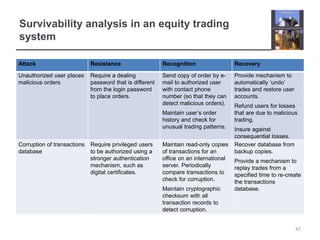
Survivability analysis in an equity trading
system
Attack Resistance Recognition Recovery
Unauthorized user places
malicious orders
Require a dealing
password that is different
from the login password
to place orders.
Send copy of order by e-
mail to authorized user
with contact phone
number (so that they can
detect malicious orders).
Maintain user’s order
history and check for
unusual trading patterns.
Provide mechanism to
automatically ‘undo’
trades and restore user
accounts.
Refund users for losses
that are due to malicious
trading.
Insure against
consequential losses.
Corruption of transactions
database
Require privileged users
to be authorized using a
stronger authentication
mechanism, such as
digital certificates.
Maintain read-only copies
of transactions for an
office on an international
server. Periodically
compare transactions to
check for corruption.
Maintain cryptographic
checksum with all
transaction records to
detect corruption.
Recover database from
backup copies.
Provide a mechanism to
replay trades from a
specified time to re-create
the transactions
database.
47
Key points
 General security guidelines sensitize designers to
security issues and serve as review checklists
 Configuration visualization, setting localization, and
minimization of default privileges help reduce
deployment errors
 System survivability reflects the ability of a system to
deliver services whilst under attack or after part of the
system has been damaged.
Chapter 14 Security Engineering 48

Ch14

  • 1.
    Chapter 14 –Security Engineering Lecture 1 Chapter 14 Security Engineering 1
  • 2.
    Topics covered  Securityengineering and security management  Security engineering concerned with applications; security management with infrastructure.  Security risk assessment  Designing a system based on the assessment of security risks.  Design for security  How system architectures have to be designed for security. Chapter 14 Security Engineering 2
  • 3.
    Security engineering  Tools,techniques and methods to support the development and maintenance of systems that can resist malicious attacks that are intended to damage a computer-based system or its data.  A sub-field of the broader field of computer security.  Assumes background knowledge of dependability and security concepts (Chapter 10) and security requirements specification (Chapter 12) Chapter 14 Security Engineering 3
  • 4.
    Application/infrastructure security  Applicationsecurity is a software engineering problem where the system is designed to resist attacks.  Infrastructure security is a systems management problem where the infrastructure is configured to resist attacks.  The focus of this chapter is application security. Chapter 14 Security Engineering 4
  • 5.
    System layers wheresecurity may be compromised Chapter 14 Security Engineering 5
  • 6.
    System security management User and permission management  Adding and removing users from the system and setting up appropriate permissions for users  Software deployment and maintenance  Installing application software and middleware and configuring these systems so that vulnerabilities are avoided.  Attack monitoring, detection and recovery  Monitoring the system for unauthorized access, design strategies for resisting attacks and develop backup and recovery strategies. Chapter 14 Security Engineering 6
  • 7.
    Security risk management Risk management is concerned with assessing the possible losses that might ensue from attacks on the system and balancing these losses against the costs of security procedures that may reduce these losses.  Risk management should be driven by an organisational security policy.  Risk management involves  Preliminary risk assessment  Life cycle risk assessment  Operational risk assessment Chapter 14 Security Engineering 7
  • 8.
    Preliminary risk assessment Chapter14 Security Engineering 8
  • 9.
    Misuse cases  Misusecases are instances of threats to a system  Interception threats  Attacker gains access to an asset  Interruption threats  Attacker makes part of a system unavailable  Modification threats  A system asset if tampered with  Fabrication threats  False information is added to a system Chapter 14 Security Engineering 9
  • 10.
    Asset analysis Chapter 14Security Engineering 10 Asset Value Exposure The information system High. Required to support all clinical consultations. Potentially safety-critical. High. Financial loss as clinics may have to be canceled. Costs of restoring system. Possible patient harm if treatment cannot be prescribed. The patient database High. Required to support all clinical consultations. Potentially safety-critical. High. Financial loss as clinics may have to be canceled. Costs of restoring system. Possible patient harm if treatment cannot be prescribed. An individual patient record Normally low although may be high for specific high-profile patients. Low direct losses but possible loss of reputation.
  • 11.
    Threat and controlanalysis Chapter 14 Security Engineering 11 Threat Probability Control Feasibility Unauthorized user gains access as system manager and makes system unavailable Low Only allow system management from specific locations that are physically secure. Low cost of implementation but care must be taken with key distribution and to ensure that keys are available in the event of an emergency. Unauthorized user gains access as system user and accesses confidential information High Require all users to authenticate themselves using a biometric mechanism. Log all changes to patient information to track system usage. Technically feasible but high-cost solution. Possible user resistance. Simple and transparent to implement and also supports recovery.
  • 12.
    Security requirements  Patientinformation must be downloaded at the start of a clinic session to a secure area on the system client that is used by clinical staff.  Patient information must not be maintained on system clients after a clinic session has finished.  A log on a separate computer from the database server must be maintained of all changes made to the system database. Chapter 14 Security Engineering 12
  • 13.
    Life cycle riskassessment  Risk assessment while the system is being developed and after it has been deployed  More information is available - system platform, middleware and the system architecture and data organisation.  Vulnerabilities that arise from design choices may therefore be identified. Chapter 14 Security Engineering 13
  • 14.
    Life-cycle risk analysis Chapter14 Security Engineering 14
  • 15.
    Design decisions fromuse of COTS  System users authenticated using a name/password combination.  The system architecture is client-server with clients accessing the system through a standard web browser.  Information is presented as an editable web form. Chapter 14 Security Engineering 15
  • 16.
    Vulnerabilities associated withtechnology choices Chapter 14 Security Engineering 16
  • 17.
    Security requirements  Apassword checker shall be made available and shall be run daily. Weak passwords shall be reported to system administrators.  Access to the system shall only be allowed by approved client computers.  All client computers shall have a single, approved web browser installed by system administrators. Chapter 14 Security Engineering 17
  • 18.
    Operational risk assessment Continuation of life cycle risk assessment but with additional information about the environment where the system is used.  Environment characteristics can lead to new system risks  Risk of interruption means that logged in computers are left unattended. Chapter 14 Security Engineering 18
  • 19.
    Design for security Architectural design  how do architectural design decisions affect the security of a system?  Good practice  what is accepted good practice when designing secure systems?  Design for deployment  what support should be designed into a system to avoid the introduction of vulnerabilities when a system is deployed for use? Chapter 14 Security Engineering 19
  • 20.
    Architectural design  Twofundamental issues have to be considered when designing an architecture for security.  Protection • How should the system be organised so that critical assets can be protected against external attack?  Distribution • How should system assets be distributed so that the effects of a successful attack are minimized?  These are potentially conflicting  If assets are distributed, then they are more expensive to protect. If assets are protected, then usability and performance requirements may be compromised. Chapter 14 Security Engineering 20
  • 21.
    Protection  Platform-level protection Top-level controls on the platform on which a system runs.  Application-level protection  Specific protection mechanisms built into the application itself e.g. additional password protection.  Record-level protection  Protection that is invoked when access to specific information is requested  These lead to a layered protection architecture Chapter 14 Security Engineering 21
  • 22.
    A layered protectionarchitecture Chapter 14 Security Engineering 22
  • 23.
    Distribution  Distributing assetsmeans that attacks on one system do not necessarily lead to complete loss of system service  Each platform has separate protection features and may be different from other platforms so that they do not share a common vulnerability  Distribution is particularly important if the risk of denial of service attacks is high Chapter 14 Security Engineering 23
  • 24.
    Distributed assets inan equity trading system Chapter 14 Security Engineering 24
  • 25.
    Key points  Securityengineering is concerned with how to develop systems that can resist malicious attacks  Security threats can be threats to confidentiality, integrity or availability of a system or its data  Security risk management is concerned with assessing possible losses from attacks and deriving security requirements to minimise losses  Design for security involves architectural design, following good design practice and minimising the introduction of system vulnerabilities Chapter 14 Security Engineering 25
  • 26.
    Chapter 14 –Security Engineering Lecture 2 Chapter 14 Security Engineering 26
  • 27.
    Topics covered  Designguidelines for security  Guidelines that help you design a secure system  Design for deployment  Design so that deployment problems that may introduce vulnerabilities are minimized  System survivability  Allow the system to deliver essential services when under attack Chapter 14 Security Engineering 27
  • 28.
    Design guidelines forsecurity engineering  Design guidelines encapsulate good practice in secure systems design  Design guidelines serve two purposes:  They raise awareness of security issues in a software engineering team. Security is considered when design decisions are made.  They can be used as the basis of a review checklist that is applied during the system validation process.  Design guidelines here are applicable during software specification and design Chapter 14 Security Engineering 28
  • 29.
    Design guidelines forsecure systems engineering Security guidelines Base security decisions on an explicit security policy Avoid a single point of failure Fail securely Balance security and usability Log user actions Use redundancy and diversity to reduce risk Validate all inputs Compartmentalize your assets Design for deployment Design for recoverability Chapter 14 Security Engineering 29
  • 30.
    Design guidelines 1-3 Base decisions on an explicit security policy  Define a security policy for the organization that sets out the fundamental security requirements that should apply to all organizational systems.  Avoid a single point of failure  Ensure that a security failure can only result when there is more than one failure in security procedures. For example, have password and question-based authentication.  Fail securely  When systems fail, for whatever reason, ensure that sensitive information cannot be accessed by unauthorized users even although normal security procedures are unavailable. Chapter 14 Security Engineering 30
  • 31.
    Design guidelines 4-6 Balance security and usability  Try to avoid security procedures that make the system difficult to use. Sometimes you have to accept weaker security to make the system more usable.  Log user actions  Maintain a log of user actions that can be analyzed to discover who did what. If users know about such a log, they are less likely to behave in an irresponsible way.  Use redundancy and diversity to reduce risk  Keep multiple copies of data and use diverse infrastructure so that an infrastructure vulnerability cannot be the single point of failure. Chapter 14 Security Engineering 31
  • 32.
    Design guidelines 7-10 Validate all inputs  Check that all inputs are within range so that unexpected inputs cannot cause problems.  Compartmentalize your assets  Organize the system so that assets are in separate areas and users only have access to the information that they need rather than all system information.  Design for deployment  Design the system to avoid deployment problems  Design for recoverability  Design the system to simplify recoverability after a successful attack. Chapter 14 Security Engineering 32
  • 33.
    Design for deployment Deployment involves configuring software to operate in its working environment, installing the system and configuring it for the operational platform.  Vulnerabilities may be introduced at this stage as a result of configuration mistakes.  Designing deployment support into the system can reduce the probability that vulnerabilities will be introduced. Chapter 14 Security Engineering 33
  • 34.
    Software deployment Chapter 14Security Engineering 34
  • 35.
    Configuration vulnerabilities  Vulnerabledefault settings  Attackers can find out the default settings for software. If these are weak (often to increase usability) then they can be exploited by users when attacking a system.  Development rather than deployment  Some configuration settings in systems are designed to support development and debugging. If these are not turned off, they can be a vulnerability that can be exploited by attackers. Chapter 14 Security Engineering 35
  • 36.
    Deployment support 1 Include support for viewing and analyzing configurations  Make sure that the system administrator responsible for deployment can easily view the entire configuration. This makes it easier to spot omissions and errors that have been made.  Minimize default privileges and thus limit the damage that might be caused  Design the system so that the default privileges for an administrator are minimized. This means that if someone gains admin access, they do not have immediate access to the features of the system. Chapter 14 Security Engineering 36
  • 37.
    Deployment support 2 Localize configuration settings  When setting up a system, all information that is relevant to the same part or component of a system should be localized so that it is all set up at once. Otherwise, it is easy to forget to set up related security features.  Provide easy ways to fix security vulnerabilities  When problems are detected, provide easy ways, such as auto- updating, to repair security vulnerabilities in the deployed systems. Chapter 14 Security Engineering 37
  • 38.
    System survivability  Survivabilityis an emergent system property that reflects the systems ability to deliver essential services whilst it is under attack or after part of the system has been damaged  Survivability analysis and design should be part of the security engineering process Chapter 14 Security Engineering 38
  • 39.
    Importance of survivability Our economic and social lives are dependent on computer systems  Critical infrastructure – electricity, gas, telecommunications, transport  Healthcare  Government  Loss of business systems for even a short time can have very severe economic effects  Airline reservation systems  E-commerce systems  Payment systems Chapter 14 Security Engineering 39
  • 40.
    Service availability  Whichsystem services are the most critical for a business?  How might these services be compromised?  What is the minimal quality of service that must be maintained?  How can these services be protected?  If a service becomes unavailable, how quickly can it be recovered? Chapter 14 Security Engineering 40
  • 41.
    Survivability strategies  Resistance Avoiding problems by building capabilities into the system to resist attacks  Recognition  Detecting problems by building capabilities into the system to detect attacks and failures and assess the resultant damage  Recovery  Tolerating problems by building capabilities into the system to deliver services whilst under attack Chapter 14 Security Engineering 41
  • 42.
    Stages in survivabilityanalysis Chapter 14 Security Engineering 42
  • 43.
    Key activities  Systemunderstanding  Review golas, requirements and architecture  Critical service identification  Identify services that must be maintained  Attack simulation  Devise attack scenarios and identify components affected  Survivability analysis  Identify survivability strategies to be applied Chapter 14 Security Engineering 43
  • 44.
    Trading system survivability User accounts and equity prices replicated across servers so some provision for survivability made  Key capability to be maintained is the ability to place orders for stock  Orders must be accurate and reflect the actual sales/purchases made by a trader Chapter 14 Security Engineering 44
  • 45.
    Survivable ordering service The critical service that must survive is the ability for authorized users to place orders for stock  This requires 3 components of the system to be available and operating reliability:  User authentication, allowing authorized users to log on to the system  Price quotation, allowing buying and selling prices to be quoted  Order placement, allowing buy and sell orders to be made Chapter 14 Security Engineering 45
  • 46.
    Possible attacks  Malicioususer masquerades as a legitimate user and places malicious orders for stock, with the aim of causing problems for the legitimate user  An unauthorized user corrupts the database of transactions thus making reconciliation of sales and purchases impossible Chapter 14 Security Engineering 46
  • 47.
    Survivability analysis inan equity trading system Attack Resistance Recognition Recovery Unauthorized user places malicious orders Require a dealing password that is different from the login password to place orders. Send copy of order by e- mail to authorized user with contact phone number (so that they can detect malicious orders). Maintain user’s order history and check for unusual trading patterns. Provide mechanism to automatically ‘undo’ trades and restore user accounts. Refund users for losses that are due to malicious trading. Insure against consequential losses. Corruption of transactions database Require privileged users to be authorized using a stronger authentication mechanism, such as digital certificates. Maintain read-only copies of transactions for an office on an international server. Periodically compare transactions to check for corruption. Maintain cryptographic checksum with all transaction records to detect corruption. Recover database from backup copies. Provide a mechanism to replay trades from a specified time to re-create the transactions database. 47
  • 48.
    Key points  Generalsecurity guidelines sensitize designers to security issues and serve as review checklists  Configuration visualization, setting localization, and minimization of default privileges help reduce deployment errors  System survivability reflects the ability of a system to deliver services whilst under attack or after part of the system has been damaged. Chapter 14 Security Engineering 48