Introduction to FileSystems
• File systems
– From users point of view
– Implementation point of view
3.
Introduction…
• File Naming
–Files are an abstraction mechanism.
• They provide a way to store information on the disk and
read it back later.
• This must be done in such a way as to shield the user
from the details of how and where the information is
stored, and how the disks actually work.
– The exact rules for file naming vary somewhat
from system to system
4.
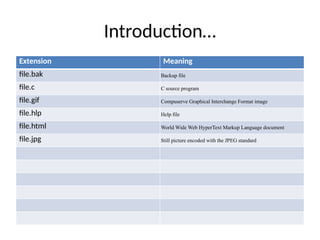
Introduction…
Extension Meaning
file.bak Backupfile
file.c C source program
file.gif Compuserve Graphical Interchange Format image
file.hlp Help file
file.html World Wide Web HyperText Markup Language document
file.jpg Still picture encoded with the JPEG standard
5.
Introduction…
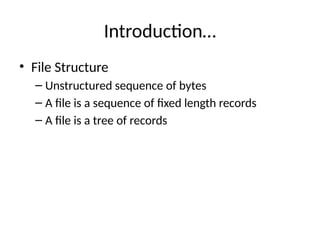
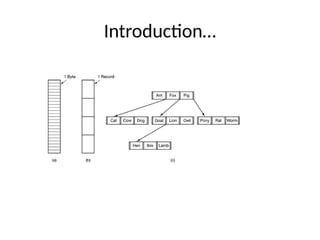
• File Structure
–Unstructured sequence of bytes
– A file is a sequence of fixed length records
– A file is a tree of records
Introduction…
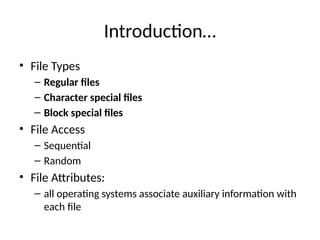
• File Types
–Regular files
– Character special files
– Block special files
• File Access
– Sequential
– Random
• File Attributes:
– all operating systems associate auxiliary information with
each file
8.
Introduction…
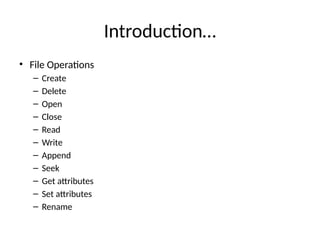
• File Operations
–Create
– Delete
– Open
– Close
– Read
– Write
– Append
– Seek
– Get attributes
– Set attributes
– Rename
9.
Introduction…
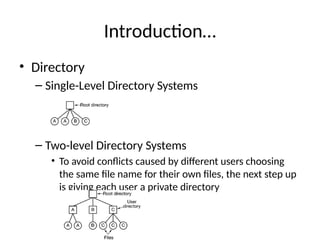
• Directory
– Single-LevelDirectory Systems
– Two-level Directory Systems
• To avoid conflicts caused by different users choosing
the same file name for their own files, the next step up
is giving each user a private directory
10.
Introduction…
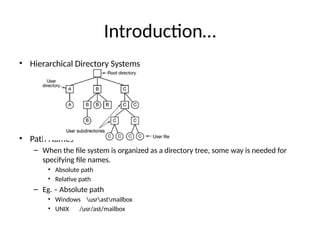
• Hierarchical DirectorySystems
• Path Names
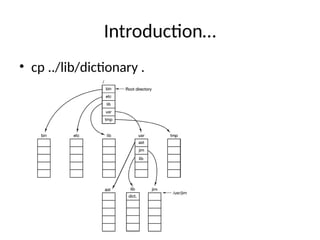
– When the file system is organized as a directory tree, some way is needed for
specifying file names.
• Absolute path
• Relative path
– Eg. – Absolute path
• Windows usrastmailbox
• UNIX /usr/ast/mailbox
File system implementation
•From the user’s view of the file system to the
implementor’s view
• File System Layout
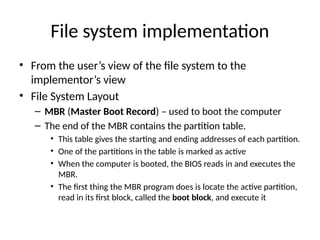
– MBR (Master Boot Record) – used to boot the computer
– The end of the MBR contains the partition table.
• This table gives the starting and ending addresses of each partition.
• One of the partitions in the table is marked as active
• When the computer is booted, the BIOS reads in and executes the
MBR.
• The first thing the MBR program does is locate the active partition,
read in its first block, called the boot block, and execute it
14.
File system implementation…
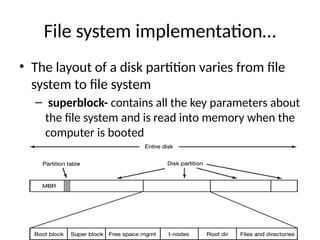
•The layout of a disk partition varies from file
system to file system
– superblock- contains all the key parameters about
the file system and is read into memory when the
computer is booted
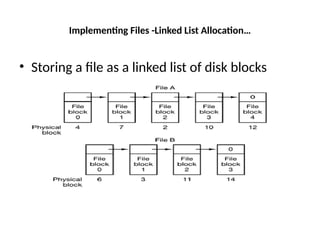
Implementing Files -LinkedList Allocation
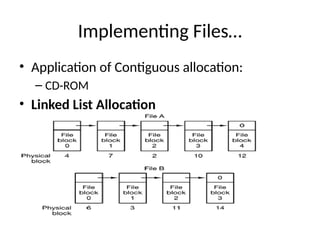
• linked list of disk blocks
• The first word of each block is used as a pointer to
the next one. The rest of the block is for data
• Unlike contiguous allocation, every disk block can
be used in this method
• No space is lost to disk fragmentation (except for
internal fragmentation in the last block).
• The disk address of the first block
– The rest can be found starting there.
18.
Implementing Files -LinkedList Allocation…
• Disadvantages:
– On the other hand, although reading a file
sequentially is straightforward, random access is
extremely slow.
– To get to block n, the operating system has to start
at the beginning and read the n – 1
– Also, the amount of data storage in a block is no
longer a power of two because the pointer takes
up a few bytes.
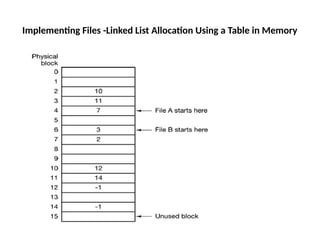
Implementing Files -LinkedList Allocation Using a Table in Memory
• Both disadvantages of the linked list allocation
can be eliminated by taking the pointer word
from each disk block and putting it in a table in
memory.
Implementing Files -LinkedList Allocation…
• Using this organization,
– the entire block is available for data.
– Furthermore, random access is much easier.
– Although the chain must still be followed to find a given
offset within the file, the chain is entirely in memory, so
it can be followed without making any disk references.
• The primary disadvantage of this method is that
the entire table must be in memory all the time to
make it work.
23.
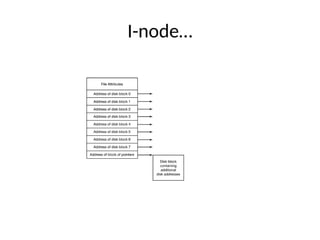
I-node
• Indexed node
–keeping track of which blocks belong to which file.
– which lists the attributes and disk addresses of the
files blocks
– Given the i-node, it is then possible to find all the
blocks of the file.
– The big advantage of this scheme over linked files
using an in-memory table is that the i-node need
only be in memory when the corresponding file is
open.
Directory Implementation
• Beforea file can be read, it must be opened. When a file is
opened, the operating system uses the path name supplied by
the user to locate the directory entry.
• The directory entry provides the information needed to find the
disk blocks.
• Depending on the system, this information may be the disk
address of the entire file (contiguous allocation), the number of
the first block (both linked list schemes), or the number of the i-
node.
• In all cases, the main function of the directory system is to map
the ASCII name of the file onto the information needed to locate
the data.
27.
Directory Implementation…
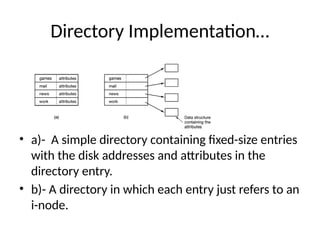
• a)-A simple directory containing fixed-size entries
with the disk addresses and attributes in the
directory entry.
• b)- A directory in which each entry just refers to an
i-node.
28.
Shared Files
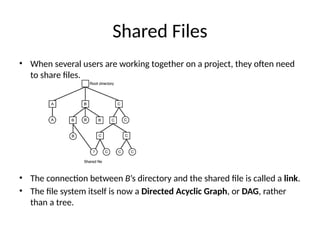
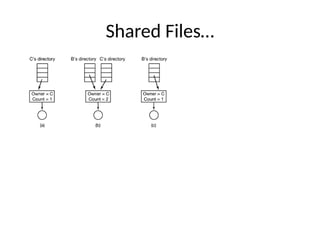
• Whenseveral users are working together on a project, they often need
to share files.
• The connection between B’s directory and the shared file is called a link.
• The file system itself is now a Directed Acyclic Graph, or DAG, rather
than a tree.
Disk Space Management
•Files are normally stored on disk, so
management of disk space is a major concern
to file system designers.
• Strategies
– storing an n byte file: n consecutive bytes of disk
space are allocated,
– file is split up into a number of (not necessarily)
contiguous blocks.
31.
Disk Space Management…
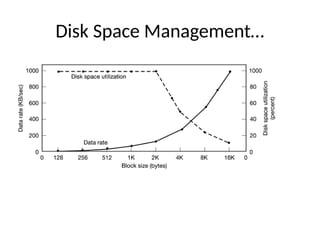
•Block Size
– Once it has been decided to store files in fixed-size
blocks, the question arises of how big the block
should be.
– Having a large allocation unit
• Disk space wastage
– Having a small allocation unit
• each file will consist of many blocks
– Reading each block normally requires a seek and a rotational
delay, so reading a file consisting of many small blocks will be
slow.
32.
Disk Space Management…
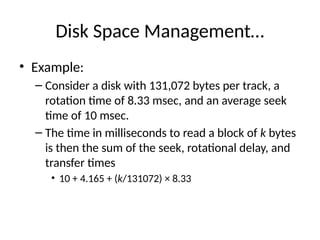
•Example:
– Consider a disk with 131,072 bytes per track, a
rotation time of 8.33 msec, and an average seek
time of 10 msec.
– The time in milliseconds to read a block of k bytes
is then the sum of the seek, rotational delay, and
transfer times
• 10 + 4.165 + (k/131072) × 8.33
Disk Space Management…
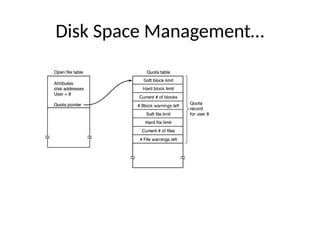
•Disk Quotas
– To prevent people from hogging too much disk
space, multiuser operating systems often provide
a mechanism for enforcing disk quotas.
– The idea is that the system administrator assigns
each user a maximum allotment of files and
blocks, and the operating system makes sure that
the users do not exceed their quotas. A typical
mechanism is described below.
Disk Space Management…
•File System Reliability
– Destruction of a file system is often a far greater
disaster than destruction of a computer.
– Recovery mechanisms
• Backups
– Recover from disaster.
– Recover from stupidity.
– File System Consistency
38.
Disk Space Management…
•File System Performance
– Caching
– write-through caches- write immediately to disk
– Block Read Ahead
• improving perceived file system performance is to try to get
blocks into the cache before they are needed to increase the
hit rate
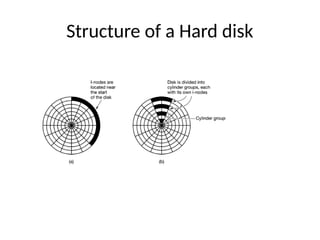
– Reducing Disk Arm Motion
• to reduce the amount of disk arm motion by putting blocks
that are likely to be accessed in sequence close to each
other, preferably in the same cylinder.



![제 23회 보아즈(BOAZ) 빅데이터 컨퍼런스 - [MBOAX] : ABSA를 활용한 소비자 반응 분석 기반 운영 효율화 대시보드 설계](https://cdn.slidesharecdn.com/ss_thumbnails/3-1boaz23rdconferencemboax-260203102709-9d519923-thumbnail.jpg?width=640&height=640&fit=bounds)


![7.__Developing_a_Research_Proposal[1].pptx](https://cdn.slidesharecdn.com/ss_thumbnails/7-260131073037-df92dd7d-thumbnail.jpg?width=640&height=640&fit=bounds)

