Intranets and Extranets
An "intranet" is the generic term for a collection of private computer networks within an
organization.
An "extranet" is a computer network that allows controlled access from the outside for
specific business or educational purposes. Intranets and extranets are communication tools
designed to enable easy information sharing within workgroups.
Internetwork
A global mesh of interconnected networks (internetworks) meets these human
communication needs. Some of these interconnected networks are owned by large public and
private organizations, such as government agencies or industrial enterprises, and are reserved
for their exclusive use. The most well-known and widely used publicly-accessible
internetwork is the Internet.
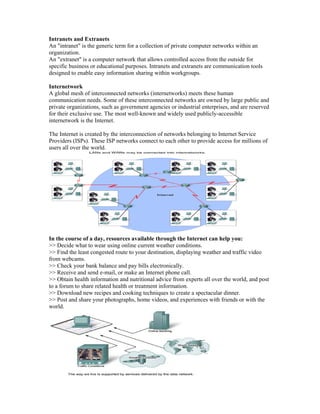
The Internet is created by the interconnection of networks belonging to Internet Service
Providers (ISPs). These ISP networks connect to each other to provide access for millions of
users all over the world.
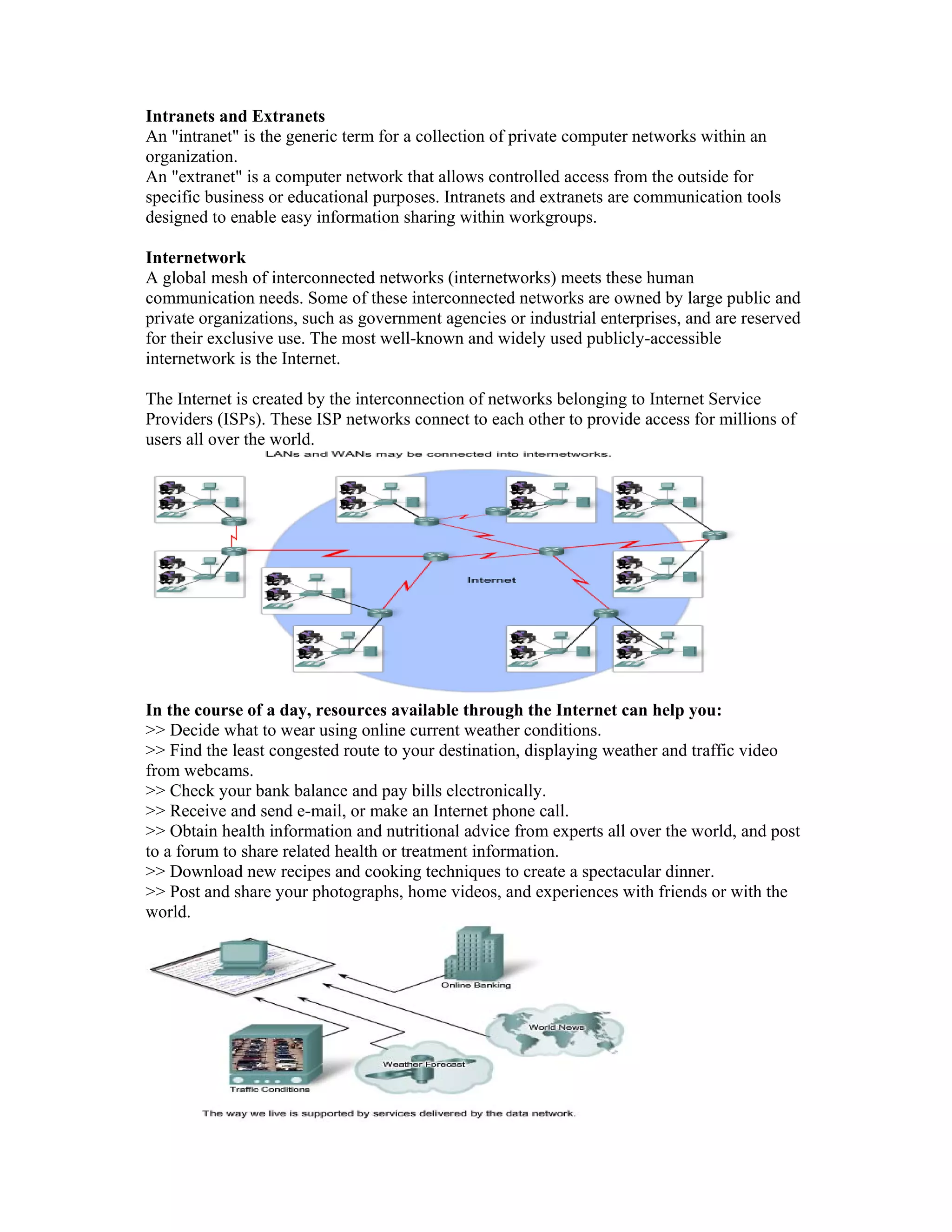
In the course of a day, resources available through the Internet can help you:
>> Decide what to wear using online current weather conditions.
>> Find the least congested route to your destination, displaying weather and traffic video
from webcams.
>> Check your bank balance and pay bills electronically.
>> Receive and send e-mail, or make an Internet phone call.
>> Obtain health information and nutritional advice from experts all over the world, and post
to a forum to share related health or treatment information.
>> Download new recipes and cooking techniques to create a spectacular dinner.
>> Post and share your photographs, home videos, and experiences with friends or with the
world.
Establishing the Communication Rules
Before beginning to communicate with each other, we establish rules or agreements to govern
the conversation. These rules, or protocols, must be followed in order for the message to be
successfully delivered and understood. Among the protocols that govern successful human
communication are:
>> An identified sender and receiver
>> Agreed upon method of communicating (face-to-face, telephone, letter, photograph)
>> Common language and grammar
>> Speed and timing of delivery
>> Confirmation or acknowledgement requirements
Quality of Communications
Communication between individuals is determined to be successful when the meaning of the
message understood by the recipient matches the meaning intended by the sender.
For data networks, we use the same basic criteria to judge success. However, as a message
moves through the network, many factors can prevent the message from reaching the
recipient or distort its intended meaning. These factors can be either external or internal.
External Factors
The external factors affecting communication are related to the complexity of the network
and the number of devices a message must pass through on its route to its final destination.
External factors affecting the success of communication include:
>> The quality of the pathway between the sender and the recipient
>> The number of times the message has to change form
>> The number of times the message has to be redirected or readdressed
>> The number of other messages being transmitted simultaneously on the communication
network
>> The amount of time allotted for successful communication
Internal Factors
Internal factors that interfere with network communication are related to the nature of the
message itself.
Different types of messages may vary in complexity and importance. Clear and concise
messages are usually easier to understand than complex messages. Internal factors affecting
the successful communication across the network include:
>> The size of the message
>> The complexity of the message
>> The importance of the message
Large messages may be interrupted or delayed at different points within the network. A
message with a low importance or priority could be dropped if the network becomes
overloaded.
Both the internal and external factors that affect the receipt of a message must be anticipated
and controlled for network communications to be successful. New innovations in network
hardware and software are being implemented to ensure the quality and reliability of network
communications.
Multiple services-multiple networks
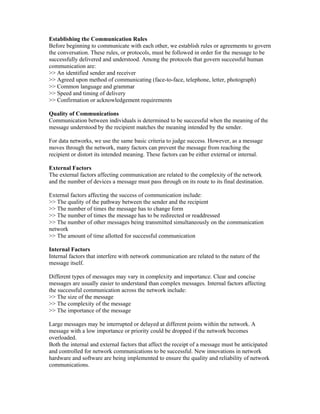
Traditional telephone, radio, television, and computer data networks each have their own
individual versions of the four basic network elements. In the past, every one of these
services required a different technology to carry its particular communication signal.
Additionally, each service had its own set of rules and standards to ensure successful
communication of its signal across a specific medium.
Converged networks
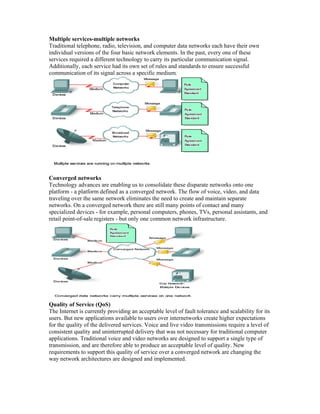
Technology advances are enabling us to consolidate these disparate networks onto one
platform - a platform defined as a converged network. The flow of voice, video, and data
traveling over the same network eliminates the need to create and maintain separate
networks. On a converged network there are still many points of contact and many
specialized devices - for example, personal computers, phones, TVs, personal assistants, and
retail point-of-sale registers - but only one common network infrastructure.
Quality of Service (QoS)
The Internet is currently providing an acceptable level of fault tolerance and scalability for its
users. But new applications available to users over internetworks create higher expectations
for the quality of the delivered services. Voice and live video transmissions require a level of
consistent quality and uninterrupted delivery that was not necessary for traditional computer
applications. Traditional voice and video networks are designed to support a single type of
transmission, and are therefore able to produce an acceptable level of quality. New
requirements to support this quality of service over a converged network are changing the
way network architectures are designed and implemented.

Ch1 computer networks internet_basic_1

  • 1.
    Intranets and Extranets An"intranet" is the generic term for a collection of private computer networks within an organization. An "extranet" is a computer network that allows controlled access from the outside for specific business or educational purposes. Intranets and extranets are communication tools designed to enable easy information sharing within workgroups. Internetwork A global mesh of interconnected networks (internetworks) meets these human communication needs. Some of these interconnected networks are owned by large public and private organizations, such as government agencies or industrial enterprises, and are reserved for their exclusive use. The most well-known and widely used publicly-accessible internetwork is the Internet. The Internet is created by the interconnection of networks belonging to Internet Service Providers (ISPs). These ISP networks connect to each other to provide access for millions of users all over the world. In the course of a day, resources available through the Internet can help you: >> Decide what to wear using online current weather conditions. >> Find the least congested route to your destination, displaying weather and traffic video from webcams. >> Check your bank balance and pay bills electronically. >> Receive and send e-mail, or make an Internet phone call. >> Obtain health information and nutritional advice from experts all over the world, and post to a forum to share related health or treatment information. >> Download new recipes and cooking techniques to create a spectacular dinner. >> Post and share your photographs, home videos, and experiences with friends or with the world.
  • 2.
    Establishing the CommunicationRules Before beginning to communicate with each other, we establish rules or agreements to govern the conversation. These rules, or protocols, must be followed in order for the message to be successfully delivered and understood. Among the protocols that govern successful human communication are: >> An identified sender and receiver >> Agreed upon method of communicating (face-to-face, telephone, letter, photograph) >> Common language and grammar >> Speed and timing of delivery >> Confirmation or acknowledgement requirements Quality of Communications Communication between individuals is determined to be successful when the meaning of the message understood by the recipient matches the meaning intended by the sender. For data networks, we use the same basic criteria to judge success. However, as a message moves through the network, many factors can prevent the message from reaching the recipient or distort its intended meaning. These factors can be either external or internal. External Factors The external factors affecting communication are related to the complexity of the network and the number of devices a message must pass through on its route to its final destination. External factors affecting the success of communication include: >> The quality of the pathway between the sender and the recipient >> The number of times the message has to change form >> The number of times the message has to be redirected or readdressed >> The number of other messages being transmitted simultaneously on the communication network >> The amount of time allotted for successful communication Internal Factors Internal factors that interfere with network communication are related to the nature of the message itself. Different types of messages may vary in complexity and importance. Clear and concise messages are usually easier to understand than complex messages. Internal factors affecting the successful communication across the network include: >> The size of the message >> The complexity of the message >> The importance of the message Large messages may be interrupted or delayed at different points within the network. A message with a low importance or priority could be dropped if the network becomes overloaded. Both the internal and external factors that affect the receipt of a message must be anticipated and controlled for network communications to be successful. New innovations in network hardware and software are being implemented to ensure the quality and reliability of network communications.
  • 3.
    Multiple services-multiple networks Traditionaltelephone, radio, television, and computer data networks each have their own individual versions of the four basic network elements. In the past, every one of these services required a different technology to carry its particular communication signal. Additionally, each service had its own set of rules and standards to ensure successful communication of its signal across a specific medium. Converged networks Technology advances are enabling us to consolidate these disparate networks onto one platform - a platform defined as a converged network. The flow of voice, video, and data traveling over the same network eliminates the need to create and maintain separate networks. On a converged network there are still many points of contact and many specialized devices - for example, personal computers, phones, TVs, personal assistants, and retail point-of-sale registers - but only one common network infrastructure. Quality of Service (QoS) The Internet is currently providing an acceptable level of fault tolerance and scalability for its users. But new applications available to users over internetworks create higher expectations for the quality of the delivered services. Voice and live video transmissions require a level of consistent quality and uninterrupted delivery that was not necessary for traditional computer applications. Traditional voice and video networks are designed to support a single type of transmission, and are therefore able to produce an acceptable level of quality. New requirements to support this quality of service over a converged network are changing the way network architectures are designed and implemented.