
Presented by,
Menath Winnie
Computer Networks
(Types)
What is a Network?
A network is a combination of
devices or nodes connected to each other
through one of the communication channels.
Types of Network
Computer networks are classified as follows:
o Local Area Network
o Metropolitan Area Network
o Wide Area Network
o Personal Area Network
o Virtual Private Network
Local Area Network
A computer network within a
building, or a campus of adjacent buildings, is
called a local area network(LAN).LAN’s are set up
by organizations to enhance communications
among employees and to share IT resources.
Advantages of LAN
 It permits sharing of expensive hardware's.
 LAN improves the productivity, because information storage,
processing and retrieval and other functionally can be improved.
 It provide cost effective multi-user computer environment.
 It provide high transmission rate to accommodate the needs of
both user and equipment.
 Error rate is very less because in-built method of detecting and
compensating for systems error is implied.
 It allows file/record locking.
Disadvantages of LAN
 Installation and reconfiguration always requires
technical & skilled man power.
 Due to sharing of resources, sometime
operational speed may be slow down.
 Insufficient knowledge of network administrator
creates improper authorization and security
problem.
 Problem of password hacking.
Metropolitan Area Network
A network is bigger than LAN
but smaller than WAN, “Multiple LANs that are
connected within the same city to form a citywide
network for a specific government or industry
using a high speed backbone” It is known as
MAN.
Advantages of MAN
 Any company can connect all its branches
existing in the same city.
 It is economical because sharing of costly
resources for all branches of a company.
Disadvantages of MAN
 Network installation is difficult and required skilled
persons.
 Installation cost is very much.
Wide Area Network
A WAN is a network that connect
users across large distances, often crossing the
geographical boundaries of cities, states or
Nations.
Advantages of WAN
 WAN has no limit of area, so it is world wide
network.
 Multi country’s organizations have facility to form
their global integrated network through WAN.
 WAN support global markets and global business.
 For a network database, WAN allows users all
over a network to access and update a single,
consistent view of data.
Disadvantages of WAN
 WAN is very big and complex network.
 It is slow in speed.
 WAN is not very much secured means not
reliable.
 It is very costly because we have to pay every
time for transferring data.
 Very much dependency on the third party
because it is public network.
Personal Area Network
Personal Area Network or PAN is a
small network , Bluetooth is the best example of
PAN. TV remote uses infrared that's also can be
included in the PAN.
Advantages of PAN
 The pan is a personal network of one or two
person so there is no risk of any leak of data.
Disadvantages of PAN
 The network it can only travel straight up to 10mts
and if in different rooms then only 2mts.
 In the case of infrared the infra red sensor bust
be in a straight line otherwise it won't
communicate.
 Transmission speed is slow to moderate.
Virtual Private Networks
A virtual private network extends
a private network across a public network, such
as the Internet. It enables a computer to send and
receive data across shared or public networks as
if it is directly connected to the private network,
while benefiting from the functionality, security
and management policies of the private network.
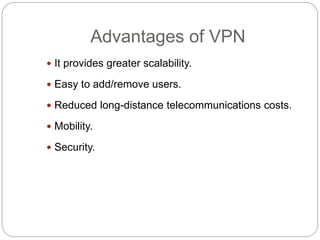
Advantages of VPN
 It provides greater scalability.
 Easy to add/remove users.
 Reduced long-distance telecommunications costs.
 Mobility.
 Security.
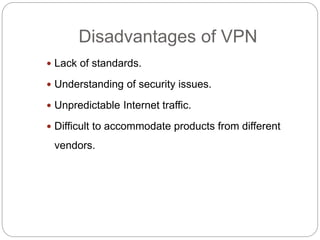
Disadvantages of VPN
 Lack of standards.
 Understanding of security issues.
 Unpredictable Internet traffic.
 Difficult to accommodate products from different
vendors.
THANK YOU…

Computer networks

  • 1.
  • 2.
    What is aNetwork? A network is a combination of devices or nodes connected to each other through one of the communication channels.
  • 3.
    Types of Network Computernetworks are classified as follows: o Local Area Network o Metropolitan Area Network o Wide Area Network o Personal Area Network o Virtual Private Network
  • 4.
    Local Area Network Acomputer network within a building, or a campus of adjacent buildings, is called a local area network(LAN).LAN’s are set up by organizations to enhance communications among employees and to share IT resources.
  • 5.
    Advantages of LAN It permits sharing of expensive hardware's.  LAN improves the productivity, because information storage, processing and retrieval and other functionally can be improved.  It provide cost effective multi-user computer environment.  It provide high transmission rate to accommodate the needs of both user and equipment.  Error rate is very less because in-built method of detecting and compensating for systems error is implied.  It allows file/record locking.
  • 6.
    Disadvantages of LAN Installation and reconfiguration always requires technical & skilled man power.  Due to sharing of resources, sometime operational speed may be slow down.  Insufficient knowledge of network administrator creates improper authorization and security problem.  Problem of password hacking.
  • 7.
    Metropolitan Area Network Anetwork is bigger than LAN but smaller than WAN, “Multiple LANs that are connected within the same city to form a citywide network for a specific government or industry using a high speed backbone” It is known as MAN.
  • 8.
    Advantages of MAN Any company can connect all its branches existing in the same city.  It is economical because sharing of costly resources for all branches of a company.
  • 9.
    Disadvantages of MAN Network installation is difficult and required skilled persons.  Installation cost is very much.
  • 10.
    Wide Area Network AWAN is a network that connect users across large distances, often crossing the geographical boundaries of cities, states or Nations.
  • 11.
    Advantages of WAN WAN has no limit of area, so it is world wide network.  Multi country’s organizations have facility to form their global integrated network through WAN.  WAN support global markets and global business.  For a network database, WAN allows users all over a network to access and update a single, consistent view of data.
  • 12.
    Disadvantages of WAN WAN is very big and complex network.  It is slow in speed.  WAN is not very much secured means not reliable.  It is very costly because we have to pay every time for transferring data.  Very much dependency on the third party because it is public network.
  • 13.
    Personal Area Network PersonalArea Network or PAN is a small network , Bluetooth is the best example of PAN. TV remote uses infrared that's also can be included in the PAN.
  • 14.
    Advantages of PAN The pan is a personal network of one or two person so there is no risk of any leak of data.
  • 15.
    Disadvantages of PAN The network it can only travel straight up to 10mts and if in different rooms then only 2mts.  In the case of infrared the infra red sensor bust be in a straight line otherwise it won't communicate.  Transmission speed is slow to moderate.
  • 16.
    Virtual Private Networks Avirtual private network extends a private network across a public network, such as the Internet. It enables a computer to send and receive data across shared or public networks as if it is directly connected to the private network, while benefiting from the functionality, security and management policies of the private network.
  • 17.
    Advantages of VPN It provides greater scalability.  Easy to add/remove users.  Reduced long-distance telecommunications costs.  Mobility.  Security.
  • 18.
    Disadvantages of VPN Lack of standards.  Understanding of security issues.  Unpredictable Internet traffic.  Difficult to accommodate products from different vendors.
  • 19.