Adolescents, Young
Adults, and Adults


     Chapter 8
Introduction
• Adolescents and young adults (15-24)
  • Adolescence generally regarded as puberty to
    maturity
• Adults (25-64)
• 15-64 some of the most productive, or most
  productive, years of people’s lives
• Most enjoy the best health of their lives
• Shape health through lifestyle and health
  behavior for later years
Adolescents and Young Adults
• Represent the future of the nation
• Adolescence is difficult stage; period of
  transition from childhood to adulthood
     • Comfort and security to complex and
       challenging situations
• Young adults complete physical growth;
  experience significant life changes
     • Leave home, join military, begin careers, etc.
• Many health beliefs, attitudes, and behaviors
  are adopted and consolidated
Demography
• Numbers
  • Peaked in 1979 at 21% of population; now
    ~14%
• Living arrangements
  • 1/3 live in single parent families
• Employment status
  • Participation in labor force has remained fairly
    constant in recent decades
  • Disparities by race
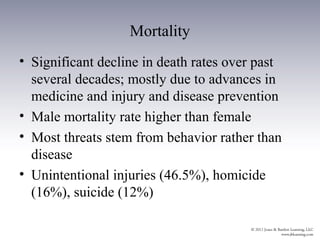
Mortality
• Significant decline in death rates over past
  several decades; mostly due to advances in
  medicine and injury and disease prevention
• Male mortality rate higher than female
• Most threats stem from behavior rather than
  disease
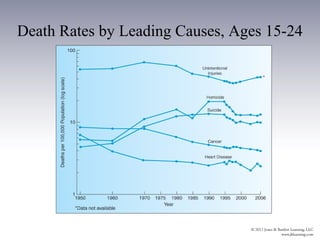
• Unintentional injuries (46.5%), homicide
  (16%), suicide (12%)
Death Rates by Leading Causes, Ages 15-24
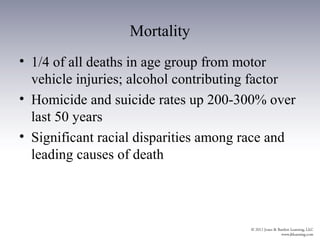
Mortality
• 1/4 of all deaths in age group from motor
  vehicle injuries; alcohol contributing factor
• Homicide and suicide rates up 200-300% over
  last 50 years
• Significant racial disparities among race and
  leading causes of death
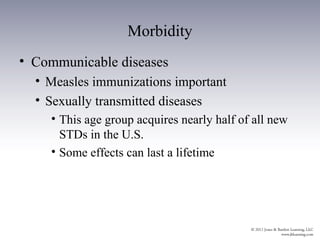
Morbidity
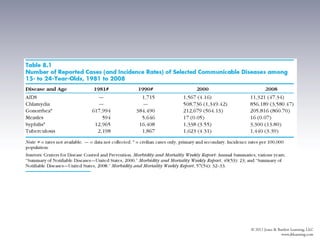
• Communicable diseases
  • Measles immunizations important
  • Sexually transmitted diseases
    • This age group acquires nearly half of all new
      STDs in the U.S.
    • Some effects can last a lifetime
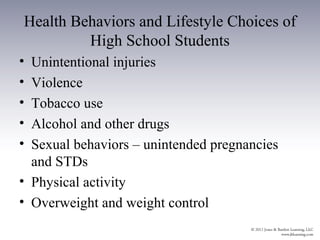
Health Behaviors and Lifestyle Choices of
         High School Students
• Unintentional injuries
• Violence
• Tobacco use
• Alcohol and other drugs
• Sexual behaviors – unintended pregnancies
  and STDs
• Physical activity
• Overweight and weight control
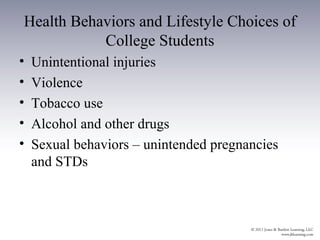
Health Behaviors and Lifestyle Choices of
           College Students
•   Unintentional injuries
•   Violence
•   Tobacco use
•   Alcohol and other drugs
•   Sexual behaviors – unintended pregnancies
    and STDs
Community Health Strategies
• Main factors affecting community health with
  age group are social and cultural factors and
  community organizing
• Alcohol use a main problem
Adults
• Ages 25-64
• Represent more than half of U.S. population
Health Profile
• Mortality
  • mainly from chronic diseases
  • Many associated with unhealthy behaviors and
    poor lifestyle choices
  • Lifestyle improvements and public health
    advances have led to decline in death rate for
    adults
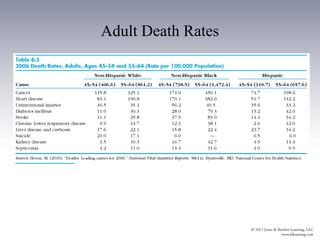
Adult Death Rates
Cancer
• #1 cause of death for adult age group in recent
  decades
  • Males – prostate, lung, and colorectal
  • Females – breast, lung, and colorectal
Cardiovascular Disease
• Age-adjusted mortality rates dropped over past
  60 years
  • Mainly due to public health efforts related to
    smoking cessation, increased physical activity,
    and nutrition
Health Behaviors and Lifestyle Choices
• Risk factors for chronic disease
  • Most significant for adults – smoking, lack of
    exercise, BMI, alcohol
• Risk factors for personal injury
  • Motor vehicle safety – seatbelts and alcohol
    use
• Awareness and screening of certain conditions
  • Hypertension, diabetes, cholesterol
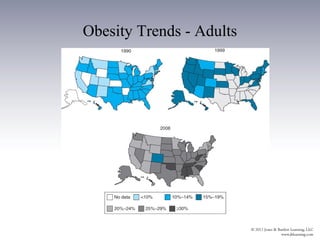
Obesity Trends - Adults
Community Health Strategies
• Emphasis on individual responsibility for
  health
• Primary, secondary, and tertiary prevention
  efforts for adults
  • Primary – exercise and nutrition programs
  • Secondary – self and clinical screenings to
    identify and control disease processes
  • Tertiary – medication compliance
Discussion Questions
• Why are lifestyle and health behaviors
  significant for the adult age group compared to
  other age groups?

• How can community health efforts affect
  leading causes of death for the adolescent and
  young adult age group?

Ch08 outline

  • 1.
  • 2.
    Introduction • Adolescents andyoung adults (15-24) • Adolescence generally regarded as puberty to maturity • Adults (25-64) • 15-64 some of the most productive, or most productive, years of people’s lives • Most enjoy the best health of their lives • Shape health through lifestyle and health behavior for later years
  • 3.
    Adolescents and YoungAdults • Represent the future of the nation • Adolescence is difficult stage; period of transition from childhood to adulthood • Comfort and security to complex and challenging situations • Young adults complete physical growth; experience significant life changes • Leave home, join military, begin careers, etc. • Many health beliefs, attitudes, and behaviors are adopted and consolidated
  • 4.
    Demography • Numbers • Peaked in 1979 at 21% of population; now ~14% • Living arrangements • 1/3 live in single parent families • Employment status • Participation in labor force has remained fairly constant in recent decades • Disparities by race
  • 5.
    Mortality • Significant declinein death rates over past several decades; mostly due to advances in medicine and injury and disease prevention • Male mortality rate higher than female • Most threats stem from behavior rather than disease • Unintentional injuries (46.5%), homicide (16%), suicide (12%)
  • 6.
    Death Rates byLeading Causes, Ages 15-24
  • 7.
    Mortality • 1/4 ofall deaths in age group from motor vehicle injuries; alcohol contributing factor • Homicide and suicide rates up 200-300% over last 50 years • Significant racial disparities among race and leading causes of death
  • 8.
    Morbidity • Communicable diseases • Measles immunizations important • Sexually transmitted diseases • This age group acquires nearly half of all new STDs in the U.S. • Some effects can last a lifetime
  • 10.
    Health Behaviors andLifestyle Choices of High School Students • Unintentional injuries • Violence • Tobacco use • Alcohol and other drugs • Sexual behaviors – unintended pregnancies and STDs • Physical activity • Overweight and weight control
  • 11.
    Health Behaviors andLifestyle Choices of College Students • Unintentional injuries • Violence • Tobacco use • Alcohol and other drugs • Sexual behaviors – unintended pregnancies and STDs
  • 12.
    Community Health Strategies •Main factors affecting community health with age group are social and cultural factors and community organizing • Alcohol use a main problem
  • 13.
    Adults • Ages 25-64 •Represent more than half of U.S. population
  • 14.
    Health Profile • Mortality • mainly from chronic diseases • Many associated with unhealthy behaviors and poor lifestyle choices • Lifestyle improvements and public health advances have led to decline in death rate for adults
  • 15.
  • 16.
    Cancer • #1 causeof death for adult age group in recent decades • Males – prostate, lung, and colorectal • Females – breast, lung, and colorectal
  • 17.
    Cardiovascular Disease • Age-adjustedmortality rates dropped over past 60 years • Mainly due to public health efforts related to smoking cessation, increased physical activity, and nutrition
  • 18.
    Health Behaviors andLifestyle Choices • Risk factors for chronic disease • Most significant for adults – smoking, lack of exercise, BMI, alcohol • Risk factors for personal injury • Motor vehicle safety – seatbelts and alcohol use • Awareness and screening of certain conditions • Hypertension, diabetes, cholesterol
  • 19.
  • 20.
    Community Health Strategies •Emphasis on individual responsibility for health • Primary, secondary, and tertiary prevention efforts for adults • Primary – exercise and nutrition programs • Secondary – self and clinical screenings to identify and control disease processes • Tertiary – medication compliance
  • 21.
    Discussion Questions • Whyare lifestyle and health behaviors significant for the adult age group compared to other age groups? • How can community health efforts affect leading causes of death for the adolescent and young adult age group?