Epidemiology:
Prevention and Control
of Diseases and Health
      Conditions


       Chapter 4
Introduction
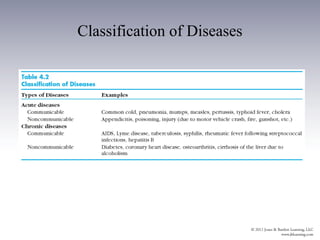
• Disease classification can lead to prevention
  and control strategies
  • In community health, classification is usually
     • Acute or chronic (<3 or >3 months)
     • Communicable (infectious-caused by a specific
       biological agent/pathogen) or noncommunicable
       (noninfectious-cannot be transmitted from one
       person to another)
Classification of Diseases
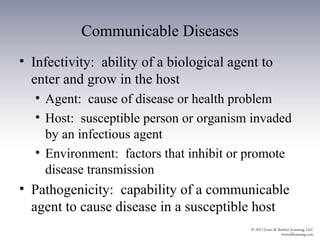
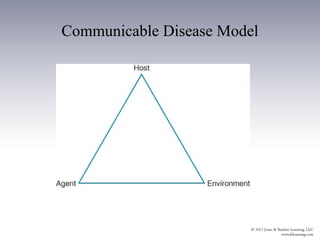
Communicable Diseases
• Infectivity: ability of a biological agent to
  enter and grow in the host
  • Agent: cause of disease or health problem
  • Host: susceptible person or organism invaded
    by an infectious agent
  • Environment: factors that inhibit or promote
    disease transmission
• Pathogenicity: capability of a communicable
  agent to cause disease in a susceptible host
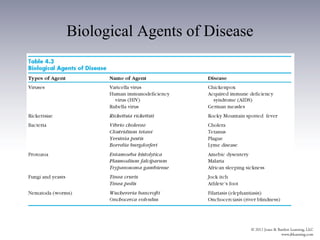
Biological Agents of Disease
Communicable Disease Model
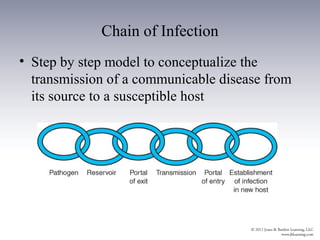
Chain of Infection
• Step by step model to conceptualize the
  transmission of a communicable disease from
  its source to a susceptible host
Chain of Infection
• Pathogen: disease causing agent (virus,
  bacterium, etc.)
• Reservoir: favorable environment for
  infectious agent to live and grow (human,
  animal, etc.)
• Portal of exit: path by which agent leaves host
  (blood, respiratory system, digestive system,
  etc.)
Chain of Infection
• Mode of transmission: how pathogens are
  passed from reservoir to next host
• Portal of entry: where agent enters susceptible
  host (blood, respiratory or digestive system,
  etc.)
• New host: susceptible to new infection being
  established
Modes of Transmission
• Direct transmission
  • Immediate transfer of disease agent between
    infected and susceptible individuals
     • Touching, biting, kissing, sexual intercourse
• Indirect transmission
  • Disease transmission involving an intermediate
    step
     • Airborne, vehicleborne, vectorborne, biological
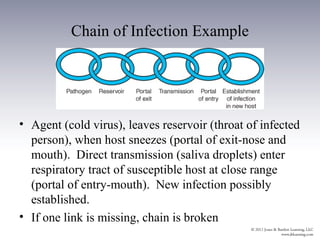
Chain of Infection Example


• Agent (cold virus), leaves reservoir (throat of infected
  person), when host sneezes (portal of exit-nose and
  mouth). Direct transmission (saliva droplets) enter
  respiratory tract of susceptible host at close range
  (portal of entry-mouth). New infection possibly
  established.
• If one link is missing, chain is broken
Noncommunicable Diseases
• Nation’s leading causes of death
  • Heart disease, stroke, cancer
• Complex etiologies (causes)
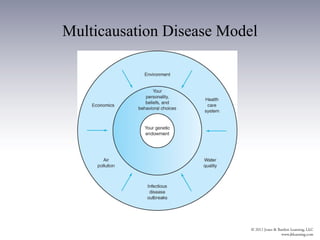
• Multicausation disease model
  • Host: inalterable, unique genetic endowment
  • Personality, beliefs, behavioral choices: impact
    host
  • Complex environment: exposes host to risk
    factors
Multicausation Disease Model
Noncommunicable Disease Problems
•   Coronary heart disease
•   Malignant neoplasms (cancer)
•   Stroke
•   Chronic obstructive pulmonary disease
•   Diabetes
•   Alzheimer’s disease
Prioritizing Prevention and Control Efforts
• Criteria used to judge importance of disease to
  a community
  • # of people who will die from a disease
     • Leading causes of death
  • # of years of potential life lost
     • Captures issues affiliated with various groups
  • Economic costs associated with disease
     • $ spent at various levels of government; ex:
       alcohol and other drugs
Prevention, Intervention, Control and
            Eradication of Diseases
• Prevention: planning for and taking action to
  prevent or forestall onset of disease or health
  problem
• Intervention: effort to control disease in
  progress; taking action during an event
     • Control - Containment of a disease;
       prevention and intervention measures
• Eradication: total elimination of disease from
  human population
Levels of Prevention
• Primary prevention
  • Forestall onset of illness or injury during
    prepathogenesis period
• Secondary prevention
  • Early diagnosis and prompt treatment before
    disease becomes advanced and disability severe
• Tertiary prevention
  • Aimed at rehabilitation following significant
    pathogenesis; retrain, reeducate, rehabilitate
Primary Prevention of
           Communicable Diseases
• Strategies at each link in chain of infection
  • Individuals
     • Hand washing, using condoms, properly
       cooking food
  • Communities
     • Chlorinating water supply, inspecting
       restaurants, immunization programs for all
       citizens, vector control, solid waste disposal
Secondary Prevention of
          Communicable Diseases
• Individuals
  • Self-diagnosis, self-treatment w/home remedies
  • Antibiotics prescribed by a physician
• Communities
  • Controlling or limiting extent of an epidemic
     • Carefully maintaining records; investigating
       cases
• Isolation, quarantine, disinfection
Tertiary Prevention of
           Communicable Diseases
• Individuals
  • Recovery to full health after infection; return to
    normal activity
• Communities
  • Preventing recurrence of epidemics
     • Removal, embalming, burial of dead
     • Reapplication of primary and secondary
       measures
Primary Prevention of
        Noncommunicable Diseases
• Individuals
  • Education and knowledge about health and
    disease prevention, eating properly, adequate
    exercise, driving safely
• Communities
  • Adequate food and energy supplies, efficient
    community services, opportunities for
    education, employment, and housing
Secondary Prevention of
        Noncommunicable Diseases
• Individuals
  • Personal screenings (mammogram, pap test,
    PSA test), regular medical and dental checkups,
    pursuit of diagnosis and prompt treatment
• Communities
  • Provision of mass screenings for chronic
    diseases, case-finding measures, provision of
    adequate health personnel, equipment, and
    facilities
Tertiary Prevention of
        Noncommunicable Diseases
• Individuals
  • Significant behavioral or lifestyle changes,
    adherence to prescribed medications, following
    rehabilitation requirements after surgery
• Communities
  • Adequate emergency medical personnel and
    services: hospitals, surgeons, nurses,
    ambulance services
Discussion Questions
• Which components of the Multicausation
  Disease Model can communities most
  effectively impact?
• Which level of prevention is most important
  for better community health outcomes and
  why?
• Who plays a more significant role in
  preventing diseases, individuals or
  communities?

Ch04 outline

  • 1.
    Epidemiology: Prevention and Control ofDiseases and Health Conditions Chapter 4
  • 2.
    Introduction • Disease classificationcan lead to prevention and control strategies • In community health, classification is usually • Acute or chronic (<3 or >3 months) • Communicable (infectious-caused by a specific biological agent/pathogen) or noncommunicable (noninfectious-cannot be transmitted from one person to another)
  • 3.
  • 4.
    Communicable Diseases • Infectivity:ability of a biological agent to enter and grow in the host • Agent: cause of disease or health problem • Host: susceptible person or organism invaded by an infectious agent • Environment: factors that inhibit or promote disease transmission • Pathogenicity: capability of a communicable agent to cause disease in a susceptible host
  • 5.
  • 6.
  • 7.
    Chain of Infection •Step by step model to conceptualize the transmission of a communicable disease from its source to a susceptible host
  • 8.
    Chain of Infection •Pathogen: disease causing agent (virus, bacterium, etc.) • Reservoir: favorable environment for infectious agent to live and grow (human, animal, etc.) • Portal of exit: path by which agent leaves host (blood, respiratory system, digestive system, etc.)
  • 9.
    Chain of Infection •Mode of transmission: how pathogens are passed from reservoir to next host • Portal of entry: where agent enters susceptible host (blood, respiratory or digestive system, etc.) • New host: susceptible to new infection being established
  • 10.
    Modes of Transmission •Direct transmission • Immediate transfer of disease agent between infected and susceptible individuals • Touching, biting, kissing, sexual intercourse • Indirect transmission • Disease transmission involving an intermediate step • Airborne, vehicleborne, vectorborne, biological
  • 11.
    Chain of InfectionExample • Agent (cold virus), leaves reservoir (throat of infected person), when host sneezes (portal of exit-nose and mouth). Direct transmission (saliva droplets) enter respiratory tract of susceptible host at close range (portal of entry-mouth). New infection possibly established. • If one link is missing, chain is broken
  • 12.
    Noncommunicable Diseases • Nation’sleading causes of death • Heart disease, stroke, cancer • Complex etiologies (causes) • Multicausation disease model • Host: inalterable, unique genetic endowment • Personality, beliefs, behavioral choices: impact host • Complex environment: exposes host to risk factors
  • 13.
  • 14.
    Noncommunicable Disease Problems • Coronary heart disease • Malignant neoplasms (cancer) • Stroke • Chronic obstructive pulmonary disease • Diabetes • Alzheimer’s disease
  • 15.
    Prioritizing Prevention andControl Efforts • Criteria used to judge importance of disease to a community • # of people who will die from a disease • Leading causes of death • # of years of potential life lost • Captures issues affiliated with various groups • Economic costs associated with disease • $ spent at various levels of government; ex: alcohol and other drugs
  • 16.
    Prevention, Intervention, Controland Eradication of Diseases • Prevention: planning for and taking action to prevent or forestall onset of disease or health problem • Intervention: effort to control disease in progress; taking action during an event • Control - Containment of a disease; prevention and intervention measures • Eradication: total elimination of disease from human population
  • 17.
    Levels of Prevention •Primary prevention • Forestall onset of illness or injury during prepathogenesis period • Secondary prevention • Early diagnosis and prompt treatment before disease becomes advanced and disability severe • Tertiary prevention • Aimed at rehabilitation following significant pathogenesis; retrain, reeducate, rehabilitate
  • 18.
    Primary Prevention of Communicable Diseases • Strategies at each link in chain of infection • Individuals • Hand washing, using condoms, properly cooking food • Communities • Chlorinating water supply, inspecting restaurants, immunization programs for all citizens, vector control, solid waste disposal
  • 19.
    Secondary Prevention of Communicable Diseases • Individuals • Self-diagnosis, self-treatment w/home remedies • Antibiotics prescribed by a physician • Communities • Controlling or limiting extent of an epidemic • Carefully maintaining records; investigating cases • Isolation, quarantine, disinfection
  • 20.
    Tertiary Prevention of Communicable Diseases • Individuals • Recovery to full health after infection; return to normal activity • Communities • Preventing recurrence of epidemics • Removal, embalming, burial of dead • Reapplication of primary and secondary measures
  • 21.
    Primary Prevention of Noncommunicable Diseases • Individuals • Education and knowledge about health and disease prevention, eating properly, adequate exercise, driving safely • Communities • Adequate food and energy supplies, efficient community services, opportunities for education, employment, and housing
  • 22.
    Secondary Prevention of Noncommunicable Diseases • Individuals • Personal screenings (mammogram, pap test, PSA test), regular medical and dental checkups, pursuit of diagnosis and prompt treatment • Communities • Provision of mass screenings for chronic diseases, case-finding measures, provision of adequate health personnel, equipment, and facilities
  • 23.
    Tertiary Prevention of Noncommunicable Diseases • Individuals • Significant behavioral or lifestyle changes, adherence to prescribed medications, following rehabilitation requirements after surgery • Communities • Adequate emergency medical personnel and services: hospitals, surgeons, nurses, ambulance services
  • 24.
    Discussion Questions • Whichcomponents of the Multicausation Disease Model can communities most effectively impact? • Which level of prevention is most important for better community health outcomes and why? • Who plays a more significant role in preventing diseases, individuals or communities?