1
BASIC CONCEPT
CHAPTER 1 2
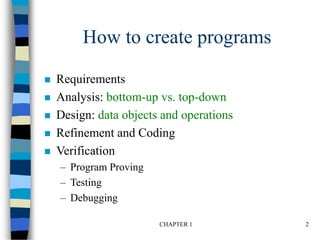
How to create programs
 Requirements
 Analysis: bottom-up vs. top-down
 Design: data objects and operations
 Refinement and Coding
 Verification
– Program Proving
– Testing
– Debugging
CHAPTER 1 3
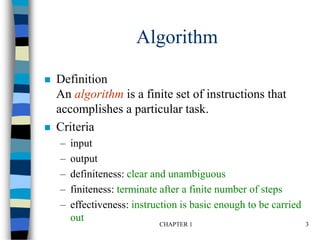
Algorithm
 Definition
An algorithm is a finite set of instructions that
accomplishes a particular task.
 Criteria
– input
– output
– definiteness: clear and unambiguous
– finiteness: terminate after a finite number of steps
– effectiveness: instruction is basic enough to be carried
out
CHAPTER 1 4
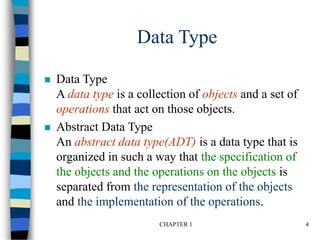
Data Type
 Data Type
A data type is a collection of objects and a set of
operations that act on those objects.
 Abstract Data Type
An abstract data type(ADT) is a data type that is
organized in such a way that the specification of
the objects and the operations on the objects is
separated from the representation of the objects
and the implementation of the operations.
CHAPTER 1 5
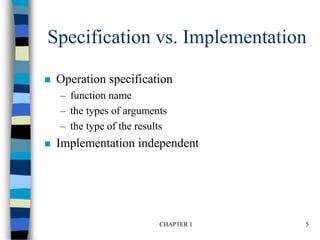
Specification vs. Implementation
 Operation specification
– function name
– the types of arguments
– the type of the results
 Implementation independent
CHAPTER 1 6
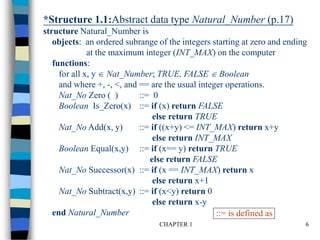
*Structure 1.1:Abstract data type Natural_Number (p.17)
structure Natural_Number is
objects: an ordered subrange of the integers starting at zero and ending
at the maximum integer (INT_MAX) on the computer
functions:
for all x, y  Nat_Number; TRUE, FALSE  Boolean
and where +, -, <, and == are the usual integer operations.
Nat_No Zero ( ) ::= 0
Boolean Is_Zero(x) ::= if (x) return FALSE
else return TRUE
Nat_No Add(x, y) ::= if ((x+y) <= INT_MAX) return x+y
else return INT_MAX
Boolean Equal(x,y) ::= if (x== y) return TRUE
else return FALSE
Nat_No Successor(x) ::= if (x == INT_MAX) return x
else return x+1
Nat_No Subtract(x,y) ::= if (x<y) return 0
else return x-y
end Natural_Number ::= is defined as
CHAPTER 1 7
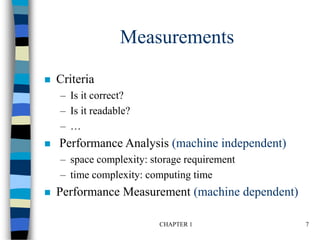
Measurements
 Criteria
– Is it correct?
– Is it readable?
– …
 Performance Analysis (machine independent)
– space complexity: storage requirement
– time complexity: computing time
 Performance Measurement (machine dependent)
CHAPTER 1 8
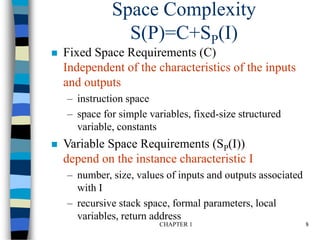
Space Complexity
S(P)=C+SP(I)
 Fixed Space Requirements (C)
Independent of the characteristics of the inputs
and outputs
– instruction space
– space for simple variables, fixed-size structured
variable, constants
 Variable Space Requirements (SP(I))
depend on the instance characteristic I
– number, size, values of inputs and outputs associated
with I
– recursive stack space, formal parameters, local
variables, return address
CHAPTER 1 9
*Program 1.9: Simple arithmetic function (p.19)
float abc(float a, float b, float c)
{
return a + b + b * c + (a + b - c) / (a + b) + 4.00;
}
*Program 1.10: Iterative function for summing a list of numbers (p.20)
float sum(float list[ ], int n)
{
float tempsum = 0;
int i;
for (i = 0; i<n; i++)
tempsum += list [i];
return tempsum;
}
Sabc(I) = 0
Ssum(I) = 0
Recall: pass the address of the
first element of the array &
pass by value
CHAPTER 1 10
*Program 1.11: Recursive function for summing a list of numbers (p.20)
float rsum(float list[ ], int n)
{
if (n) return rsum(list, n-1) + list[n-1];
return 0;
}
*Figure 1.1: Space needed for one recursive call of Program 1.11 (p.21)
Type Name Number of bytes
parameter: float
parameter: integer
return address:(used internally)
list [ ]
n
2
2
2(unless a far address)
TOTAL per recursive call 6
Ssum(I)=Ssum(n)=6n
Assumptions:
CHAPTER 1 11
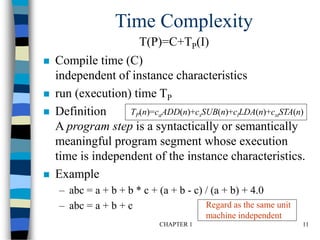
Time Complexity
 Compile time (C)
independent of instance characteristics
 run (execution) time TP
 Definition
A program step is a syntactically or semantically
meaningful program segment whose execution
time is independent of the instance characteristics.
 Example
– abc = a + b + b * c + (a + b - c) / (a + b) + 4.0
– abc = a + b + c Regard as the same unit
machine independent
T(P)=C+TP(I)
TP(n)=caADD(n)+csSUB(n)+clLDA(n)+cstSTA(n)
CHAPTER 1 12
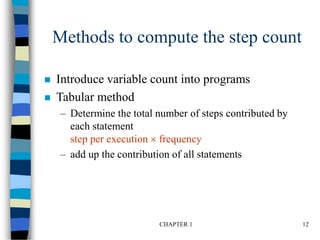
Methods to compute the step count
 Introduce variable count into programs
 Tabular method
– Determine the total number of steps contributed by
each statement
step per execution  frequency
– add up the contribution of all statements
CHAPTER 1 13
*Program 1.12: Program 1.10 with count statements (p.23)
float sum(float list[ ], int n)
{
float tempsum = 0; count++; /* for assignment */
int i;
for (i = 0; i < n; i++) {
count++; /*for the for loop */
tempsum += list[i]; count++; /* for assignment */
}
count++; /* last execution of for */
return tempsum;
count++; /* for return */
}
2n + 3 steps
Iterative summing of a list of numbers
CHAPTER 1 14
*Program 1.13: Simplified version of Program 1.12 (p.23)
float sum(float list[ ], int n)
{
float tempsum = 0;
int i;
for (i = 0; i < n; i++)
count += 2;
count += 3;
return 0;
}
2n + 3 steps
CHAPTER 1 15
*Program 1.14: Program 1.11 with count statements added (p.24)
float rsum(float list[ ], int n)
{
count++; /*for if conditional */
if (n) {
count++; /* for return and rsum invocation */
return rsum(list, n-1) + list[n-1];
}
count++;
return list[0];
}
2n+2
Recursive summing of a list of numbers
CHAPTER 1 16
*Program 1.15: Matrix addition (p.25)
void add( int a[ ] [MAX_SIZE], int b[ ] [MAX_SIZE],
int c [ ] [MAX_SIZE], int rows, int cols)
{
int i, j;
for (i = 0; i < rows; i++)
for (j= 0; j < cols; j++)
c[i][j] = a[i][j] +b[i][j];
}
Matrix addition
CHAPTER 1 17
*Program 1.16: Matrix addition with count statements (p.25)
void add(int a[ ][MAX_SIZE], int b[ ][MAX_SIZE],
int c[ ][MAX_SIZE], int row, int cols )
{
int i, j;
for (i = 0; i < rows; i++){
count++; /* for i for loop */
for (j = 0; j < cols; j++) {
count++; /* for j for loop */
c[i][j] = a[i][j] + b[i][j];
count++; /* for assignment statement */
}
count++; /* last time of j for loop */
}
count++; /* last time of i for loop */
}
2rows * cols + 2 rows + 1
CHAPTER 1 18
*Program 1.17: Simplification of Program 1.16 (p.26)
void add(int a[ ][MAX_SIZE], int b [ ][MAX_SIZE],
int c[ ][MAX_SIZE], int rows, int cols)
{
int i, j;
for( i = 0; i < rows; i++) {
for (j = 0; j < cols; j++)
count += 2;
count += 2;
}
count++;
}
2rows  cols + 2rows +1
Suggestion: Interchange the loops when rows >> cols
CHAPTER 1 19
*Figure 1.2: Step count table for Program 1.10 (p.26)
Statement s/e Frequency Total steps
float sum(float list[ ], int n)
{
float tempsum = 0;
int i;
for(i=0; i <n; i++)
tempsum += list[i];
return tempsum;
}
0 0 0
0 0 0
1 1 1
0 0 0
1 n+1 n+1
1 n n
1 1 1
0 0 0
Total 2n+3
Tabular Method
steps/execution
Iterative function to sum a list of numbers
CHAPTER 1 20
*Figure 1.3: Step count table for recursive summing function (p.27)
Statement s/e Frequency Total steps
float rsum(float list[ ], int n)
{
if (n)
return rsum(list, n-1)+list[n-1];
return list[0];
}
0 0 0
0 0 0
1 n+1 n+1
1 n n
1 1 1
0 0 0
Total 2n+2
Recursive Function to sum of a list of numbers
CHAPTER 1 21
*Figure 1.4: Step count table for matrix addition (p.27)
Statement s/e Frequency Total steps
Void add (int a[ ][MAX_SIZE]‧‧‧)
{
int i, j;
for (i = 0; i < row; i++)
for (j=0; j< cols; j++)
c[i][j] = a[i][j] + b[i][j];
}
0 0 0
0 0 0
0 0 0
1 rows+1 rows+1
1 rows‧(cols+1) rows‧cols+rows
1 rows‧cols rows‧cols
0 0 0
Total 2rows‧cols+2rows+1
Matrix Addition
CHAPTER 1 22
*Program 1.18: Printing out a matrix (p.28)
void print_matrix(int matrix[ ][MAX_SIZE], int rows, int cols)
{
int i, j;
for (i = 0; i < row; i++) {
for (j = 0; j < cols; j++)
printf(“%d”, matrix[i][j]);
printf( “n”);
}
}
Exercise 1
CHAPTER 1 23
*Program 1.19:Matrix multiplication function(p.28)
void mult(int a[ ][MAX_SIZE], int b[ ][MAX_SIZE], int c[ ][MAX_SIZE])
{
int i, j, k;
for (i = 0; i < MAX_SIZE; i++)
for (j = 0; j< MAX_SIZE; j++) {
c[i][j] = 0;
for (k = 0; k < MAX_SIZE; k++)
c[i][j] += a[i][k] * b[k][j];
}
}
Exercise 2
CHAPTER 1 24
*Program 1.20:Matrix product function(p.29)
void prod(int a[ ][MAX_SIZE], int b[ ][MAX_SIZE], int c[ ][MAX_SIZE],
int rowsa, int colsb, int colsa)
{
int i, j, k;
for (i = 0; i < rowsa; i++)
for (j = 0; j< colsb; j++) {
c[i][j] = 0;
for (k = 0; k< colsa; k++)
c[i][j] += a[i][k] * b[k][j];
}
}
Exercise 3
CHAPTER 1 25
*Program 1.21:Matrix transposition function (p.29)
void transpose(int a[ ][MAX_SIZE])
{
int i, j, temp;
for (i = 0; i < MAX_SIZE-1; i++)
for (j = i+1; j < MAX_SIZE; j++)
SWAP (a[i][j], a[j][i], temp);
}
Exercise 4
CHAPTER 1 26
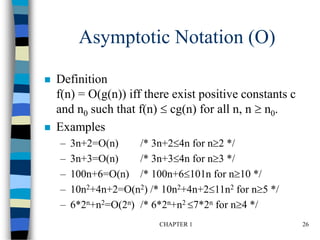
Asymptotic Notation (O)
 Definition
f(n) = O(g(n)) iff there exist positive constants c
and n0 such that f(n)  cg(n) for all n, n  n0.
 Examples
– 3n+2=O(n) /* 3n+24n for n2 */
– 3n+3=O(n) /* 3n+34n for n3 */
– 100n+6=O(n) /* 100n+6101n for n10 */
– 10n2+4n+2=O(n2) /* 10n2+4n+211n2 for n5 */
– 6*2n+n2=O(2n) /* 6*2n+n2 7*2n for n4 */
CHAPTER 1 27
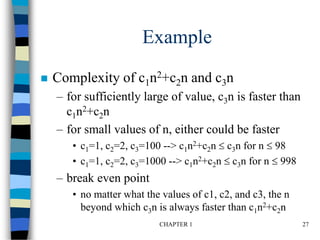
Example
 Complexity of c1n2+c2n and c3n
– for sufficiently large of value, c3n is faster than
c1n2+c2n
– for small values of n, either could be faster
• c1=1, c2=2, c3=100 --> c1n2+c2n  c3n for n  98
• c1=1, c2=2, c3=1000 --> c1n2+c2n  c3n for n  998
– break even point
• no matter what the values of c1, c2, and c3, the n
beyond which c3n is always faster than c1n2+c2n
CHAPTER 1 28
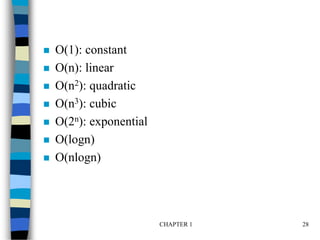
 O(1): constant
 O(n): linear
 O(n2): quadratic
 O(n3): cubic
 O(2n): exponential
 O(logn)
 O(nlogn)
CHAPTER 1 29
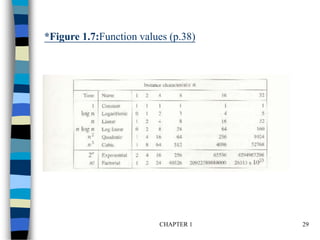
*Figure 1.7:Function values (p.38)
CHAPTER 1 30
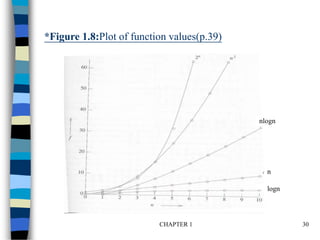
*Figure 1.8:Plot of function values(p.39)
nlogn
n
logn
CHAPTER 1 31
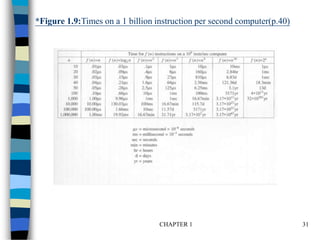
*Figure 1.9:Times on a 1 billion instruction per second computer(p.40)

Basic_analysis.ppt

  • 1.
  • 2.
    CHAPTER 1 2 Howto create programs  Requirements  Analysis: bottom-up vs. top-down  Design: data objects and operations  Refinement and Coding  Verification – Program Proving – Testing – Debugging
  • 3.
    CHAPTER 1 3 Algorithm Definition An algorithm is a finite set of instructions that accomplishes a particular task.  Criteria – input – output – definiteness: clear and unambiguous – finiteness: terminate after a finite number of steps – effectiveness: instruction is basic enough to be carried out
  • 4.
    CHAPTER 1 4 DataType  Data Type A data type is a collection of objects and a set of operations that act on those objects.  Abstract Data Type An abstract data type(ADT) is a data type that is organized in such a way that the specification of the objects and the operations on the objects is separated from the representation of the objects and the implementation of the operations.
  • 5.
    CHAPTER 1 5 Specificationvs. Implementation  Operation specification – function name – the types of arguments – the type of the results  Implementation independent
  • 6.
    CHAPTER 1 6 *Structure1.1:Abstract data type Natural_Number (p.17) structure Natural_Number is objects: an ordered subrange of the integers starting at zero and ending at the maximum integer (INT_MAX) on the computer functions: for all x, y  Nat_Number; TRUE, FALSE  Boolean and where +, -, <, and == are the usual integer operations. Nat_No Zero ( ) ::= 0 Boolean Is_Zero(x) ::= if (x) return FALSE else return TRUE Nat_No Add(x, y) ::= if ((x+y) <= INT_MAX) return x+y else return INT_MAX Boolean Equal(x,y) ::= if (x== y) return TRUE else return FALSE Nat_No Successor(x) ::= if (x == INT_MAX) return x else return x+1 Nat_No Subtract(x,y) ::= if (x<y) return 0 else return x-y end Natural_Number ::= is defined as
  • 7.
    CHAPTER 1 7 Measurements Criteria – Is it correct? – Is it readable? – …  Performance Analysis (machine independent) – space complexity: storage requirement – time complexity: computing time  Performance Measurement (machine dependent)
  • 8.
    CHAPTER 1 8 SpaceComplexity S(P)=C+SP(I)  Fixed Space Requirements (C) Independent of the characteristics of the inputs and outputs – instruction space – space for simple variables, fixed-size structured variable, constants  Variable Space Requirements (SP(I)) depend on the instance characteristic I – number, size, values of inputs and outputs associated with I – recursive stack space, formal parameters, local variables, return address
  • 9.
    CHAPTER 1 9 *Program1.9: Simple arithmetic function (p.19) float abc(float a, float b, float c) { return a + b + b * c + (a + b - c) / (a + b) + 4.00; } *Program 1.10: Iterative function for summing a list of numbers (p.20) float sum(float list[ ], int n) { float tempsum = 0; int i; for (i = 0; i<n; i++) tempsum += list [i]; return tempsum; } Sabc(I) = 0 Ssum(I) = 0 Recall: pass the address of the first element of the array & pass by value
  • 10.
    CHAPTER 1 10 *Program1.11: Recursive function for summing a list of numbers (p.20) float rsum(float list[ ], int n) { if (n) return rsum(list, n-1) + list[n-1]; return 0; } *Figure 1.1: Space needed for one recursive call of Program 1.11 (p.21) Type Name Number of bytes parameter: float parameter: integer return address:(used internally) list [ ] n 2 2 2(unless a far address) TOTAL per recursive call 6 Ssum(I)=Ssum(n)=6n Assumptions:
  • 11.
    CHAPTER 1 11 TimeComplexity  Compile time (C) independent of instance characteristics  run (execution) time TP  Definition A program step is a syntactically or semantically meaningful program segment whose execution time is independent of the instance characteristics.  Example – abc = a + b + b * c + (a + b - c) / (a + b) + 4.0 – abc = a + b + c Regard as the same unit machine independent T(P)=C+TP(I) TP(n)=caADD(n)+csSUB(n)+clLDA(n)+cstSTA(n)
  • 12.
    CHAPTER 1 12 Methodsto compute the step count  Introduce variable count into programs  Tabular method – Determine the total number of steps contributed by each statement step per execution  frequency – add up the contribution of all statements
  • 13.
    CHAPTER 1 13 *Program1.12: Program 1.10 with count statements (p.23) float sum(float list[ ], int n) { float tempsum = 0; count++; /* for assignment */ int i; for (i = 0; i < n; i++) { count++; /*for the for loop */ tempsum += list[i]; count++; /* for assignment */ } count++; /* last execution of for */ return tempsum; count++; /* for return */ } 2n + 3 steps Iterative summing of a list of numbers
  • 14.
    CHAPTER 1 14 *Program1.13: Simplified version of Program 1.12 (p.23) float sum(float list[ ], int n) { float tempsum = 0; int i; for (i = 0; i < n; i++) count += 2; count += 3; return 0; } 2n + 3 steps
  • 15.
    CHAPTER 1 15 *Program1.14: Program 1.11 with count statements added (p.24) float rsum(float list[ ], int n) { count++; /*for if conditional */ if (n) { count++; /* for return and rsum invocation */ return rsum(list, n-1) + list[n-1]; } count++; return list[0]; } 2n+2 Recursive summing of a list of numbers
  • 16.
    CHAPTER 1 16 *Program1.15: Matrix addition (p.25) void add( int a[ ] [MAX_SIZE], int b[ ] [MAX_SIZE], int c [ ] [MAX_SIZE], int rows, int cols) { int i, j; for (i = 0; i < rows; i++) for (j= 0; j < cols; j++) c[i][j] = a[i][j] +b[i][j]; } Matrix addition
  • 17.
    CHAPTER 1 17 *Program1.16: Matrix addition with count statements (p.25) void add(int a[ ][MAX_SIZE], int b[ ][MAX_SIZE], int c[ ][MAX_SIZE], int row, int cols ) { int i, j; for (i = 0; i < rows; i++){ count++; /* for i for loop */ for (j = 0; j < cols; j++) { count++; /* for j for loop */ c[i][j] = a[i][j] + b[i][j]; count++; /* for assignment statement */ } count++; /* last time of j for loop */ } count++; /* last time of i for loop */ } 2rows * cols + 2 rows + 1
  • 18.
    CHAPTER 1 18 *Program1.17: Simplification of Program 1.16 (p.26) void add(int a[ ][MAX_SIZE], int b [ ][MAX_SIZE], int c[ ][MAX_SIZE], int rows, int cols) { int i, j; for( i = 0; i < rows; i++) { for (j = 0; j < cols; j++) count += 2; count += 2; } count++; } 2rows  cols + 2rows +1 Suggestion: Interchange the loops when rows >> cols
  • 19.
    CHAPTER 1 19 *Figure1.2: Step count table for Program 1.10 (p.26) Statement s/e Frequency Total steps float sum(float list[ ], int n) { float tempsum = 0; int i; for(i=0; i <n; i++) tempsum += list[i]; return tempsum; } 0 0 0 0 0 0 1 1 1 0 0 0 1 n+1 n+1 1 n n 1 1 1 0 0 0 Total 2n+3 Tabular Method steps/execution Iterative function to sum a list of numbers
  • 20.
    CHAPTER 1 20 *Figure1.3: Step count table for recursive summing function (p.27) Statement s/e Frequency Total steps float rsum(float list[ ], int n) { if (n) return rsum(list, n-1)+list[n-1]; return list[0]; } 0 0 0 0 0 0 1 n+1 n+1 1 n n 1 1 1 0 0 0 Total 2n+2 Recursive Function to sum of a list of numbers
  • 21.
    CHAPTER 1 21 *Figure1.4: Step count table for matrix addition (p.27) Statement s/e Frequency Total steps Void add (int a[ ][MAX_SIZE]‧‧‧) { int i, j; for (i = 0; i < row; i++) for (j=0; j< cols; j++) c[i][j] = a[i][j] + b[i][j]; } 0 0 0 0 0 0 0 0 0 1 rows+1 rows+1 1 rows‧(cols+1) rows‧cols+rows 1 rows‧cols rows‧cols 0 0 0 Total 2rows‧cols+2rows+1 Matrix Addition
  • 22.
    CHAPTER 1 22 *Program1.18: Printing out a matrix (p.28) void print_matrix(int matrix[ ][MAX_SIZE], int rows, int cols) { int i, j; for (i = 0; i < row; i++) { for (j = 0; j < cols; j++) printf(“%d”, matrix[i][j]); printf( “n”); } } Exercise 1
  • 23.
    CHAPTER 1 23 *Program1.19:Matrix multiplication function(p.28) void mult(int a[ ][MAX_SIZE], int b[ ][MAX_SIZE], int c[ ][MAX_SIZE]) { int i, j, k; for (i = 0; i < MAX_SIZE; i++) for (j = 0; j< MAX_SIZE; j++) { c[i][j] = 0; for (k = 0; k < MAX_SIZE; k++) c[i][j] += a[i][k] * b[k][j]; } } Exercise 2
  • 24.
    CHAPTER 1 24 *Program1.20:Matrix product function(p.29) void prod(int a[ ][MAX_SIZE], int b[ ][MAX_SIZE], int c[ ][MAX_SIZE], int rowsa, int colsb, int colsa) { int i, j, k; for (i = 0; i < rowsa; i++) for (j = 0; j< colsb; j++) { c[i][j] = 0; for (k = 0; k< colsa; k++) c[i][j] += a[i][k] * b[k][j]; } } Exercise 3
  • 25.
    CHAPTER 1 25 *Program1.21:Matrix transposition function (p.29) void transpose(int a[ ][MAX_SIZE]) { int i, j, temp; for (i = 0; i < MAX_SIZE-1; i++) for (j = i+1; j < MAX_SIZE; j++) SWAP (a[i][j], a[j][i], temp); } Exercise 4
  • 26.
    CHAPTER 1 26 AsymptoticNotation (O)  Definition f(n) = O(g(n)) iff there exist positive constants c and n0 such that f(n)  cg(n) for all n, n  n0.  Examples – 3n+2=O(n) /* 3n+24n for n2 */ – 3n+3=O(n) /* 3n+34n for n3 */ – 100n+6=O(n) /* 100n+6101n for n10 */ – 10n2+4n+2=O(n2) /* 10n2+4n+211n2 for n5 */ – 6*2n+n2=O(2n) /* 6*2n+n2 7*2n for n4 */
  • 27.
    CHAPTER 1 27 Example Complexity of c1n2+c2n and c3n – for sufficiently large of value, c3n is faster than c1n2+c2n – for small values of n, either could be faster • c1=1, c2=2, c3=100 --> c1n2+c2n  c3n for n  98 • c1=1, c2=2, c3=1000 --> c1n2+c2n  c3n for n  998 – break even point • no matter what the values of c1, c2, and c3, the n beyond which c3n is always faster than c1n2+c2n
  • 28.
    CHAPTER 1 28 O(1): constant  O(n): linear  O(n2): quadratic  O(n3): cubic  O(2n): exponential  O(logn)  O(nlogn)
  • 29.
    CHAPTER 1 29 *Figure1.7:Function values (p.38)
  • 30.
    CHAPTER 1 30 *Figure1.8:Plot of function values(p.39) nlogn n logn
  • 31.
    CHAPTER 1 31 *Figure1.9:Times on a 1 billion instruction per second computer(p.40)