Screw Thread
Manufacturing
By S K Mondal
Processes, Machines and Tools
Used For Producing Screw Threads
(a) Machining
(b) Rolling
(c) Grinding
Thread Cutting
External Internal
• Threading on a lathe
• Threading on a NC lathe
• With a die held in a stock
(manual)
• With an automatic die
(turret lathe or screw
machine) or NC lathe
• By milling
• By Grinding
• Threading (on a lathe or
NC lathe)
• With a tap and holder
(manual NC, machine,
semiautomatic, or
automatic)
• With a collapsible tap
(turret lathe, screw
machine, or special
threading machine)
•By milling
Thread Cutting on Lathe
 Can cut both external and
Internal thread
 Thread cutting is a form-
cutting operation an
accurately shaped tool is
used (with zero rake)
 The lead screw and the
split nut, which provide
positive motion of the
carriage relative to the
rotation of the spindle.
Cutting Threads with Dies
 Straight and tapered external threads can be cut quickly
manually by means of threading dies.
 Dies are made of carbon or high-speed tool steel
(a) Solid threading die; (b) solid-adjustable threading die
Thread Tapping
 Cutting internal thread by a multiple-point tool is called
thread tapping, and the tool is called a tap.
 A hole of diameter slightly larger than the minor
diameter of the thread must already exist.
•The flutes on tap create cutting
edges on the thread profile and
provide space for the chips and
the passage of cutting fluid.
•Taps are made of either carbon
or high-speed steel and coated
with TiN.
Thread Milling
 Highly accurate threads,
particularly in larger
sizes, are often form-
milled. Either a single or
a multiple-form Cutter
may be used.
 The milling cutter is
tilted at an angle equal
to the helix angle of the
thread and is fed inward
radially to full depth
while the work is
stationary.
Thread Grinding
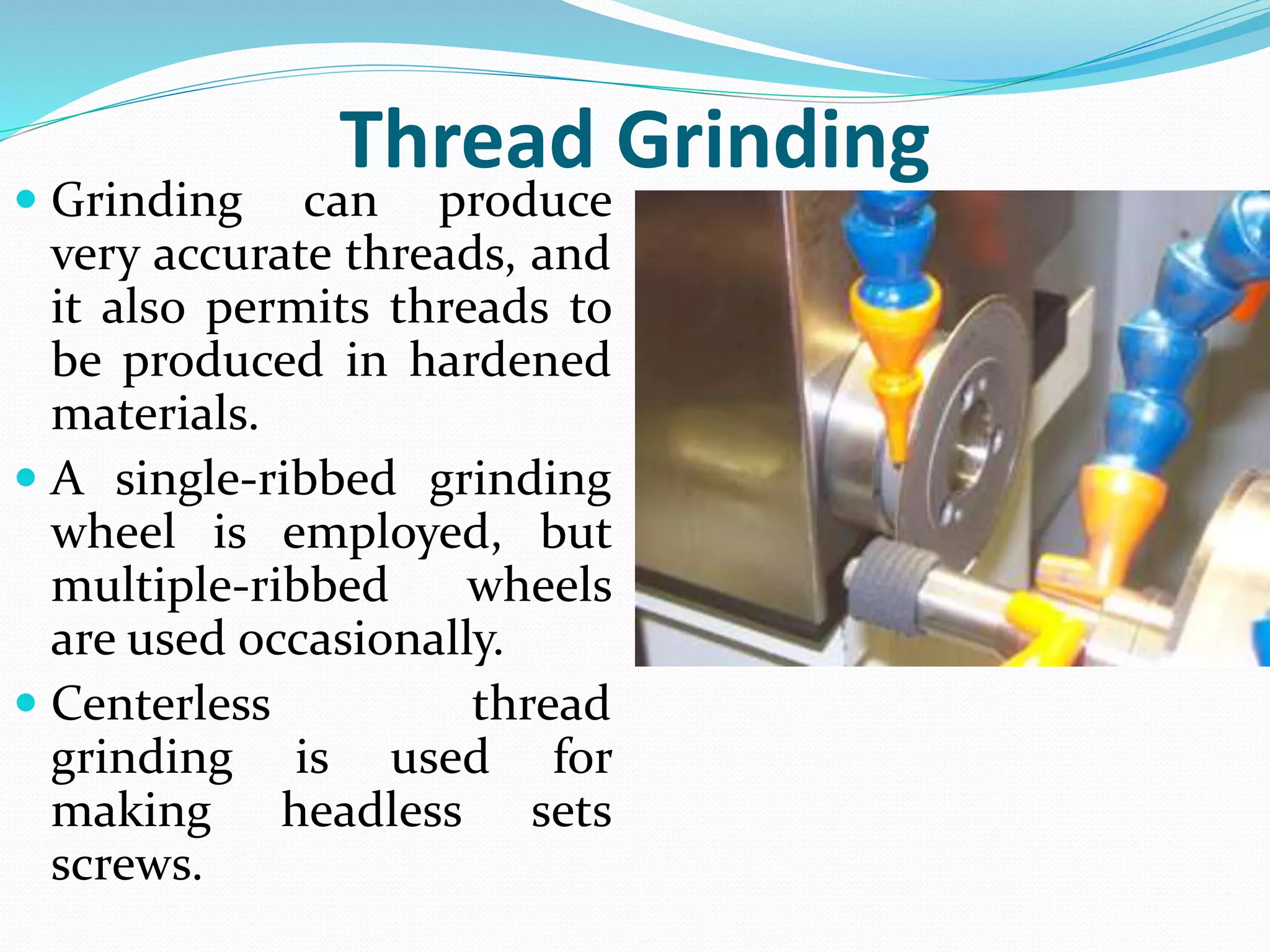
 Grinding can produce
very accurate threads, and
it also permits threads to
be produced in hardened
materials.
 A single-ribbed grinding
wheel is employed, but
multiple-ribbed wheels
are used occasionally.
 Centerless thread
grinding is used for
making headless sets
screws.
Thread Rolling
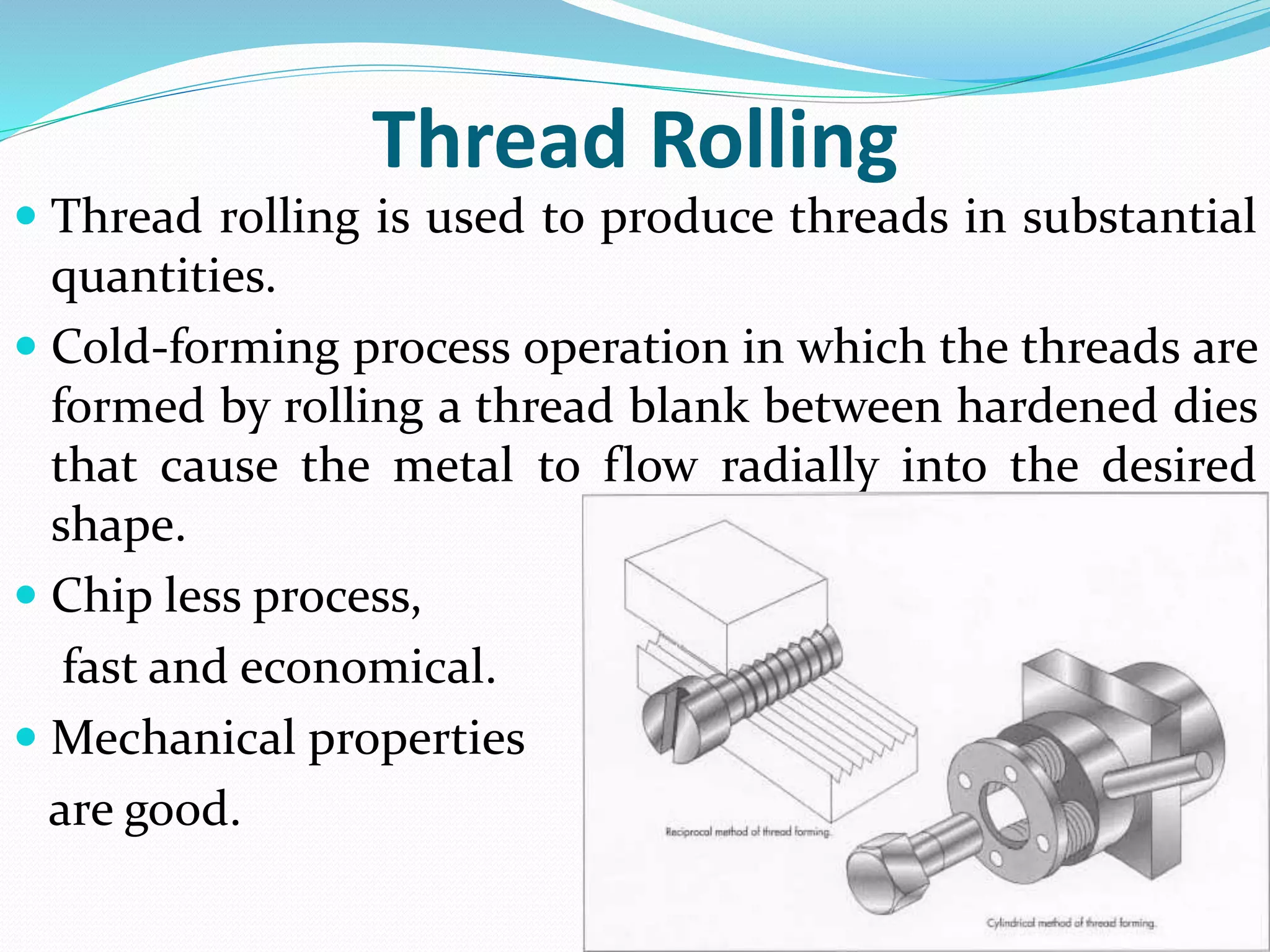
 Thread rolling is used to produce threads in substantial
quantities.
 Cold-forming process operation in which the threads are
formed by rolling a thread blank between hardened dies
that cause the metal to flow radially into the desired
shape.
 Chip less process,
fast and economical.
 Mechanical properties
are good.
GATE - 2003
Quality screw threads are produced by
(a) Thread milling
(b) Thread chasing
(c) Thread cutting with single point tool
(d) Thread casting
IES 2011
External threads can be produced by :
1. Rolling
2. Grinding
3. Milling
(a) 1 and 3 only
(b) 1 and 2 only
(c) 2 and 3only
(d) 1, 2 and 3
IES 2010
For producing both internal and external
screw threads, the method used is
(a) Thread chasing with multiple-rib chasers
(b) Thread milling and multiple-thread cutters
(c) Thread tapping with taps
(d) Die threading with self-opening die heads
IES - 2007
Screw threads are produced on solid rods by using
which of the following?
(a) Dies (b) Punch
(c) Mandrel (d) Boring bar
ISRO-2011
Which of the following screw thread is adapted for
power transmission in one direction
(a) Acme threads
(b) Buttress threads
(c) Square threads
(d) Multiple threads
ISRO-2010
Internal and external threads can be produced
on tapered surfaces conveniently by
(a) Universal milling machine
(b) Plano miller
(c) Planetary milling machine
(d) lathe
IES - 2012
The differential screw is used in a
(a) Turnbuckle
(b) Micrometer
(c) Vernier Caliper
(d) Coupler
IES - 2012
Multistart threads are used to get
(a) Smaller linear displacement
(b) Larger linear displacement with assured self locking
(c) Larger linear displacement with no guarantee of self
locking
(d) None of the above
IES - 2012
Which of the following screw threads is adopted for
power transmission in either direction
(a) ACME threads
(b) Square threads
(c) Buttress threads
(d) Multiple threads

Ch 8.2 screw thread manufacturing

  • 1.
  • 2.
    Processes, Machines andTools Used For Producing Screw Threads (a) Machining (b) Rolling (c) Grinding
  • 3.
    Thread Cutting External Internal •Threading on a lathe • Threading on a NC lathe • With a die held in a stock (manual) • With an automatic die (turret lathe or screw machine) or NC lathe • By milling • By Grinding • Threading (on a lathe or NC lathe) • With a tap and holder (manual NC, machine, semiautomatic, or automatic) • With a collapsible tap (turret lathe, screw machine, or special threading machine) •By milling
  • 4.
    Thread Cutting onLathe  Can cut both external and Internal thread  Thread cutting is a form- cutting operation an accurately shaped tool is used (with zero rake)  The lead screw and the split nut, which provide positive motion of the carriage relative to the rotation of the spindle.
  • 5.
    Cutting Threads withDies  Straight and tapered external threads can be cut quickly manually by means of threading dies.  Dies are made of carbon or high-speed tool steel (a) Solid threading die; (b) solid-adjustable threading die
  • 6.
    Thread Tapping  Cuttinginternal thread by a multiple-point tool is called thread tapping, and the tool is called a tap.  A hole of diameter slightly larger than the minor diameter of the thread must already exist. •The flutes on tap create cutting edges on the thread profile and provide space for the chips and the passage of cutting fluid. •Taps are made of either carbon or high-speed steel and coated with TiN.
  • 7.
    Thread Milling  Highlyaccurate threads, particularly in larger sizes, are often form- milled. Either a single or a multiple-form Cutter may be used.  The milling cutter is tilted at an angle equal to the helix angle of the thread and is fed inward radially to full depth while the work is stationary.
  • 8.
    Thread Grinding  Grindingcan produce very accurate threads, and it also permits threads to be produced in hardened materials.  A single-ribbed grinding wheel is employed, but multiple-ribbed wheels are used occasionally.  Centerless thread grinding is used for making headless sets screws.
  • 9.
    Thread Rolling  Threadrolling is used to produce threads in substantial quantities.  Cold-forming process operation in which the threads are formed by rolling a thread blank between hardened dies that cause the metal to flow radially into the desired shape.  Chip less process, fast and economical.  Mechanical properties are good.
  • 10.
    GATE - 2003 Qualityscrew threads are produced by (a) Thread milling (b) Thread chasing (c) Thread cutting with single point tool (d) Thread casting
  • 11.
    IES 2011 External threadscan be produced by : 1. Rolling 2. Grinding 3. Milling (a) 1 and 3 only (b) 1 and 2 only (c) 2 and 3only (d) 1, 2 and 3
  • 12.
    IES 2010 For producingboth internal and external screw threads, the method used is (a) Thread chasing with multiple-rib chasers (b) Thread milling and multiple-thread cutters (c) Thread tapping with taps (d) Die threading with self-opening die heads
  • 13.
    IES - 2007 Screwthreads are produced on solid rods by using which of the following? (a) Dies (b) Punch (c) Mandrel (d) Boring bar
  • 14.
    ISRO-2011 Which of thefollowing screw thread is adapted for power transmission in one direction (a) Acme threads (b) Buttress threads (c) Square threads (d) Multiple threads
  • 15.
    ISRO-2010 Internal and externalthreads can be produced on tapered surfaces conveniently by (a) Universal milling machine (b) Plano miller (c) Planetary milling machine (d) lathe
  • 16.
    IES - 2012 Thedifferential screw is used in a (a) Turnbuckle (b) Micrometer (c) Vernier Caliper (d) Coupler
  • 17.
    IES - 2012 Multistartthreads are used to get (a) Smaller linear displacement (b) Larger linear displacement with assured self locking (c) Larger linear displacement with no guarantee of self locking (d) None of the above
  • 18.
    IES - 2012 Whichof the following screw threads is adopted for power transmission in either direction (a) ACME threads (b) Square threads (c) Buttress threads (d) Multiple threads

Editor's Notes

  • #11 Ans. (b)
  • #12 Ans. (d)
  • #13 Ans. (b)
  • #14 Ans. (a)
  • #15 Ans. (b)
  • #16 Ans. (c)
  • #17 Ans. (b) This question is from Machine design – Kulkarni Book
  • #18 Ans. (c) This question is also from Machine Design – Kulkarni book
  • #19 Ans. (b) Square threads: Is used for power transmission in either direction  Results in maximum efficiency and minimum bursting pressure to nut It is employed in screw jacks and clamp