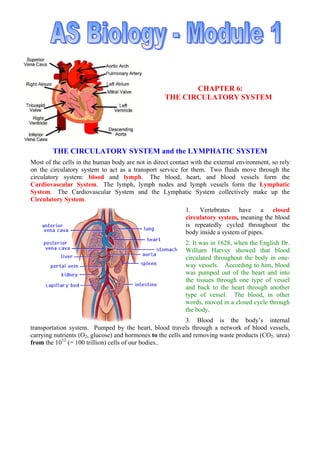
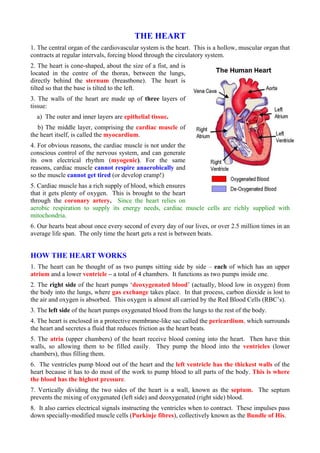
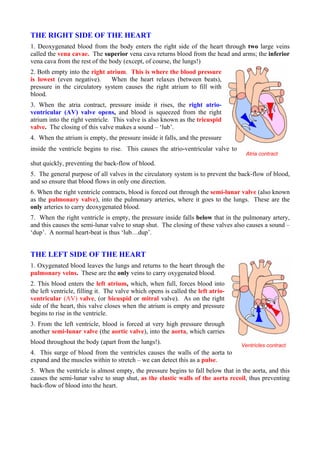
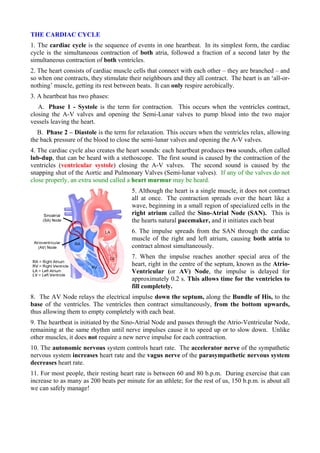
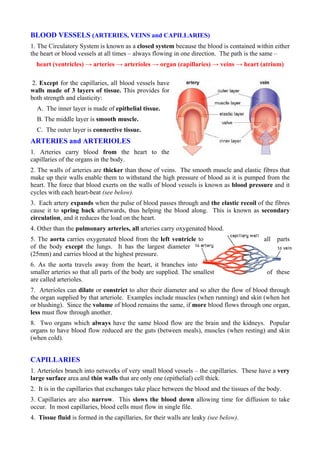
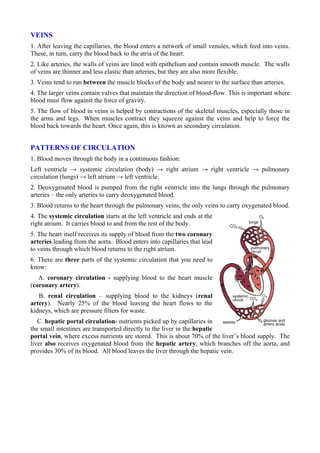
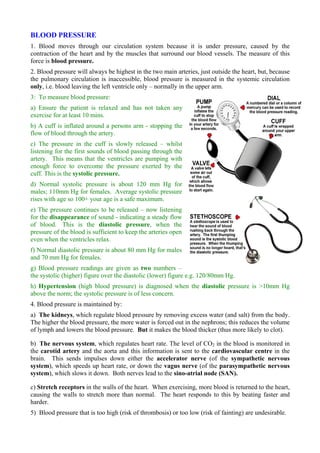
The circulatory system transports nutrients, gases, hormones, and waste products to and from cells using blood and lymph. It consists of the cardiovascular system - the heart, blood vessels, and blood - and the lymphatic system - lymph vessels and lymph. Blood is pumped from the heart through arteries, then capillaries where exchange occurs, and returns to the heart via veins. The heart has four chambers that pump blood through two separate circuits - systemic circulation transports blood to the body and pulmonary circulation transports blood to the lungs. Blood pressure is highest in the arteries and is measured in the brachial artery.
![TISSUE FLUID and the LYMPHATIC SYSTEM
1. As blood passes through the capillaries, about 10%
of its fluid leaks into the surrounding tissues. This is
known as tissue fluid.
2. This fluid carries chemicals such as glucose and
hormones to the cells of the body that are not next to
the capillary, and removes waste products, such as
urea and CO2.
3. The mechanism behind the formation of this fluid
is a common question!
a) The high blood pressure (‘hydrostatic
pressure’)at the arteriole end of the capillary bed is
much greater than the solute potential (‘osmotic
pressure’) of the surrounding cells. Thus fluid is forced out of the capillary.
b) at the venous end of the capillary bed, the blood pressure (‘hydrostatic pressure’) is low,
whilst the solute potential (‘osmotic pressure’) of the blood is much stronger, since the blood is
more concentrated. [The proteins in the blood are generally too big to leave the capillaries, whilst
the blood cells (and their proteins) all remain behind]. This causes some water to be returned to the
blood in the capillaries by osmosis. (see diagram above)
c) The overall effect is to ensure that the tissue
fluid is constantly on the move and so every cell in the
body receives a fresh supply of nutrients.
4. Not all of the fluid forced out of the capillaries is
returned by osmosis (which anyway only moves water –
what about the other chemicals?) and a network of vessels
known as the lymphatic system collects this excess fluid
and returns it to the circulatory system.
5. This fluid – lymph – flows through wider and wider
vessels which contain valves to ensure a one-way flow,
before it is returned to the blood in the vena cava, just
outside the right atrium (where blood pressure is lowest).
6. The lymphatic system has no pump, so lymph must be
moved through vessels by the squeezing of skeletal muscles.
7. These lymph vessels pass through small bean-shaped enlargements (organs) called lymph nodes,
which produce one type of white blood cell (lymphocytes) which are an important source of
antibodies and help us to fight infection. Examples of lymph nodes are the tonsils, the appendix,
the spleen and the thymus gland (in children only – it disappears from the age of 10 or so).
8. If the blood pressure is too high, or if the person is inactive, the lymph can build up in the
tissues, particularly around the ankles and feet. This is known as oedema and is common in older
people and can also happen on long-distance flights. With the blood now thicker, it is more likely
to clot, forming DVT or deep vein thrombosis. A simple precaution against this is to take one
aspirin tablet, 24 and 12 hours before flying, and also to regularly move your feet and ankles during
the flight. However, going for a jog is not recommended!](https://image.slidesharecdn.com/ch6-thecirculatorysystem-140812085824-phpapp01/85/Ch-6-the-circulatory-system-8-320.jpg)


![Hypothalamus short notes on location, function and disorders by Dr. Neha [PT]...](https://cdn.slidesharecdn.com/ss_thumbnails/hypothalamusbydr-260124142231-2b48143d-thumbnail.jpg?width=640&height=640&fit=bounds)


