FINANCIAL MATHEMATICS
Simple and Compound interest
SPECIFIC AIMS






Vukile Xhego



By the end of the lesson, learners should be able
to:
Define compounded and simple interest
Apply compound and simple interest formulae to
calculate future value of an investment/loan
Appreciate the knowledge of compound and
simple interest in real life situations, e.g:
choosing a better investment/loan offer
SPECIFIC AIMS


After the lesson learners will be able to differentiate



They will be able to calculate interest earned



Learners will be able to calculate any variable when
given adequate information



The can find interest; number of years ;future value;
principal amount, etc.



Differentiate between different types of interest rate,
example compounded monthly , semi-annual,
annually, quarterly and so on

Vukile Xhego

between simple interest and compound interest
INTRODUCTION


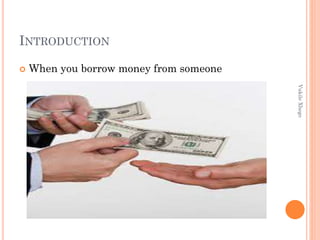
When you borrow money from someone
Vukile Xhego
INTRODUCTION


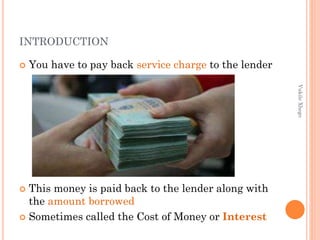
You have to pay back service charge to the lender
Vukile Xhego

This money is paid back to the lender along with
the amount borrowed
 Sometimes called the Cost of Money or Interest

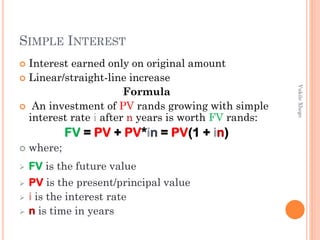
SIMPLE INTEREST
Interest earned only on original amount
 Linear/straight-line increase
Formula
 An investment of PV rands growing with simple
interest rate i after n years is worth FV rands:




where;



FV is the future value





PV is the present/principal value
i is the interest rate
n is time in years

Vukile Xhego

FV = PV + PV*in = PV(1 + in)
EXAMPLE


Vukile Xhego

Steve invested R 300 on an account which pays
10% simple interest. How much will his
investment be worth after 3 years?
EXAMPLE 1: SOLUTION
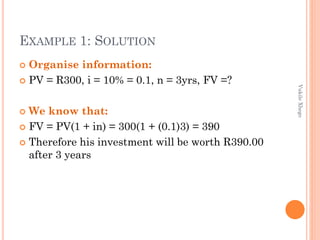
Organise information:
 PV = R300, i = 10% = 0.1, n = 3yrs, FV =?


Vukile Xhego

We know that:
 FV = PV(1 + in) = 300(1 + (0.1)3) = 390
 Therefore his investment will be worth R390.00
after 3 years

COMPOUND INTEREST


Vukile Xhego

Another bank approaches Steve and claims they
will give him a better offer that will earn him
interest at the same interest rate, but
compounded yearly
COMPOUND INTEREST
How much will his invest be worth after the 3
years?
 Which investment would you advise Steve to opt
for? Why?


Vukile Xhego
COMPOUND INTEREST
This is interest calculated not only on the original
investment but as well as on the interest that has
been earned previously
 Exponential growth
 An investment of PV rands earning interest at
an annual rate i compounded m times a year for
a period of n years is worth FV rands:


Vukile Xhego

FV = PV(1+i/m)n*m
COMPOUND INTEREST
Where;
 FV is the future value
 PV is the principal/present value
 i is interest rate
 n is the period of investment/loan
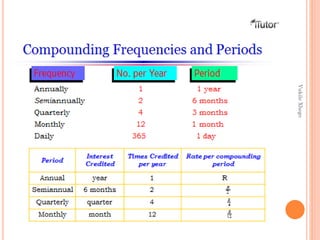
 m is the number of compounding periods in one
year


Vukile Xhego
SOLVING STEVE’S PROBLEM
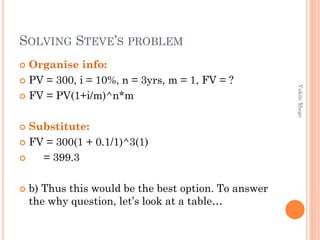
Organise info:
 PV = 300, i = 10%, n = 3yrs, m = 1, FV = ?
 FV = PV(1+i/m)^n*m




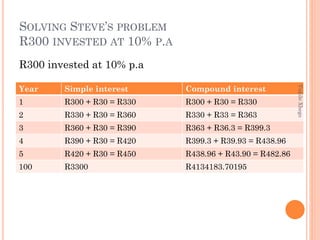
b) Thus this would be the best option. To answer
the why question, let’s look at a table…

Vukile Xhego

Substitute:
 FV = 300(1 + 0.1/1)^3(1)

= 399.3

SOLVING STEVE’S PROBLEM
R300 INVESTED AT 10% P.A
R300 invested at 10% p.a
Simple interest

Compound interest

1

R300 + R30 = R330

R300 + R30 = R330

2

R330 + R30 = R360

R330 + R33 = R363

3

R360 + R30 = R390

R363 + R36.3 = R399.3

4

R390 + R30 = R420

R399.3 + R39.93 = R438.96

5

R420 + R30 = R450

R438.96 + R43.90 = R482.86

100

R3300

R4134183.70195

Vukile Xhego

Year
SOLVING STEVE’S PROBLEM






Vukile Xhego



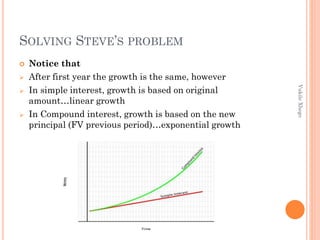
Notice that
After first year the growth is the same, however
In simple interest, growth is based on original
amount…linear growth
In Compound interest, growth is based on the new
principal (FV previous period)…exponential growth
SOLVING STEVE’S PROBLEM


Vukile Xhego

Thus exponential investment will yield much
better returns than linear investment…a good
option for Steve
SOLVING STEVE’S PROBLEM


A good option for YOU too…
Vukile Xhego
Vukile Xhego
REFERENCES
Iniego D. (2014): http://www.slideshare.net/IniegoDianne/compoundinterest-29921929?qid=b1cbfc82-2060-4cc5-aad0b82ce0100578&v=default&b=&from_search=1


Bruce C. (2010) : http://www.slideshare.net/brucecoulter/lesson-4compound-interest-2009


Mike Glenon (2012): http://www.slideshare.net/glennontech/simpleinterest-vs-compound-interest?qid=03f1d1bf-4878-41ac-84d882f9c9b3ace9&v=qf1&b=&from_search=1#btnNext


Mahapatra H.S. (2013) : http://www.slideshare.net/hisema/simpleand-compound-interest-24834757?qid=03f1d1bf-4878-41ac-84d882f9c9b3ace9&v=qf1&b=&from_search=3


Vukile Xhego

Itutor. (2013) : http://www.slideshare.net/itutor/compound-interest26220842

REFERENCE


Vukile Xhego



Images taken from:
Google Images: http//:google.co.za/images

Financial mathematics

  • 1.
  • 2.
    SPECIFIC AIMS    Vukile Xhego  Bythe end of the lesson, learners should be able to: Define compounded and simple interest Apply compound and simple interest formulae to calculate future value of an investment/loan Appreciate the knowledge of compound and simple interest in real life situations, e.g: choosing a better investment/loan offer
  • 3.
    SPECIFIC AIMS  After thelesson learners will be able to differentiate  They will be able to calculate interest earned  Learners will be able to calculate any variable when given adequate information  The can find interest; number of years ;future value; principal amount, etc.  Differentiate between different types of interest rate, example compounded monthly , semi-annual, annually, quarterly and so on Vukile Xhego between simple interest and compound interest
  • 4.
    INTRODUCTION  When you borrowmoney from someone Vukile Xhego
  • 5.
    INTRODUCTION  You have topay back service charge to the lender Vukile Xhego This money is paid back to the lender along with the amount borrowed  Sometimes called the Cost of Money or Interest 
  • 6.
    SIMPLE INTEREST Interest earnedonly on original amount  Linear/straight-line increase Formula  An investment of PV rands growing with simple interest rate i after n years is worth FV rands:   where;  FV is the future value    PV is the present/principal value i is the interest rate n is time in years Vukile Xhego FV = PV + PV*in = PV(1 + in)
  • 7.
    EXAMPLE  Vukile Xhego Steve investedR 300 on an account which pays 10% simple interest. How much will his investment be worth after 3 years?
  • 8.
    EXAMPLE 1: SOLUTION Organiseinformation:  PV = R300, i = 10% = 0.1, n = 3yrs, FV =?  Vukile Xhego We know that:  FV = PV(1 + in) = 300(1 + (0.1)3) = 390  Therefore his investment will be worth R390.00 after 3 years 
  • 9.
    COMPOUND INTEREST  Vukile Xhego Anotherbank approaches Steve and claims they will give him a better offer that will earn him interest at the same interest rate, but compounded yearly
  • 10.
    COMPOUND INTEREST How muchwill his invest be worth after the 3 years?  Which investment would you advise Steve to opt for? Why?  Vukile Xhego
  • 11.
    COMPOUND INTEREST This isinterest calculated not only on the original investment but as well as on the interest that has been earned previously  Exponential growth  An investment of PV rands earning interest at an annual rate i compounded m times a year for a period of n years is worth FV rands:  Vukile Xhego FV = PV(1+i/m)n*m
  • 12.
    COMPOUND INTEREST Where;  FVis the future value  PV is the principal/present value  i is interest rate  n is the period of investment/loan  m is the number of compounding periods in one year  Vukile Xhego
  • 13.
    SOLVING STEVE’S PROBLEM Organiseinfo:  PV = 300, i = 10%, n = 3yrs, m = 1, FV = ?  FV = PV(1+i/m)^n*m   b) Thus this would be the best option. To answer the why question, let’s look at a table… Vukile Xhego Substitute:  FV = 300(1 + 0.1/1)^3(1)  = 399.3 
  • 14.
    SOLVING STEVE’S PROBLEM R300INVESTED AT 10% P.A R300 invested at 10% p.a Simple interest Compound interest 1 R300 + R30 = R330 R300 + R30 = R330 2 R330 + R30 = R360 R330 + R33 = R363 3 R360 + R30 = R390 R363 + R36.3 = R399.3 4 R390 + R30 = R420 R399.3 + R39.93 = R438.96 5 R420 + R30 = R450 R438.96 + R43.90 = R482.86 100 R3300 R4134183.70195 Vukile Xhego Year
  • 15.
    SOLVING STEVE’S PROBLEM    VukileXhego  Notice that After first year the growth is the same, however In simple interest, growth is based on original amount…linear growth In Compound interest, growth is based on the new principal (FV previous period)…exponential growth
  • 16.
    SOLVING STEVE’S PROBLEM  VukileXhego Thus exponential investment will yield much better returns than linear investment…a good option for Steve
  • 17.
    SOLVING STEVE’S PROBLEM  Agood option for YOU too… Vukile Xhego
  • 18.
  • 19.
    REFERENCES Iniego D. (2014):http://www.slideshare.net/IniegoDianne/compoundinterest-29921929?qid=b1cbfc82-2060-4cc5-aad0b82ce0100578&v=default&b=&from_search=1  Bruce C. (2010) : http://www.slideshare.net/brucecoulter/lesson-4compound-interest-2009  Mike Glenon (2012): http://www.slideshare.net/glennontech/simpleinterest-vs-compound-interest?qid=03f1d1bf-4878-41ac-84d882f9c9b3ace9&v=qf1&b=&from_search=1#btnNext  Mahapatra H.S. (2013) : http://www.slideshare.net/hisema/simpleand-compound-interest-24834757?qid=03f1d1bf-4878-41ac-84d882f9c9b3ace9&v=qf1&b=&from_search=3  Vukile Xhego Itutor. (2013) : http://www.slideshare.net/itutor/compound-interest26220842 
  • 20.
    REFERENCE  Vukile Xhego  Images takenfrom: Google Images: http//:google.co.za/images