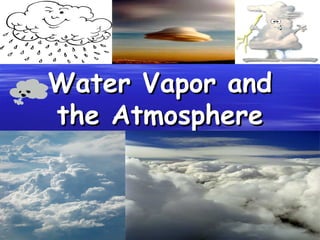
Water Vapor andWater Vapor and
the Atmospherethe Atmosphere
Water in theWater in the
AtmosphereAtmosphere
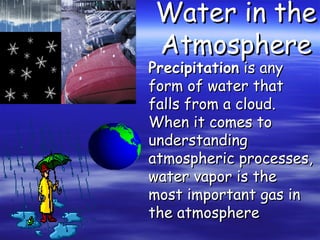
PrecipitationPrecipitation is anyis any
form of water thatform of water that
falls from a cloud.falls from a cloud.
When it comes toWhen it comes to
understandingunderstanding
atmospheric processes,atmospheric processes,
water vapor is thewater vapor is the
most important gas inmost important gas in
the atmospherethe atmosphere
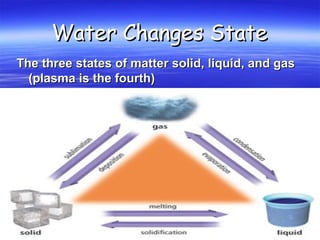
Water Changes StateWater Changes State
The three states of matter solid, liquid, and gasThe three states of matter solid, liquid, and gas
(plasma is the fourth)(plasma is the fourth)
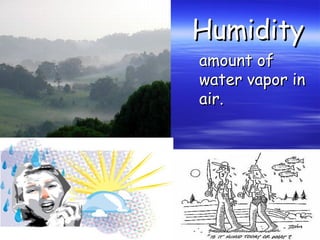
HumidityHumidity
amount ofamount of
water vapor inwater vapor in
air.air.
RelativeRelative
HumidityHumidity
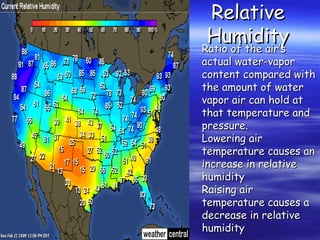
Ratio of the air’sRatio of the air’s
actual water-vaporactual water-vapor
content compared withcontent compared with
the amount of waterthe amount of water
vapor air can hold atvapor air can hold at
that temperature andthat temperature and
pressure.pressure.
Lowering airLowering air
temperature causes antemperature causes an
increase in relativeincrease in relative
humidityhumidity
Raising airRaising air
temperature causes atemperature causes a
decrease in relativedecrease in relative
humidityhumidity
Dew PointDew Point
Dew pointDew point is theis the
temperature totemperature to
which a parcel ofwhich a parcel of
air would need toair would need to
be cooled tobe cooled to
reach saturation.reach saturation.
How do I measureHow do I measure
humidity?humidity?
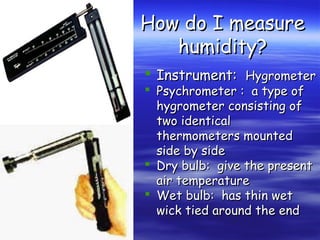
 Instrument:Instrument: HygrometerHygrometer
 Psychrometer : a type ofPsychrometer : a type of
hygrometer consisting ofhygrometer consisting of
two identicaltwo identical
thermometers mountedthermometers mounted
side by sideside by side
 Dry bulb: give the presentDry bulb: give the present
air temperatureair temperature
 Wet bulb: has thin wetWet bulb: has thin wet
wick tied around the endwick tied around the end
Cloud FormationCloud Formation
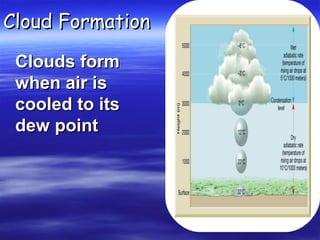
Clouds formClouds form
when air iswhen air is
cooled to itscooled to its
dew pointdew point
CloudsClouds
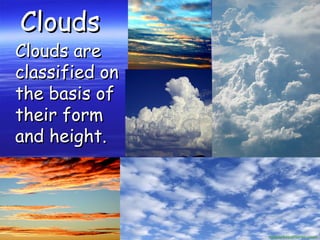
Clouds areClouds are
classified onclassified on
the basis ofthe basis of
their formtheir form
and height.and height.
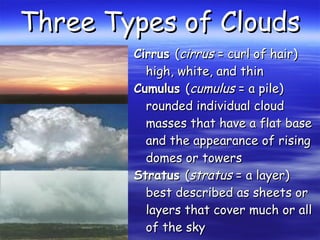
Three Types of CloudsThree Types of Clouds
CirrusCirrus ((cirruscirrus = curl of hair)= curl of hair)
high, white, and thinhigh, white, and thin
CumulusCumulus ((cumuluscumulus = a pile)= a pile)
rounded individual cloudrounded individual cloud
masses that have a flat basemasses that have a flat base
and the appearance of risingand the appearance of rising
domes or towersdomes or towers
StratusStratus ((stratusstratus = a layer)= a layer)
best described as sheets orbest described as sheets or
layers that cover much or alllayers that cover much or all
of the skyof the sky
Classification ofClassification of
Clouds by HeightClouds by Height
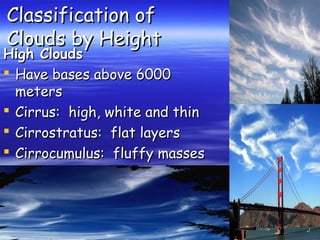
High CloudsHigh Clouds
 Have bases above 6000Have bases above 6000
metersmeters
 Cirrus: high, white and thinCirrus: high, white and thin
 Cirrostratus: flat layersCirrostratus: flat layers
 Cirrocumulus: fluffy massesCirrocumulus: fluffy masses
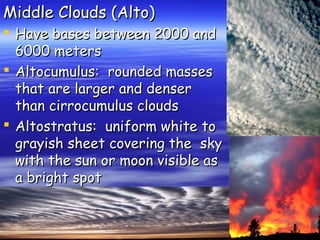
Middle Clouds (Alto)Middle Clouds (Alto)
 Have bases between 2000 andHave bases between 2000 and
6000 meters6000 meters
 Altocumulus: rounded massesAltocumulus: rounded masses
that are larger and denserthat are larger and denser
than cirrocumulus cloudsthan cirrocumulus clouds
 Altostratus: uniform white toAltostratus: uniform white to
grayish sheet covering the skygrayish sheet covering the sky
with the sun or moon visible aswith the sun or moon visible as
a bright spota bright spot
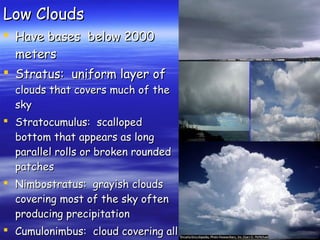
Low CloudsLow Clouds
 Have bases below 2000Have bases below 2000
metersmeters
 Stratus: uniform layer ofStratus: uniform layer of
clouds that covers much of theclouds that covers much of the
skysky
 Stratocumulus: scallopedStratocumulus: scalloped
bottom that appears as longbottom that appears as long
parallel rolls or broken roundedparallel rolls or broken rounded
patchespatches
 Nimbostratus: grayish cloudsNimbostratus: grayish clouds
covering most of the sky oftencovering most of the sky often
producing precipitationproducing precipitation
 Cumulonimbus: cloud covering allCumulonimbus: cloud covering all
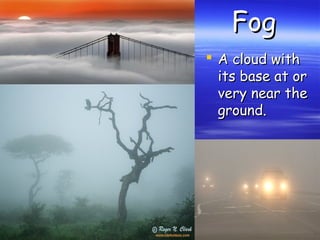
FogFog
 A cloud withA cloud with
its base at orits base at or
very near thevery near the
ground.ground.
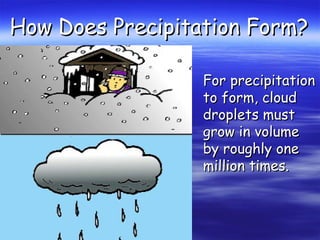
How Does Precipitation Form?How Does Precipitation Form?
For precipitationFor precipitation
to form, cloudto form, cloud
droplets mustdroplets must
grow in volumegrow in volume
by roughly oneby roughly one
million times.million times.
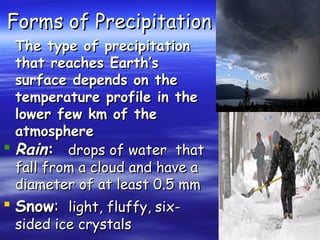
Forms of PrecipitationForms of Precipitation
The type of precipitationThe type of precipitation
that reaches Earth’sthat reaches Earth’s
surface depends on thesurface depends on the
temperature profile in thetemperature profile in the
lower few km of thelower few km of the
atmosphereatmosphere
 RainRain:: drops of water thatdrops of water that
fall from a cloud and have afall from a cloud and have a
diameter of at least 0.5 mmdiameter of at least 0.5 mm
 SnowSnow:: light, fluffy,light, fluffy, six-six-
sided ice crystalssided ice crystals
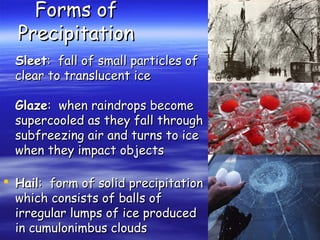
Forms ofForms of
PrecipitationPrecipitation
SleetSleet: fall of small particles of: fall of small particles of
clear to translucent iceclear to translucent ice
GlazeGlaze: when raindrops become: when raindrops become
supercooled as they fall throughsupercooled as they fall through
subfreezing air and turns to icesubfreezing air and turns to ice
when they impact objectswhen they impact objects
 HailHail: form of solid precipitation: form of solid precipitation
which consists of balls ofwhich consists of balls of
irregular lumps of ice producedirregular lumps of ice produced
in cumulonimbus cloudsin cumulonimbus clouds

Ch 18 ppt 2012

  • 1.
    Water Vapor andWaterVapor and the Atmospherethe Atmosphere
  • 2.
    Water in theWaterin the AtmosphereAtmosphere PrecipitationPrecipitation is anyis any form of water thatform of water that falls from a cloud.falls from a cloud. When it comes toWhen it comes to understandingunderstanding atmospheric processes,atmospheric processes, water vapor is thewater vapor is the most important gas inmost important gas in the atmospherethe atmosphere
  • 3.
    Water Changes StateWaterChanges State The three states of matter solid, liquid, and gasThe three states of matter solid, liquid, and gas (plasma is the fourth)(plasma is the fourth)
  • 4.
    HumidityHumidity amount ofamount of watervapor inwater vapor in air.air.
  • 5.
    RelativeRelative HumidityHumidity Ratio of theair’sRatio of the air’s actual water-vaporactual water-vapor content compared withcontent compared with the amount of waterthe amount of water vapor air can hold atvapor air can hold at that temperature andthat temperature and pressure.pressure. Lowering airLowering air temperature causes antemperature causes an increase in relativeincrease in relative humidityhumidity Raising airRaising air temperature causes atemperature causes a decrease in relativedecrease in relative humidityhumidity
  • 6.
    Dew PointDew Point DewpointDew point is theis the temperature totemperature to which a parcel ofwhich a parcel of air would need toair would need to be cooled tobe cooled to reach saturation.reach saturation.
  • 7.
    How do ImeasureHow do I measure humidity?humidity?  Instrument:Instrument: HygrometerHygrometer  Psychrometer : a type ofPsychrometer : a type of hygrometer consisting ofhygrometer consisting of two identicaltwo identical thermometers mountedthermometers mounted side by sideside by side  Dry bulb: give the presentDry bulb: give the present air temperatureair temperature  Wet bulb: has thin wetWet bulb: has thin wet wick tied around the endwick tied around the end
  • 8.
    Cloud FormationCloud Formation CloudsformClouds form when air iswhen air is cooled to itscooled to its dew pointdew point
  • 9.
    CloudsClouds Clouds areClouds are classifiedonclassified on the basis ofthe basis of their formtheir form and height.and height.
  • 10.
    Three Types ofCloudsThree Types of Clouds CirrusCirrus ((cirruscirrus = curl of hair)= curl of hair) high, white, and thinhigh, white, and thin CumulusCumulus ((cumuluscumulus = a pile)= a pile) rounded individual cloudrounded individual cloud masses that have a flat basemasses that have a flat base and the appearance of risingand the appearance of rising domes or towersdomes or towers StratusStratus ((stratusstratus = a layer)= a layer) best described as sheets orbest described as sheets or layers that cover much or alllayers that cover much or all of the skyof the sky
  • 11.
    Classification ofClassification of Cloudsby HeightClouds by Height High CloudsHigh Clouds  Have bases above 6000Have bases above 6000 metersmeters  Cirrus: high, white and thinCirrus: high, white and thin  Cirrostratus: flat layersCirrostratus: flat layers  Cirrocumulus: fluffy massesCirrocumulus: fluffy masses
  • 12.
    Middle Clouds (Alto)MiddleClouds (Alto)  Have bases between 2000 andHave bases between 2000 and 6000 meters6000 meters  Altocumulus: rounded massesAltocumulus: rounded masses that are larger and denserthat are larger and denser than cirrocumulus cloudsthan cirrocumulus clouds  Altostratus: uniform white toAltostratus: uniform white to grayish sheet covering the skygrayish sheet covering the sky with the sun or moon visible aswith the sun or moon visible as a bright spota bright spot
  • 13.
    Low CloudsLow Clouds Have bases below 2000Have bases below 2000 metersmeters  Stratus: uniform layer ofStratus: uniform layer of clouds that covers much of theclouds that covers much of the skysky  Stratocumulus: scallopedStratocumulus: scalloped bottom that appears as longbottom that appears as long parallel rolls or broken roundedparallel rolls or broken rounded patchespatches  Nimbostratus: grayish cloudsNimbostratus: grayish clouds covering most of the sky oftencovering most of the sky often producing precipitationproducing precipitation  Cumulonimbus: cloud covering allCumulonimbus: cloud covering all
  • 14.
    FogFog  A cloudwithA cloud with its base at orits base at or very near thevery near the ground.ground.
  • 15.
    How Does PrecipitationForm?How Does Precipitation Form? For precipitationFor precipitation to form, cloudto form, cloud droplets mustdroplets must grow in volumegrow in volume by roughly oneby roughly one million times.million times.
  • 16.
    Forms of PrecipitationFormsof Precipitation The type of precipitationThe type of precipitation that reaches Earth’sthat reaches Earth’s surface depends on thesurface depends on the temperature profile in thetemperature profile in the lower few km of thelower few km of the atmosphereatmosphere  RainRain:: drops of water thatdrops of water that fall from a cloud and have afall from a cloud and have a diameter of at least 0.5 mmdiameter of at least 0.5 mm  SnowSnow:: light, fluffy,light, fluffy, six-six- sided ice crystalssided ice crystals
  • 17.
    Forms ofForms of PrecipitationPrecipitation SleetSleet:fall of small particles of: fall of small particles of clear to translucent iceclear to translucent ice GlazeGlaze: when raindrops become: when raindrops become supercooled as they fall throughsupercooled as they fall through subfreezing air and turns to icesubfreezing air and turns to ice when they impact objectswhen they impact objects  HailHail: form of solid precipitation: form of solid precipitation which consists of balls ofwhich consists of balls of irregular lumps of ice producedirregular lumps of ice produced in cumulonimbus cloudsin cumulonimbus clouds