Water Vapor and
the Atmosphere
Water in the
Atmosphere

Precipitation is any
form of water that
falls from a cloud.
When it comes to
understanding
atmospheric processes,
water vapor is the
most important gas in
the atmosphere
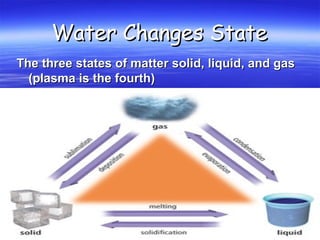
Water Changes State
The three states of matter solid, liquid, and gas
(plasma is the fourth)
Humidity
amount of
water vapor in
air.
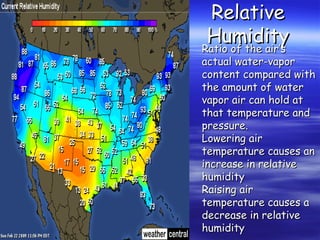
Relative
Humidity
Ratio of the air’s

actual water-vapor
content compared with
the amount of water
vapor air can hold at
that temperature and
pressure.
Lowering air
temperature causes an
increase in relative
humidity
Raising air
temperature causes a
decrease in relative
humidity
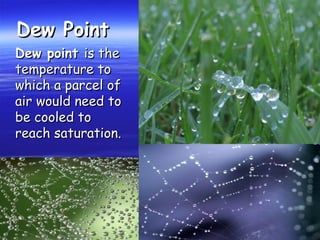
Dew Point
Dew point is the
temperature to
which a parcel of
air would need to
be cooled to
reach saturation.
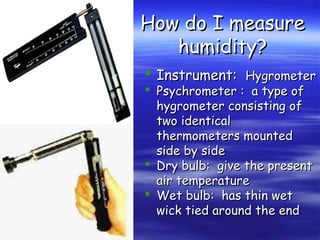
How do I measure
humidity?
 Instrument: Hygrometer
 Psychrometer : a type of
hygrometer consisting of
two identical
thermometers mounted
side by side
 Dry bulb: give the present
air temperature
 Wet bulb: has thin wet
wick tied around the end
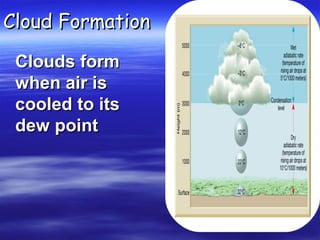
Cloud Formation
Clouds form
when air is
cooled to its
dew point
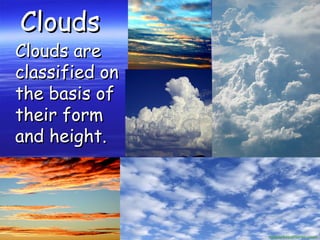
Clouds

Clouds are
classified on
the basis of
their form
and height.
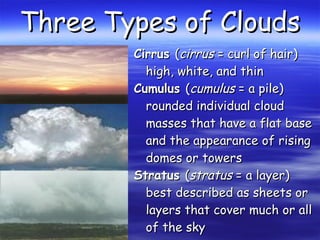
Three Types of Clouds
Cirrus (cirrus = curl of hair)
high, white, and thin
Cumulus (cumulus = a pile)
rounded individual cloud
masses that have a flat base
and the appearance of rising
domes or towers
Stratus (stratus = a layer)
best described as sheets or
layers that cover much or all
of the sky
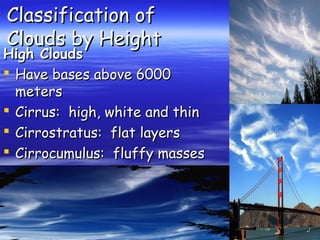
Classification of
Clouds by Height

High Clouds
 Have bases above 6000
meters
 Cirrus: high, white and thin
 Cirrostratus: flat layers
 Cirrocumulus: fluffy masses
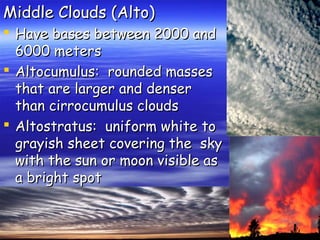
Middle Clouds (Alto)

 Have bases between 2000 and
6000 meters
 Altocumulus: rounded masses
that are larger and denser
than cirrocumulus clouds
 Altostratus: uniform white to
grayish sheet covering the sky
with the sun or moon visible as
a bright spot
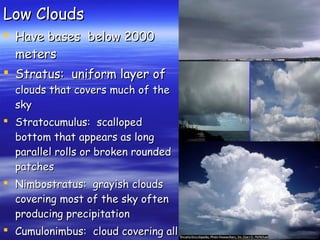
Low Clouds
 Have bases below 2000
meters
 Stratus: uniform layer of

clouds that covers much of the
sky

 Stratocumulus: scalloped
bottom that appears as long
parallel rolls or broken rounded
patches
 Nimbostratus: grayish clouds
covering most of the sky often
producing precipitation
 Cumulonimbus: cloud covering all
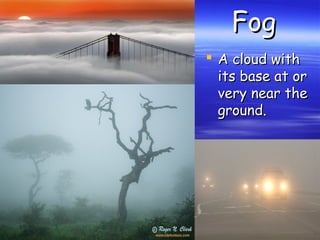
Fog
 A cloud with
its base at or
very near the
ground.
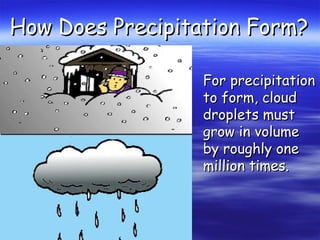
How Does Precipitation Form?
For precipitation
to form, cloud
droplets must
grow in volume
by roughly one
million times.
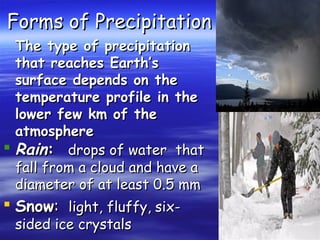
Forms of Precipitation
The type of precipitation
that reaches Earth’s
surface depends on the
temperature profile in the
lower few km of the
atmosphere
 Rain: drops of water that
fall from a cloud and have a
diameter of at least 0.5 mm

 Snow: light, fluffy, sixsided ice crystals
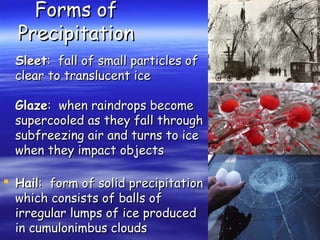
Forms of
Precipitation
Sleet: fall of small particles of
clear to translucent ice
Glaze: when raindrops become
supercooled as they fall through
subfreezing air and turns to ice
when they impact objects
 Hail: form of solid precipitation
which consists of balls of
irregular lumps of ice produced
in cumulonimbus clouds

Ch 18 ppt 2012

  • 1.
  • 2.
    Water in the Atmosphere Precipitationis any form of water that falls from a cloud. When it comes to understanding atmospheric processes, water vapor is the most important gas in the atmosphere
  • 3.
    Water Changes State Thethree states of matter solid, liquid, and gas (plasma is the fourth)
  • 4.
  • 5.
    Relative Humidity Ratio of theair’s actual water-vapor content compared with the amount of water vapor air can hold at that temperature and pressure. Lowering air temperature causes an increase in relative humidity Raising air temperature causes a decrease in relative humidity
  • 6.
    Dew Point Dew pointis the temperature to which a parcel of air would need to be cooled to reach saturation.
  • 7.
    How do Imeasure humidity?  Instrument: Hygrometer  Psychrometer : a type of hygrometer consisting of two identical thermometers mounted side by side  Dry bulb: give the present air temperature  Wet bulb: has thin wet wick tied around the end
  • 8.
    Cloud Formation Clouds form whenair is cooled to its dew point
  • 9.
    Clouds Clouds are classified on thebasis of their form and height.
  • 10.
    Three Types ofClouds Cirrus (cirrus = curl of hair) high, white, and thin Cumulus (cumulus = a pile) rounded individual cloud masses that have a flat base and the appearance of rising domes or towers Stratus (stratus = a layer) best described as sheets or layers that cover much or all of the sky
  • 11.
    Classification of Clouds byHeight High Clouds  Have bases above 6000 meters  Cirrus: high, white and thin  Cirrostratus: flat layers  Cirrocumulus: fluffy masses
  • 12.
    Middle Clouds (Alto) Have bases between 2000 and 6000 meters  Altocumulus: rounded masses that are larger and denser than cirrocumulus clouds  Altostratus: uniform white to grayish sheet covering the sky with the sun or moon visible as a bright spot
  • 13.
    Low Clouds  Havebases below 2000 meters  Stratus: uniform layer of clouds that covers much of the sky  Stratocumulus: scalloped bottom that appears as long parallel rolls or broken rounded patches  Nimbostratus: grayish clouds covering most of the sky often producing precipitation  Cumulonimbus: cloud covering all
  • 14.
    Fog  A cloudwith its base at or very near the ground.
  • 15.
    How Does PrecipitationForm? For precipitation to form, cloud droplets must grow in volume by roughly one million times.
  • 16.
    Forms of Precipitation Thetype of precipitation that reaches Earth’s surface depends on the temperature profile in the lower few km of the atmosphere  Rain: drops of water that fall from a cloud and have a diameter of at least 0.5 mm  Snow: light, fluffy, sixsided ice crystals
  • 17.
    Forms of Precipitation Sleet: fallof small particles of clear to translucent ice Glaze: when raindrops become supercooled as they fall through subfreezing air and turns to ice when they impact objects  Hail: form of solid precipitation which consists of balls of irregular lumps of ice produced in cumulonimbus clouds