ORGANIZATIONAL BEHAVIOR
                                      S T E P H E N P. R O B B I N S
                                          WWW.PRENHALL.COM/ROBBINS

                                            T    E   N   T   H   E   D   I   T   I   O   N


© 2003 Prentice Hall Inc. All rights reserved.                                           PowerPoint Presentation by Charlie Cook
O B J E C T I V E S
                       AFTER STUDYING THIS CHAPTER,
                       YOU SHOULD BE ABLE TO:

                        1. Describe the communication process.
                        2. Contrast the advantages and disadvantages of
                           oral versus written communication.
L E A R N I N G


                        3. Compare the effectiveness of the chain,
                           wheel, and all-channel networks.
                        4. Identify the factors affecting the use of the
                           grapevine.
                        5. Discuss how computer-aided technology is
                           changing organizational communication.
                      © 2003 Prentice Hall Inc.
                      All rights reserved.                                 10–2
O B J E C T I V E S (cont’d)
                                AFTER STUDYING THIS CHAPTER,
                                YOU SHOULD BE ABLE TO:

                                 6. Explain the importance of channel richness to
                                    improving communication effectiveness.
                                 7. Identify common barriers to effective
                                    communication.
                                 8. List behaviors related to effective active
                                    listening.
L E A R N I N G


                                 9. Contrast the meaning of talk for men versus
                                    women.
                                 10. Describe the potential problems in cross-
                               © 2003 Prentice communication.
                                     cultural Hall Inc.
                               All rights reserved.                              10–3
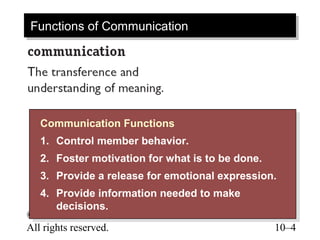
Functions of Communication


  Communication Functions
   Communication Functions
  1. Control member behavior.
   1. Control member behavior.
  2.
   2.   Foster motivation for what is to be done.
         Foster motivation for what is to be done.
  3.
   3.   Provide a release for emotional expression.
         Provide a release for emotional expression.
   4. Provide information needed to make
    4. Provide information needed to make
       decisions.
        decisions.
© 2003 Prentice Hall Inc.
All rights reserved.                              10–4
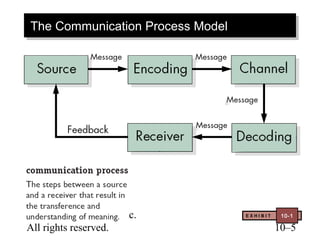
The Communication Process Model


© 2003 Prentice Hall Inc.         EXHIBIT    10-1

All rights reserved.                        10–5
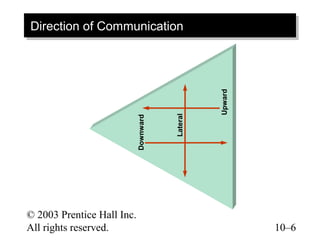
Direction of Communication


                                                 Upward
                                       Lateral
                            Downward


© 2003 Prentice Hall Inc.
All rights reserved.                                      10–6
Interpersonal Communication
 Interpersonal Communication
 Oral Communication
    – Advantages: Speed and feedback.
    – Disadvantage: Distortion of the message.
 Written Communication
    – Advantages: Tangible and verifiable.
    – Disadvantages: Time consuming and lacks feedback.
 Nonverbal Communication
   – Advantages: Supports other communications and
     provides observable expression of emotions and
     feelings.
   – Disadvantage: Misperception of body language or
     gestures can influence receiver’s interpretation of
     message.
© 2003 Prentice Hall Inc.
All rights reserved.                                       10–7
Intonations: It’s the Way You Say It!
 Intonations: It’s the Way You Say It!


© 2003 Prentice Hall Inc.                EXHIBIT    10-2

All rights reserved.                               10–8
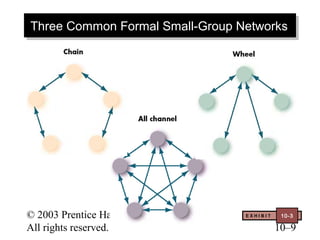
Three Common Formal Small-Group Networks


© 2003 Prentice Hall Inc.        EXHIBIT    10-3

All rights reserved.                       10–9
Small-Group Networks and Effectiveness
Criteria
Criteria


© 2003 Prentice Hall Inc.          EXHIBIT   10–
                                              10-4

All rights reserved.                         10
Grapevine
Grapevine
 Grapevine Characteristics
   – Not controlled by management.
   – Perceived by most employees as being more
     believable and reliable than formal communications.
   – Largely used to serve the self-interests of those who
     use it.
   – Results from:
       • Desire for information about important situations
       • Ambiguous conditions
       • Conditions that cause anxiety


© 2003 Prentice Hall Inc.                                 10–
All rights reserved.                                      11
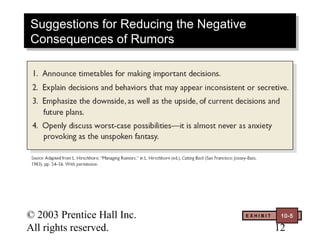
Suggestions for Reducing the Negative
Consequences of Rumors


© 2003 Prentice Hall Inc.           EXHIBIT   10–
                                               10-5

All rights reserved.                          12
Computer-Aided Communication
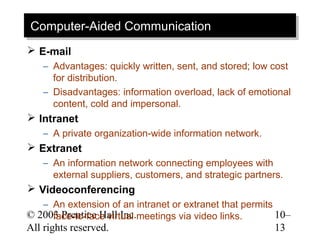
 E-mail
    – Advantages: quickly written, sent, and stored; low cost
      for distribution.
    – Disadvantages: information overload, lack of emotional
      content, cold and impersonal.
 Intranet
    – A private organization-wide information network.
 Extranet
    – An information network connecting employees with
      external suppliers, customers, and strategic partners.
 Videoconferencing
   – An extension of an intranet or extranet that permits
© 2003 Prentice Hall Inc.meetings via video links.
     face-to-face virtual                                 10–
All rights reserved.                                      13
Emoticons: Showing Emotion in E-Mail


© 2003 Prentice Hall Inc.          EXHIBIT   10–
                                              10-6

All rights reserved.                         14
Choice of Communication Channel


       Characteristics of Rich Channels
        Characteristics of Rich Channels
       1. Handle multiple cues simultaneously.
        1. Handle multiple cues simultaneously.
       2.
        2.   Facilitate rapid feedback.
              Facilitate rapid feedback.
       3.
        3.   Are very personal in context.
              Are very personal in context.
© 2003 Prentice Hall Inc.                         10–
All rights reserved.                              15
Information Richness of Communication
 Information Richness of Communication
Channels
 Channels


  Low channel richness          High channel richness


  Routine                                   Nonroutine


© 2003 Prentice Hall Inc.              EXHIBIT   10–
                                                  10-7

All rights reserved.                             16
Barriers to Effective Communication


© 2003 Prentice Hall Inc.             10–
All rights reserved.                  17
Barriers to Effective Communication (cont’d)
 emotions                      language
 How a receiver feels at the   Words have different
 time a message is received    meanings to different
 will influence how the        people.
 message is interpreted.


© 2003 Prentice Hall Inc.                          10–
All rights reserved.                               18
Communication Barriers Between Men and
Women
Women
 Men talk to:               Women talk to:
   – Emphasize status,        – Establish connection
     power, and                 and intimacy.
     independence.            – Criticize men for not
   – Complain that women        listening.
     talk on and on.          – Speak of problems to
   – Offer solutions.           promote closeness.
   – To boast about their     – Express regret and
     accomplishments.           restore balance to a
                                conversation.

© 2003 Prentice Hall Inc.                         10–
All rights reserved.                              19
Cross-Cultural Communication
 Cultural Barriers
   –   Barriers caused by semantics
   –   Barriers caused by word connotations
   –   Barriers caused by tone differences
   –   Barriers caused by differences among perceptions


© 2003 Prentice Hall Inc.                                 10–
All rights reserved.                                      20
Hand Gestures Mean Different Things in
Different Countries
Different Countries


© 2003 Prentice Hall Inc.           EXHIBIT   10–
                                              10-10a

All rights reserved.                          21
Hand Gestures Mean Different Things in
Different Countries (cont’d)


© 2003 Prentice Hall Inc.           EXHIBIT   10–
                                              10-10b

All rights reserved.                          22
Communication Barriers and Cultural Context


© 2003 Prentice Hall Inc.                10–
All rights reserved.                     23
High-
  High-
   vs.
   vs.
  Low-
  Low-
Context
 Context
Cultures
Cultures


© 2003 Prentice Hall Inc.   EXHIBIT   10–
                                       10-11

All rights reserved.                  24
A Cultural Guide
A Cultural Guide


  Cultural Context Communication Rules:
   Cultural Context Communication Rules:
  1. Assume differences until similarity is proven.
   1. Assume differences until similarity is proven.
  2. Emphasize description rather than
   2. Emphasize description rather than
      interpretation or evaluation.
       interpretation or evaluation.
  3. Practice empathy.
   3. Practice empathy.
  4. Treat your interpretations as a working
   4. Treat your interpretations as a working
      hypothesis.
       hypothesis.


© 2003 Prentice Hall Inc.                        10–
All rights reserved.                             25

Communication

  • 1.
    ORGANIZATIONAL BEHAVIOR S T E P H E N P. R O B B I N S WWW.PRENHALL.COM/ROBBINS T E N T H E D I T I O N © 2003 Prentice Hall Inc. All rights reserved. PowerPoint Presentation by Charlie Cook
  • 2.
    O B JE C T I V E S AFTER STUDYING THIS CHAPTER, YOU SHOULD BE ABLE TO: 1. Describe the communication process. 2. Contrast the advantages and disadvantages of oral versus written communication. L E A R N I N G 3. Compare the effectiveness of the chain, wheel, and all-channel networks. 4. Identify the factors affecting the use of the grapevine. 5. Discuss how computer-aided technology is changing organizational communication. © 2003 Prentice Hall Inc. All rights reserved. 10–2
  • 3.
    O B JE C T I V E S (cont’d) AFTER STUDYING THIS CHAPTER, YOU SHOULD BE ABLE TO: 6. Explain the importance of channel richness to improving communication effectiveness. 7. Identify common barriers to effective communication. 8. List behaviors related to effective active listening. L E A R N I N G 9. Contrast the meaning of talk for men versus women. 10. Describe the potential problems in cross- © 2003 Prentice communication. cultural Hall Inc. All rights reserved. 10–3
  • 4.
    Functions of Communication Functionsof Communication Communication Functions Communication Functions 1. Control member behavior. 1. Control member behavior. 2. 2. Foster motivation for what is to be done. Foster motivation for what is to be done. 3. 3. Provide a release for emotional expression. Provide a release for emotional expression. 4. Provide information needed to make 4. Provide information needed to make decisions. decisions. © 2003 Prentice Hall Inc. All rights reserved. 10–4
  • 5.
    The Communication ProcessModel The Communication Process Model © 2003 Prentice Hall Inc. EXHIBIT 10-1 All rights reserved. 10–5
  • 6.
    Direction of Communication Directionof Communication Upward Lateral Downward © 2003 Prentice Hall Inc. All rights reserved. 10–6
  • 7.
    Interpersonal Communication InterpersonalCommunication  Oral Communication – Advantages: Speed and feedback. – Disadvantage: Distortion of the message.  Written Communication – Advantages: Tangible and verifiable. – Disadvantages: Time consuming and lacks feedback.  Nonverbal Communication – Advantages: Supports other communications and provides observable expression of emotions and feelings. – Disadvantage: Misperception of body language or gestures can influence receiver’s interpretation of message. © 2003 Prentice Hall Inc. All rights reserved. 10–7
  • 8.
    Intonations: It’s theWay You Say It! Intonations: It’s the Way You Say It! © 2003 Prentice Hall Inc. EXHIBIT 10-2 All rights reserved. 10–8
  • 9.
    Three Common FormalSmall-Group Networks Three Common Formal Small-Group Networks © 2003 Prentice Hall Inc. EXHIBIT 10-3 All rights reserved. 10–9
  • 10.
    Small-Group Networks andEffectiveness Small-Group Networks and Effectiveness Criteria Criteria © 2003 Prentice Hall Inc. EXHIBIT 10– 10-4 All rights reserved. 10
  • 11.
    Grapevine Grapevine  Grapevine Characteristics – Not controlled by management. – Perceived by most employees as being more believable and reliable than formal communications. – Largely used to serve the self-interests of those who use it. – Results from: • Desire for information about important situations • Ambiguous conditions • Conditions that cause anxiety © 2003 Prentice Hall Inc. 10– All rights reserved. 11
  • 12.
    Suggestions for Reducingthe Negative Suggestions for Reducing the Negative Consequences of Rumors Consequences of Rumors © 2003 Prentice Hall Inc. EXHIBIT 10– 10-5 All rights reserved. 12
  • 13.
    Computer-Aided Communication Computer-Aided Communication E-mail – Advantages: quickly written, sent, and stored; low cost for distribution. – Disadvantages: information overload, lack of emotional content, cold and impersonal.  Intranet – A private organization-wide information network.  Extranet – An information network connecting employees with external suppliers, customers, and strategic partners.  Videoconferencing – An extension of an intranet or extranet that permits © 2003 Prentice Hall Inc.meetings via video links. face-to-face virtual 10– All rights reserved. 13
  • 14.
    Emoticons: Showing Emotionin E-Mail Emoticons: Showing Emotion in E-Mail © 2003 Prentice Hall Inc. EXHIBIT 10– 10-6 All rights reserved. 14
  • 15.
    Choice of CommunicationChannel Choice of Communication Channel Characteristics of Rich Channels Characteristics of Rich Channels 1. Handle multiple cues simultaneously. 1. Handle multiple cues simultaneously. 2. 2. Facilitate rapid feedback. Facilitate rapid feedback. 3. 3. Are very personal in context. Are very personal in context. © 2003 Prentice Hall Inc. 10– All rights reserved. 15
  • 16.
    Information Richness ofCommunication Information Richness of Communication Channels Channels Low channel richness High channel richness Routine Nonroutine © 2003 Prentice Hall Inc. EXHIBIT 10– 10-7 All rights reserved. 16
  • 17.
    Barriers to EffectiveCommunication Barriers to Effective Communication © 2003 Prentice Hall Inc. 10– All rights reserved. 17
  • 18.
    Barriers to EffectiveCommunication (cont’d) Barriers to Effective Communication (cont’d) emotions language How a receiver feels at the Words have different time a message is received meanings to different will influence how the people. message is interpreted. © 2003 Prentice Hall Inc. 10– All rights reserved. 18
  • 19.
    Communication Barriers BetweenMen and Communication Barriers Between Men and Women Women  Men talk to:  Women talk to: – Emphasize status, – Establish connection power, and and intimacy. independence. – Criticize men for not – Complain that women listening. talk on and on. – Speak of problems to – Offer solutions. promote closeness. – To boast about their – Express regret and accomplishments. restore balance to a conversation. © 2003 Prentice Hall Inc. 10– All rights reserved. 19
  • 20.
    Cross-Cultural Communication Cross-Cultural Communication Cultural Barriers – Barriers caused by semantics – Barriers caused by word connotations – Barriers caused by tone differences – Barriers caused by differences among perceptions © 2003 Prentice Hall Inc. 10– All rights reserved. 20
  • 21.
    Hand Gestures MeanDifferent Things in Hand Gestures Mean Different Things in Different Countries Different Countries © 2003 Prentice Hall Inc. EXHIBIT 10– 10-10a All rights reserved. 21
  • 22.
    Hand Gestures MeanDifferent Things in Hand Gestures Mean Different Things in Different Countries (cont’d) Different Countries (cont’d) © 2003 Prentice Hall Inc. EXHIBIT 10– 10-10b All rights reserved. 22
  • 23.
    Communication Barriers andCultural Context Communication Barriers and Cultural Context © 2003 Prentice Hall Inc. 10– All rights reserved. 23
  • 24.
    High- High- vs. vs. Low- Low- Context Context Cultures Cultures © 2003 Prentice Hall Inc. EXHIBIT 10– 10-11 All rights reserved. 24
  • 25.
    A Cultural Guide ACultural Guide Cultural Context Communication Rules: Cultural Context Communication Rules: 1. Assume differences until similarity is proven. 1. Assume differences until similarity is proven. 2. Emphasize description rather than 2. Emphasize description rather than interpretation or evaluation. interpretation or evaluation. 3. Practice empathy. 3. Practice empathy. 4. Treat your interpretations as a working 4. Treat your interpretations as a working hypothesis. hypothesis. © 2003 Prentice Hall Inc. 10– All rights reserved. 25