Department of GeologyDepartment of Geology
By:-By:-
Shamshad SheikhShamshad Sheikh
M.Sc.M.Sc.
Introduction of Soil ProfileIntroduction of Soil Profile
A soil horizon makes up a distinct layerA soil horizon makes up a distinct layer
of soil. The horizon runs roughly parallel toof soil. The horizon runs roughly parallel to
the soil surface and has different propertiesthe soil surface and has different properties
and characteristics than the adjacent layersand characteristics than the adjacent layers
above and below. The soil profile is a verticalabove and below. The soil profile is a vertical
section of the soil that depicts all of itssection of the soil that depicts all of its
horizons.horizons.
Soil HorizonsSoil Horizons
O) Organic surface layer: Litter layer of plant residues, the 
upper part often relatively undecomposed, but the lower 
part may be strongly humified.
A) Surface soil:  Layer  of  mineral  soil  with  most 
organic matter accumulation and soil life. Additionally, due 
to weathering, oxides (mainly  iron  oxides)  and clay
 minerals  are  formed  and  accumulated.  It  has  a 
pronounced soil structure. But in some soils, clay minerals, 
iron, aluminium,  organic  compounds,  and  other 
constituents are soluble and move downwards. When this 
eluviation is  pronounced,  a  lighter  coloured  E  subsurface 
soil  horizon  is  apparent  at  the  base  of  the  A  horizon.  A 
horizons  may  also  be  the  result  of  a  combination  of 
soil bioturbation and  surface  processes  that  winnow  fine 
particles  from  biologically  mounded topsoil.  In  this  case, 
the A horizon is regarded as a "biomantle".
  B) Subsoil: This layer has normally less organic 
matter  than  the  A  horizon,  so  its  colour  is 
mainly  derived  from  iron  oxides.  Iron  oxides 
and  clay  minerals  accumulate  as  a  result  of 
weathering. In a soil, where substances move 
down from the topsoil, this is the layer, where 
they accumulate. The process of accumulation 
of clay minerals, iron, aluminium and organic 
compounds, is referred to as illuviation. The B 
horizon has generally a soil structure.
C) Substratum: Layer of non-indurated poorly 
weathered or unweathered rocks. This layer may 
accumulate the more soluble compounds like 
CaCO3. Soils formed in situ from non-indurated 
material exhibit similarities to this C layer.
R) Bedrock: R horizons denote the layer of 
partially weathered or unweathered bedrock at 
the base of the soil profile. Unlike the above 
layers, R horizons largely comprise continuous 
masses (as opposed to boulders) of hard rock 
that cannot be excavated by hand. Soils 
formed in situ from bedrock will exhibit strong 
similarities to this bedrock layer.
Soil Texture and CompositionSoil Texture and Composition
The inorganic portion of soil is made of
many different size particles, and these
different size particles are present in
different proportions. The combination
of these two factors determines some of
the properties of the soil.
• AA permeablepermeable soil allows water to flow throughsoil allows water to flow through
it easily because the spaces between theit easily because the spaces between the
inorganic particles are large and wellinorganic particles are large and well
connected. Sandy or silty soils are consideredconnected. Sandy or silty soils are considered
‘light’ soils because they are permeable,‘light’ soils because they are permeable,
water-draining types of soils.water-draining types of soils.
• Soils that have lots of very small spaces areSoils that have lots of very small spaces are
water-holding soils. For example, when clay iswater-holding soils. For example, when clay is
present in a soil, the soil is heavier, holdspresent in a soil, the soil is heavier, holds
together more tightly, and holds water.together more tightly, and holds water.
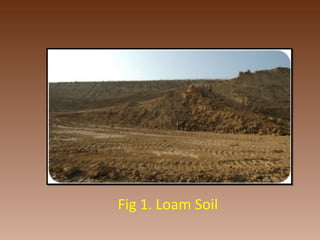
• When a soil contains a mixture of grain sizes,When a soil contains a mixture of grain sizes,
the soil is called athe soil is called a loamloam (figure 1).(figure 1).
Fig 1. Loam Soil
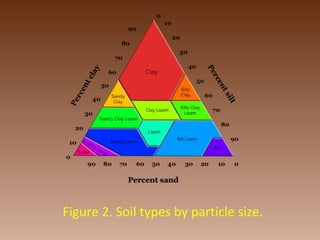
When soil scientists want to preciselyWhen soil scientists want to precisely
determine soil type, they measure thedetermine soil type, they measure the
percentage of sand, silt, and clay. They plotpercentage of sand, silt, and clay. They plot
this information on a triangular diagram, withthis information on a triangular diagram, with
each size particle at one corner (figure 2).each size particle at one corner (figure 2).
The soil type can then be determined from theThe soil type can then be determined from the
location on the diagram. At the top, a soillocation on the diagram. At the top, a soil
would be clay; at the left corner, it would bewould be clay; at the left corner, it would be
sand, and at the right corner it would be silt.sand, and at the right corner it would be silt.
Soils in the lower middle with less than 50%Soils in the lower middle with less than 50%
clay are loams.clay are loams.
Figure 2. Soil types by particle size.
Thanks !Thanks !

Soil profile