Physical Geography


                Geography 101
            Professor Lisa Schmidt
                Section 42134
            Monday 6:30-10:05 PM
Welcome to
Geography 101!

            • In this class you will learn the
              basic elements of geography.
            • We will study climate,
              landforms, water, soils, and
              native plants and animals.
            • We will examine the inter-
              relationships between these
              things and we will look at
              their patterns of distribution
              throughout the world.
Textbooks
• Required
  – Physical Geography
    California Edition
     • McKnight and Hess
• ISBN 0-558-11417-2
• Required
  – Goode’s World Atlas
     • ISBN 0-528-65000-3
  – Or any recent World Atlas
    that contains physical maps
• Recommended
  – The Geography Coloring
    Book
     • Wynn Kapit
     • 978-0131014725
Alternate Texts

• You may use older editions of this book.
• Details can be found here:

http://schmidtphysicalgeography.wikispaces.com/Textbooks
Required Materials
•   Pencils
•   Pens
•   Paper
•   Internet Access
Recommended Materials
•   Colored Pens or Pencils
    • For map studies
Course
    Description
• The goal of this
  course is to
  introduce students
  to basic concepts in
  physical
  geography…
   – Since it is an
     introductory course,
     it is assumed
     students have little
     or no background in
     physical geography.
• By the end of this course
               you should be able to do
               the following:
                – Explain why we have
                  seasons
                – Describe the function and
                  composition of the
                  atmosphere
             • Discuss the earth's
               hydrologic cycle
                – Describe the structure of
                  the solid earth and relate
                  it to phenomena such as
                  earthquakes, mountain
                  ranges and volcanoes
                – Evaluate the effects of the
                  atmosphere and the
                  hydrosphere on the
 Course           lithosphere
                – Compare and contrast the
                  earth's ecosystems
Objectives      – Identify various landforms
                – Be more geographically
                  literate!
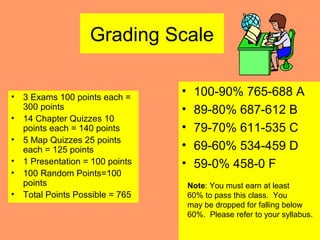
Grading Scale

•   3 Exams 100 points each =
                                  •    100-90% 765-688 A
    300 points                    •    89-80% 687-612 B
•   14 Chapter Quizzes 10
    points each = 140 points      •    79-70% 611-535 C
•   5 Map Quizzes 25 points
    each = 125 points             •    69-60% 534-459 D
•   1 Presentation = 100 points   •    59-0% 458-0 F
•   100 Random Points=100
    points                            Note: You must earn at least
•   Total Points Possible = 765       60% to pass this class. You
                                      may be dropped for falling below
                                      60%. Please refer to your syllabus.
Exams
        • There will be three
          exams.
        • You will need to log in
          to Blackboard for each
          exam.
        • The format will be
          multiple choice, true
          and false, and/or
          matching.
        • Each exam will be
          worth 100 points.
        • Exams will close at
          6:00 PM on their due
          dates.
Chapter Quizzes


        • There will be a quiz for each chapter we cover
          in the textbook.
           – Quizzes will be posted on Blackboard after each
             lecture.
               • You must be connected to the internet to complete the
                 quizzes. See syllabus for campus locations.
           – Quizzes will be due one week after they are posted
             by 6:00 PM.
        • There will be 14 quizzes.
           – The format will be multiple choice, true/false, and or
             matching.
        • Quiz questions may be used on exams.
           – You will want to take notes from your quizzes and
             study them.
Map Quizzes

    • We will study the physical features of Earth.
    • You MUST bring your atlas to class on map
      study nights.
    • Colored pens or pencils will be helpful.
    • You will have five map quizzes.
    • Map Quizzes will be given using Blackboard and
      will also close at 6:00 PM.
       –   North America 25 points
       –   South America 25 points
       –   Europe 25 points
       –   Asia 25 points
       –   Africa 25 points
            • Total 125 points
Presentation


• A presentation is required
  for this class.
• Presentations will be no
  less than five minutes
  and no more than ten.
• You may choose from a
  list of topics.
• Presentations MAY be
  done in groups with
  instructor approval.
• A video may be created
  as an alternative to a
  presentation.
Random Points


            • These may be
              assigned at any time
              during this course.
            • This could be and
              assignment or simply
              an attendance check.
Late Work

• Late work will not be
  accepted.
• Do not ask to have
  quizzes or exams
  opened if you miss
  them.
Absences and
• I reserve the right to drop         Tardiness
  students who miss class
  twice.
• If you have to miss class,
  you should stay in contact
  with me if you do not want
  to be dropped.
• You may be dropped for
  excessive tardiness.
   – This means being more than
     five minutes late, more than
     three times.
• If you are going to be late,
  come in quietly and take a
  seat WITHOUT
  interrupting lecture.
E-mailing Assignments/My
              Mailbox
• Assignments will NOT
  be accepted by e-mail.

• If you cannot make it
  to class, take your
  assignment to my
  mailbox which is
  located in the Liberal
  Arts Building, where
  the faculty offices and
  secretaries are
  located.
Last Day to
Turn in Work
               • The last day that extra
                 credit work or late
                 work (if it has been
                 approved), will be
                 accepted is Dec. 3rd.
               • No exceptions will be
                 made.
Dropping
• If you decide to drop, you must do it
  formally.
• If you stop coming to class, I have no way
  of knowing if you want to drop or receive
  and F.
  – I will give F’s, it is your responsibility to drop.
Graded Work
              • It is your
                responsibility to pick
                up graded work.
              • You should keep all
                of your graded work
                until you receive your
                final grade.
                 – Not only for this class
                   but all of your classes!
              • All graded work will
                be held for 30 days
                after the end of the
                semester then
                discarded.
• Some extra credit may be
  assigned throughout the
  semester.
• It will be announced in class
  and you must be present in
  order to take advantage of it.
Academic Honesty


• Cheating of any kind
  will not be tolerated.
   – Any incidences of
     cheating or plagiarism
     will be reported to the
     deans office.
   – Please refer to Victor
     Valley College’s policy
     on academic honesty.
Cell Phones and Texting
•   Use of cell phones for talking or texting
    during class is inappropriate.
•   You may be asked to leave the
    classroom if you are talking or texting
    on your phone during lecture.
•   Phones should be set to silent mode
    when in class.
Blackboard

             • Blackboard will be used
               for this class.
             • You must use Blackboard
               for your quizzes, map
               quizzes, and exams.
               – You will also find
                 PowerPoint lectures, study
                 guides, blank maps, grades
                 and course documents.
               – http://vvc.blackboard.com

                  • If you have questions about
                    blackboard, stay after
                    class, I am here to help.
Disabled Students Programs and
              Services


• If you need accommodations for this course,
  please see me after class.
• If you have or think you may have a disability that
  might affect your performance in this course,
  please contact the office of Disabled Students
  Programs and Services at (760) 245-4271 ext,
  2212, or stop by their office located in building 50.
• There is help available.
Contact
Information
        • The best way to reach me is
          by e-mail.
        • My e-mail address is:
          Lisa_M_Schmidt@yahoo.com
        • My mailbox is located the
          Liberal Arts Building (Building
          30, our building)
        • My voice mail is (760) 245-
          4271 ext. 8585.
           – I do not check my voice mail as
             often as my e-mail.
Note bout Schedule
        and Topics


• All dates, topics, point totals, and assignments are
  tentative.
• I reserve the right to make changes as they may
  become necessary throughout the semester.
• Should you happen to miss class, it is you
  responsibility to obtain information about any changes.
Class Schedule…
•   Please take a
    moment to look at
    the schedule in
    your syllabus.
•   Notice when
    quizzes are due,
    when map studies
    are, when exams
    are, and when
    presentations
    begin.
For Your Success

• There are computers
  available for your use
  on campus in the
  library and in the ATC.
  – See the map on the
    syllabus…
What is Geography?
• The scientific study of the Earth's surface
  and its various climates, countries,
  peoples, and natural resources.
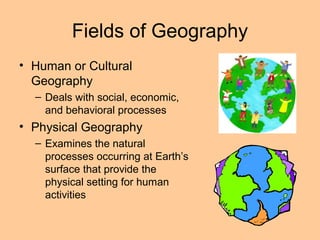
Fields of Geography
• Human or Cultural
  Geography
  – Deals with social, economic,
    and behavioral processes
• Physical Geography
  – Examines the natural
    processes occurring at Earth’s
    surface that provide the
    physical setting for human
    activities
Branches of Physical Geography
•   Biogeography
•   Climatology
•   Coastal Geography
•   Environmental Geography
•   Geomorphology
•   Glaciology
•   Hydrology
•   Oceanography
•   Paleogeography
Branches of Human Geography
• Cultural Geography     • Developmental
• Historical Geography     Geography
•                        • Economic Geography
  Political Geography
•                        • Medical Geography
  Population
  Geography              • Transportation
• Demography               Geography
                         • Urban Geography
Tools Geographers Use
•   Maps
     – Paper representations of space showing
       point, line, or area data
         • Or more simply put, locations,
           connections, and regions
•   Remote Sensing
     – Aircraft or spacecraft provide images of
       earth’s surface
•   GIS or Geographic Information Systems
     – Powerful computer mapmaking software
       connected to data bases
•   Mathematical Modeling and Statistics
     – Used to understand natural and human
       phenomenon
What we will be
     studying…


• Four great physical realms or spheres of Earth
   – Atmosphere
       • The gaseous layer that surrounds the earth
   – Lithosphere
       • The outermost solid layer of the Earth
   – Hydrosphere
       • The liquid realm of the Earth
   – Biosphere
       • Encompasses all living organisms of the Earth

Mon lec fa 2012

  • 1.
    Physical Geography Geography 101 Professor Lisa Schmidt Section 42134 Monday 6:30-10:05 PM
  • 2.
    Welcome to Geography 101! • In this class you will learn the basic elements of geography. • We will study climate, landforms, water, soils, and native plants and animals. • We will examine the inter- relationships between these things and we will look at their patterns of distribution throughout the world.
  • 3.
    Textbooks • Required – Physical Geography California Edition • McKnight and Hess • ISBN 0-558-11417-2 • Required – Goode’s World Atlas • ISBN 0-528-65000-3 – Or any recent World Atlas that contains physical maps • Recommended – The Geography Coloring Book • Wynn Kapit • 978-0131014725
  • 4.
    Alternate Texts • Youmay use older editions of this book. • Details can be found here: http://schmidtphysicalgeography.wikispaces.com/Textbooks
  • 5.
    Required Materials • Pencils • Pens • Paper • Internet Access
  • 6.
    Recommended Materials • Colored Pens or Pencils • For map studies
  • 7.
    Course Description • The goal of this course is to introduce students to basic concepts in physical geography… – Since it is an introductory course, it is assumed students have little or no background in physical geography.
  • 8.
    • By theend of this course you should be able to do the following: – Explain why we have seasons – Describe the function and composition of the atmosphere • Discuss the earth's hydrologic cycle – Describe the structure of the solid earth and relate it to phenomena such as earthquakes, mountain ranges and volcanoes – Evaluate the effects of the atmosphere and the hydrosphere on the Course lithosphere – Compare and contrast the earth's ecosystems Objectives – Identify various landforms – Be more geographically literate!
  • 9.
    Grading Scale • 3 Exams 100 points each = • 100-90% 765-688 A 300 points • 89-80% 687-612 B • 14 Chapter Quizzes 10 points each = 140 points • 79-70% 611-535 C • 5 Map Quizzes 25 points each = 125 points • 69-60% 534-459 D • 1 Presentation = 100 points • 59-0% 458-0 F • 100 Random Points=100 points Note: You must earn at least • Total Points Possible = 765 60% to pass this class. You may be dropped for falling below 60%. Please refer to your syllabus.
  • 10.
    Exams • There will be three exams. • You will need to log in to Blackboard for each exam. • The format will be multiple choice, true and false, and/or matching. • Each exam will be worth 100 points. • Exams will close at 6:00 PM on their due dates.
  • 11.
    Chapter Quizzes • There will be a quiz for each chapter we cover in the textbook. – Quizzes will be posted on Blackboard after each lecture. • You must be connected to the internet to complete the quizzes. See syllabus for campus locations. – Quizzes will be due one week after they are posted by 6:00 PM. • There will be 14 quizzes. – The format will be multiple choice, true/false, and or matching. • Quiz questions may be used on exams. – You will want to take notes from your quizzes and study them.
  • 12.
    Map Quizzes • We will study the physical features of Earth. • You MUST bring your atlas to class on map study nights. • Colored pens or pencils will be helpful. • You will have five map quizzes. • Map Quizzes will be given using Blackboard and will also close at 6:00 PM. – North America 25 points – South America 25 points – Europe 25 points – Asia 25 points – Africa 25 points • Total 125 points
  • 13.
    Presentation • A presentationis required for this class. • Presentations will be no less than five minutes and no more than ten. • You may choose from a list of topics. • Presentations MAY be done in groups with instructor approval. • A video may be created as an alternative to a presentation.
  • 14.
    Random Points • These may be assigned at any time during this course. • This could be and assignment or simply an attendance check.
  • 15.
    Late Work • Latework will not be accepted. • Do not ask to have quizzes or exams opened if you miss them.
  • 16.
    Absences and • Ireserve the right to drop Tardiness students who miss class twice. • If you have to miss class, you should stay in contact with me if you do not want to be dropped. • You may be dropped for excessive tardiness. – This means being more than five minutes late, more than three times. • If you are going to be late, come in quietly and take a seat WITHOUT interrupting lecture.
  • 17.
    E-mailing Assignments/My Mailbox • Assignments will NOT be accepted by e-mail. • If you cannot make it to class, take your assignment to my mailbox which is located in the Liberal Arts Building, where the faculty offices and secretaries are located.
  • 18.
    Last Day to Turnin Work • The last day that extra credit work or late work (if it has been approved), will be accepted is Dec. 3rd. • No exceptions will be made.
  • 19.
    Dropping • If youdecide to drop, you must do it formally. • If you stop coming to class, I have no way of knowing if you want to drop or receive and F. – I will give F’s, it is your responsibility to drop.
  • 20.
    Graded Work • It is your responsibility to pick up graded work. • You should keep all of your graded work until you receive your final grade. – Not only for this class but all of your classes! • All graded work will be held for 30 days after the end of the semester then discarded.
  • 21.
    • Some extracredit may be assigned throughout the semester. • It will be announced in class and you must be present in order to take advantage of it.
  • 22.
    Academic Honesty • Cheatingof any kind will not be tolerated. – Any incidences of cheating or plagiarism will be reported to the deans office. – Please refer to Victor Valley College’s policy on academic honesty.
  • 23.
    Cell Phones andTexting • Use of cell phones for talking or texting during class is inappropriate. • You may be asked to leave the classroom if you are talking or texting on your phone during lecture. • Phones should be set to silent mode when in class.
  • 24.
    Blackboard • Blackboard will be used for this class. • You must use Blackboard for your quizzes, map quizzes, and exams. – You will also find PowerPoint lectures, study guides, blank maps, grades and course documents. – http://vvc.blackboard.com • If you have questions about blackboard, stay after class, I am here to help.
  • 25.
    Disabled Students Programsand Services • If you need accommodations for this course, please see me after class. • If you have or think you may have a disability that might affect your performance in this course, please contact the office of Disabled Students Programs and Services at (760) 245-4271 ext, 2212, or stop by their office located in building 50. • There is help available.
  • 26.
    Contact Information • The best way to reach me is by e-mail. • My e-mail address is: Lisa_M_Schmidt@yahoo.com • My mailbox is located the Liberal Arts Building (Building 30, our building) • My voice mail is (760) 245- 4271 ext. 8585. – I do not check my voice mail as often as my e-mail.
  • 27.
    Note bout Schedule and Topics • All dates, topics, point totals, and assignments are tentative. • I reserve the right to make changes as they may become necessary throughout the semester. • Should you happen to miss class, it is you responsibility to obtain information about any changes.
  • 28.
    Class Schedule… • Please take a moment to look at the schedule in your syllabus. • Notice when quizzes are due, when map studies are, when exams are, and when presentations begin.
  • 29.
    For Your Success •There are computers available for your use on campus in the library and in the ATC. – See the map on the syllabus…
  • 30.
    What is Geography? •The scientific study of the Earth's surface and its various climates, countries, peoples, and natural resources.
  • 31.
    Fields of Geography •Human or Cultural Geography – Deals with social, economic, and behavioral processes • Physical Geography – Examines the natural processes occurring at Earth’s surface that provide the physical setting for human activities
  • 32.
    Branches of PhysicalGeography • Biogeography • Climatology • Coastal Geography • Environmental Geography • Geomorphology • Glaciology • Hydrology • Oceanography • Paleogeography
  • 33.
    Branches of HumanGeography • Cultural Geography • Developmental • Historical Geography Geography • • Economic Geography Political Geography • • Medical Geography Population Geography • Transportation • Demography Geography • Urban Geography
  • 34.
    Tools Geographers Use • Maps – Paper representations of space showing point, line, or area data • Or more simply put, locations, connections, and regions • Remote Sensing – Aircraft or spacecraft provide images of earth’s surface • GIS or Geographic Information Systems – Powerful computer mapmaking software connected to data bases • Mathematical Modeling and Statistics – Used to understand natural and human phenomenon
  • 35.
    What we willbe studying… • Four great physical realms or spheres of Earth – Atmosphere • The gaseous layer that surrounds the earth – Lithosphere • The outermost solid layer of the Earth – Hydrosphere • The liquid realm of the Earth – Biosphere • Encompasses all living organisms of the Earth