PRINCIPLES OF
CHAPTER 1
MARKETING PRINCIPLES AND STRATEGIES
Lesson 1:
Marketing and its
Traditional Approaches
WHAT IS
MARKETING?
 is a form of
communicating or
promoting the VALUE of a
product, service or brand
to the consumers.
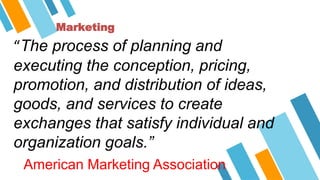
Marketing
“The process of planning and
executing the conception, pricing,
promotion, and distribution of ideas,
goods, and services to create
exchanges that satisfy individual and
organization goals.”
American Marketing Association
In summary, marketing is
• Creation
• Communication
• Delivery of value to
customers
Core
Marketing
Concepts
1. NEEDS
A human need is something
that a person must have in
order to live and survive.
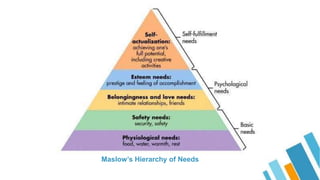
Maslow’s Hierarchy of Needs
2. WANTS
A human want is something
that a person desires to have.
3. DEMANDS
Demands are also human
wants that are supported by
buying power.
4. EXCHANGE
Marketing occurs when the
buyer and seller trade
something of equal value. Both
the buyer and the seller have
gained something that
satisfied their unmet needs.
5. MARKET
The market is composed of
people with both desire and
ability to buy a product or
service.
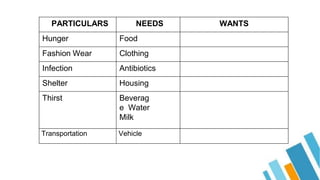
PARTICULARS NEEDS WANTS
Hunger Food
Fashion Wear Clothing
Infection Antibiotics
Shelter Housing
Thirst Beverag
e Water
Milk
Transportation Vehicle
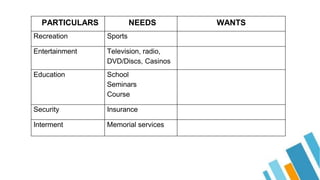
PARTICULARS NEEDS WANTS
Recreation Sports
Entertainment Television, radio,
DVD/Discs, Casinos
Education School
Seminars
Course
Security Insurance
Interment Memorial services
SCOPE OF
MARKETING
1. GOODS
Physical goods comprise
the volume of most
countries’
production and marketing
effort.
2. SERVICES
as economies progress, a
growing proportion of their
activities are concentrated
on the production of
services.
Through organizing a
number of services and
goods, one can generate,
stage, and market
experiences.
3. EXPERIENCES
Marketers
endorse time-
based events.
4. EVENTS
5. PERSONS
celebrity marketing has
turn into a main and
popular business.
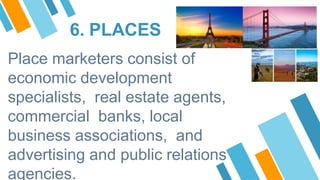
6. PLACES
Place marketers consist of
economic development
specialists, real estate agents,
commercial banks, local
business associations, and
advertising and public relations
agencies.
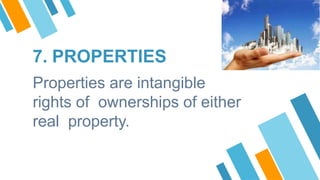
7. PROPERTIES
Properties are intangible
rights of ownerships of either
real property.
organizations aggressively
labor to create a strong,
positive image in the mind of
their publics.
8. ORGANIZATIONS
9. INFORMATION
The production, packaging,
and distribution of
information is one of
society’s chief industries.
10. IDEALS
Each market offering has
a fundamental idea at its
core.
TRADITIONAL
APPROACHES TO
MARKETING
Traditional concept marketing is
a marketing strategy a company
uses to determine if it can
produce a viable product
consumers want or need, whether
the company can produce enough
products to fill the need, and the
marketing method by which the
need can be filled.
SEVERAL DISTINCT TRADITIONAL APPROACHES
Production
concept focuses
on the internal
potentials of the
company and not
based on the
desires and needs
of the market.
Sales concept
refers to the idea
that people will buy
more goods and
services through
personal selling and
advertising done
aggressively to
push them in the
market.
Marketing concept
a philosophy which
states that
organization must
try hard to find out
and satisfy the
needs and wants of
consumers while at
the same time
accomplishing the
organizational
goals.
Relationship
concept/marketing an
approach that centers on
maintaining and improving
value- added long-term
relationships with current
customers, distributors,
dealers and suppliers.
Societal Marketing
Concept views that
organizations must satisfy
the needs of consumers in
a manner that gives for
society’s benefit.
CHAPTER 1
MARKETING PRINCIPLES AND STRATEGIES
Lesson 2:
Goals of Marketing
Goals are
different from
objectives
Marketing goals are
statements of what results
the company wants to
achieve with its marketing
efforts. Just like any other
goal, marketing goals
should be clear. Goals must
be credible and realistic as
well
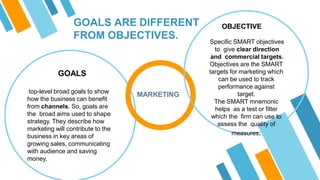
GOALS ARE DIFFERENT
FROM OBJECTIVES.
GOALS
top-level broad goals to show
how the business can benefit
from channels. So, goals are
the broad aims used to shape
strategy. They describe how
marketing will contribute to the
business in key areas of
growing sales, communicating
with audience and saving
money.
MARKETING
OBJECTIVE
Specific SMART objectives
to give clear direction
and commercial targets.
Objectives are the SMART
targets for marketing which
can be used to track
performance against
target.
The SMART mnemonic
helps as a test or filter
which the firm can use to
assess the quality of
measures.
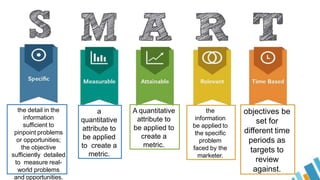
the detail in the
information
sufficient to
pinpoint problems
or opportunities;
the objective
sufficiently detailed
to measure real-
world problems
and opportunities.
a
quantitative
attribute to
be applied
to create a
metric.
A quantitative
attribute to
be applied to
create a
metric.
the
information
be applied to
the specific
problem
faced by the
marketer.
objectives be
set for
different time
periods as
targets to
review
against.
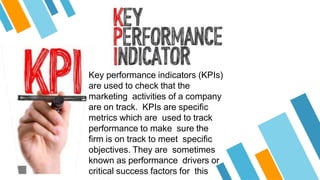
Key performance indicators (KPIs)
are used to check that the
marketing activities of a company
are on track. KPIs are specific
metrics which are used to track
performance to make sure the
firm is on track to meet specific
objectives. They are sometimes
known as performance drivers or
critical success factors for this
DEVELOPING MARKETING GOALS
GOALS MUST
BE:
ATTAINABILITY
Goals must be realistic
so that important
parties who will be
reaching must
see each goal as
reasonable.
CONSISTENCY
Management should
exert to set goals that are
consistent with one
another.
COMPREHENSIVENESS
the process of goal-setting
must be comprehensive.
Simply it means that each
functional area must be
able to formulate its own
goals that relate to the
organization’s goals.
INTANGIBILITY
planners often confuse goals with
strategies, objectives and even tactics.
A goal is not an action the firm can
take, it is an outcome of the
organization wishes to realize.
GOALS OF
MARKETING
Examples of noteworthy marketing
goals:
1.Identifying the target market
2.Increasing sales and profits
3.Increasing brand awareness
4.Increasing market share
5.Countering competitive
strategies
6.Reputation
7.Increasing distribution channels
GOALS OF MARKETING
1.Understand the market and its
consumers, and satisfy their changing
needs and wants.
2.Introduce and innovate products and
services that improve human condition
and the quality of life.
3.Design and implement effective
customer- driven marketing strategies.
GOALS OF MARKETING
4. Develop marketing programs that
deliver superior value to consumers.
5. Build and maintain mutually beneficial
and profitable customer relationships.
6. Capture customer value to create
profits.
7. Promote value transactions with full
regard to the well- being of societies.
CHAPTER 1
MARKETING PRINCIPLES AND STRATEGIES
Lesson 3:
Contemporary Approaches
to Marketing
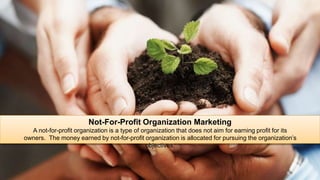
Not-For-Profit Organization Marketing
A not-for-profit organization is a type of organization that does not aim for earning profit for its
owners. The money earned by not-for-profit organization is allocated for pursuing the organization’s
objectives.
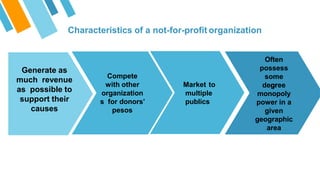
Characteristics of a not-for-profit organization
Generate as
much revenue
as possible to
support their
causes
Compete
with other
organization
s for donors’
pesos
Often
possess
some
degree
or
monopoly
power in a
given
geographic
area
Market to
multiple
publics
PERSON
MARKETING
Person marketing entails
endeavors aimed at
cultivating the attention,
interest and preferences of a
target market toward a
celebrity or authority figure.
PLACE
MARKETING
Place marketing or place branding attempts
to exert a pull customers to particular areas.
Place marketing is used to attract tourist and
showcase the beautiful spots in different
cities, provinces, and regions. Place
marketing is also used to promote sites that
can be a nice choice for putting up a
business.
CAUSE
MARKETING
Cause marketing is the recognition and
marketing of a social issue, cause or idea to
the target markets. Cause marketing
increases the awareness of issues such as
literacy, physical fitness, child obesity, and
environmental protection, elimination of birth
defects, child-abuse prevention and
preventing drunk-driving.
There are some guidelines to consider before
creating a cause marketing campaign.
UNDERSTAND
MARKETING
before a firm create a cause
marketing, it needs to
understand first the
essential
elements of marketing to
its
specific target audience.
MAINTAIN
TRANSPARENCY
if the firm wants
consumers to join its
cause, it has to make it
easy and transparent for
them to do so.
THINK
MAINSTREAM
the majority of the firm’s
patron should support the
effort of its supporting.
SUPPORT REPUTATION
CAUSES
Support reputable causes – if the
companyis going to give large amounts
of money, resources or time to a
philanthropic cause, it must first do its
homework. The organization must
choose the right charity to give help to
and check its every detail.
»
STAY
CONSISTENT
it is best for the company if it is
going to be generous in one
charity for long time to be
predictable in the eyes of the
consumers.
is the sport, culture and charity activities to
selected target markets. it consists of different
sponsors from different companies to support
such activities and also serves as public
Essential features of event marketing:
1. Wide range of events – event marketing encompasses a
wide range of event types:
a.Mega events and local events,
b.Exhibitions,
c.Trade shows,
d.Publicity stunts,
e.Themed and created events,
f.Corporate entertainment,
g.Award ceremonies.
2.Goal oriented
3. Effective promotion and communication – it is important to get the
message to the target audience clearly.
4.Proper evaluation – it is necessary for the team to be able to evaluate
the event/project to be more effective and efficient the next time.
5.Feedback from clients
6.Location – this is the most important aspect as the location of the
event should be accessible and should be near important areas.
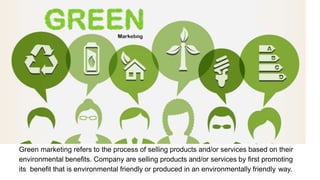
Green marketing refers to the process of selling products and/or services based on their
environmental benefits. Company are selling products and/or services by first promoting
its benefit that is environmental friendly or produced in an environmentally friendly way.
F or green marketing to be effective, there are three things that needs
to be done:
1.Being genuine
a. The company is actually doing what it claims to be doing in its
green marketing campaign and
b. The rest of the business policies are consistent with whatever the firm
is doing that’s environmentally friendly.
2.Educating the customers isn’t just a matter of letting people know that the
company is doing whatever its doing to protect the environment, but also a matter
of letting them know why it matters.
3.Giving customers an opportunity to participate means personalizing the benefits
of the company’s environmentally friendly actions, normally through letting the
customer take part in positive environmental action.
THANK YOU!

Principles-of-Marketing-Chapter-1.pptssx

  • 1.
  • 2.
    CHAPTER 1 MARKETING PRINCIPLESAND STRATEGIES Lesson 1: Marketing and its Traditional Approaches
  • 3.
  • 4.
     is aform of communicating or promoting the VALUE of a product, service or brand to the consumers.
  • 5.
    Marketing “The process ofplanning and executing the conception, pricing, promotion, and distribution of ideas, goods, and services to create exchanges that satisfy individual and organization goals.” American Marketing Association
  • 6.
    In summary, marketingis • Creation • Communication • Delivery of value to customers
  • 7.
  • 8.
    1. NEEDS A humanneed is something that a person must have in order to live and survive.
  • 9.
  • 10.
    2. WANTS A humanwant is something that a person desires to have.
  • 11.
    3. DEMANDS Demands arealso human wants that are supported by buying power.
  • 12.
    4. EXCHANGE Marketing occurswhen the buyer and seller trade something of equal value. Both the buyer and the seller have gained something that satisfied their unmet needs.
  • 13.
    5. MARKET The marketis composed of people with both desire and ability to buy a product or service.
  • 14.
    PARTICULARS NEEDS WANTS HungerFood Fashion Wear Clothing Infection Antibiotics Shelter Housing Thirst Beverag e Water Milk Transportation Vehicle
  • 15.
    PARTICULARS NEEDS WANTS RecreationSports Entertainment Television, radio, DVD/Discs, Casinos Education School Seminars Course Security Insurance Interment Memorial services
  • 16.
  • 17.
    1. GOODS Physical goodscomprise the volume of most countries’ production and marketing effort.
  • 18.
    2. SERVICES as economiesprogress, a growing proportion of their activities are concentrated on the production of services.
  • 19.
    Through organizing a numberof services and goods, one can generate, stage, and market experiences. 3. EXPERIENCES
  • 20.
  • 21.
    5. PERSONS celebrity marketinghas turn into a main and popular business.
  • 22.
    6. PLACES Place marketersconsist of economic development specialists, real estate agents, commercial banks, local business associations, and advertising and public relations agencies.
  • 23.
    7. PROPERTIES Properties areintangible rights of ownerships of either real property.
  • 24.
    organizations aggressively labor tocreate a strong, positive image in the mind of their publics. 8. ORGANIZATIONS
  • 25.
    9. INFORMATION The production,packaging, and distribution of information is one of society’s chief industries.
  • 26.
    10. IDEALS Each marketoffering has a fundamental idea at its core.
  • 27.
  • 28.
    Traditional concept marketingis a marketing strategy a company uses to determine if it can produce a viable product consumers want or need, whether the company can produce enough products to fill the need, and the marketing method by which the need can be filled.
  • 29.
    SEVERAL DISTINCT TRADITIONALAPPROACHES Production concept focuses on the internal potentials of the company and not based on the desires and needs of the market. Sales concept refers to the idea that people will buy more goods and services through personal selling and advertising done aggressively to push them in the market. Marketing concept a philosophy which states that organization must try hard to find out and satisfy the needs and wants of consumers while at the same time accomplishing the organizational goals. Relationship concept/marketing an approach that centers on maintaining and improving value- added long-term relationships with current customers, distributors, dealers and suppliers. Societal Marketing Concept views that organizations must satisfy the needs of consumers in a manner that gives for society’s benefit.
  • 30.
    CHAPTER 1 MARKETING PRINCIPLESAND STRATEGIES Lesson 2: Goals of Marketing
  • 31.
    Goals are different from objectives Marketinggoals are statements of what results the company wants to achieve with its marketing efforts. Just like any other goal, marketing goals should be clear. Goals must be credible and realistic as well
  • 32.
    GOALS ARE DIFFERENT FROMOBJECTIVES. GOALS top-level broad goals to show how the business can benefit from channels. So, goals are the broad aims used to shape strategy. They describe how marketing will contribute to the business in key areas of growing sales, communicating with audience and saving money. MARKETING OBJECTIVE Specific SMART objectives to give clear direction and commercial targets. Objectives are the SMART targets for marketing which can be used to track performance against target. The SMART mnemonic helps as a test or filter which the firm can use to assess the quality of measures.
  • 33.
    the detail inthe information sufficient to pinpoint problems or opportunities; the objective sufficiently detailed to measure real- world problems and opportunities. a quantitative attribute to be applied to create a metric. A quantitative attribute to be applied to create a metric. the information be applied to the specific problem faced by the marketer. objectives be set for different time periods as targets to review against.
  • 34.
    Key performance indicators(KPIs) are used to check that the marketing activities of a company are on track. KPIs are specific metrics which are used to track performance to make sure the firm is on track to meet specific objectives. They are sometimes known as performance drivers or critical success factors for this
  • 35.
    DEVELOPING MARKETING GOALS GOALSMUST BE: ATTAINABILITY Goals must be realistic so that important parties who will be reaching must see each goal as reasonable. CONSISTENCY Management should exert to set goals that are consistent with one another. COMPREHENSIVENESS the process of goal-setting must be comprehensive. Simply it means that each functional area must be able to formulate its own goals that relate to the organization’s goals. INTANGIBILITY planners often confuse goals with strategies, objectives and even tactics. A goal is not an action the firm can take, it is an outcome of the organization wishes to realize.
  • 36.
    GOALS OF MARKETING Examples ofnoteworthy marketing goals: 1.Identifying the target market 2.Increasing sales and profits 3.Increasing brand awareness 4.Increasing market share 5.Countering competitive strategies 6.Reputation 7.Increasing distribution channels
  • 37.
    GOALS OF MARKETING 1.Understandthe market and its consumers, and satisfy their changing needs and wants. 2.Introduce and innovate products and services that improve human condition and the quality of life. 3.Design and implement effective customer- driven marketing strategies.
  • 38.
    GOALS OF MARKETING 4.Develop marketing programs that deliver superior value to consumers. 5. Build and maintain mutually beneficial and profitable customer relationships. 6. Capture customer value to create profits. 7. Promote value transactions with full regard to the well- being of societies.
  • 39.
    CHAPTER 1 MARKETING PRINCIPLESAND STRATEGIES Lesson 3: Contemporary Approaches to Marketing
  • 40.
    Not-For-Profit Organization Marketing Anot-for-profit organization is a type of organization that does not aim for earning profit for its owners. The money earned by not-for-profit organization is allocated for pursuing the organization’s objectives.
  • 41.
    Characteristics of anot-for-profit organization Generate as much revenue as possible to support their causes Compete with other organization s for donors’ pesos Often possess some degree or monopoly power in a given geographic area Market to multiple publics
  • 42.
    PERSON MARKETING Person marketing entails endeavorsaimed at cultivating the attention, interest and preferences of a target market toward a celebrity or authority figure.
  • 43.
    PLACE MARKETING Place marketing orplace branding attempts to exert a pull customers to particular areas. Place marketing is used to attract tourist and showcase the beautiful spots in different cities, provinces, and regions. Place marketing is also used to promote sites that can be a nice choice for putting up a business.
  • 44.
    CAUSE MARKETING Cause marketing isthe recognition and marketing of a social issue, cause or idea to the target markets. Cause marketing increases the awareness of issues such as literacy, physical fitness, child obesity, and environmental protection, elimination of birth defects, child-abuse prevention and preventing drunk-driving.
  • 45.
    There are someguidelines to consider before creating a cause marketing campaign. UNDERSTAND MARKETING before a firm create a cause marketing, it needs to understand first the essential elements of marketing to its specific target audience. MAINTAIN TRANSPARENCY if the firm wants consumers to join its cause, it has to make it easy and transparent for them to do so. THINK MAINSTREAM the majority of the firm’s patron should support the effort of its supporting. SUPPORT REPUTATION CAUSES Support reputable causes – if the companyis going to give large amounts of money, resources or time to a philanthropic cause, it must first do its homework. The organization must choose the right charity to give help to and check its every detail. » STAY CONSISTENT it is best for the company if it is going to be generous in one charity for long time to be predictable in the eyes of the consumers.
  • 46.
    is the sport,culture and charity activities to selected target markets. it consists of different sponsors from different companies to support such activities and also serves as public
  • 47.
    Essential features ofevent marketing: 1. Wide range of events – event marketing encompasses a wide range of event types: a.Mega events and local events, b.Exhibitions, c.Trade shows, d.Publicity stunts, e.Themed and created events, f.Corporate entertainment, g.Award ceremonies.
  • 48.
    2.Goal oriented 3. Effectivepromotion and communication – it is important to get the message to the target audience clearly. 4.Proper evaluation – it is necessary for the team to be able to evaluate the event/project to be more effective and efficient the next time. 5.Feedback from clients 6.Location – this is the most important aspect as the location of the event should be accessible and should be near important areas.
  • 49.
    Green marketing refersto the process of selling products and/or services based on their environmental benefits. Company are selling products and/or services by first promoting its benefit that is environmental friendly or produced in an environmentally friendly way.
  • 50.
    F or greenmarketing to be effective, there are three things that needs to be done: 1.Being genuine a. The company is actually doing what it claims to be doing in its green marketing campaign and b. The rest of the business policies are consistent with whatever the firm is doing that’s environmentally friendly. 2.Educating the customers isn’t just a matter of letting people know that the company is doing whatever its doing to protect the environment, but also a matter of letting them know why it matters. 3.Giving customers an opportunity to participate means personalizing the benefits of the company’s environmentally friendly actions, normally through letting the customer take part in positive environmental action.
  • 51.