1
BBA 229 Training and Development
Lecture 2
Strategic Training
S. Chan
Department of Business Administration
charmaine@chuhai.edu.hk
http://home.chuhai.hk/~charmaine
2
HR Department and Training
• HR: to improve the organization’s effectiveness
by providing employees with KSAs which will
ultimately enhance employees’ current or future job
performance.
•Training strategies should meet the needs of
organization while also responding to the needs of
individual employees.
•Therefore should align training activities with
company’s strategic plan.
3
The Evolution of Training’s Role
Training’s role has to evolve from program focus to a
broader focus: learning, creating and sharing knowledge
Traditional approach:
-Training is seen as a series of programs or events that employees
attend.
-Provides no information that would help employees understand the
relationship between the training content and individual performance
or development objectives or business goals.
-A single training event or program is not likely to give a company a
competitive advantage because explicit knowledge is well-known and
programs designed to teach it can be easily developed and imitated.
The emphasis on learning has several implications.
4
The Evolution of Training’s Role (2)
Learning: the acquisition of knowledge by individual
employees or groups of employees who are willing
to apply that knowledge in their jobs in making
decisions and accomplishing tasks for the company.
Knowledge: what individuals/teams of employees know
or know how to do (human and social knowledge) as
well as company rules, processes, tools, and routines
(structured knowledge). Can be tactics or explicit.
5
The Evolution of Training’s Role (3)
The emphasis on learning these implications
•Learning has to be related to helping employees’ performances
improve and company achieves its business goals.
•Tactic knowledge is difficult to acquire, companies need to
support informal learning that occurs through mentoring and job
experience.
•Learning not only has to be supported by physical and technical
resources, but also psychologically. Managers need to concern
employees interests and career goals to help them find suitable
development activities that will prepare them to be successful in
the position
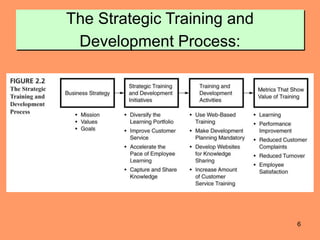
6
The Strategic Training and
Development Process:
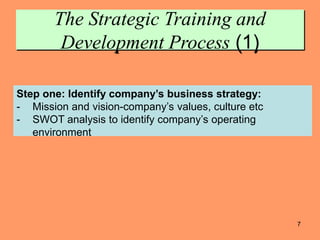
7
The Strategic Training and
Development Process (1)
Step one: Identify company’s business strategy:
- Mission and vision-company’s values, culture etc
- SWOT analysis to identify company’s operating
environment
8
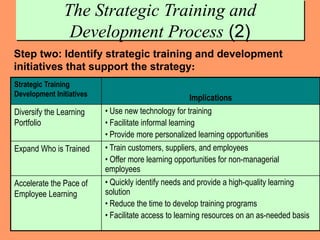
Strategic Training
Development Initiatives
Implications
Diversify the Learning
Portfolio
• Use new technology for training
• Facilitate informal learning
• Provide more personalized learning opportunities
Expand Who is Trained • Train customers, suppliers, and employees
• Offer more learning opportunities for non-managerial
employees
Accelerate the Pace of
Employee Learning
• Quickly identify needs and provide a high-quality learning
solution
• Reduce the time to develop training programs
• Facilitate access to learning resources on an as-needed basis
Step two: Identify strategic training and development
initiatives that support the strategy:
The Strategic Training and
Development Process (2)
9
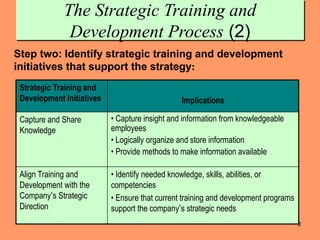
Step two: Identify strategic training and development
initiatives that support the strategy:
The Strategic Training and
Development Process (2)
Strategic Training and
Development Initiatives Implications
Capture and Share
Knowledge
• Capture insight and information from knowledgeable
employees
• Logically organize and store information
• Provide methods to make information available
Align Training and
Development with the
Company’s Strategic
Direction
• Identify needed knowledge, skills, abilities, or
competencies
• Ensure that current training and development programs
support the company’s strategic needs
10
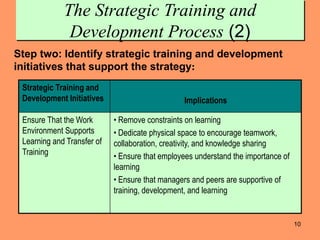
Step two: Identify strategic training and development
initiatives that support the strategy:
The Strategic Training and
Development Process (2)
Strategic Training and
Development Initiatives Implications
Ensure That the Work
Environment Supports
Learning and Transfer of
Training
• Remove constraints on learning
• Dedicate physical space to encourage teamwork,
collaboration, creativity, and knowledge sharing
• Ensure that employees understand the importance of
learning
• Ensure that managers and peers are supportive of
training, development, and learning
11
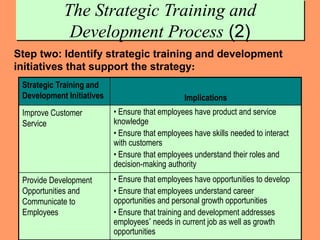
Step two: Identify strategic training and development
initiatives that support the strategy:
The Strategic Training and
Development Process (2)
Strategic Training and
Development Initiatives Implications
Improve Customer
Service
• Ensure that employees have product and service
knowledge
• Ensure that employees have skills needed to interact
with customers
• Ensure that employees understand their roles and
decision-making authority
Provide Development
Opportunities and
Communicate to
Employees
• Ensure that employees have opportunities to develop
• Ensure that employees understand career
opportunities and personal growth opportunities
• Ensure that training and development addresses
employees’ needs in current job as well as growth
opportunities
12
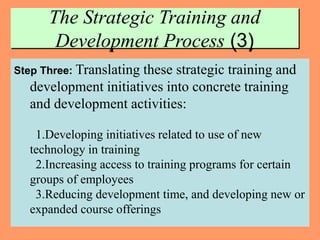
Step Three: Translating these strategic training and
development initiatives into concrete training
and development activities:
1.Developing initiatives related to use of new
technology in training
2.Increasing access to training programs for certain
groups of employees
3.Reducing development time, and developing new or
expanded course offerings
The Strategic Training and
Development Process (3)
13
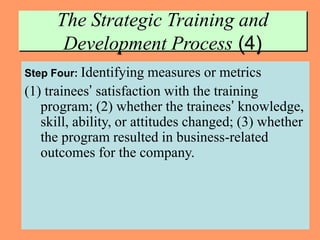
The Strategic Training and
Development Process (4)
Step Four: Identifying measures or metrics
(1) trainees’ satisfaction with the training
program; (2) whether the trainees’ knowledge,
skill, ability, or attitudes changed; (3) whether
the program resulted in business-related
outcomes for the company.
14
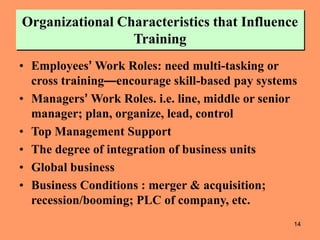
Organizational Characteristics that Influence
Training
• Employees’ Work Roles: need multi-tasking or
cross training—encourage skill-based pay systems
• Managers’ Work Roles. i.e. line, middle or senior
manager; plan, organize, lead, control
• Top Management Support
• The degree of integration of business units
• Global business
• Business Conditions : merger & acquisition;
recession/booming; PLC of company, etc.
15
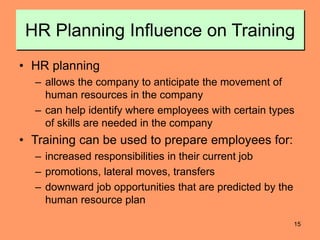
HR Planning Influence on Training
• HR planning
– allows the company to anticipate the movement of
human resources in the company
– can help identify where employees with certain types
of skills are needed in the company
• Training can be used to prepare employees for:
– increased responsibilities in their current job
– promotions, lateral moves, transfers
– downward job opportunities that are predicted by the
human resource plan
16
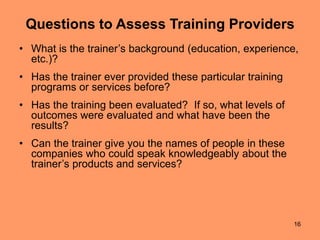
Questions to Assess Training Providers
• What is the trainer’s background (education, experience,
etc.)?
• Has the trainer ever provided these particular training
programs or services before?
• Has the training been evaluated? If so, what levels of
outcomes were evaluated and what have been the
results?
• Can the trainer give you the names of people in these
companies who could speak knowledgeably about the
trainer’s products and services?
17
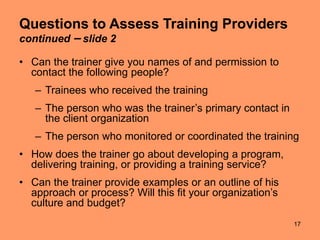
Questions to Assess Training Providers
continued – slide 2
• Can the trainer give you names of and permission to
contact the following people?
– Trainees who received the training
– The person who was the trainer’s primary contact in
the client organization
– The person who monitored or coordinated the training
• How does the trainer go about developing a program,
delivering training, or providing a training service?
• Can the trainer provide examples or an outline of his
approach or process? Will this fit your organization’s
culture and budget?
18
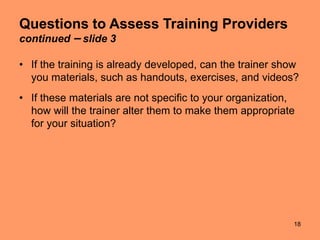
Questions to Assess Training Providers
continued – slide 3
• If the training is already developed, can the trainer show
you materials, such as handouts, exercises, and videos?
• If these materials are not specific to your organization,
how will the trainer alter them to make them appropriate
for your situation?

6963377

  • 1.
    1 BBA 229 Trainingand Development Lecture 2 Strategic Training S. Chan Department of Business Administration charmaine@chuhai.edu.hk http://home.chuhai.hk/~charmaine
  • 2.
    2 HR Department andTraining • HR: to improve the organization’s effectiveness by providing employees with KSAs which will ultimately enhance employees’ current or future job performance. •Training strategies should meet the needs of organization while also responding to the needs of individual employees. •Therefore should align training activities with company’s strategic plan.
  • 3.
    3 The Evolution ofTraining’s Role Training’s role has to evolve from program focus to a broader focus: learning, creating and sharing knowledge Traditional approach: -Training is seen as a series of programs or events that employees attend. -Provides no information that would help employees understand the relationship between the training content and individual performance or development objectives or business goals. -A single training event or program is not likely to give a company a competitive advantage because explicit knowledge is well-known and programs designed to teach it can be easily developed and imitated. The emphasis on learning has several implications.
  • 4.
    4 The Evolution ofTraining’s Role (2) Learning: the acquisition of knowledge by individual employees or groups of employees who are willing to apply that knowledge in their jobs in making decisions and accomplishing tasks for the company. Knowledge: what individuals/teams of employees know or know how to do (human and social knowledge) as well as company rules, processes, tools, and routines (structured knowledge). Can be tactics or explicit.
  • 5.
    5 The Evolution ofTraining’s Role (3) The emphasis on learning these implications •Learning has to be related to helping employees’ performances improve and company achieves its business goals. •Tactic knowledge is difficult to acquire, companies need to support informal learning that occurs through mentoring and job experience. •Learning not only has to be supported by physical and technical resources, but also psychologically. Managers need to concern employees interests and career goals to help them find suitable development activities that will prepare them to be successful in the position
  • 6.
    6 The Strategic Trainingand Development Process:
  • 7.
    7 The Strategic Trainingand Development Process (1) Step one: Identify company’s business strategy: - Mission and vision-company’s values, culture etc - SWOT analysis to identify company’s operating environment
  • 8.
    8 Strategic Training Development Initiatives Implications Diversifythe Learning Portfolio • Use new technology for training • Facilitate informal learning • Provide more personalized learning opportunities Expand Who is Trained • Train customers, suppliers, and employees • Offer more learning opportunities for non-managerial employees Accelerate the Pace of Employee Learning • Quickly identify needs and provide a high-quality learning solution • Reduce the time to develop training programs • Facilitate access to learning resources on an as-needed basis Step two: Identify strategic training and development initiatives that support the strategy: The Strategic Training and Development Process (2)
  • 9.
    9 Step two: Identifystrategic training and development initiatives that support the strategy: The Strategic Training and Development Process (2) Strategic Training and Development Initiatives Implications Capture and Share Knowledge • Capture insight and information from knowledgeable employees • Logically organize and store information • Provide methods to make information available Align Training and Development with the Company’s Strategic Direction • Identify needed knowledge, skills, abilities, or competencies • Ensure that current training and development programs support the company’s strategic needs
  • 10.
    10 Step two: Identifystrategic training and development initiatives that support the strategy: The Strategic Training and Development Process (2) Strategic Training and Development Initiatives Implications Ensure That the Work Environment Supports Learning and Transfer of Training • Remove constraints on learning • Dedicate physical space to encourage teamwork, collaboration, creativity, and knowledge sharing • Ensure that employees understand the importance of learning • Ensure that managers and peers are supportive of training, development, and learning
  • 11.
    11 Step two: Identifystrategic training and development initiatives that support the strategy: The Strategic Training and Development Process (2) Strategic Training and Development Initiatives Implications Improve Customer Service • Ensure that employees have product and service knowledge • Ensure that employees have skills needed to interact with customers • Ensure that employees understand their roles and decision-making authority Provide Development Opportunities and Communicate to Employees • Ensure that employees have opportunities to develop • Ensure that employees understand career opportunities and personal growth opportunities • Ensure that training and development addresses employees’ needs in current job as well as growth opportunities
  • 12.
    12 Step Three: Translatingthese strategic training and development initiatives into concrete training and development activities: 1.Developing initiatives related to use of new technology in training 2.Increasing access to training programs for certain groups of employees 3.Reducing development time, and developing new or expanded course offerings The Strategic Training and Development Process (3)
  • 13.
    13 The Strategic Trainingand Development Process (4) Step Four: Identifying measures or metrics (1) trainees’ satisfaction with the training program; (2) whether the trainees’ knowledge, skill, ability, or attitudes changed; (3) whether the program resulted in business-related outcomes for the company.
  • 14.
    14 Organizational Characteristics thatInfluence Training • Employees’ Work Roles: need multi-tasking or cross training—encourage skill-based pay systems • Managers’ Work Roles. i.e. line, middle or senior manager; plan, organize, lead, control • Top Management Support • The degree of integration of business units • Global business • Business Conditions : merger & acquisition; recession/booming; PLC of company, etc.
  • 15.
    15 HR Planning Influenceon Training • HR planning – allows the company to anticipate the movement of human resources in the company – can help identify where employees with certain types of skills are needed in the company • Training can be used to prepare employees for: – increased responsibilities in their current job – promotions, lateral moves, transfers – downward job opportunities that are predicted by the human resource plan
  • 16.
    16 Questions to AssessTraining Providers • What is the trainer’s background (education, experience, etc.)? • Has the trainer ever provided these particular training programs or services before? • Has the training been evaluated? If so, what levels of outcomes were evaluated and what have been the results? • Can the trainer give you the names of people in these companies who could speak knowledgeably about the trainer’s products and services?
  • 17.
    17 Questions to AssessTraining Providers continued – slide 2 • Can the trainer give you names of and permission to contact the following people? – Trainees who received the training – The person who was the trainer’s primary contact in the client organization – The person who monitored or coordinated the training • How does the trainer go about developing a program, delivering training, or providing a training service? • Can the trainer provide examples or an outline of his approach or process? Will this fit your organization’s culture and budget?
  • 18.
    18 Questions to AssessTraining Providers continued – slide 3 • If the training is already developed, can the trainer show you materials, such as handouts, exercises, and videos? • If these materials are not specific to your organization, how will the trainer alter them to make them appropriate for your situation?