The College Standard ?
Writing College Papers: Identifying Standards and Critical Thinking Challenges
Building Blocks Grammar Vocabulary Questions The Goals of Academic Writing Thesis Argument Research Plagiarism Critical Analysis Expository Writing The First Draft Rewriting Your Paper
Guide to Grammar and Writing http://grammar.ccc.commnet.edu/grammar/ University of Toronto Advice on Academic Writing http://www.writing.utoronto.ca/advice Guide to Grammar and Style http://newark.rutgers.edu/~jlynch/Writing/ This is a Test of the Emergency Grammar System http://jcomm.uoregon.edu/~russial/grammar/grambo.html Grammar Not Your Bag? Give These Websites a Try!
Vocabulary Precise usage is the hallmark of top level scholarship – you must be aware of your professors’ expectations  Discipline-specific vocabulary must be mastered in order to participate in the marketplace of ideas The process of acquiring a strong vocabulary can help teach you how to become an active learner Identify what it is you need to learn Research Connect new information to what you already know Test your ability to apply new information Refine understanding  Reflect on deeper meanings
Questions Identify the questions that dominate in class Identify the questions that make you want to listen Determine which questions prompt  you  to construct an informed argument in response Will you research scholarly arguments on the topic? Will you analyze these arguments with an open mind? Will you risk adding your own original thinking to the scholarly discussion? http://www.dartmouth.edu/%7Ecompose/student/ac_paper/what.html
Goals of Academic Writing Seek truth Argue a point Propose solutions  Deepen insights Clarify a theory Challenge conventional wisdom
What is Academic Writing? Writing is a response Writing is linear Writing is recursive Writing is both subject and object Writing is decision-making Writing is a process, frequently involving much trial and error http://www.unc.edu/depts/wcweb/pdf/writing.pdf
Thesis Generate several theses that respond to “on topic” questions during brainstorming Write each thesis out using complete sentences Evaluate the clarity of each thesis statement and force yourself to remove all obfuscation from your writing Evaluate each thesis – is it ? A generalization and not a fact   Demanding of proof or further development Motivating (does it prompt the reader to look for facts and details) Thought-provoking Focused (avoid vague words such as  interesting ,  good , or  disgusting)
Argument Sketch out an argument for each working thesis Identify areas where research is needed to support your premises Research supporting premises Discard theses/arguments whose premises prove unsupportable Choose the  working  thesis that allows you to make the strongest argument for a conclusion about which you are motivated to write Be prepared to modify your thesis to reflect the final argument that makes it into your paper
What is an Argument? A collection of statements that can be given a logical ordering such that:  Given statements designated as  premises  and a statement designated as the  conclusion ,  the  conclusion  is justified by all the information given in the  premises Arguments come in different flavors: Deductive Inductive Analogy Particular to general General to particular http://www.kcmetro.cc.mo.us/longview/ctac/flowpt3.htm
What Do We Do With Arguments? Reconstruct  –  sift out the premises and the conclusion and lay bare the logical structure of the underlying argument  Assess  – determine whether the premises provide sufficient grounds for the conclusion Evaluate  -  judge whether the premises are true or false, clear or vague, and in need of further defense or not Identify Fallacies  – double-check the argument’s reasoning to see if any fallacies appear http://www.kcmetro.cc.mo.us/longview/ctac/argument1.htm
Another Way to View Arguments The premises are all   acceptable The premises are  relevant  to the conclusion The premises supply sufficient or  good grounds  for the conclusion A R G Trudy Govier's  A Practical Study of Argument , (3rd Ed., Wadsworth Publishing , Belmont, California 1992) as referenced by Jeff McLaughlin  http://www.cariboo.bc.ca/ae/php/phil/mclaughl/courses/crit/lectures.htm
Research Take accurate and complete notes Copy all quotes, statistics, etc. verbatim   If you do not quote, paraphrase accurately but in your own words   Record author, title, page number and note where you found the source   Clearly indicate when ideas in your notes are your own   Consider using note cards and limit each card to a single point   Develop a bibliography even if it is not needed for the final paper
Plagiarism What is Plagiarism and Why is it Important? In college courses, we are continually engaged with other people's ideas: we read them in texts, hear them in lecture, discuss them in class, and incorporate them into our own writing. As a result, it is very important that we give credit where it is due. Plagiarism is using others' ideas and words without clearly acknowledging the source of that information. Produced by Writing Tutorial Services, Indiana University, Bloomington, IN http://www.indiana.edu/~wts/wts/plagiarism.html “ Quote End quote”
Plagiarism (cont’d) How Can Students Avoid Plagiarism?   To avoid plagiarism, you must give credit whenever you use another person's idea, opinion, or theory;  any facts, statistics, graphs, drawings--any pieces of information--that are not common knowledge;  quotations of another person's actual spoken or written words; or  paraphrase of another person's spoken or written words.  Produced by Writing Tutorial Services, Indiana University, Bloomington, IN http://www.indiana.edu/~wts/wts/plagiarism.html “ Quote End quote”
Critical Analysis Anticipate readers’ questions about the strength of your argument and supporting evidence Is your argument clearly delineated? Have you left critical assumptions unnamed? Have you acknowledged contextual limitations to the universality of your argument? Have you been able to cite evidence or justification that draws on sources outside your personal beliefs and values? Have you addressed obvious objections to your argument or evaluated readily accessible counter-evidence?
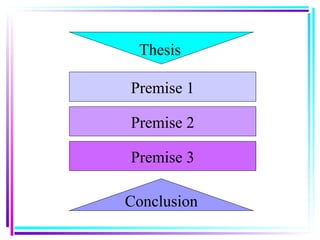
Basic Expository Writing Outline your argument (premises and conclusion) before writing Present your conclusion in your thesis statement and outline your supporting premises in your introduction Write at least one paragraph in support of each premise Use transitions to link your premises and to structure your argument Write a paragraph summarizing the logic of your argument and acknowledging external assumptions if necessary  Summarize your thesis in your concluding paragraph and outline the significance of your findings
Premise 1 Premise 2 Premise 3 Conclusion Thesis
The First Draft Write one idea per paragraph Follow notes that have been organized logically   Go for quantity, not quality   Write for revision, not delivery   Write freely   Write about what is most comfortable first   Develop a habit that encourages you to write on a regular basis – with or without inspiration   Identify times when your “deep” mind is most active, and plan to write after those periods
Allow 50% of your time for planning, research, and writing the first draft Allow the other 50% for revising your paper   Write in Haste, Revise at Leisure
Rewriting Your Paper When rewriting, consider: Your reader Precise language   Careful thinking Your own learning – rewriting is a great way to learn the material   To achieve distance when revising your paper, try : Reading it aloud to yourself   Have someone else read it aloud to you Schedule at least one day between revisions, or three or four days if possible
Cut  – anything that does not contribute to your thesis Paste  – reorder and add new transitions after cutting portions   Fix   – words, phrases, sentence structures Prepare  – adhere to good production values and give proper credit Proof  – check your grammar and confirm that your paper features: Clear thesis statement   Sentences or paragraphs that orient the reader – introduction, transitions and summary Supporting details – specific quotations, examples, and statistics Lean sentences Action verbs and concrete, specific nouns   Rewriting Your Paper  (cont’d)
You must be able to identify the subject and verb of every sentence Your subject and verb must agree (singular vs. plural) You must be able to identify every  Independent Clause  [IC] in every sentence Every [IC] can end with a  period  or connect to another [IC] with the following punctuation/connectors: [IC]; [IC]. [IC],  and  [IC]. [IC];  however , [IC]. [IC] :  Defining  [IC]. (note that the colon can also be used  [IC] :  list or explanation .) Recommended First Steps to Applying Grammar Rules to Your Writing
[IC]; [IC]. semi-colon [IC],  and  [IC]. comma with fanboys connector [IC];  however , [IC]. semi-colon and comma with non-fanboys connector [IC]: [IC]. colon with capitalized IC
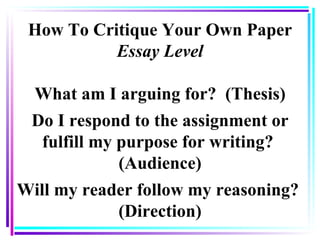
How To Critique Your Own Paper Essay Level What am I arguing for?  (Thesis) Do I respond to the assignment or fulfill my purpose for writing?  (Audience) Will my reader follow my reasoning?  (Direction)
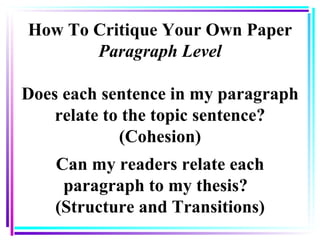
How To Critique Your Own Paper Paragraph Level Does each sentence in my paragraph relate to the topic sentence? (Cohesion) Can my readers relate each paragraph to my thesis?  (Structure and Transitions)
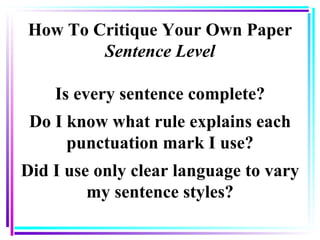
How To Critique Your Own Paper Sentence Level Is every sentence complete? Do I know what rule explains each punctuation mark I use? Did I use only clear language to vary my sentence styles?
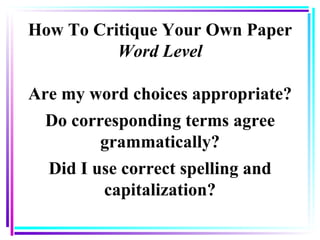
How To Critique Your Own Paper Word Level Are my word choices appropriate? Do corresponding terms agree grammatically? Did I use correct spelling and capitalization?
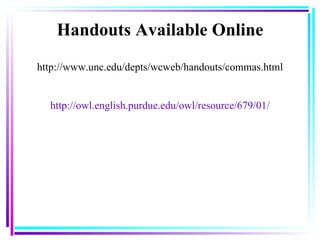
http://www.unc.edu/depts/wcweb/handouts/commas.html http://owl.english.purdue.edu/owl/resource/679/01/ Handouts Available Online
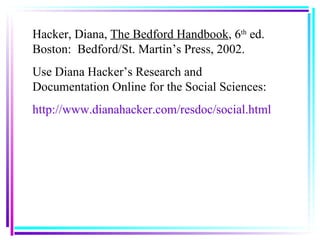
Hacker, Diana,  The Bedford Handbook , 6 th  ed.  Boston:  Bedford/St. Martin’s Press, 2002. Use Diana Hacker’s Research and Documentation Online for the Social Sciences: http://www.dianahacker.com/resdoc/social.html

Writing College Papers

  • 1.
  • 2.
    Writing College Papers:Identifying Standards and Critical Thinking Challenges
  • 3.
    Building Blocks GrammarVocabulary Questions The Goals of Academic Writing Thesis Argument Research Plagiarism Critical Analysis Expository Writing The First Draft Rewriting Your Paper
  • 4.
    Guide to Grammarand Writing http://grammar.ccc.commnet.edu/grammar/ University of Toronto Advice on Academic Writing http://www.writing.utoronto.ca/advice Guide to Grammar and Style http://newark.rutgers.edu/~jlynch/Writing/ This is a Test of the Emergency Grammar System http://jcomm.uoregon.edu/~russial/grammar/grambo.html Grammar Not Your Bag? Give These Websites a Try!
  • 5.
    Vocabulary Precise usageis the hallmark of top level scholarship – you must be aware of your professors’ expectations Discipline-specific vocabulary must be mastered in order to participate in the marketplace of ideas The process of acquiring a strong vocabulary can help teach you how to become an active learner Identify what it is you need to learn Research Connect new information to what you already know Test your ability to apply new information Refine understanding Reflect on deeper meanings
  • 6.
    Questions Identify thequestions that dominate in class Identify the questions that make you want to listen Determine which questions prompt you to construct an informed argument in response Will you research scholarly arguments on the topic? Will you analyze these arguments with an open mind? Will you risk adding your own original thinking to the scholarly discussion? http://www.dartmouth.edu/%7Ecompose/student/ac_paper/what.html
  • 7.
    Goals of AcademicWriting Seek truth Argue a point Propose solutions Deepen insights Clarify a theory Challenge conventional wisdom
  • 8.
    What is AcademicWriting? Writing is a response Writing is linear Writing is recursive Writing is both subject and object Writing is decision-making Writing is a process, frequently involving much trial and error http://www.unc.edu/depts/wcweb/pdf/writing.pdf
  • 9.
    Thesis Generate severaltheses that respond to “on topic” questions during brainstorming Write each thesis out using complete sentences Evaluate the clarity of each thesis statement and force yourself to remove all obfuscation from your writing Evaluate each thesis – is it ? A generalization and not a fact Demanding of proof or further development Motivating (does it prompt the reader to look for facts and details) Thought-provoking Focused (avoid vague words such as interesting , good , or disgusting)
  • 10.
    Argument Sketch outan argument for each working thesis Identify areas where research is needed to support your premises Research supporting premises Discard theses/arguments whose premises prove unsupportable Choose the working thesis that allows you to make the strongest argument for a conclusion about which you are motivated to write Be prepared to modify your thesis to reflect the final argument that makes it into your paper
  • 11.
    What is anArgument? A collection of statements that can be given a logical ordering such that: Given statements designated as premises and a statement designated as the conclusion , the conclusion is justified by all the information given in the premises Arguments come in different flavors: Deductive Inductive Analogy Particular to general General to particular http://www.kcmetro.cc.mo.us/longview/ctac/flowpt3.htm
  • 12.
    What Do WeDo With Arguments? Reconstruct – sift out the premises and the conclusion and lay bare the logical structure of the underlying argument Assess – determine whether the premises provide sufficient grounds for the conclusion Evaluate - judge whether the premises are true or false, clear or vague, and in need of further defense or not Identify Fallacies – double-check the argument’s reasoning to see if any fallacies appear http://www.kcmetro.cc.mo.us/longview/ctac/argument1.htm
  • 13.
    Another Way toView Arguments The premises are all acceptable The premises are relevant to the conclusion The premises supply sufficient or good grounds for the conclusion A R G Trudy Govier's A Practical Study of Argument , (3rd Ed., Wadsworth Publishing , Belmont, California 1992) as referenced by Jeff McLaughlin http://www.cariboo.bc.ca/ae/php/phil/mclaughl/courses/crit/lectures.htm
  • 14.
    Research Take accurateand complete notes Copy all quotes, statistics, etc. verbatim If you do not quote, paraphrase accurately but in your own words Record author, title, page number and note where you found the source Clearly indicate when ideas in your notes are your own Consider using note cards and limit each card to a single point Develop a bibliography even if it is not needed for the final paper
  • 15.
    Plagiarism What isPlagiarism and Why is it Important? In college courses, we are continually engaged with other people's ideas: we read them in texts, hear them in lecture, discuss them in class, and incorporate them into our own writing. As a result, it is very important that we give credit where it is due. Plagiarism is using others' ideas and words without clearly acknowledging the source of that information. Produced by Writing Tutorial Services, Indiana University, Bloomington, IN http://www.indiana.edu/~wts/wts/plagiarism.html “ Quote End quote”
  • 16.
    Plagiarism (cont’d) HowCan Students Avoid Plagiarism? To avoid plagiarism, you must give credit whenever you use another person's idea, opinion, or theory; any facts, statistics, graphs, drawings--any pieces of information--that are not common knowledge; quotations of another person's actual spoken or written words; or paraphrase of another person's spoken or written words. Produced by Writing Tutorial Services, Indiana University, Bloomington, IN http://www.indiana.edu/~wts/wts/plagiarism.html “ Quote End quote”
  • 17.
    Critical Analysis Anticipatereaders’ questions about the strength of your argument and supporting evidence Is your argument clearly delineated? Have you left critical assumptions unnamed? Have you acknowledged contextual limitations to the universality of your argument? Have you been able to cite evidence or justification that draws on sources outside your personal beliefs and values? Have you addressed obvious objections to your argument or evaluated readily accessible counter-evidence?
  • 18.
    Basic Expository WritingOutline your argument (premises and conclusion) before writing Present your conclusion in your thesis statement and outline your supporting premises in your introduction Write at least one paragraph in support of each premise Use transitions to link your premises and to structure your argument Write a paragraph summarizing the logic of your argument and acknowledging external assumptions if necessary Summarize your thesis in your concluding paragraph and outline the significance of your findings
  • 19.
    Premise 1 Premise2 Premise 3 Conclusion Thesis
  • 20.
    The First DraftWrite one idea per paragraph Follow notes that have been organized logically Go for quantity, not quality Write for revision, not delivery Write freely Write about what is most comfortable first Develop a habit that encourages you to write on a regular basis – with or without inspiration Identify times when your “deep” mind is most active, and plan to write after those periods
  • 21.
    Allow 50% ofyour time for planning, research, and writing the first draft Allow the other 50% for revising your paper Write in Haste, Revise at Leisure
  • 22.
    Rewriting Your PaperWhen rewriting, consider: Your reader Precise language Careful thinking Your own learning – rewriting is a great way to learn the material To achieve distance when revising your paper, try : Reading it aloud to yourself Have someone else read it aloud to you Schedule at least one day between revisions, or three or four days if possible
  • 23.
    Cut –anything that does not contribute to your thesis Paste – reorder and add new transitions after cutting portions Fix – words, phrases, sentence structures Prepare – adhere to good production values and give proper credit Proof – check your grammar and confirm that your paper features: Clear thesis statement Sentences or paragraphs that orient the reader – introduction, transitions and summary Supporting details – specific quotations, examples, and statistics Lean sentences Action verbs and concrete, specific nouns Rewriting Your Paper (cont’d)
  • 24.
    You must beable to identify the subject and verb of every sentence Your subject and verb must agree (singular vs. plural) You must be able to identify every Independent Clause [IC] in every sentence Every [IC] can end with a period or connect to another [IC] with the following punctuation/connectors: [IC]; [IC]. [IC], and [IC]. [IC]; however , [IC]. [IC] : Defining [IC]. (note that the colon can also be used [IC] : list or explanation .) Recommended First Steps to Applying Grammar Rules to Your Writing
  • 25.
    [IC]; [IC]. semi-colon[IC], and [IC]. comma with fanboys connector [IC]; however , [IC]. semi-colon and comma with non-fanboys connector [IC]: [IC]. colon with capitalized IC
  • 26.
    How To CritiqueYour Own Paper Essay Level What am I arguing for? (Thesis) Do I respond to the assignment or fulfill my purpose for writing? (Audience) Will my reader follow my reasoning? (Direction)
  • 27.
    How To CritiqueYour Own Paper Paragraph Level Does each sentence in my paragraph relate to the topic sentence? (Cohesion) Can my readers relate each paragraph to my thesis? (Structure and Transitions)
  • 28.
    How To CritiqueYour Own Paper Sentence Level Is every sentence complete? Do I know what rule explains each punctuation mark I use? Did I use only clear language to vary my sentence styles?
  • 29.
    How To CritiqueYour Own Paper Word Level Are my word choices appropriate? Do corresponding terms agree grammatically? Did I use correct spelling and capitalization?
  • 30.
  • 31.
    Hacker, Diana, The Bedford Handbook , 6 th ed. Boston: Bedford/St. Martin’s Press, 2002. Use Diana Hacker’s Research and Documentation Online for the Social Sciences: http://www.dianahacker.com/resdoc/social.html

Editor's Notes

  • #2 Mercer University Academic Resource Center http://faculty.mercer.edu/zimmerman_jj