Configuration Management with SaltStack
Act II
Arnold Bechtoldt
Berlin, 14.05.14
2
1.  Configuration Management Systems
2.  SaltStack Fundamentals
3.  SaltStack Inside
4.  Conclusions
5.  Showcase/ Walkthrough
Topics
3
‣  Linux-Systems Engineer at inovex GmbH
‣  Develop lots of features for (Open Source) Datacenter Management
‣  Provisioning of physical & virtual infrastructure
‣  SaltStack user since December, 2012 (~ v0.10.x)
About me
arnold.bechtoldt@inovex.de
4
‣  Provides a wide set of IT services:
§  Application Development
§  Mobile Development
§  Business Intelligence
§  IT Engineering & Operations
§  Consulting
§  Trainings
‣  Cool projects with great Open Source Software
‣  Teams of high-experienced engineers
‣  We have excellent job offers in Karlsruhe, Cologne, Munich and Pforzheim!
About inovex
inovex.de
5
Configuration Management Systems
(a.k.a. CMS)
Configuration Management with SaltStack
Part 1
6
‣  Support building a defined infrastructure
‣  Support managing a defined infrastructure
‣  Definition of infrastructure in code (“Infrastructure as code”)
‣  Configuration Management requires Software Development
Configuration Management Systems
Definition
7
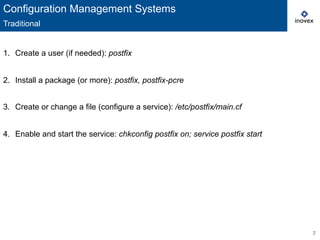
1.  Create a user (if needed): postfix
2.  Install a package (or more): postfix, postfix-pcre
3.  Create or change a file (configure a service): /etc/postfix/main.cf
4.  Enable and start the service: chkconfig postfix on; service postfix start
Configuration Management Systems
Traditional
8
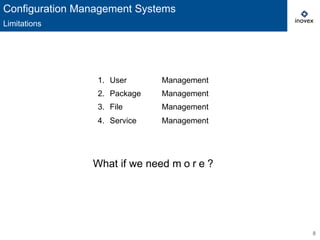
1.  User Management
2.  Package Management
3.  File Management
4.  Service Management
What if we need m o r e ?
Configuration Management Systems
Limitations
9
SaltStack Fundamentals
Configuration Management with SaltStack
Part 2
10
Salt …
1.  … is extremely flexible.
2.  … is very easy to use.
3.  … has lots of exciting features.
4.  … is fast.
5.  … makes sysadmin’s life easier.
SaltStack Fundamentals
Why Salt?
11
‣  It’s all about (simple) data
‣  Central place for configuration
‣  Asynchronous (send commands to 10,000 server at a time in seconds)
‣  Configuration management
‣  Remote execution
‣  Core functions are available as execution modules
‣  Hundreds of state + execution modules
‣  Easy to extend
‣  Separate data and code easily with pillars
SaltStack Fundamentals
Why Salt? (2)
12
SaltStack Inside
Configuration Management with SaltStack
Part 3
13
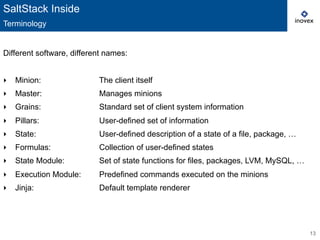
Different software, different names:
‣  Minion: The client itself
‣  Master: Manages minions
‣  Grains: Standard set of client system information
‣  Pillars: User-defined set of information
‣  State: User-defined description of a state of a file, package, …
‣  Formulas: Collection of user-defined states
‣  State Module: Set of state functions for files, packages, LVM, MySQL, …
‣  Execution Module: Predefined commands executed on the minions
‣  Jinja: Default template renderer
SaltStack Inside
Terminology
14
SaltStack Inside
Default Architecture
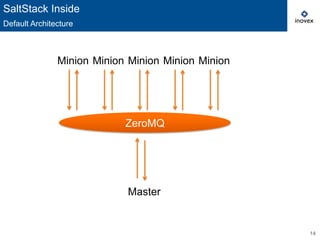
Master
Minion
ZeroMQ
MinionMinion Minion Minion
15
You specify minion targeting to apply states, pillars or commands to a desired set of
minions:
‣  Globbing: feweb*.domain.local, *.domain.local, feweb[1-3].domain.local
‣  PCRE: fe(web|mail)1.domain.local
‣  Grains: ‘os:CentOS’, ‘saltversion:2014.1.1’
‣  Pillars: ‘role:mailserver’, ‘cluster_name:fehomepage’
‣  Lists: feweb1.domain…, feweb2.domain…, feweb3.domain…
‣  Nodegroups: Predefined list of minions
‣  Compound (Mix): Mix of the above targeting types (operators: and, or, not)
‣  Batch Size: 4, 10% (execute on X minions at a time)
SaltStack Inside
Minion Targeting
16
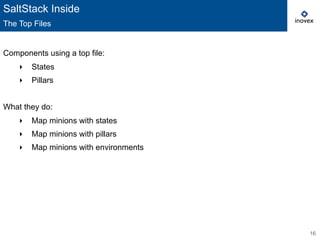
Components using a top file:
‣  States
‣  Pillars
What they do:
‣  Map minions with states
‣  Map minions with pillars
‣  Map minions with environments
SaltStack Inside
The Top Files
17
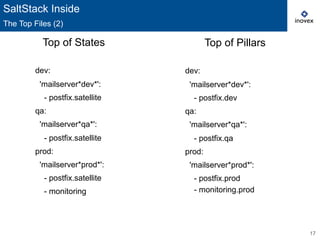
Top of States
dev:
'mailserver*dev*':
- postfix.satellite
qa:
'mailserver*qa*':
- postfix.satellite
prod:
'mailserver*prod*':
- postfix.satellite
- monitoring
SaltStack Inside
The Top Files (2)
Top of Pillars
dev:
'mailserver*dev*':
- postfix.dev
qa:
'mailserver*qa*':
- postfix.qa
prod:
'mailserver*prod*':
- postfix.prod
- monitoring.prod
18
SaltStack Inside
States
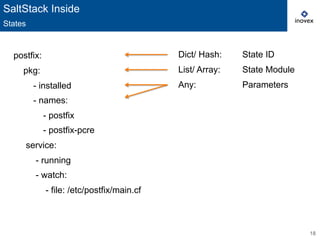
postfix:
pkg:
- installed
- names:
- postfix
- postfix-pcre
service:
- running
- watch:
- file: /etc/postfix/main.cf
Dict/ Hash: State ID
List/ Array: State Module
Any: Parameters
19
SaltStack Inside
States (2)
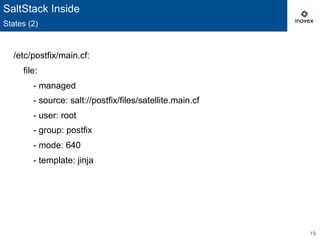
/etc/postfix/main.cf:
file:
- managed
- source: salt://postfix/files/satellite.main.cf
- user: root
- group: postfix
- mode: 640
- template: jinja
postscreen_dnsbl_sites:
- zen.spamhaus.org*2
- ix.dnsbl.manitu.net*2
- dnsbl.sorbs.net=127.0.0.[2;3;5;6;7;9;10]
- list.dnswl.org=127.0.[0..255].0*-1
- list.dnswl.org=127.0.[0..255].[2..3]*-3
any:
generic:
list:
- foo: oof
bar: rab
20
type: satellite
relayhost: smtp.domain.local
inet_protocols:
- ipv4
soft_bounce: True
postscreen:
- greylisting
- pregreet
- dnsbl
mynetworks: 127.0.0.0/8 [::ffff:127...
SaltStack Inside
Pillars
21
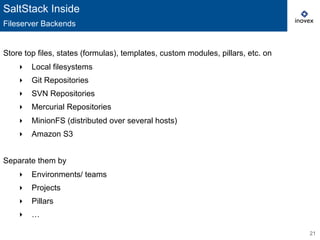
Store top files, states (formulas), templates, custom modules, pillars, etc. on
‣  Local filesystems
‣  Git Repositories
‣  SVN Repositories
‣  Mercurial Repositories
‣  MinionFS (distributed over several hosts)
‣  Amazon S3
Separate them by
‣  Environments/ teams
‣  Projects
‣  Pillars
‣  …
SaltStack Inside
Fileserver Backends
22
Access data by:
‣  Pillars: {{ salt[‘pillar.get’](‘inet_protocols’, [‘ipv4’, ‘ipv6’]) }}
‣  Grains: {{ salt[‘grains.get’](‘os_family’) }}
‣  Peer Publish: {{ salt[‘publish.publish’](‘web*’, ‘grains.item’, ‘fqdn’) }}
‣  Mine: {{ salt[‘pillar.item’](‘mine_functions:network.interfaces’) }}
‣  Local env variables: {% set foo = ‘bar’ %} {{ foo }}
‣  Deserializing: load_json(‘file.json’) / load_yaml(‘file.yaml’) / …
‣  …
These are available in:
‣  Top Files
‣  State Files
‣  Template Files
‣  Pillar Files
‣  …
SaltStack Inside
Data Access
23
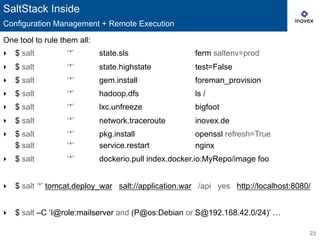
One tool to rule them all:
‣  $ salt ‘*’ state.sls ferm saltenv=prod
‣  $ salt ‘*’ state.highstate test=False
‣  $ salt ‘*’ gem.install foreman_provision
‣  $ salt ‘*’ hadoop.dfs ls /
‣  $ salt ‘*’ lxc.unfreeze bigfoot
‣  $ salt ‘*’ network.traceroute inovex.de
‣  $ salt ‘*’ pkg.install openssl refresh=True
$ salt ‘*’ service.restart nginx
‣  $ salt ‘*’ dockerio.pull index.docker.io:MyRepo/image foo
‣  $ salt ‘*’ tomcat.deploy_war salt://application.war /api yes http://localhost:8080/
‣  $ salt –C ‘I@role:mailserver and (P@os:Debian or S@192.168.42.0/24)’ …
SaltStack Inside
Configuration Management + Remote Execution
24
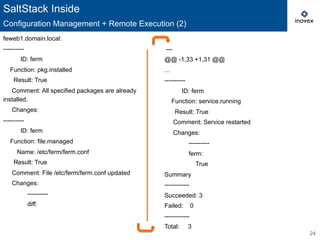
feweb1.domain.local:
----------
ID: ferm
Function: pkg.installed
Result: True
Comment: All specified packages are already
installed.
Changes:
----------
ID: ferm
Function: file.managed
Name: /etc/ferm/ferm.conf
Result: True
Comment: File /etc/ferm/ferm.conf updated
Changes:
----------
diff:
SaltStack Inside
Configuration Management + Remote Execution (2)
---
@@ -1,33 +1,31 @@
...
----------
ID: ferm
Function: service.running
Result: True
Comment: Service restarted
Changes:
----------
ferm:
True
Summary
------------
Succeeded: 3
Failed: 0
------------
Total: 3
25
Conclusions
Configuration Management with SaltStack
Part 4
26
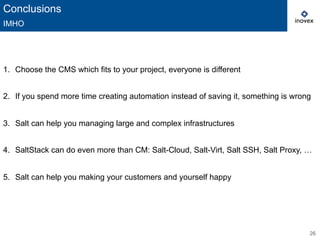
1.  Choose the CMS which fits to your project, everyone is different
2.  If you spend more time creating automation instead of saving it, something is wrong
3.  Salt can help you managing large and complex infrastructures
4.  SaltStack can do even more than CM: Salt-Cloud, Salt-Virt, Salt SSH, Salt Proxy, …
5.  Salt can help you making your customers and yourself happy
Conclusions
IMHO
27
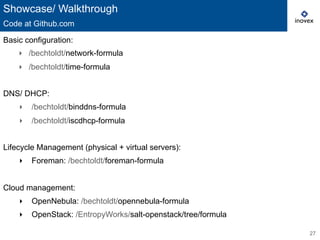
Basic configuration:
‣  /bechtoldt/network-formula
‣  /bechtoldt/time-formula
DNS/ DHCP:
‣  /bechtoldt/binddns-formula
‣  /bechtoldt/iscdhcp-formula
Lifecycle Management (physical + virtual servers):
‣  Foreman: /bechtoldt/foreman-formula
Cloud management:
‣  OpenNebula: /bechtoldt/opennebula-formula
‣  OpenStack: /EntropyWorks/salt-openstack/tree/formula
Showcase/ Walkthrough
Code at Github.com
28
Github.com/bechtoldt – Github.com/saltstack-formulas – talks.arbe.io
Thank You
Questions?
Contact
Arnold Bechtoldt
Linux-Systems Engineer
inovex GmbH
Office Karlsruhe
Ludwig-Erhard-Allee 6
D-76131 Karlsruhe
+49 (0)173 31 81 117
arnold.bechtoldt@inovex.de
„Wir nutzen Technologien, um unsere Kunden
glücklich zu machen. Und uns selbst.“

Arnold Bechtoldt, Inovex GmbH Linux systems engineer - Configuration Management with SaltStack

  • 1.
    Configuration Management withSaltStack Act II Arnold Bechtoldt Berlin, 14.05.14
  • 2.
    2 1.  Configuration ManagementSystems 2.  SaltStack Fundamentals 3.  SaltStack Inside 4.  Conclusions 5.  Showcase/ Walkthrough Topics
  • 3.
    3 ‣  Linux-Systems Engineerat inovex GmbH ‣  Develop lots of features for (Open Source) Datacenter Management ‣  Provisioning of physical & virtual infrastructure ‣  SaltStack user since December, 2012 (~ v0.10.x) About me arnold.bechtoldt@inovex.de
  • 4.
    4 ‣  Provides awide set of IT services: §  Application Development §  Mobile Development §  Business Intelligence §  IT Engineering & Operations §  Consulting §  Trainings ‣  Cool projects with great Open Source Software ‣  Teams of high-experienced engineers ‣  We have excellent job offers in Karlsruhe, Cologne, Munich and Pforzheim! About inovex inovex.de
  • 5.
    5 Configuration Management Systems (a.k.a.CMS) Configuration Management with SaltStack Part 1
  • 6.
    6 ‣  Support buildinga defined infrastructure ‣  Support managing a defined infrastructure ‣  Definition of infrastructure in code (“Infrastructure as code”) ‣  Configuration Management requires Software Development Configuration Management Systems Definition
  • 7.
    7 1.  Create auser (if needed): postfix 2.  Install a package (or more): postfix, postfix-pcre 3.  Create or change a file (configure a service): /etc/postfix/main.cf 4.  Enable and start the service: chkconfig postfix on; service postfix start Configuration Management Systems Traditional
  • 8.
    8 1.  User Management 2. Package Management 3.  File Management 4.  Service Management What if we need m o r e ? Configuration Management Systems Limitations
  • 9.
  • 10.
    10 Salt … 1.  …is extremely flexible. 2.  … is very easy to use. 3.  … has lots of exciting features. 4.  … is fast. 5.  … makes sysadmin’s life easier. SaltStack Fundamentals Why Salt?
  • 11.
    11 ‣  It’s allabout (simple) data ‣  Central place for configuration ‣  Asynchronous (send commands to 10,000 server at a time in seconds) ‣  Configuration management ‣  Remote execution ‣  Core functions are available as execution modules ‣  Hundreds of state + execution modules ‣  Easy to extend ‣  Separate data and code easily with pillars SaltStack Fundamentals Why Salt? (2)
  • 12.
  • 13.
    13 Different software, differentnames: ‣  Minion: The client itself ‣  Master: Manages minions ‣  Grains: Standard set of client system information ‣  Pillars: User-defined set of information ‣  State: User-defined description of a state of a file, package, … ‣  Formulas: Collection of user-defined states ‣  State Module: Set of state functions for files, packages, LVM, MySQL, … ‣  Execution Module: Predefined commands executed on the minions ‣  Jinja: Default template renderer SaltStack Inside Terminology
  • 14.
  • 15.
    15 You specify miniontargeting to apply states, pillars or commands to a desired set of minions: ‣  Globbing: feweb*.domain.local, *.domain.local, feweb[1-3].domain.local ‣  PCRE: fe(web|mail)1.domain.local ‣  Grains: ‘os:CentOS’, ‘saltversion:2014.1.1’ ‣  Pillars: ‘role:mailserver’, ‘cluster_name:fehomepage’ ‣  Lists: feweb1.domain…, feweb2.domain…, feweb3.domain… ‣  Nodegroups: Predefined list of minions ‣  Compound (Mix): Mix of the above targeting types (operators: and, or, not) ‣  Batch Size: 4, 10% (execute on X minions at a time) SaltStack Inside Minion Targeting
  • 16.
    16 Components using atop file: ‣  States ‣  Pillars What they do: ‣  Map minions with states ‣  Map minions with pillars ‣  Map minions with environments SaltStack Inside The Top Files
  • 17.
    17 Top of States dev: 'mailserver*dev*': -postfix.satellite qa: 'mailserver*qa*': - postfix.satellite prod: 'mailserver*prod*': - postfix.satellite - monitoring SaltStack Inside The Top Files (2) Top of Pillars dev: 'mailserver*dev*': - postfix.dev qa: 'mailserver*qa*': - postfix.qa prod: 'mailserver*prod*': - postfix.prod - monitoring.prod
  • 18.
    18 SaltStack Inside States postfix: pkg: - installed -names: - postfix - postfix-pcre service: - running - watch: - file: /etc/postfix/main.cf Dict/ Hash: State ID List/ Array: State Module Any: Parameters
  • 19.
    19 SaltStack Inside States (2) /etc/postfix/main.cf: file: -managed - source: salt://postfix/files/satellite.main.cf - user: root - group: postfix - mode: 640 - template: jinja
  • 20.
    postscreen_dnsbl_sites: - zen.spamhaus.org*2 - ix.dnsbl.manitu.net*2 -dnsbl.sorbs.net=127.0.0.[2;3;5;6;7;9;10] - list.dnswl.org=127.0.[0..255].0*-1 - list.dnswl.org=127.0.[0..255].[2..3]*-3 any: generic: list: - foo: oof bar: rab 20 type: satellite relayhost: smtp.domain.local inet_protocols: - ipv4 soft_bounce: True postscreen: - greylisting - pregreet - dnsbl mynetworks: 127.0.0.0/8 [::ffff:127... SaltStack Inside Pillars
  • 21.
    21 Store top files,states (formulas), templates, custom modules, pillars, etc. on ‣  Local filesystems ‣  Git Repositories ‣  SVN Repositories ‣  Mercurial Repositories ‣  MinionFS (distributed over several hosts) ‣  Amazon S3 Separate them by ‣  Environments/ teams ‣  Projects ‣  Pillars ‣  … SaltStack Inside Fileserver Backends
  • 22.
    22 Access data by: ‣ Pillars: {{ salt[‘pillar.get’](‘inet_protocols’, [‘ipv4’, ‘ipv6’]) }} ‣  Grains: {{ salt[‘grains.get’](‘os_family’) }} ‣  Peer Publish: {{ salt[‘publish.publish’](‘web*’, ‘grains.item’, ‘fqdn’) }} ‣  Mine: {{ salt[‘pillar.item’](‘mine_functions:network.interfaces’) }} ‣  Local env variables: {% set foo = ‘bar’ %} {{ foo }} ‣  Deserializing: load_json(‘file.json’) / load_yaml(‘file.yaml’) / … ‣  … These are available in: ‣  Top Files ‣  State Files ‣  Template Files ‣  Pillar Files ‣  … SaltStack Inside Data Access
  • 23.
    23 One tool torule them all: ‣  $ salt ‘*’ state.sls ferm saltenv=prod ‣  $ salt ‘*’ state.highstate test=False ‣  $ salt ‘*’ gem.install foreman_provision ‣  $ salt ‘*’ hadoop.dfs ls / ‣  $ salt ‘*’ lxc.unfreeze bigfoot ‣  $ salt ‘*’ network.traceroute inovex.de ‣  $ salt ‘*’ pkg.install openssl refresh=True $ salt ‘*’ service.restart nginx ‣  $ salt ‘*’ dockerio.pull index.docker.io:MyRepo/image foo ‣  $ salt ‘*’ tomcat.deploy_war salt://application.war /api yes http://localhost:8080/ ‣  $ salt –C ‘I@role:mailserver and (P@os:Debian or S@192.168.42.0/24)’ … SaltStack Inside Configuration Management + Remote Execution
  • 24.
    24 feweb1.domain.local: ---------- ID: ferm Function: pkg.installed Result:True Comment: All specified packages are already installed. Changes: ---------- ID: ferm Function: file.managed Name: /etc/ferm/ferm.conf Result: True Comment: File /etc/ferm/ferm.conf updated Changes: ---------- diff: SaltStack Inside Configuration Management + Remote Execution (2) --- @@ -1,33 +1,31 @@ ... ---------- ID: ferm Function: service.running Result: True Comment: Service restarted Changes: ---------- ferm: True Summary ------------ Succeeded: 3 Failed: 0 ------------ Total: 3
  • 25.
  • 26.
    26 1.  Choose theCMS which fits to your project, everyone is different 2.  If you spend more time creating automation instead of saving it, something is wrong 3.  Salt can help you managing large and complex infrastructures 4.  SaltStack can do even more than CM: Salt-Cloud, Salt-Virt, Salt SSH, Salt Proxy, … 5.  Salt can help you making your customers and yourself happy Conclusions IMHO
  • 27.
    27 Basic configuration: ‣  /bechtoldt/network-formula ‣ /bechtoldt/time-formula DNS/ DHCP: ‣  /bechtoldt/binddns-formula ‣  /bechtoldt/iscdhcp-formula Lifecycle Management (physical + virtual servers): ‣  Foreman: /bechtoldt/foreman-formula Cloud management: ‣  OpenNebula: /bechtoldt/opennebula-formula ‣  OpenStack: /EntropyWorks/salt-openstack/tree/formula Showcase/ Walkthrough Code at Github.com
  • 28.
    28 Github.com/bechtoldt – Github.com/saltstack-formulas– talks.arbe.io Thank You Questions? Contact Arnold Bechtoldt Linux-Systems Engineer inovex GmbH Office Karlsruhe Ludwig-Erhard-Allee 6 D-76131 Karlsruhe +49 (0)173 31 81 117 arnold.bechtoldt@inovex.de „Wir nutzen Technologien, um unsere Kunden glücklich zu machen. Und uns selbst.“