Mentoring Devs
Into DevOps
Justin Carmony
Director of Development
Deseret Digital Media
Lets Measure
The Audience
• Who here is a…
• System Administrator?
• Developer?
• Manager / Management?
• “DevOp?”
Confession:
I’m a Developer
Self-Taught Ops
Because There Was No One Else To Do It
About Me
• Director of Development

for Deseret Digital Media
• Utah PHP Usergroup

President
• I Make (and Break) 

Web Stuff (10 years)
• Salt User in Production
since 0.8
(I <3 Salt)
This Presentation
• Lessons learned at DDM & previous jobs
• Insight into our process of increasing “DevOps”
• We’re still learning, but this what we’ve found.
• Slides will be posted online, so don’t worry about
copying slide content.
• Feel free to ask on-topic questions during, and
we’ll have questions at the end.
About DDM
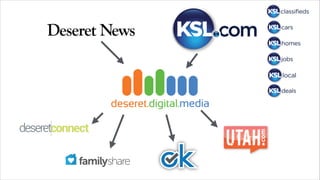
• Deseret Digital Media runs local website like
KSL.com, DeseretNews.com
• Running National and International Websites like
OK.com, familia.com.br, etc.
• ~10 million pageviews a day across sites.
• ~150 internal VMs, a few dozen physical
machines, some AWS sprinkled around.
Lets Start With a Story!
You Work for an
Awesome Tech Company
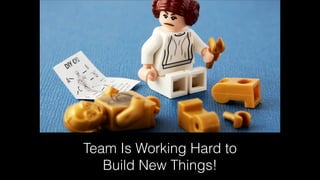
Team Is Working Hard to
Build New Things!
You launch your
awesome product!
A Few More Features…
… and next thing you know…
Awesome Job
Team, We Rock!
We Need !
Real-Time XYZ Feature!
ASAP!
We Need !
Real-Time XYZ Feature!
ASAP!
We Need !
Real-Time XYZ Feature!
ASAP!
&#$%!
“Huh, it works if you !
just turn off caching…”!
- Dev @ 80th Hour This Week
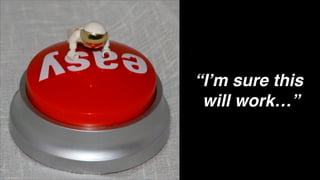
“I’m sure this !
will work…”
“Our servers are melting!”
“We Need a Better Solution!”
So…
Where Do We Start?
We Have This Problem
Challenges We Faced
• Giant mesh-up of technologies
• Tightly-coupled & fragile infrastructure
• Debugging production only bugs was difficult
• Bugs that were part code, part environment were
a nightmare to track down.
So One Day…
We Had A Genius Idea!
Lets Hire a DevOp!
I’m Not Joking
We Actually Said This
Two Problems
with this “Idea”
Problem #1 - We Didn’t Understand
What We Really Wanted
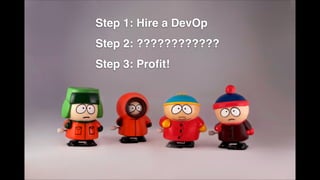
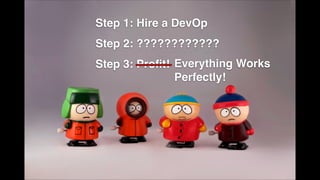
Step 1: Hire a DevOp!
Step 2: ????????????!
Step 3: Profit!
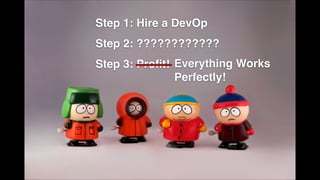
Step 1: Hire a DevOp!
Step 2: ????????????!
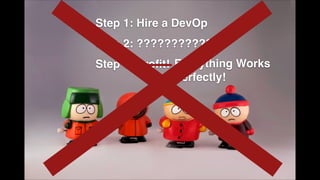
Step 3: Profit! Everything Works !
Perfectly!
Problem #2 - People Who Are Great
At Dev & Ops Are Hard To Find
Expectation:
Reality:
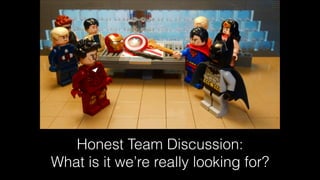
Honest Team Discussion:
What is it we’re really looking for?
We Discovered a Few Things
What does DevOps
Mean To Us?
• DevOps: Dev & Ops, a Culture of Collaboration
• Our Goal: “10 deploys a day without issues”
• Everyone shares the goal of quick development of
features AND a stable system that stays up.
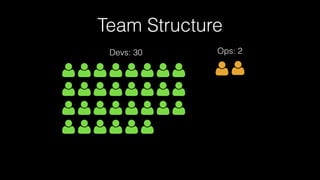
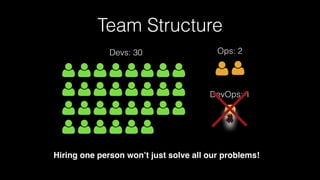
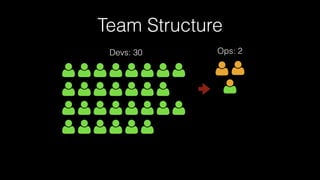
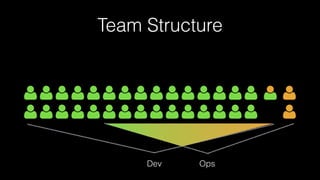
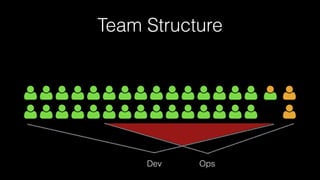
Team Structure
Devs: 30 Ops: 2
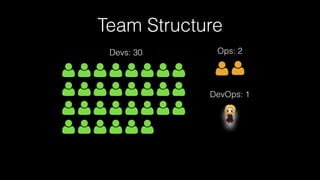
Team Structure
Devs: 30 Ops: 2
DevOps: 1
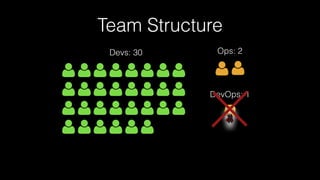
Team Structure
Devs: 30 Ops: 2
DevOps: 1
Team Structure
Devs: 30 Ops: 2
DevOps: 1
Hiring one person won’t just solve all our problems!
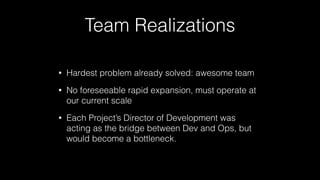
Team Realizations
• Hardest problem already solved: awesome team
• No foreseeable rapid expansion, must operate at
our current scale
• Each Project’s Director of Development was
acting as the bridge between Dev and Ops, but
would become a bottleneck.
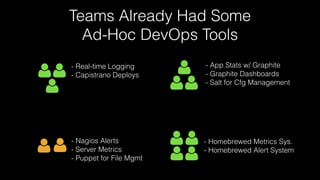
Teams Already Had Some
Ad-Hoc DevOps Tools
- Real-time Logging
- Capistrano Deploys
- Nagios Alerts
- Server Metrics
- Puppet for File Mgmt
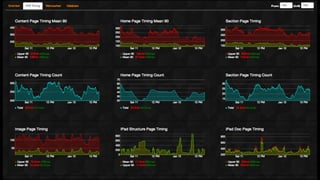
- App Stats w/ Graphite
- Graphite Dashboards
- Salt for Cfg Management
- Homebrewed Metrics Sys.
- Homebrewed Alert System
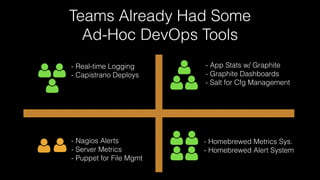
Teams Already Had Some
Ad-Hoc DevOps Tools
- Real-time Logging
- Capistrano Deploys
- Nagios Alerts
- Server Metrics
- Puppet for File Mgmt
- App Stats w/ Graphite
- Graphite Dashboards
- Salt for Cfg Management
- Homebrewed Metrics Sys.
- Homebrewed Alert System
Step 1: Hire a DevOp!
Step 2: ????????????!
Step 3: Profit! Everything Works !
Perfectly!
Step 1: Hire a DevOp!
Step 2: ????????????!
Step 3: Profit! Everything Works !
Perfectly!
We Formed A Strategy
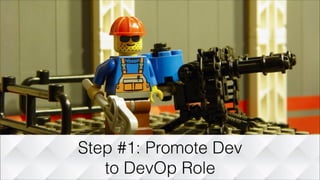
Step #1: Promote Dev
to DevOp Role
WAIT!
Isn’t that the advice you just
said was a bad idea?!
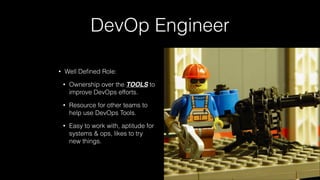
DevOp Engineer
• Well Defined Role:
• Ownership over the TOOLS to
improve DevOps efforts.
• Resource for other teams to
help use DevOps Tools.
• Easy to work with, aptitude for
systems & ops, likes to try
new things.
Promoting From Within
• A seasoned dev for your team already knows:
• Your Pain Points
• Your System’s Quirks
• How the “Chaos Works”
• Knows the people & personalities on your team
Step #2: Change
Team Structure
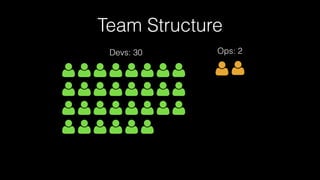
Team Structure
Devs: 30 Ops: 2
Team Structure
Devs: 30 Ops: 2
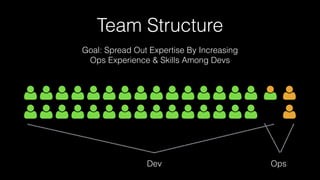
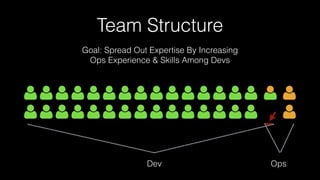
Team Structure
Goal: Spread Out Expertise By Increasing
Ops Experience & Skills Among Devs
Dev Ops
Team Structure
Goal: Spread Out Expertise By Increasing
Ops Experience & Skills Among Devs
Dev Ops
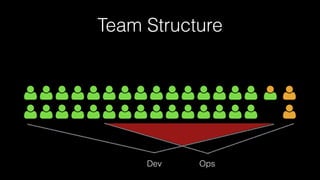
Team Structure
Dev Ops
Team Structure
Dev Ops
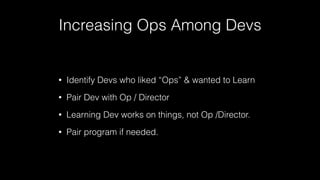
Increasing Ops Among Devs
• Identify Devs who liked “Ops” & wanted to Learn
• Pair Dev with Op / Director
• Learning Dev works on things, not Op /Director.
• Pair program if needed.
Step #3: Increase
Everyone’s Insight
Step #3: Increase
Everyone’s Insight
Metrics
• Everyone has access to Network, Server, and
Application Metrics.
• Consolidate & reduce places to look. We try to
pipe everything to StatsD / Graphite
• Each developer trained to add & track metrics in
production.
• We’re okay with 98% uptime of stats to avoid
complexity.
Real-Time Logging
Real-Time Logging
• Harder & more complicated at scale
• Still trying to solve well, we have lots of logs.
• Start with small window of data (i.e. 48 hours) and
start to expand window.
• We’re trying Logstash, ElasticSearch, and Kibana
right now.
• Generate Statistics off our Logs
Tracking Changes
• Everything, everything, everything in git 

(we use GitHub)
• Everyone has access to all repos
• Everyone does work through Pull Requests
• Everyone has their work code reviewed *
* - Your can merge w/o a review, but must be
willing to defend your choice
Deploys
Everyone Can Deploy
• Automated our deployment process to a single
step.
• Everyone can deploy, deployments are logged
• Easy rollback is a requirement!
• Implementing feature flags to turn off single parts
of our application.
Tests
Unit
Functional
Integration
Acceptance
etc
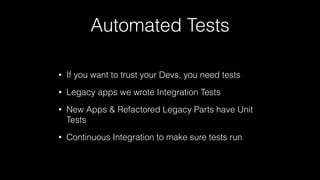
Automated Tests
• If you want to trust your Devs, you need tests
• Legacy apps we wrote Integration Tests
• New Apps & Refactored Legacy Parts have Unit
Tests
• Continuous Integration to make sure tests run
So, where’s the salt?
Step #4: Devs
Use The Ops Tools
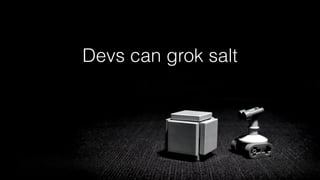
Devs can grok salt
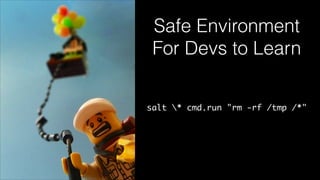
Safe Environment
For Devs to Learn
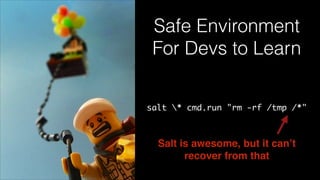
Safe Environment
For Devs to Learn
salt * cmd.run "rm -rf /tmp /*"
Safe Environment
For Devs to Learn
salt * cmd.run "rm -rf /tmp /*"
Salt is awesome, but it can’t !
recover from that
Dev Salt Master
Devs Can Look Into Every Server
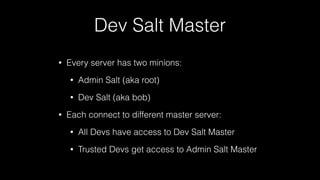
Dev Salt Master
• Every server has two minions:
• Admin Salt (aka root)
• Dev Salt (aka bob)
• Each connect to different master server:
• All Devs have access to Dev Salt Master
• Trusted Devs get access to Admin Salt Master
Everything Salty in Git
Reminder:
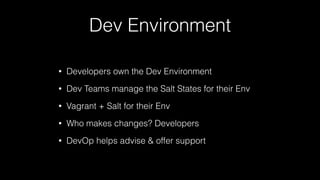
Dev Environment
• Developers own the Dev Environment
• Dev Teams manage the Salt States for their Env
• Vagrant + Salt for their Env
• Who makes changes? Developers
• DevOp helps advise & offer support
Team Structure
Dev Ops
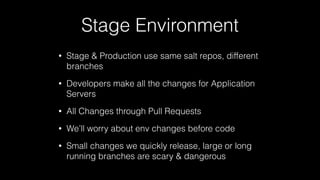
Stage Environment
• Stage & Production use same salt repos, different
branches
• Developers make all the changes for Application
Servers
• All Changes through Pull Requests
• We’ll worry about env changes before code
• Small changes we quickly release, large or long
running branches are scary & dangerous
Production Environment
• Merge change to Production Branch
• salt * state.highstate
• Reminder: Small quick changes over time, never
a large change at once.
Environment Caveats
• Ops & DevOps Manage VM Hosts, Physical Load
Balancers, FireWalls, etc
• Ops & DevOps manage servers that deal with
data:
• MySQL
• MongoDB
• etc
Mentoring Devs
Mentoring Devs
• Not every Dev will become an amazing DevOp
• Thats okay!
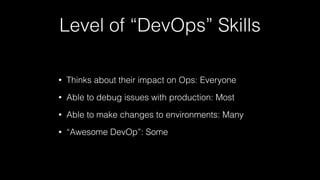
Level of “DevOps” Skills
• Thinks about their impact on Ops: Everyone
• Able to debug issues with production: Most
• Able to make changes to environments: Many
• “Awesome DevOp”: Some
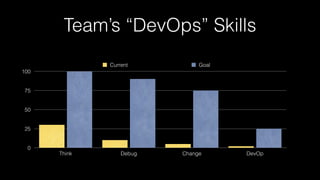
Team’s “DevOps” Skills
0
25
50
75
100
Think Debug Change DevOp
Current Goal
So Everything Is
Awesome for us, right?
Honesty Slide: We Have
Skeletons In Our Closets
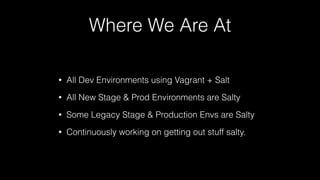
Where We Are At
• All Dev Environments using Vagrant + Salt
• All New Stage & Prod Environments are Salty
• Some Legacy Stage & Production Envs are Salty
• Continuously working on getting out stuff salty.
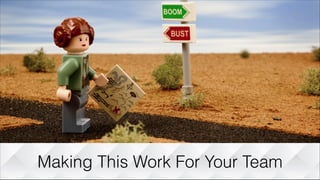
Making This Work For Your Team
Honest Introspection
• Determine for your
team what are your…
• Strengths
• Weaknesses
• Problems
• Goals
Increase Team’s Insight
• Make sure devs can see
& understand how their
code performs
• Increase responsibility of
team for those metrics.
• If they break it, they fix it. 

Do not always bail them
out.
• Everyone can see
everything.
Increase Team’s Insight
• Make sure devs can see
& understand how their
code performs
• Increase responsibility of
team for those metrics.
• If they break it, they fix it. 

Do not always bail them
out.
• Everyone can see
everything.
Mentor Those With
Desire / Aptitude
• Give Developers Safe
Environment to Learn
• Let them submit code-reviewed
changes for Stage & Production
• When teaching / mentoring, let
the learner drive, kindly offer
advice and help.
• It takes time, but worth the
investment.
A Few Final Thoughts
Team Culture Matters
Positive Influence
Questions?
Thank You
Justin Carmony
Email: justin@justincarmony.com
Twitter: @JustinCarmony
IRC: carmony #salt #uphpu
Website: justin@justincarmony.com
p.s. we’re hiring, email / pm / tweet me

SaltConf14 - Justin Carmony, Deseret Digital Media - Teaching Devs About DevOps