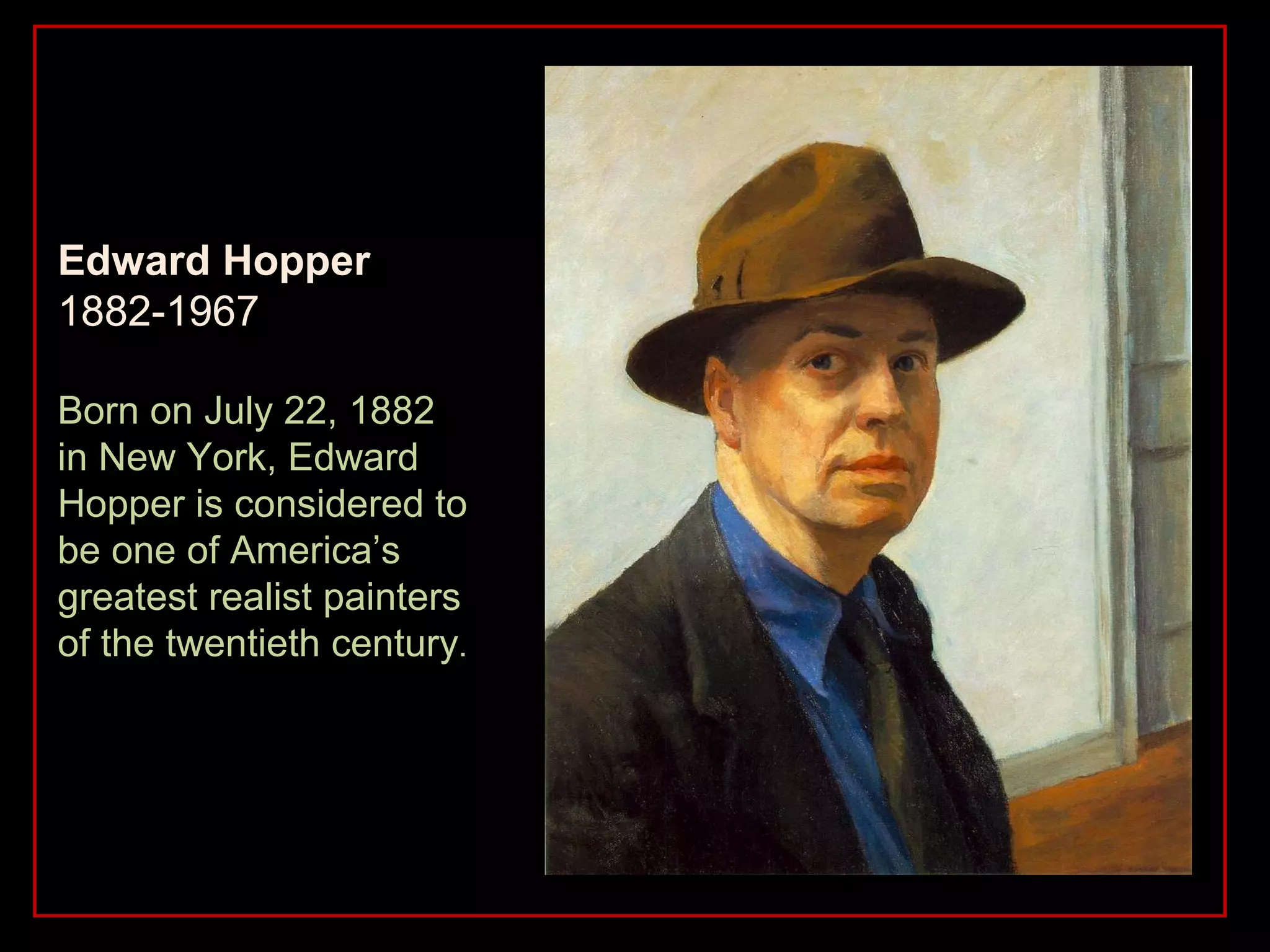
Edward Hopper
1882-1967

Born on July 22, 1882
in New York, Edward
Hopper is considered to
be one of America’s
greatest realist painters
of the twentieth century.
Hopper studied illustration at
the New York School of Art,
between 1900 and 1906.

 In 1906 he travelled to Paris,
London, Amsterdam, Berlin and
Brussels to study works by
European artists.

Returning to New York in 1907,
he painted and worked part-
time as an illustrator for fiction
and trade magazines.
From 1910, Hopper spent his summers painting in rural New England, in
Gloucester and Cape Anne, Massachusetts, and in Maine.
In 1913 he moved to Washington Square, in the Greenwich Village area of
New York, which remained his permanent base.
Hopper’s subjects were derived from three main sources:

 - everyday American life such as
   restaurants, cafés, gas stations,
   theaters, and street scenes;
 - images of loneliness and detachment
   where he often depicted solitary
   figures (mostly women) occupied with
   their own thoughts, bathed by the sun
   light.
 - and third, seascapes and rural
    landscapes.
In 1923, with the encouragement of his wife artist Josephine Niviso, Hopper
began painting in watercolour. In 1924, he had his first exhibition to reach
critical and commercial success.
From 1930, Edward and Josephine (Jo) used to spend summer painting in Truro
on Cape Cod, Massachusetts, where they built a home in 1934.


Many artists have cited him as influential, including Mark Rothko. His cinematic
compositions and use of light and dark made him popular with filmmakers such
as Alfred Hitchcock (Psycho , 39 Steps, Rear Window), Ridley Scott (Blade
Runner), Wim Wenders (American friend).
Hopper made several extended trips abroad and came under the influence
of French and European literature and culture.

The painting that apparently impressed him the most during his travels was
Rembrandt’s “The Night Watch,” which he viewed in Amsterdam.


But he would be strongly
influenced by many flemish
works, his painted women
revealing frequently a
Vermeer touch – static
figures with light coming
down from a window as if
from some heavenly source.
The window is in fact a recurring theme in Hopper’s paintings. It is this hint of
voyeurism linked to an acute sense of ‘being alone’ that so captures
Hopper’s twentieth century America.
Edward Hopper peered through windows into the soul of the US.


Hopper avoided sentimentality to the point of verging on detachment.
He painted mundane places and ordinary people doing ordinary things, and
powerfully revealed an essential disquiet in that existence.
The characters in Nighthawks are not going anywhere; loneliness and desolation is
   Nighthawks
expressed by the presence of anonymous, non-communicating figures.

We feel the emptiness created by the massive dark window,
The famous work might be a manifesto of the film noir aesthetic.
“Room in New York” (1932)
A couple in their living room observed through the open window of a city
apartment. The pair are separated by space both physical and psychological.
Disquietness shows in the angle of the woman’s starkly lit shoulder as she
turns away to plunk a solitary note on a piano.
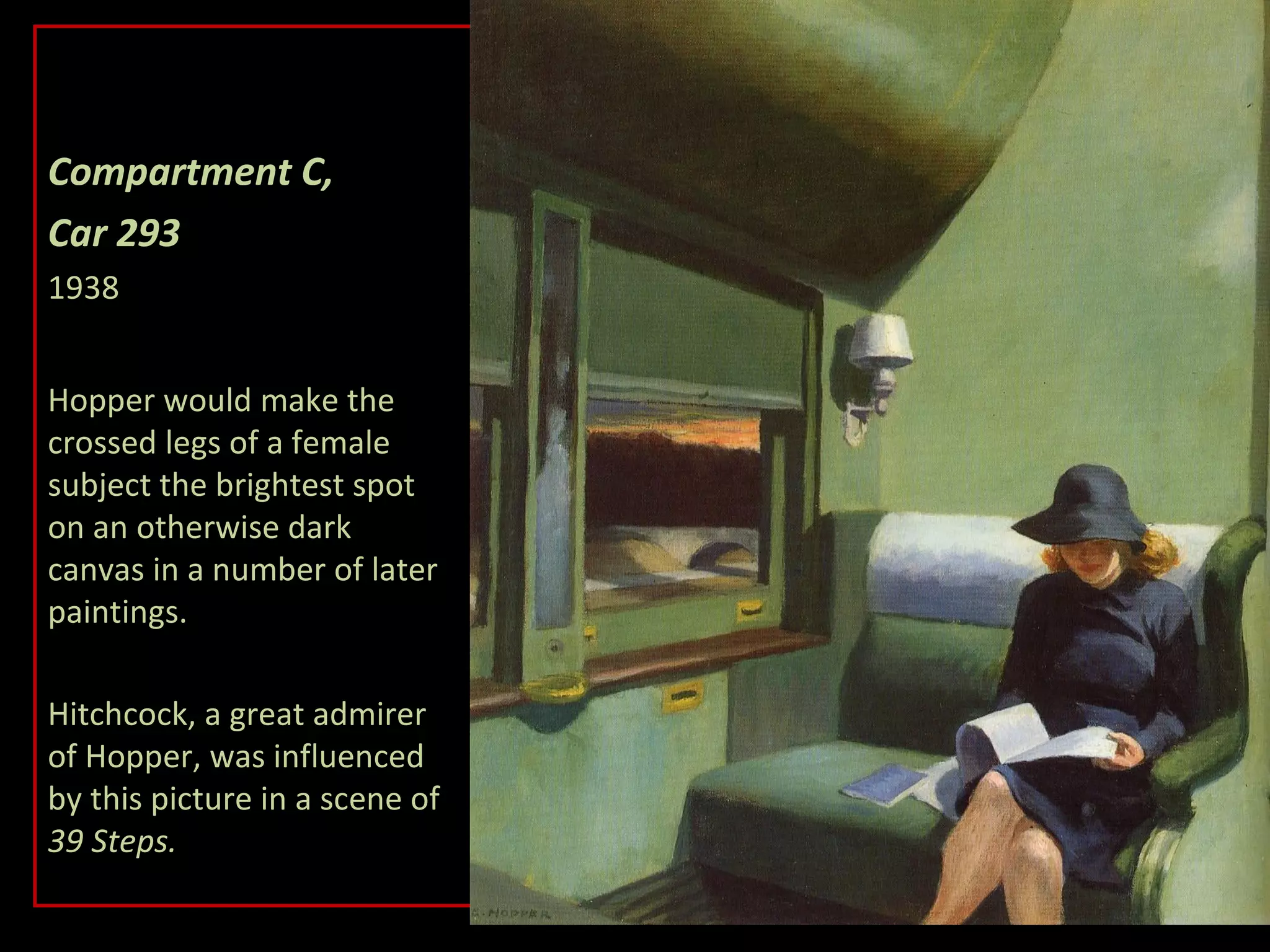
Compartment C,
Car 293
1938


Hopper would make the
crossed legs of a female
subject the brightest spot
on an otherwise dark
canvas in a number of later
paintings.

Hitchcock, a great admirer
of Hopper, was influenced
by this picture in a scene of
39 Steps.
Reading is also a frequent theme in Hopper: many of his
women have a book in hands. Maybe they don’t really read.
39 Steps
Hitchcock inspired in Hopper: Madeleine Carroll reads, her legs crossed
The female subject of his 1931 painting Barber Shop is also in a
similar pose:


The coulours, the shades, the angled light bathing the woman, all
remind of Vermeer famous paintings.
Hotel room,
1931

Nothing left,
but to read?
Morning Sun (1952): solitude
Edward Hopper's wife, Josephine Hopper, served as his model for Morning Sun.
Hopper’s work conveys a psychological uneasiness pervasive in modern society
“Night Windows” (1928)
“Night Windows” caused
controversy: it shows the
rounded corner of an
apartment as if seen from a
passing elevated train. The
illuminated interior is seen
through three windows.

A rounded woman in a
translucent red slip, her
back to the observer and
half-obscured by the central
window, is captured slightly
bent over as if putting
something on an unseen
chair.
Automat, 1927

Hopper's wife, Jo, served as
  model for the woman.

The restaurant appears to be
   empty, no signs of any life on
   the street outside.

This sense of loneliness was
   associated with the concept
   of urban alienation.


                                 The woman’s reflection is absent from the window.
                                                                        Is she real?
Chop Suey,
1929


Close attention
to the effects
of light
“Hopper is always on the verge of telling a story."
John Updike.
Thw work is figurative, but many
geometric elements surround the
human figures, like the light and blue
surface from outside through the
window.
Tables for ladies, 1930


                          This time we look
                          from the street into
                          a restaurant’s front
                          window – more like
                          in Nighthawks.


                          Some influence of
                          dutch painters can
                          be found in the two
                          females , one in
                          white, one in black.
A message of sensuality mixed with melancholy.
Sunday
1926


Sunday, the owner or the employee of a small store is waiting for customers.
The street is empty and indifferent. He is looking to nowhere. He is inside his
working time but he is not working.
Hopper, it seems, calls our attention to that: when we are not working we are
left empty. We feel empty of ourselves.
‘Pennsylvania Coal Town’, 1947
He is outside of his life, his home, but still nearby – he is in a similar situation as the
man in Sunday. He is in between what his life is and himself.
He is here, near his house, and he is not – he is looking somewhere else.
What is he looking at? The gaze of the man, it seems, like in the Sunday painting, is
directed at somewhere that is nowhere: he sees something without being
interested in what he sees.
Office in a small city, 1953


Straight geometry adds to the impersonal atmosphere of the office, and further helps
to create a feeling of containment and solitude.
Bare windows, frames, a solitary person with an undefinite look, empty streets and
façades shining in early morning sunlight.
High Noon, 1949
Blazing with all the brightness of summer, a solitary woman stands framed in
the doorway of a lonely house somewhere on the American prairie. She has
just opened her robe, and she looks up into the sunlight that falls on her bare
breasts, trapped on the threshold, neither outside nor in.


We have a sense that this isn’t a real house at all; it’s as artificial as a movie
set. This place is truly in the middle of nowhere.
Summertime, 1943
Cape cod evening, 1939
Cape Cod Evening should be idyllic: the couple enjoy the evening
sunshine outside their home. But the door is firmly shut and the windows
covered, the thick, sinister trees tap on the window panes.
Landscapes
House by the Railroad, 1925
Hitchcock’s Psycho
Captain Upton’s House, 1927
Gas, 1940
The last car seems to have passed long ago, the gas station has the
appearance of a last outpost.


The bright, almost pure white fluorescent light in the gas station,   in
contrast, is almost painful to look at.
Wim Wenders

Street Corner
(Butte,
Montana), 2003

Photography


      ‘Vermeer was my biggest hero, then later on it was definitely Hopper’.
                                                             Wim Wenders
Later works

Hopper’s later work became less sensuous, more
  geometric and deliberately surreal.
Sea Watchers ,1952
Study for Sea watchers
Sunlight on Brownstones , 1956
Study for Sunlight on Brownstones
Western Motel, 1957
Sunlight in a cafeteria, 1958
A window again, shadows and light, lonesome people
‘Her eyes, unsettled, investigate the skin on her arm as her coffee grows cold’
Sun in an empty room, 1963
Rooms by the sea, 1951 – a study of light, a surrealistic approach.
Edward Hopper died on May 15,
1967 in his studio in New York City.

Jo, who died 10 months later, left
their collection of over three
thousand works to the Whitney
Museum of American Art.
This presentation ©Mário Ricca, 2012

Edward Hopper, a presentation

  • 1.
    Edward Hopper 1882-1967 Born onJuly 22, 1882 in New York, Edward Hopper is considered to be one of America’s greatest realist painters of the twentieth century.
  • 2.
    Hopper studied illustrationat the New York School of Art, between 1900 and 1906. In 1906 he travelled to Paris, London, Amsterdam, Berlin and Brussels to study works by European artists. Returning to New York in 1907, he painted and worked part- time as an illustrator for fiction and trade magazines.
  • 3.
    From 1910, Hopperspent his summers painting in rural New England, in Gloucester and Cape Anne, Massachusetts, and in Maine. In 1913 he moved to Washington Square, in the Greenwich Village area of New York, which remained his permanent base. Hopper’s subjects were derived from three main sources: - everyday American life such as restaurants, cafés, gas stations, theaters, and street scenes; - images of loneliness and detachment where he often depicted solitary figures (mostly women) occupied with their own thoughts, bathed by the sun light. - and third, seascapes and rural landscapes. In 1923, with the encouragement of his wife artist Josephine Niviso, Hopper began painting in watercolour. In 1924, he had his first exhibition to reach critical and commercial success.
  • 4.
    From 1930, Edwardand Josephine (Jo) used to spend summer painting in Truro on Cape Cod, Massachusetts, where they built a home in 1934. Many artists have cited him as influential, including Mark Rothko. His cinematic compositions and use of light and dark made him popular with filmmakers such as Alfred Hitchcock (Psycho , 39 Steps, Rear Window), Ridley Scott (Blade Runner), Wim Wenders (American friend).
  • 5.
    Hopper made severalextended trips abroad and came under the influence of French and European literature and culture. The painting that apparently impressed him the most during his travels was Rembrandt’s “The Night Watch,” which he viewed in Amsterdam. But he would be strongly influenced by many flemish works, his painted women revealing frequently a Vermeer touch – static figures with light coming down from a window as if from some heavenly source.
  • 6.
    The window isin fact a recurring theme in Hopper’s paintings. It is this hint of voyeurism linked to an acute sense of ‘being alone’ that so captures Hopper’s twentieth century America. Edward Hopper peered through windows into the soul of the US. Hopper avoided sentimentality to the point of verging on detachment. He painted mundane places and ordinary people doing ordinary things, and powerfully revealed an essential disquiet in that existence.
  • 7.
    The characters inNighthawks are not going anywhere; loneliness and desolation is Nighthawks expressed by the presence of anonymous, non-communicating figures. We feel the emptiness created by the massive dark window,
  • 8.
    The famous workmight be a manifesto of the film noir aesthetic.
  • 10.
    “Room in NewYork” (1932)
  • 11.
    A couple intheir living room observed through the open window of a city apartment. The pair are separated by space both physical and psychological. Disquietness shows in the angle of the woman’s starkly lit shoulder as she turns away to plunk a solitary note on a piano.
  • 12.
    Compartment C, Car 293 1938 Hopperwould make the crossed legs of a female subject the brightest spot on an otherwise dark canvas in a number of later paintings. Hitchcock, a great admirer of Hopper, was influenced by this picture in a scene of 39 Steps.
  • 13.
    Reading is alsoa frequent theme in Hopper: many of his women have a book in hands. Maybe they don’t really read.
  • 14.
    39 Steps Hitchcock inspiredin Hopper: Madeleine Carroll reads, her legs crossed
  • 15.
    The female subjectof his 1931 painting Barber Shop is also in a similar pose: The coulours, the shades, the angled light bathing the woman, all remind of Vermeer famous paintings.
  • 17.
  • 18.
  • 19.
    Edward Hopper's wife,Josephine Hopper, served as his model for Morning Sun.
  • 20.
    Hopper’s work conveysa psychological uneasiness pervasive in modern society
  • 21.
  • 22.
    “Night Windows” caused controversy:it shows the rounded corner of an apartment as if seen from a passing elevated train. The illuminated interior is seen through three windows. A rounded woman in a translucent red slip, her back to the observer and half-obscured by the central window, is captured slightly bent over as if putting something on an unseen chair.
  • 23.
    Automat, 1927 Hopper's wife,Jo, served as model for the woman. The restaurant appears to be empty, no signs of any life on the street outside. This sense of loneliness was associated with the concept of urban alienation. The woman’s reflection is absent from the window. Is she real?
  • 25.
  • 26.
    “Hopper is alwayson the verge of telling a story." John Updike.
  • 27.
    Thw work isfigurative, but many geometric elements surround the human figures, like the light and blue surface from outside through the window.
  • 28.
    Tables for ladies,1930 This time we look from the street into a restaurant’s front window – more like in Nighthawks. Some influence of dutch painters can be found in the two females , one in white, one in black.
  • 29.
    A message ofsensuality mixed with melancholy.
  • 30.
    Sunday 1926 Sunday, the owneror the employee of a small store is waiting for customers. The street is empty and indifferent. He is looking to nowhere. He is inside his working time but he is not working. Hopper, it seems, calls our attention to that: when we are not working we are left empty. We feel empty of ourselves.
  • 32.
  • 33.
    He is outsideof his life, his home, but still nearby – he is in a similar situation as the man in Sunday. He is in between what his life is and himself. He is here, near his house, and he is not – he is looking somewhere else. What is he looking at? The gaze of the man, it seems, like in the Sunday painting, is directed at somewhere that is nowhere: he sees something without being interested in what he sees.
  • 34.
    Office in asmall city, 1953 Straight geometry adds to the impersonal atmosphere of the office, and further helps to create a feeling of containment and solitude. Bare windows, frames, a solitary person with an undefinite look, empty streets and façades shining in early morning sunlight.
  • 35.
  • 36.
    Blazing with allthe brightness of summer, a solitary woman stands framed in the doorway of a lonely house somewhere on the American prairie. She has just opened her robe, and she looks up into the sunlight that falls on her bare breasts, trapped on the threshold, neither outside nor in. We have a sense that this isn’t a real house at all; it’s as artificial as a movie set. This place is truly in the middle of nowhere.
  • 37.
  • 38.
  • 39.
    Cape Cod Eveningshould be idyllic: the couple enjoy the evening sunshine outside their home. But the door is firmly shut and the windows covered, the thick, sinister trees tap on the window panes.
  • 40.
  • 41.
    House by theRailroad, 1925
  • 42.
  • 43.
  • 44.
  • 45.
    The last carseems to have passed long ago, the gas station has the appearance of a last outpost. The bright, almost pure white fluorescent light in the gas station, in contrast, is almost painful to look at.
  • 46.
    Wim Wenders Street Corner (Butte, Montana),2003 Photography ‘Vermeer was my biggest hero, then later on it was definitely Hopper’. Wim Wenders
  • 47.
    Later works Hopper’s laterwork became less sensuous, more geometric and deliberately surreal.
  • 48.
  • 49.
    Study for Seawatchers
  • 50.
  • 51.
    Study for Sunlighton Brownstones
  • 52.
  • 53.
    Sunlight in acafeteria, 1958 A window again, shadows and light, lonesome people ‘Her eyes, unsettled, investigate the skin on her arm as her coffee grows cold’
  • 54.
    Sun in anempty room, 1963
  • 55.
    Rooms by thesea, 1951 – a study of light, a surrealistic approach.
  • 56.
    Edward Hopper diedon May 15, 1967 in his studio in New York City. Jo, who died 10 months later, left their collection of over three thousand works to the Whitney Museum of American Art.
  • 57.