The Young PlanDone by: Aloysius Oh (1)Adrian Fong (7)Justin Lim (11)Aloysius Poh (18)Yong Zhu Cheng (28)
WHAT’s That?
The Young Plan
CAUSES?
Dawes Plan (1924) was unsuccessfulGermany was able to meet its obligations for a number of years, largely due to the infusion of capital from the United States.However, Germany could not meet the huge annual payments soon after.Other countries abstained from helping out due to ‘The Great Depression’.
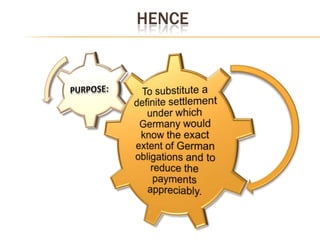
HENCE
CLAUSES
CLAUSES1) Germany to pay 18 billion dollars over 37 years. 2) The annual payments to average $487,600,000, and of this $165,900,000 to be paid unconditionally, with payment of the rest conditioned on German capacity to pay without impairing the value of the mark—a protection which the Fatherland already enjoys under the so-called "transfer clause" of the Dawes Plan.3) Bonds to be issued against the unconditional portion of Germany's pledge to pay, and sold to the world public, the proceeds to go at once into the treasuries of the creditor Powers.
CLAUSES4)The bond transaction to be carried on through an international bank of settlement (all details of which had already been agreed upon by the Second Dawes Committee).
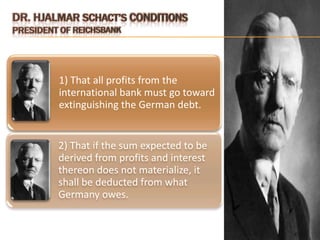
Dr. HjalmarSchact’sConditionsPresident of ReichsBank
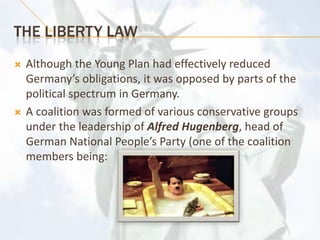
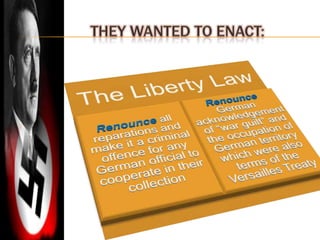
The LIBERTY LAWAlthough the Young Plan had effectively reduced Germany’s obligations, it was opposed by parts of the political spectrum in Germany. A coalition was formed of various conservative groups under the leadership of Alfred Hugenberg, head of German National People’s Party (one of the coalition members being:
They wanted to enact:
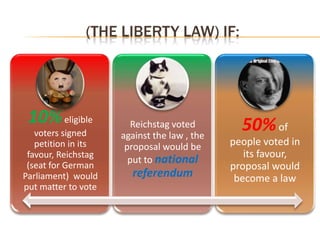
(The Liberty Law) IF:
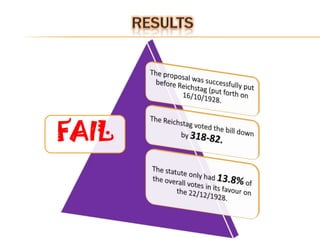
RESULTSFAIL
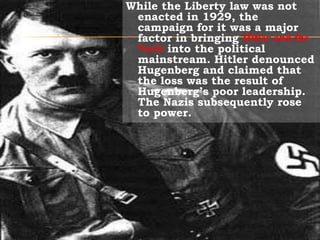
While the Liberty law was not enacted in 1929, the campaign for it was a major factor in bringing Hitler and the Nazis into the political mainstream. Hitler denounced Hugenberg and claimed that the loss was the result of Hugenberg’s poor leadership. The Nazis subsequently rose to power.
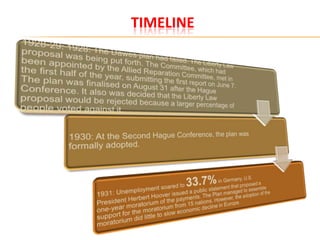
TIMELINE
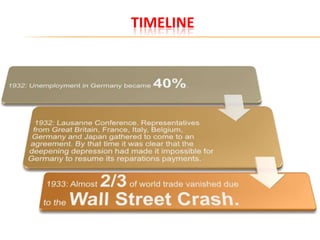
TIMELINE
C:\Fakepath\History Ace Project Young Plan Powerpoint Presentation

C:\Fakepath\History Ace Project Young Plan Powerpoint Presentation

  • 1.
    The Young PlanDoneby: Aloysius Oh (1)Adrian Fong (7)Justin Lim (11)Aloysius Poh (18)Yong Zhu Cheng (28)
  • 2.
  • 3.
  • 4.
  • 5.
    Dawes Plan (1924)was unsuccessfulGermany was able to meet its obligations for a number of years, largely due to the infusion of capital from the United States.However, Germany could not meet the huge annual payments soon after.Other countries abstained from helping out due to ‘The Great Depression’.
  • 6.
  • 7.
  • 8.
    CLAUSES1) Germany topay 18 billion dollars over 37 years. 2) The annual payments to average $487,600,000, and of this $165,900,000 to be paid unconditionally, with payment of the rest conditioned on German capacity to pay without impairing the value of the mark—a protection which the Fatherland already enjoys under the so-called "transfer clause" of the Dawes Plan.3) Bonds to be issued against the unconditional portion of Germany's pledge to pay, and sold to the world public, the proceeds to go at once into the treasuries of the creditor Powers.
  • 9.
    CLAUSES4)The bond transactionto be carried on through an international bank of settlement (all details of which had already been agreed upon by the Second Dawes Committee).
  • 10.
  • 11.
    The LIBERTY LAWAlthoughthe Young Plan had effectively reduced Germany’s obligations, it was opposed by parts of the political spectrum in Germany. A coalition was formed of various conservative groups under the leadership of Alfred Hugenberg, head of German National People’s Party (one of the coalition members being:
  • 12.
  • 13.
  • 14.
  • 15.
    While the Libertylaw was not enacted in 1929, the campaign for it was a major factor in bringing Hitler and the Nazis into the political mainstream. Hitler denounced Hugenberg and claimed that the loss was the result of Hugenberg’s poor leadership. The Nazis subsequently rose to power.
  • 16.
  • 17.