1© GfK January 12, 2016 CES presentation | Smart home: a global perspective | Insights from GfK smart home study
Smart home:
a global perspective
Towards the smart(er) home
2© GfK January 12, 2016 CES presentation | Smart home: a global perspective | Insights from GfK smart home study
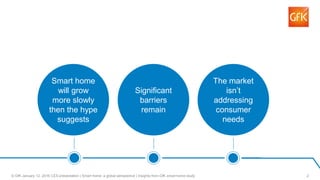
The market
isn’t
addressing
consumer
needs
Smart home
will grow
more slowly
then the hype
suggests
Significant
barriers
remain
3© GfK January 12, 2016 CES presentation | Smart home: a global perspective | Insights from GfK smart home study
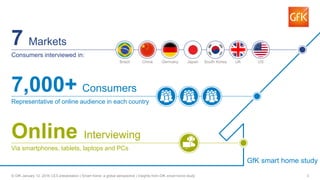
Representative of online audience in each country
7,000+ Consumers
Online Interviewing
Via smartphones, tablets, laptops and PCs
7 Markets
Brazil
Consumers interviewed in:
Germany Japan UK USChina South Korea
GfK smart home study
4© GfK January 12, 2016 CES presentation | Smart home: a global perspective | Insights from GfK smart home study
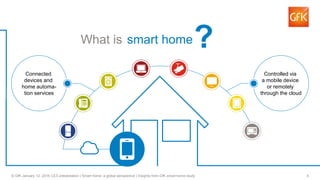
smart home
Controlled via
a mobile device
or remotely
through the cloud
Connected
devices and
home automa-
tion services
What is ?
5© GfK January 12, 2016 CES presentation | Smart home: a global perspective | Insights from GfK smart home study
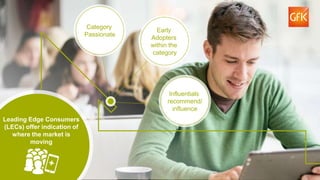
Leading Edge Consumers
(LECs) offer indication of
where the market is
moving
Category
Passionate
Early
Adopters
within the
category
Influentials
recommend/
influence
5
6© GfK January 12, 2016 CES presentation | Smart home: a global perspective | Insights from GfK smart home study
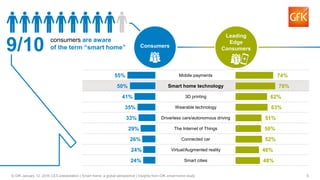
9/10 consumers are aware
of the term “smart home” Consumers
Leading
Edge
Consumers
Mobile payments
Smart home technology
3D printing
Wearable technology
Driverless cars/autonomous driving
The Internet of Things
Connected car
Virtual/Augmented reality
Smart cities
55%
50%
41%
35%
33%
29%
26%
24%
24%
74%
78%
62%
63%
51%
50%
52%
46%
48%
7© GfK January 12, 2016 CES presentation | Smart home: a global perspective | Insights from GfK smart home study
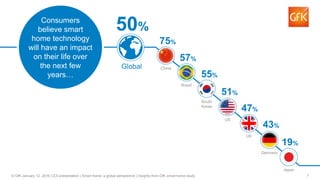
Consumers
believe smart
home technology
will have an impact
on their life over
the next few
years…
75%
China
Brazil
South
Korea
US
UK
Germany
Japan
57%
55%
51%
47%
43%
19%
Global
50%
8© GfK January 12, 2016 CES presentation | Smart home: a global perspective | Insights from GfK smart home study
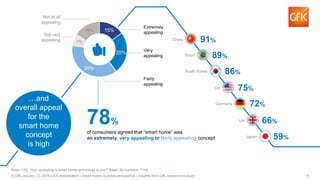
Base: C02. How appealing is smart home technology to you? Base: All markets= 7149
15%
25%
38%
7%
16%
…and
overall appeal
for the
smart home
concept
is high
Extremely
appealing
Very
appealing
Fairly
appealing
Not at all
appealing
Not very
appealing
78%
of consumers agreed that “smart home” was
an extremely, very appealing or fairly appealing concept
China 91%
Brazil 89%
South Korea 86%
US 75%
UK 66%
Germany 72%
Japan 59%
9© GfK January 12, 2016 CES presentation | Smart home: a global perspective | Insights from GfK smart home study
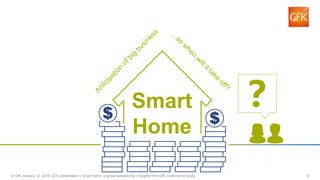
Smart
Home $$
10© GfK January 12, 2016 CES presentation | Smart home: a global perspective | Insights from GfK smart home study
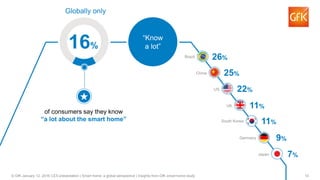
Globally only
16%
of consumers say they know
“a lot about the smart home”
China 25%
South Korea 11%
Japan 7%
“Know
a lot”
Brazil 26%
US 22%
UK 11%
Germany 9%
11© GfK January 12, 2016 CES presentation | Smart home: a global perspective | Insights from GfK smart home study
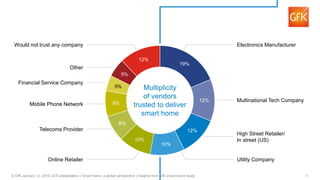
19%
12%
12%
10%
10%
8%
8%
5%
5%
12%
Multiplicity
of vendors
trusted to deliver
smart home
Electronics Manufacturer
Multinational Tech Company
High Street Retailer/
In street (US)
Utility Company
Would not trust any company
Other
Financial Service Company
Mobile Phone Network
Telecoms Provider
Online Retailer
12© GfK January 12, 2016 CES presentation | Smart home: a global perspective | Insights from GfK smart home study
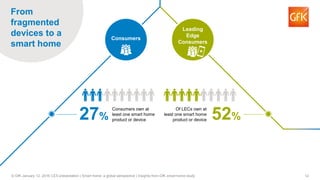
From
fragmented
devices to a
smart home
27%
Consumers own at
least one smart home
product or device 52%
Of LECs own at
least one smart home
product or device
Consumers
Leading
Edge
Consumers
13© GfK January 12, 2016 CES presentation | Smart home: a global perspective | Insights from GfK smart home study
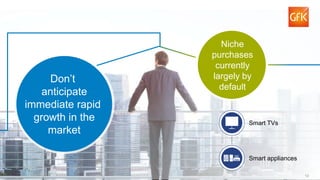
Don’t
anticipate
immediate rapid
growth in the
market
Smart TVs
Smart appliances
13
Niche
purchases
currently
largely by
default
14© GfK January 12, 2016 CES presentation | Smart home: a global perspective | Insights from GfK smart home study
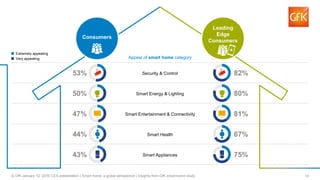
Security & Control
Smart Energy & Lighting
Smart Entertainment & Connectivity
Smart Health
Smart Appliances
53%
50%
47%
44%
43%
82%
80%
81%
67%
75%
Appeal of smart home category
Consumers
Leading
Edge
Consumers
Extremely appealing
Very appealing
15© GfK January 12, 2016 CES presentation | Smart home: a global perspective | Insights from GfK smart home study
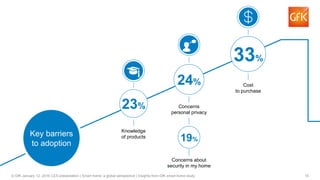
Key barriers
to adoption
23%
Knowledge
of products
24%
Concerns
personal privacy
33%
Cost
to purchase
19%
Concerns about
security in my home
16© GfK January 12, 2016 CES presentation | Smart home: a global perspective | Insights from GfK smart home study
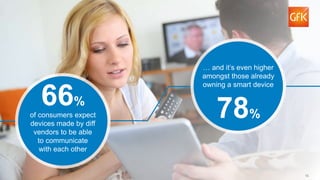
of consumers expect
devices made by diff
vendors to be able
to communicate
with each other
66%
… and it’s even higher
amongst those already
owning a smart device
78%
16
17© GfK January 12, 2016 CES presentation | Smart home: a global perspective | Insights from GfK smart home study
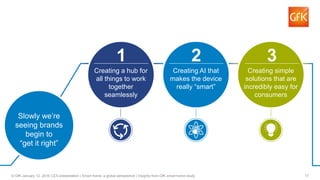
Slowly we’re
seeing brands
begin to
“get it right”
Creating a hub for
all things to work
together
seamlessly
1
Creating AI that
makes the device
really “smart”
2
Creating simple
solutions that are
incredibly easy for
consumers
3
18© GfK January 12, 2016 CES presentation | Smart home: a global perspective | Insights from GfK smart home study
Find out more about our global smart home study
and detailed market reports:
http://www.gfk.com/insights/report/making-the-smart-home-a-reality/
@
Contact us:
Kevin Taylor
kevin.taylor@gfk.com
18
19© GfK January 12, 2016 CES presentation | Smart home: a global perspective | Insights from GfK smart home study
About GfK
GfK is the trusted source of relevant market and consumer information that enables its clients to make smarter decisions.
More than 13,000 market research experts combine their passion with GfK’s long-standing data science experience.
This allows GfK to deliver vital global insights matched with local market intelligence from more than 100 countries. By using
innovative technologies and data sciences, GfK turns big data into smart data, enabling its clients to improve their competitive
edge and enrich consumers’ experiences and choices.

CES 2016 – GfK smart home presentation

  • 1.
    1© GfK January12, 2016 CES presentation | Smart home: a global perspective | Insights from GfK smart home study Smart home: a global perspective Towards the smart(er) home
  • 2.
    2© GfK January12, 2016 CES presentation | Smart home: a global perspective | Insights from GfK smart home study The market isn’t addressing consumer needs Smart home will grow more slowly then the hype suggests Significant barriers remain
  • 3.
    3© GfK January12, 2016 CES presentation | Smart home: a global perspective | Insights from GfK smart home study Representative of online audience in each country 7,000+ Consumers Online Interviewing Via smartphones, tablets, laptops and PCs 7 Markets Brazil Consumers interviewed in: Germany Japan UK USChina South Korea GfK smart home study
  • 4.
    4© GfK January12, 2016 CES presentation | Smart home: a global perspective | Insights from GfK smart home study smart home Controlled via a mobile device or remotely through the cloud Connected devices and home automa- tion services What is ?
  • 5.
    5© GfK January12, 2016 CES presentation | Smart home: a global perspective | Insights from GfK smart home study Leading Edge Consumers (LECs) offer indication of where the market is moving Category Passionate Early Adopters within the category Influentials recommend/ influence 5
  • 6.
    6© GfK January12, 2016 CES presentation | Smart home: a global perspective | Insights from GfK smart home study 9/10 consumers are aware of the term “smart home” Consumers Leading Edge Consumers Mobile payments Smart home technology 3D printing Wearable technology Driverless cars/autonomous driving The Internet of Things Connected car Virtual/Augmented reality Smart cities 55% 50% 41% 35% 33% 29% 26% 24% 24% 74% 78% 62% 63% 51% 50% 52% 46% 48%
  • 7.
    7© GfK January12, 2016 CES presentation | Smart home: a global perspective | Insights from GfK smart home study Consumers believe smart home technology will have an impact on their life over the next few years… 75% China Brazil South Korea US UK Germany Japan 57% 55% 51% 47% 43% 19% Global 50%
  • 8.
    8© GfK January12, 2016 CES presentation | Smart home: a global perspective | Insights from GfK smart home study Base: C02. How appealing is smart home technology to you? Base: All markets= 7149 15% 25% 38% 7% 16% …and overall appeal for the smart home concept is high Extremely appealing Very appealing Fairly appealing Not at all appealing Not very appealing 78% of consumers agreed that “smart home” was an extremely, very appealing or fairly appealing concept China 91% Brazil 89% South Korea 86% US 75% UK 66% Germany 72% Japan 59%
  • 9.
    9© GfK January12, 2016 CES presentation | Smart home: a global perspective | Insights from GfK smart home study Smart Home $$
  • 10.
    10© GfK January12, 2016 CES presentation | Smart home: a global perspective | Insights from GfK smart home study Globally only 16% of consumers say they know “a lot about the smart home” China 25% South Korea 11% Japan 7% “Know a lot” Brazil 26% US 22% UK 11% Germany 9%
  • 11.
    11© GfK January12, 2016 CES presentation | Smart home: a global perspective | Insights from GfK smart home study 19% 12% 12% 10% 10% 8% 8% 5% 5% 12% Multiplicity of vendors trusted to deliver smart home Electronics Manufacturer Multinational Tech Company High Street Retailer/ In street (US) Utility Company Would not trust any company Other Financial Service Company Mobile Phone Network Telecoms Provider Online Retailer
  • 12.
    12© GfK January12, 2016 CES presentation | Smart home: a global perspective | Insights from GfK smart home study From fragmented devices to a smart home 27% Consumers own at least one smart home product or device 52% Of LECs own at least one smart home product or device Consumers Leading Edge Consumers
  • 13.
    13© GfK January12, 2016 CES presentation | Smart home: a global perspective | Insights from GfK smart home study Don’t anticipate immediate rapid growth in the market Smart TVs Smart appliances 13 Niche purchases currently largely by default
  • 14.
    14© GfK January12, 2016 CES presentation | Smart home: a global perspective | Insights from GfK smart home study Security & Control Smart Energy & Lighting Smart Entertainment & Connectivity Smart Health Smart Appliances 53% 50% 47% 44% 43% 82% 80% 81% 67% 75% Appeal of smart home category Consumers Leading Edge Consumers Extremely appealing Very appealing
  • 15.
    15© GfK January12, 2016 CES presentation | Smart home: a global perspective | Insights from GfK smart home study Key barriers to adoption 23% Knowledge of products 24% Concerns personal privacy 33% Cost to purchase 19% Concerns about security in my home
  • 16.
    16© GfK January12, 2016 CES presentation | Smart home: a global perspective | Insights from GfK smart home study of consumers expect devices made by diff vendors to be able to communicate with each other 66% … and it’s even higher amongst those already owning a smart device 78% 16
  • 17.
    17© GfK January12, 2016 CES presentation | Smart home: a global perspective | Insights from GfK smart home study Slowly we’re seeing brands begin to “get it right” Creating a hub for all things to work together seamlessly 1 Creating AI that makes the device really “smart” 2 Creating simple solutions that are incredibly easy for consumers 3
  • 18.
    18© GfK January12, 2016 CES presentation | Smart home: a global perspective | Insights from GfK smart home study Find out more about our global smart home study and detailed market reports: http://www.gfk.com/insights/report/making-the-smart-home-a-reality/ @ Contact us: Kevin Taylor kevin.taylor@gfk.com 18
  • 19.
    19© GfK January12, 2016 CES presentation | Smart home: a global perspective | Insights from GfK smart home study About GfK GfK is the trusted source of relevant market and consumer information that enables its clients to make smarter decisions. More than 13,000 market research experts combine their passion with GfK’s long-standing data science experience. This allows GfK to deliver vital global insights matched with local market intelligence from more than 100 countries. By using innovative technologies and data sciences, GfK turns big data into smart data, enabling its clients to improve their competitive edge and enrich consumers’ experiences and choices.

Editor's Notes

  • #3 Challenging and potentially dismal outlook - How can we use the resources we have left efficiently and become a smarter generation that protects the futures of our children?
  • #4 Our study looked at 7 markets and we were able to dig into overall consumer sentiment, as well as looking at LECs (+ explanation). In this presentation, we want to give you an insight into the smart home market and how it will evolve in the next year and beyond
  • #5 Macro-trends will drive the impetus for adopting smarter tech in the home Key manifestation of this – most personal and tangible way this will manifest (and is manifesting) is in the smart home. Push of macro-factors versus pull – both factors having a play to smart home adoption – macro + consumer desire/interest This context led us to dig deeper into this exciting market to better understand the real value for consumers today and how this trend will evolve To all of us here, we’re probably all pretty aligned in what we believe the smart home to be – see points above. But what about consumers? Do they understand the term?
  • #6 LECs made up 17% of our sample 3 questions combined to define LECs – early adoption behavior, influential status (driving other people to adopt), passion for/interest in the category The LEC framework helps identify the minority of consumers most likely to predict the future direction of the majority
  • #7 We asked consumers if they’re aware of the term ‘smart home’ (variation seen by market). So it looks like consumers are getting a sense of this market; they’ve heard a bit about it, aware of it. Vast majority are aware of this market but the knowledge of the market is relatively shallow = 10% Media awareness + brand launches of smart products So do they expect it to impact their lives? Can they relate to it and do they see it influencing them?
  • #8 Consumers are expecting the smart home to have an impact on their lives. Based on LECs as predicting the future, they even more so expect smart home to be the lead tech in the next few years. Here we wanted to test the relative importance of this trend – is it really that big? These insights showcase that it really is. We tested 11 trends – here are the top 5. So if consumers are generally aware of the term smart home, have a vague understanding of it and also believe that it will impact their lives, the smart home market must be a money making machine….
  • #10 …..maybe not quite yet…what we can say though is that: Anticipation is that it’ll be a big opportunity Consumers are key More brands entering the market But from a consumer perspective, to drive adoption, there’s still lots of challenges to address Smart home increasingly established as a term that has currency – we know this because we placed it in the context of a number of broad trends People recognise it as a key tech trend Why – so many companies are entering the place now in anticipation of growth here Plus media interest – launches are getting attention Launches are from key tech brands and beyond from other industries – retailers, etc. This has achieved a blot of cut through – people expect a lot from the smart home A trend that will impact their lives in the near future LECs are a key indicator of this
  • #11 We asked consumers if they’re aware of the term ‘smart home’ (variation seen by market). So it looks like consumers are getting a sense of this market; they’ve heard a bit about it, aware of it. Vast majority are aware of this market but the knowledge of the market is relatively shallow = 10% Media awareness + brand launches of smart products So do they expect it to impact their lives? Can they relate to it and do they see it influencing them?
  • #12 Partnerships across these types of companies that will really unlock the value for consumers Reality is consumers don’t know much about smart home, don’t know who’s going to deliver it. Point is to show that there’s general confusion about who will deliver Smart Home.
  • #13 The way this is manifesting is piecemeal But people also don’t necessarily realize that their homes are smart - people’s homes will get smarter by stealth as tech advances (start to allude to this line of thought) Nearly 1/3 consumers already have at least one smart home product or device Looking at US, above average – 35% consumers own at least 1 smart device LECs spelling out the future – 52% Smartness is currently discrete – when we get truly smart homes = when multiple devices link together So we’re really at a very early stage – not necessarily intentional purchases right now Piecemeal adoption – consumers are interested in diff things helping them solve one problem – they’re not thinking about the potential that all these discrete devices/solutions could offer something bigger and better in the end = a smart home Like the development of online/offline retail – battle ground that has come together to offer consumers what they really want and give them the true benefit they need
  • #15 So from a consumer perspective, where do the opportunities lie? The interest sits across these areas – in particularly security and control, smart energy and smart entertainment - consumer can relate to these areas. Clear examples that they can relate to For all consumers, security and control and energy and lighting resonate the most – driven by a clear understanding on what these aspects cover and the proliferation of devices already available in these areas. While LECs see much stronger appeal for all categories due to greater relevance and knowledge of the broader smart home concept. Entertainment and connectivity has a greater appeal in relation to the other categories – reflective of their greater device usage. Cultural differences are key: In Brazil, they consider security and control the most appealing and relevant smart home sector – allude to higher rates of crime?! In Germany, in comparison to the other smart home areas, energy and lighting was particularly high (51%) – allude to environmentally aware nation that’s leading the EU’s green agenda Significance of all this >>> opportunity for many players to make their mark in this market. Understanding specific markets and consumer drivers is key to making a success of this.
  • #16 Evolution can happen very smoothly. But there are barriers that need to be considered/addressed. Classic tech barriers were seen to come out strongly. Knowledge linked to how does it work? Is it seamless? How can I make my home smart? Do al the devices work together? And while privacy is often something consumers are aware of, here it came out we found it came out at the same level as knowledge of products being a barrier. Exponential amount of data will produced from the smart home. In particular, when looking at the individual markets, privacy came out strongly in Germany, China and South Korea – not so much of an issue currently in UK, US. Again, need to look at individual markets, e.g. Germany – tight data protection controls China & S Korea – sensitivities around government authorities monitoring consumer data, etc. – particularly around entertainment Need to reassure consumers where their data goes
  • #17 Despite the barriers, people have expectations and will expect this to be possible in spite of the barriers Need for simplicity, trust, seamlessness, intuitive UX A smart user experience The technology works but it’s all in the background – it’s just going to work Vendors really need to think about this – if they are entering the market, it has to be a seamless experience or they risk a failing product/service – disappointing consumers There are at least 4 bodies trying to work together to find standards of protocols – this will be critical. Nothing that will slow the uptake of smart home more than the tech not working well for consumers = push and pull notion – if you get it wrong, you’ll get no pull from consumers. You’ll only get push from the industry side which will take a lot longer
  • #18 We believe there are brands starting to be consumer-led: Oomi smart home - the first smart home that is made for everyone. It requires no technical knowledge. Now anyone can create a smart home that manages comfort, increases security, controls entertainment and improves ambiance. Oomi enables anyone to discover their ideal home experience. Prizm – a brain for your speakers : it is the first AI-powered music player. Thanks to sensors and algorithms, Prizm identifies music tastes of people in the room, understands the context (party, chilling...) and intuitively adapts the music, so everyone loves the music Samsung SmartThings Hub - provides users with a powerful, easy to use solution to build a smart home and help solve specific everyday problems. Dacor’s Discovery - convection ovens are Wi-Fi connected and have a graphic user interface to get your brownies baking like no other. With a Samsung one gigahertz processor and 512 megabytes of RAM, this setup isn’t just tech for tech’s sake. It’s designed to power the Discovery IQ cooking app, which guides users through all sorts of dishes and family recipes. Schlage sense - Schlage’s most advanced lock system offering to date. Designed to work with Apple® HomeKit™ technology, the Schlage Sense™ system provides consumers with key-free convenience and also lets consumers control their Schlage Sense™ lock with their voice using Siri®.
  • #19 End goal is a fully ‘enlightened’ home