1© GfK 2015 | GfK smart home Study
GfK Smart Home Study
Global Overview
January 2016
2© GfK 2015 | GfK smart home Study
1
What do consumers
know and expect of
smart home?
2
What are the key
areas of
opportunity?
3
The main barriers to
adoption?
4
How can smart home be
best delivered?
010010010
011110011
Introduction
Key topics
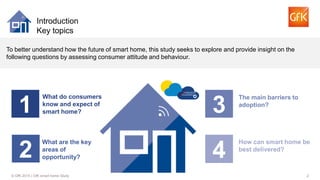
To better understand how the future of smart home, this study seeks to explore and provide insight on the
following questions by assessing consumer attitude and behaviour.
3© GfK 2015 | GfK smart home Study
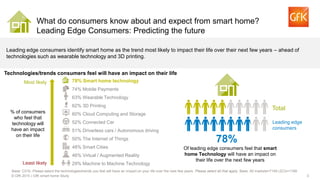
78% Smart home technology
74% Mobile Payments
63% Wearable Technology
62% 3D Printing
60% Cloud Computing and Storage
52% Connected Car
51% Driverless cars / Autonomous driving
50% The Internet of Things
48% Smart Cities
46% Virtual / Augmented Reality
29% Machine to Machine Technology
Of leading edge consumers feel that smart
home Technology will have an impact on
their life over the next few years
What do consumers know about and expect from smart home?
Leading Edge Consumers: Predicting the future
Base: C01b. Please select the technologies/trends you feel will have an impact on your life over the next few years. Please select all that apply. Base: All markets=7149 LECs=1189
78%
Most likely
Least likely
% of consumers
who feel that
technology will
have an impact
on their life
Total
Leading edge
consumers
Technologies/trends consumers feel will have an impact on their life
Leading edge consumers identify smart home as the trend most likely to impact their life over their next few years – ahead of
technologies such as wearable technology and 3D printing.
4© GfK 2015 | GfK smart home Study
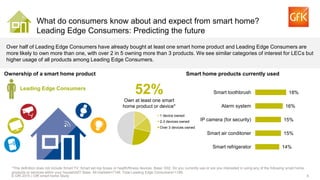
52%
Own at least one smart
home product or device*
Smart home products currently used
What do consumers know about and expect from smart home?
Leading Edge Consumers: Predicting the future
*This definition does not include Smart TV, Smart set-top boxes or health/fitness devices. Base: D02. Do you currently use or are you interested in using any of the following smart home
products or services within your household? Base: All markets=7149. Total Leading Edge Consumers=1189.
Over half of Leading Edge Consumers have already bought at least one smart home product and Leading Edge Consumers are
more likely to own more than one, with over 2 in 5 owning more than 3 products. We see similar categories of interest for LECs but
higher usage of all products among Leading Edge Consumers.
Ownership of a smart home product
1 device owned
2-3 devices owned
Over 3 devices owned
Leading Edge Consumers
14%
15%
15%
16%
18%
Smart refrigerator
Smart air conditoner
IP camera (for security)
Alarm system
Smart toothbrush
5© GfK 2015 | GfK smart home Study
Extremely appealing
Very appealing
43%53%
Security & Control
Identifying the opportunity for smart home
Category Appeal
Base: D01. How appealing are the following categories of smart home products or solutions to you? Base:All markets=7149
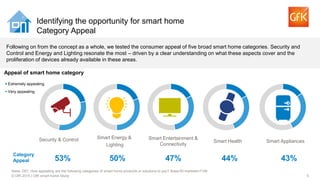
Following on from the concept as a whole, we tested the consumer appeal of five broad smart home categories. Security and
Control and Energy and Lighting resonate the most – driven by a clear understanding on what these aspects cover and the
proliferation of devices already available in these areas.
Smart Appliances
44%
Smart Health
47%
Smart Entertainment &
Connectivity
50%
Smart Energy &
Lighting
Appeal of smart home category
Category
Appeal
6© GfK 2015 | GfK smart home Study
The study covers five main categories within the smart home
Appliances Energy
& lighting
HealthSecurity
& control
Entertainment
& connectivity
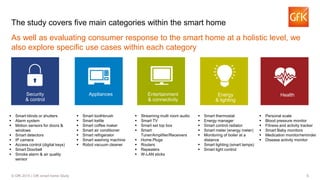
As well as evaluating consumer response to the smart home at a holistic level, we
also explore specific use cases within each category
 Smart blinds or shutters
 Alarm system
 Motion sensors for doors &
windows
 Smart detectors
 IP camera
 Access control (digital keys)
 Smart Doorbell
 Smoke alarm & air quality
sensor
 Streaming multi room audio
 Smart TV
 Smart set top box
 Smart
Tuner/Amplifier/Receivers
 Home Plugs
 Routers
 Repeaters
 W-LAN sticks
 Smart toothbrush
 Smart kettle
 Smart coffee maker
 Smart air conditioner
 Smart refrigerator
 Smart washing machine
 Robot vacuum cleaner
 Smart thermostat
 Energy manager
 Smart control radiator
 Smart meter (energy meter)
 Monitoring of boiler at a
distance
 Smart lighting (smart lamps)
 Smart light control
 Personal scale
 Blood pressure monitor
 Fitness and activity tracker
 Smart Baby monitors
 Medication monitor/reminder
 Disease activity monitor
7© GfK 2015 | GfK smart home Study
15%
17%
17%
19%
19%
23%
24%
33%
Need agreement of landlord/home
owner
Don't think Internet connection could
support this
Don't believe smart home technology
can meet expectations
Concerns about security in my home
Concerns about tech comunicating
across diferrent systems
I don't know enough about products
Concerns personal privacy
Cost to purchase
Cost to
purchase
Concerns about
personal privacy
Knowledge of
products
33% 24% 23%
Identifying the key barriers to smart home adoption
Top barriers for consumers
Base: D06. What do you see as the potential barriers for purchasing the following categories of smart hom
e technology? Base:All markets=7149
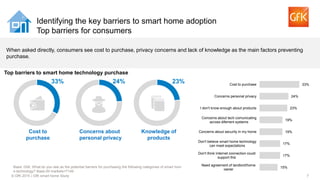
When asked directly, consumers see cost to purchase, privacy concerns and lack of knowledge as the main factors preventing
purchase.
Own property Rent property40% 60%
Top barriers to smart home technology purchase
8© GfK 2015 | GfK smart home Study
Delivering smart home
Controlling the smart home: Key devices
P06. Most of the smart home products or services that we have looked at would be remotely controlled via an app or website. Which of these devices / technologies would you consider using to
control products or services within your home? Base:All markets=7149
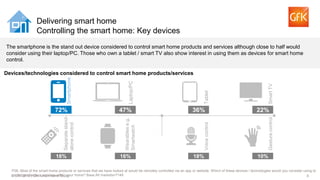
The smartphone is the stand out device considered to control smart home products and services although close to half would
consider using their laptop/PC. Those who own a tablet / smart TV also show interest in using them as devices for smart home
control.
47% 36% 22%
18% 16% 18% 10%
72%
Smartphone
Laptop/PC
Tablet
SmartTV
Separatestand-
alonecontrol
Wearablese.g.
Smartwatch
Voicecontrol
Gesturecontrol
Devices/technologies considered to control smart home products/services
9© GfK 2015 | GfK smart home Study
Delivering smart home
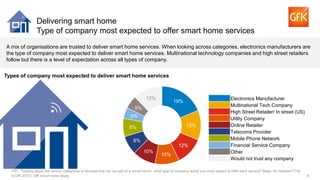
Type of company most expected to offer smart home services
P01. Thinking about the various categories of services that can be part of a ‘smart home’, what type of company would you most expect to offer each service? Base: All markets=7149
A mix of organisations are trusted to deliver smart home services. When looking across categories, electronics manufacturers are
the type of company most expected to deliver smart home services. Multinational technology companies and high street retailers
follow but there is a level of expectation across all types of company.
Types of company most expected to deliver smart home services
Electronics Manufacturer
Multinational Tech Company
High Street Retailer/ In street (US)
Utility Company
Online Retailer
Telecoms Provider
Mobile Phone Network
Financial Service Company
Other
Would not trust any company
19%
12%
12%
10%
10%
8%
8%
5%
5%
12%
10© GfK 2015 | GfK smart home Study
THANK YOU!
Oana Mirila | Qualitative Research Director
GfK Romania | Consumer Experiences
oana.mirila@gfk.com

Smart home -gf_k biz

  • 1.
    1© GfK 2015| GfK smart home Study GfK Smart Home Study Global Overview January 2016
  • 2.
    2© GfK 2015| GfK smart home Study 1 What do consumers know and expect of smart home? 2 What are the key areas of opportunity? 3 The main barriers to adoption? 4 How can smart home be best delivered? 010010010 011110011 Introduction Key topics To better understand how the future of smart home, this study seeks to explore and provide insight on the following questions by assessing consumer attitude and behaviour.
  • 3.
    3© GfK 2015| GfK smart home Study 78% Smart home technology 74% Mobile Payments 63% Wearable Technology 62% 3D Printing 60% Cloud Computing and Storage 52% Connected Car 51% Driverless cars / Autonomous driving 50% The Internet of Things 48% Smart Cities 46% Virtual / Augmented Reality 29% Machine to Machine Technology Of leading edge consumers feel that smart home Technology will have an impact on their life over the next few years What do consumers know about and expect from smart home? Leading Edge Consumers: Predicting the future Base: C01b. Please select the technologies/trends you feel will have an impact on your life over the next few years. Please select all that apply. Base: All markets=7149 LECs=1189 78% Most likely Least likely % of consumers who feel that technology will have an impact on their life Total Leading edge consumers Technologies/trends consumers feel will have an impact on their life Leading edge consumers identify smart home as the trend most likely to impact their life over their next few years – ahead of technologies such as wearable technology and 3D printing.
  • 4.
    4© GfK 2015| GfK smart home Study 52% Own at least one smart home product or device* Smart home products currently used What do consumers know about and expect from smart home? Leading Edge Consumers: Predicting the future *This definition does not include Smart TV, Smart set-top boxes or health/fitness devices. Base: D02. Do you currently use or are you interested in using any of the following smart home products or services within your household? Base: All markets=7149. Total Leading Edge Consumers=1189. Over half of Leading Edge Consumers have already bought at least one smart home product and Leading Edge Consumers are more likely to own more than one, with over 2 in 5 owning more than 3 products. We see similar categories of interest for LECs but higher usage of all products among Leading Edge Consumers. Ownership of a smart home product 1 device owned 2-3 devices owned Over 3 devices owned Leading Edge Consumers 14% 15% 15% 16% 18% Smart refrigerator Smart air conditoner IP camera (for security) Alarm system Smart toothbrush
  • 5.
    5© GfK 2015| GfK smart home Study Extremely appealing Very appealing 43%53% Security & Control Identifying the opportunity for smart home Category Appeal Base: D01. How appealing are the following categories of smart home products or solutions to you? Base:All markets=7149 Following on from the concept as a whole, we tested the consumer appeal of five broad smart home categories. Security and Control and Energy and Lighting resonate the most – driven by a clear understanding on what these aspects cover and the proliferation of devices already available in these areas. Smart Appliances 44% Smart Health 47% Smart Entertainment & Connectivity 50% Smart Energy & Lighting Appeal of smart home category Category Appeal
  • 6.
    6© GfK 2015| GfK smart home Study The study covers five main categories within the smart home Appliances Energy & lighting HealthSecurity & control Entertainment & connectivity As well as evaluating consumer response to the smart home at a holistic level, we also explore specific use cases within each category  Smart blinds or shutters  Alarm system  Motion sensors for doors & windows  Smart detectors  IP camera  Access control (digital keys)  Smart Doorbell  Smoke alarm & air quality sensor  Streaming multi room audio  Smart TV  Smart set top box  Smart Tuner/Amplifier/Receivers  Home Plugs  Routers  Repeaters  W-LAN sticks  Smart toothbrush  Smart kettle  Smart coffee maker  Smart air conditioner  Smart refrigerator  Smart washing machine  Robot vacuum cleaner  Smart thermostat  Energy manager  Smart control radiator  Smart meter (energy meter)  Monitoring of boiler at a distance  Smart lighting (smart lamps)  Smart light control  Personal scale  Blood pressure monitor  Fitness and activity tracker  Smart Baby monitors  Medication monitor/reminder  Disease activity monitor
  • 7.
    7© GfK 2015| GfK smart home Study 15% 17% 17% 19% 19% 23% 24% 33% Need agreement of landlord/home owner Don't think Internet connection could support this Don't believe smart home technology can meet expectations Concerns about security in my home Concerns about tech comunicating across diferrent systems I don't know enough about products Concerns personal privacy Cost to purchase Cost to purchase Concerns about personal privacy Knowledge of products 33% 24% 23% Identifying the key barriers to smart home adoption Top barriers for consumers Base: D06. What do you see as the potential barriers for purchasing the following categories of smart hom e technology? Base:All markets=7149 When asked directly, consumers see cost to purchase, privacy concerns and lack of knowledge as the main factors preventing purchase. Own property Rent property40% 60% Top barriers to smart home technology purchase
  • 8.
    8© GfK 2015| GfK smart home Study Delivering smart home Controlling the smart home: Key devices P06. Most of the smart home products or services that we have looked at would be remotely controlled via an app or website. Which of these devices / technologies would you consider using to control products or services within your home? Base:All markets=7149 The smartphone is the stand out device considered to control smart home products and services although close to half would consider using their laptop/PC. Those who own a tablet / smart TV also show interest in using them as devices for smart home control. 47% 36% 22% 18% 16% 18% 10% 72% Smartphone Laptop/PC Tablet SmartTV Separatestand- alonecontrol Wearablese.g. Smartwatch Voicecontrol Gesturecontrol Devices/technologies considered to control smart home products/services
  • 9.
    9© GfK 2015| GfK smart home Study Delivering smart home Type of company most expected to offer smart home services P01. Thinking about the various categories of services that can be part of a ‘smart home’, what type of company would you most expect to offer each service? Base: All markets=7149 A mix of organisations are trusted to deliver smart home services. When looking across categories, electronics manufacturers are the type of company most expected to deliver smart home services. Multinational technology companies and high street retailers follow but there is a level of expectation across all types of company. Types of company most expected to deliver smart home services Electronics Manufacturer Multinational Tech Company High Street Retailer/ In street (US) Utility Company Online Retailer Telecoms Provider Mobile Phone Network Financial Service Company Other Would not trust any company 19% 12% 12% 10% 10% 8% 8% 5% 5% 12%
  • 10.
    10© GfK 2015| GfK smart home Study THANK YOU! Oana Mirila | Qualitative Research Director GfK Romania | Consumer Experiences oana.mirila@gfk.com