See inside for further details
Berg Insight’s IoT Research Series
What are the key business opportunities in the emerging wireless M2M/IoT
market? Berg Insight’s IoT Research Series is a unique series of 40 market
reports published on a regular basis. Each title offers detailed analysis of
a specific vertical application area such as smart homes, smart metering,
fleet management and car telematics, or covers horizontal topics including
IoT platforms, software, hardware, IoT connectivity statistics and the mobile
operators’ IoT strategies.
www.berginsight.com
Smart Homes and Home Automation is the seventh
consecutive report from Berg Insight analysing the latest
developments on the connected home markets in Europe and
North America.
This report in the IoT Research Series provides you with 300
pages of unique business intelligence including 5-year industry
forecasts and expert commentary on which to base your
business decisions.
Highlights from the seventh edition of the report:
	Insights from 30 executive interviews with market leading
companies.
	360-degree overview of the smart homes & home automation
ecosystem.
	Summary of industry trends in key vertical market segments.
	Statistical data on adoption of smart home systems in Europe and
North America.
	New market forecasts lasting until 2023.
	Detailed reviews of the latest initiatives launched by industry
players.
	Updated profiles of the key vendors on this market.
Smart Homes and
Home Automation
IoT Research Series
Order now!
Please visit our web site to order this
report and find more information about
our other titles at www.berginsight.com
This report answers the following questions:
0
20
40
60
80
100
2023202220212020201920182017
Year
Million homes
Europe
North America
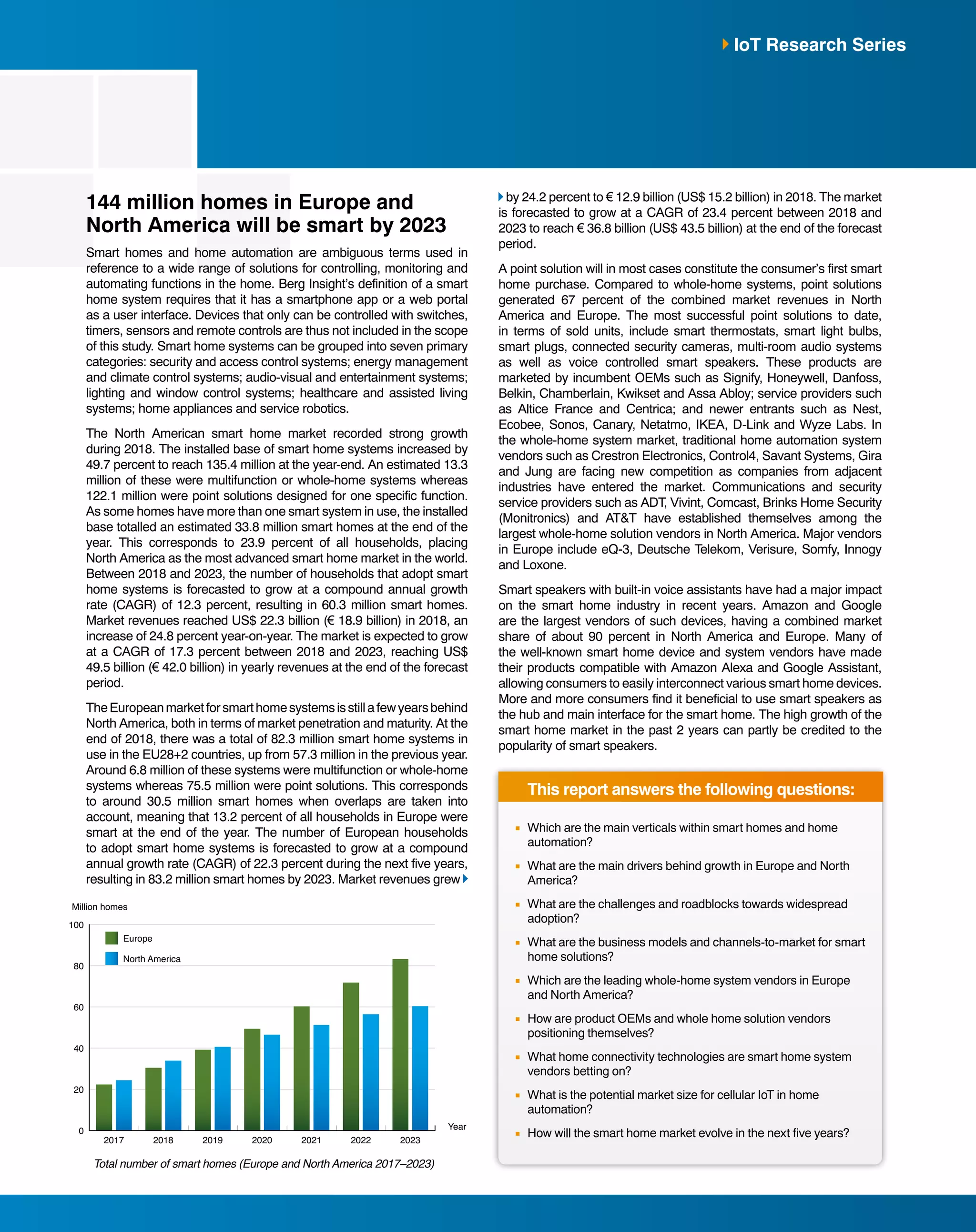
Total number of smart homes (Europe and North America 2017–2023)
144 million homes in Europe and
North America will be smart by 2023
Smart homes and home automation are ambiguous terms used in
reference to a wide range of solutions for controlling, monitoring and
automating functions in the home. Berg Insight’s definition of a smart
home system requires that it has a smartphone app or a web portal
as a user interface. Devices that only can be controlled with switches,
timers, sensors and remote controls are thus not included in the scope
of this study. Smart home systems can be grouped into seven primary
categories: security and access control systems; energy management
and climate control systems; audio-visual and entertainment systems;
lighting and window control systems; healthcare and assisted living
systems; home appliances and service robotics.
The North American smart home market recorded strong growth
during 2018. The installed base of smart home systems increased by
49.7 percent to reach 135.4 million at the year-end. An estimated 13.3
million of these were multifunction or whole-home systems whereas
122.1 million were point solutions designed for one specific function.
As some homes have more than one smart system in use, the installed
base totalled an estimated 33.8 million smart homes at the end of the
year. This corresponds to 23.9 percent of all households, placing
North America as the most advanced smart home market in the world.
Between 2018 and 2023, the number of households that adopt smart
home systems is forecasted to grow at a compound annual growth
rate (CAGR) of 12.3 percent, resulting in 60.3 million smart homes.
Market revenues reached US$ 22.3 billion (€ 18.9 billion) in 2018, an
increase of 24.8 percent year-on-year. The market is expected to grow
at a CAGR of 17.3 percent between 2018 and 2023, reaching US$
49.5 billion (€ 42.0 billion) in yearly revenues at the end of the forecast
period.
TheEuropeanmarketforsmarthomesystemsisstillafewyearsbehind
North America, both in terms of market penetration and maturity. At the
end of 2018, there was a total of 82.3 million smart home systems in
use in the EU28+2 countries, up from 57.3 million in the previous year.
Around 6.8 million of these systems were multifunction or whole-home
systems whereas 75.5 million were point solutions. This corresponds
to around 30.5 million smart homes when overlaps are taken into
account, meaning that 13.2 percent of all households in Europe were
smart at the end of the year. The number of European households
to adopt smart home systems is forecasted to grow at a compound
annual growth rate (CAGR) of 22.3 percent during the next five years,
resulting in 83.2 million smart homes by 2023. Market revenues grew
by 24.2 percent to € 12.9 billion (US$ 15.2 billion) in 2018. The market
is forecasted to grow at a CAGR of 23.4 percent between 2018 and
2023 to reach € 36.8 billion (US$ 43.5 billion) at the end of the forecast
period.
A point solution will in most cases constitute the consumer’s first smart
home purchase. Compared to whole-home systems, point solutions
generated 67 percent of the combined market revenues in North
America and Europe. The most successful point solutions to date,
in terms of sold units, include smart thermostats, smart light bulbs,
smart plugs, connected security cameras, multi-room audio systems
as well as voice controlled smart speakers. These products are
marketed by incumbent OEMs such as Signify, Honeywell, Danfoss,
Belkin, Chamberlain, Kwikset and Assa Abloy; service providers such
as Altice France and Centrica; and newer entrants such as Nest,
Ecobee, Sonos, Canary, Netatmo, IKEA, D-Link and Wyze Labs. In
the whole-home system market, traditional home automation system
vendors such as Crestron Electronics, Control4, Savant Systems, Gira
and Jung are facing new competition as companies from adjacent
industries have entered the market. Communications and security
service providers such as ADT, Vivint, Comcast, Brinks Home Security
(Monitronics) and AT&T have established themselves among the
largest whole-home solution vendors in North America. Major vendors
in Europe include eQ-3, Deutsche Telekom, Verisure, Somfy, Innogy
and Loxone.
Smart speakers with built-in voice assistants have had a major impact
on the smart home industry in recent years. Amazon and Google
are the largest vendors of such devices, having a combined market
share of about 90 percent in North America and Europe. Many of
the well-known smart home device and system vendors have made
their products compatible with Amazon Alexa and Google Assistant,
allowing consumers to easily interconnect various smart home devices.
More and more consumers find it beneficial to use smart speakers as
the hub and main interface for the smart home. The high growth of the
smart home market in the past 2 years can partly be credited to the
popularity of smart speakers.
	 Which are the main verticals within smart homes and home
automation?
	 What are the main drivers behind growth in Europe and North
America?
	 What are the challenges and roadblocks towards widespread
adoption?
	 What are the business models and channels-to-market for smart
home solutions?
	 Which are the leading whole-home system vendors in Europe
and North America?
	 How are product OEMs and whole home solution vendors
positioning themselves?
	 What home connectivity technologies are smart home system
vendors betting on?
	 What is the potential market size for cellular IoT in home
automation?
	 How will the smart home market evolve in the next five years?
IoT Research Series
1	 Smart homes, connected homes 	
		 and home automation
	 1.1	Introduction
	 1.2	 Types of home automation
	 1.2.1	 Security and access control systems	
	 1.2.2	 Energy management and climate control
systems
	 1.2.3	 Audio-visual and entertainment systems
	 1.2.4	 Lighting and window control systems
	 1.2.5	 Healthcare and assisted living
	 1.2.6	 Home appliances
	 1.2.7	 Service robotics
	 1.2.8	 Multifunction and whole-home automation
systems
	 1.3	 Home automation market segments
	 1.3.1	 Mainstream houses and multi-family dwellings
	 1.3.2	 The custom (luxury) segment
	 1.3.3	 New homes versus existing homes
	 1.4	 Channels to market
	 1.4.1	 Professional installation
	 1.4.2	Retail
	 1.4.3	 Service providers
	 2	 Networks and communications 	
		technologies
	 2.1	Overview
	 2.1.1	 Different approaches to establishing
interoperability
	 2.1.2	 Technology choices of product OEMs
	 2.1.3	 Technology choices of whole-home solution
vendors
	 2.2	 Smart home networking technologies
	 2.2.1	ANT
	 2.2.2	Bluetooth
	 2.2.3	 DECT ULE
	 2.2.4	EnOcean
	 2.2.5	HomePlug
	 2.2.6	HomeGrid
	 2.2.7	Insteon
	 2.2.8	io-homecontrol
	 2.2.9	KNX
	2.2.10	LPWA
	2.2.11	OpenTherm
	2.2.12	Thread
	2.2.13	Wi-Fi	
	2.2.14	X10
	2.2.15	Zigbee
	2.2.16	Z-Wave
	 2.3	 Smart home middleware and ecosystems
	 2.3.1	 Amazon Alexa
	 2.3.2	 Google Home and Google Assistant
	 2.3.3	 Android Things and Weave
	 2.3.4	 Apple HomeKit and Siri
	 2.3.5	IFTTT
	 2.3.6	 Open Connectivity Foundation
	 2.4	 Smart home platforms
	 2.4.1	Amdocs
	 2.4.2	AWS
	 2.4.3	 Ayla Networks
	 2.4.4	ThroughTek
	 2.4.5	Tuya
	 2.4.6	Waylay
	 3	 Technology providers and OEMs
	 3.1	 Market overview
	 3.1.1	 Compatibility with whole-home systems
	 3.1.2	 Point solutions are gaining traction among
consumers
	 3.1.3	 Smart home strategies for product OEMs
	 3.1.4	 New entrants challenge incumbents with
connected products
	 3.1.5	 Popularity of smart speakers boost smart home
product sales
	 3.2	 Security and access control system vendors
	 3.2.1	 Assa Abloy
	 3.2.2	 August Home (Assa Abloy)
	 3.2.3	Canary
	 3.2.4	 Chamberlain Group
	 3.2.5	 Groupe HBF (Otio)
	 3.2.6	iSmartAlarm
	 3.2.7	Kwikset
	 3.2.8	Minut
	 3.2.9	Schlage
	3.2.10	Simplisafe
	 3.2.11	 Wyze Labs
	 3.3	 Energy management and climate control
system vendors
	 3.3.1	Climote
	 3.3.2	Danfoss
	 3.3.3	 Diehl Connectivity Solutions
	 3.3.4	Ecobee
	 3.3.5	 Eve Systems
	 3.3.6	Geo
	 3.3.7	 Johnson Controls
	 3.3.8	 Netatmo (Legrand)
	 3.3.9	 Radio Thermostat Company of America
	 3.3.10	 Schneider Electric
	3.3.11	Tado
	 3.4	 Audio-visual and entertainment system
vendors
	 3.4.1	 Harman (Samsung Electronics)
	 3.4.2	Kaleidescape
	 3.4.3	Logitech
	 3.4.4	 Naim Audio
	 3.4.5	Sonos
	 3.4.6	Sony
	 3.4.7	 Sound United
	 3.5	 Lighting and window control system
vendors
	 3.5.1	 CentraLite (Ezlo Innovation)
	 3.5.2	 iDevices (Hubbell)
	 3.5.3	IKEA
	 3.5.4	Leviton
	 3.5.5	 LIFX (Buddy Technologies)
	 3.5.6	 Lutron Electronics
	 3.5.7	 Ledvance (MLS)
	 3.5.8	Signify
	 3.5.9	Velux
	3.5.10	View
	 3.6	 Healthcare and assisted living
	 3.6.1	 Climax Technology
	 3.6.2	Doro
	 3.6.3	 Hidea Solutions
	 3.6.4	 Just Checking
	 3.6.5	 Qorvo (GreenPeak Technologies)
	 3.6.6	Sensio
	 3.6.7	 Sleep Number
	 3.6.8	 Tunstall Healthcare Group
	 3.6.9	Verklizan
	 3.7	 Home appliances
	 3.7.1	 BSH (Bosch)
	 3.7.2	Electrolux
	 3.7.3	 GE Appliances (Haier)
	 3.7.4	Haier
	 3.7.5	 LG Electronics
	 3.7.6	Whirlpool
	 3.8	 Service Robotics
	 3.8.1	 Double Robotics
	 3.8.2	Dyson
	 3.8.3	Husqvarna
	 3.8.4	iRobot
	 3.8.5	 Neato Robotics
	 3.8.6	Robomow
	 3.8.7	 Softbank Robotics
	 3.8.8	 Zucchetti Centro Sistemi (Ambrogio Robot)
	 4	 Service providers and whole-	
		 home system vendors
	 4.1	 Market overview
	 4.1.1	 The European market
	 4.1.2	 The North American market
	 4.1.3	 Attach rates per application area in whole-home
systems
	 4.2	 Market segments and go-to-market
strategies
	 4.2.1	 Traditional home automation
	 4.2.2	 DIY systems
	 4.2.3	 Professionally monitored security
	 4.3	 Whole-home system OEMs
	 4.3.1	ABB
	 4.3.2	Alarm.com
	 4.3.3	Belkin
	 4.3.4	Bosch
	 4.3.5	 Control4 (SnapAV)
	 4.3.6	 Crestron Electronics
	 4.3.7	D-Link
	 4.3.8	 Essence Group
	 4.3.9	eQ-3
	 4.3.10	 Fibar Group (Nice)
	4.3.11	Gigaset
	4.3.12	Grenton
	 4.3.13	 Ingersoll Rand
	4.3.14	Legrand
	 4.3.15	 Loxone Electronics
	 4.3.16	 MiOS (Ezlo Innovation)
	 4.3.17	 Nest Labs
	 4.3.18	 Nice Group
	 4.3.19	 OBLO Living
	 4.3.20	 Proove (Telldus)
	 4.3.21	 Resideo Technologies
	 4.3.22	 Safe4 Security Group
	 4.3.23	 Samsung Electronics
	 4.3.24	 Savant Systems
	4.3.25	Somfy
	4.3.26	TP-Link
	 4.3.27	 United Technologies Corporation
	 4.3.28	 Viva Labs
	4.3.29	Wink
	4.3.30	Xiaomi
	 4.4	 Smart home service providers
	 4.4.1	ADT
	 4.4.2	 Altice France
	 4.4.3	AT&T
	 4.4.4	 Brinks Home Security (Monitronics)
	 4.4.5	 Centrica Hive
	 4.4.6	Comcast
	 4.4.7	 Cox Communications
	 4.4.8	 Deutsche Telekom (QIVICON)
	 4.4.9	 Innogy (E.ON)
	4.4.10	Verisure
	 4.4.11	 Vivint Smart Home
	4.4.12	Vodafone
	 5	 Market forecasts and 		
		conclusions
	 5.1	 Market trends and analysis
	 5.1.1	 Greater consumer awareness benefits all players
	 5.1.2	 Lower price points opens the doors to the mass
market
	 5.1.3	 Cloud-based systems and the integrated hub
opportunity
	 5.1.4	 Open versus closed smart home ecosystems
	 5.1.5	 Lack of interoperability causes problems for
users
	 5.1.6	 Security and integrity issues when the home is
being connected
	 5.1.7	 Smart home devices can give discounts on
home insurance premiums
	 5.1.8	 Professional security leads the North American
smart home market
	 5.1.9	 Cellular M2M in the smart home market
	 5.1.10	 Mergers and acquisitions in the smart home
industry
	5.2	Popular smart home product categories
	 5.2.1	 Smart speakers
	 5.2.2	 Smart thermostats
	 5.2.3	 Smart lighting
	 5.2.4	 Smart plugs
	5.3	Europe
	 5.3.1	Revenues
	 5.3.2	Shipments
	 5.3.3	 Installed base
	5.4	North America
	 5.4.1	Revenues
	 5.4.2	Shipments
	 5.4.3	 Installed base
Glossary
	Executive Summary
Table of Contents
Address PostcodeCountry
Position CompanyFamily/Surname Forename
Telephone Email
You can place your order in the following alternative ways:
1. Place your order online in our web shop at www.berginsight.com
2. Mail this order sheet to us at: Berg Insight AB, Viktoriagatan 3, 411 25 Gothenburg, Sweden
3. Email your order to: info@berginsight.com
4. Phone us at +46 31 711 30 91
Your PO number Your VAT/TVA/IVA/BTW/MWST number
VAT is chargeable on all orders from Sweden. Orders from all other countries in the European Union
must include the buyer’s VAT Registration number below in order to avoid the addition of VAT.
Reports will be dispatched once full
payment has been received. For any
enquiries regarding this, please contact
us. Payment may be made by credit
card, cheque made payable to Berg
Insight AB, Viktoriagatan 3, 411 25
Gothenburg, Sweden or by direct bank
transfer to Skandinaviska Enskilda
Banken, 106 40 Stockholm, Sweden.
Account Holder: Berg Insight AB
Account number: 5011 10 402 80
BIC/SWIFT: ESSESESS
IBAN: SE92 5000 0000 0501 1104 0280
Please charge my credit card
VISA Mastercard
Billing address
Postcode Country
Signature Date
We enclose our cheque payable to Berg Insight AB
Please invoice me
Card number
Cardholder’s name Signature
CV codeExpiry date (MM/YY)
/
Related productsWho should buy this report?
Berg Insight AB, Viktoriagatan 3, SE-411 25 Gothenburg, Sweden • Phone +46 31 711 30 91 • www.berginsight.com • info@berginsight.com
IoT Research Series
©BergInsightAB-No.215
Order form — TO RECEIVE YOUR COPY OF SMART HOMES AND HOME AUTOMATION
Choose type of format
Paper copy......................... 1000 EUR
PDF 1-5 user license......... 1500 EUR
PDF corporate license....... 3000 EUR
Smart Homes and Home Automation is the foremost source
of information about the emerging market for connected home
applications. Whether you are a product vendor, service
provider, telecom operator, investor, consultant, application
developer or government agency, you will gain valuable insights
from our in-depth research.
	 Security Applications and Wireless M2M
	 Smart Metering in Europe
	 Smart Metering in North America and Asia-Pacific
	 The Global M2M/IoT Communications Market
Martin Bäckman is an IoT Analyst with a Master’s
degree in Industrial Engineering and Management from
Chalmers University of Technology. He joined Berg
Insight in 2018 and his areas of expertise include smart
homes and consumer Internet-of-Things.
Johan Fagerberg is co-founder and an experienced
analyst with a Master’s degree in Electrical Engineering
from Chalmers University of Technology. He has during
the past 22 years published numerous articles and
reports about M2M/IoT markets.
Berg Insight offers premier business intelligence
to the telecom industry. We produce concise reports
providing key facts and strategic insights about pivotal
developments in our focus areas. Berg Insight also
offers detailed market forecast databases and advisory
services. Our vision is to be the most valuable source of
intelligence for our customers.
About the Authors

Smart Homes and Home Automation

  • 1.
    See inside forfurther details Berg Insight’s IoT Research Series What are the key business opportunities in the emerging wireless M2M/IoT market? Berg Insight’s IoT Research Series is a unique series of 40 market reports published on a regular basis. Each title offers detailed analysis of a specific vertical application area such as smart homes, smart metering, fleet management and car telematics, or covers horizontal topics including IoT platforms, software, hardware, IoT connectivity statistics and the mobile operators’ IoT strategies. www.berginsight.com Smart Homes and Home Automation is the seventh consecutive report from Berg Insight analysing the latest developments on the connected home markets in Europe and North America. This report in the IoT Research Series provides you with 300 pages of unique business intelligence including 5-year industry forecasts and expert commentary on which to base your business decisions. Highlights from the seventh edition of the report: Insights from 30 executive interviews with market leading companies. 360-degree overview of the smart homes & home automation ecosystem. Summary of industry trends in key vertical market segments. Statistical data on adoption of smart home systems in Europe and North America. New market forecasts lasting until 2023. Detailed reviews of the latest initiatives launched by industry players. Updated profiles of the key vendors on this market. Smart Homes and Home Automation IoT Research Series Order now! Please visit our web site to order this report and find more information about our other titles at www.berginsight.com
  • 2.
    This report answersthe following questions: 0 20 40 60 80 100 2023202220212020201920182017 Year Million homes Europe North America Total number of smart homes (Europe and North America 2017–2023) 144 million homes in Europe and North America will be smart by 2023 Smart homes and home automation are ambiguous terms used in reference to a wide range of solutions for controlling, monitoring and automating functions in the home. Berg Insight’s definition of a smart home system requires that it has a smartphone app or a web portal as a user interface. Devices that only can be controlled with switches, timers, sensors and remote controls are thus not included in the scope of this study. Smart home systems can be grouped into seven primary categories: security and access control systems; energy management and climate control systems; audio-visual and entertainment systems; lighting and window control systems; healthcare and assisted living systems; home appliances and service robotics. The North American smart home market recorded strong growth during 2018. The installed base of smart home systems increased by 49.7 percent to reach 135.4 million at the year-end. An estimated 13.3 million of these were multifunction or whole-home systems whereas 122.1 million were point solutions designed for one specific function. As some homes have more than one smart system in use, the installed base totalled an estimated 33.8 million smart homes at the end of the year. This corresponds to 23.9 percent of all households, placing North America as the most advanced smart home market in the world. Between 2018 and 2023, the number of households that adopt smart home systems is forecasted to grow at a compound annual growth rate (CAGR) of 12.3 percent, resulting in 60.3 million smart homes. Market revenues reached US$ 22.3 billion (€ 18.9 billion) in 2018, an increase of 24.8 percent year-on-year. The market is expected to grow at a CAGR of 17.3 percent between 2018 and 2023, reaching US$ 49.5 billion (€ 42.0 billion) in yearly revenues at the end of the forecast period. TheEuropeanmarketforsmarthomesystemsisstillafewyearsbehind North America, both in terms of market penetration and maturity. At the end of 2018, there was a total of 82.3 million smart home systems in use in the EU28+2 countries, up from 57.3 million in the previous year. Around 6.8 million of these systems were multifunction or whole-home systems whereas 75.5 million were point solutions. This corresponds to around 30.5 million smart homes when overlaps are taken into account, meaning that 13.2 percent of all households in Europe were smart at the end of the year. The number of European households to adopt smart home systems is forecasted to grow at a compound annual growth rate (CAGR) of 22.3 percent during the next five years, resulting in 83.2 million smart homes by 2023. Market revenues grew by 24.2 percent to € 12.9 billion (US$ 15.2 billion) in 2018. The market is forecasted to grow at a CAGR of 23.4 percent between 2018 and 2023 to reach € 36.8 billion (US$ 43.5 billion) at the end of the forecast period. A point solution will in most cases constitute the consumer’s first smart home purchase. Compared to whole-home systems, point solutions generated 67 percent of the combined market revenues in North America and Europe. The most successful point solutions to date, in terms of sold units, include smart thermostats, smart light bulbs, smart plugs, connected security cameras, multi-room audio systems as well as voice controlled smart speakers. These products are marketed by incumbent OEMs such as Signify, Honeywell, Danfoss, Belkin, Chamberlain, Kwikset and Assa Abloy; service providers such as Altice France and Centrica; and newer entrants such as Nest, Ecobee, Sonos, Canary, Netatmo, IKEA, D-Link and Wyze Labs. In the whole-home system market, traditional home automation system vendors such as Crestron Electronics, Control4, Savant Systems, Gira and Jung are facing new competition as companies from adjacent industries have entered the market. Communications and security service providers such as ADT, Vivint, Comcast, Brinks Home Security (Monitronics) and AT&T have established themselves among the largest whole-home solution vendors in North America. Major vendors in Europe include eQ-3, Deutsche Telekom, Verisure, Somfy, Innogy and Loxone. Smart speakers with built-in voice assistants have had a major impact on the smart home industry in recent years. Amazon and Google are the largest vendors of such devices, having a combined market share of about 90 percent in North America and Europe. Many of the well-known smart home device and system vendors have made their products compatible with Amazon Alexa and Google Assistant, allowing consumers to easily interconnect various smart home devices. More and more consumers find it beneficial to use smart speakers as the hub and main interface for the smart home. The high growth of the smart home market in the past 2 years can partly be credited to the popularity of smart speakers. Which are the main verticals within smart homes and home automation? What are the main drivers behind growth in Europe and North America? What are the challenges and roadblocks towards widespread adoption? What are the business models and channels-to-market for smart home solutions? Which are the leading whole-home system vendors in Europe and North America? How are product OEMs and whole home solution vendors positioning themselves? What home connectivity technologies are smart home system vendors betting on? What is the potential market size for cellular IoT in home automation? How will the smart home market evolve in the next five years? IoT Research Series
  • 3.
    1 Smart homes,connected homes and home automation 1.1 Introduction 1.2 Types of home automation 1.2.1 Security and access control systems 1.2.2 Energy management and climate control systems 1.2.3 Audio-visual and entertainment systems 1.2.4 Lighting and window control systems 1.2.5 Healthcare and assisted living 1.2.6 Home appliances 1.2.7 Service robotics 1.2.8 Multifunction and whole-home automation systems 1.3 Home automation market segments 1.3.1 Mainstream houses and multi-family dwellings 1.3.2 The custom (luxury) segment 1.3.3 New homes versus existing homes 1.4 Channels to market 1.4.1 Professional installation 1.4.2 Retail 1.4.3 Service providers 2 Networks and communications technologies 2.1 Overview 2.1.1 Different approaches to establishing interoperability 2.1.2 Technology choices of product OEMs 2.1.3 Technology choices of whole-home solution vendors 2.2 Smart home networking technologies 2.2.1 ANT 2.2.2 Bluetooth 2.2.3 DECT ULE 2.2.4 EnOcean 2.2.5 HomePlug 2.2.6 HomeGrid 2.2.7 Insteon 2.2.8 io-homecontrol 2.2.9 KNX 2.2.10 LPWA 2.2.11 OpenTherm 2.2.12 Thread 2.2.13 Wi-Fi 2.2.14 X10 2.2.15 Zigbee 2.2.16 Z-Wave 2.3 Smart home middleware and ecosystems 2.3.1 Amazon Alexa 2.3.2 Google Home and Google Assistant 2.3.3 Android Things and Weave 2.3.4 Apple HomeKit and Siri 2.3.5 IFTTT 2.3.6 Open Connectivity Foundation 2.4 Smart home platforms 2.4.1 Amdocs 2.4.2 AWS 2.4.3 Ayla Networks 2.4.4 ThroughTek 2.4.5 Tuya 2.4.6 Waylay 3 Technology providers and OEMs 3.1 Market overview 3.1.1 Compatibility with whole-home systems 3.1.2 Point solutions are gaining traction among consumers 3.1.3 Smart home strategies for product OEMs 3.1.4 New entrants challenge incumbents with connected products 3.1.5 Popularity of smart speakers boost smart home product sales 3.2 Security and access control system vendors 3.2.1 Assa Abloy 3.2.2 August Home (Assa Abloy) 3.2.3 Canary 3.2.4 Chamberlain Group 3.2.5 Groupe HBF (Otio) 3.2.6 iSmartAlarm 3.2.7 Kwikset 3.2.8 Minut 3.2.9 Schlage 3.2.10 Simplisafe 3.2.11 Wyze Labs 3.3 Energy management and climate control system vendors 3.3.1 Climote 3.3.2 Danfoss 3.3.3 Diehl Connectivity Solutions 3.3.4 Ecobee 3.3.5 Eve Systems 3.3.6 Geo 3.3.7 Johnson Controls 3.3.8 Netatmo (Legrand) 3.3.9 Radio Thermostat Company of America 3.3.10 Schneider Electric 3.3.11 Tado 3.4 Audio-visual and entertainment system vendors 3.4.1 Harman (Samsung Electronics) 3.4.2 Kaleidescape 3.4.3 Logitech 3.4.4 Naim Audio 3.4.5 Sonos 3.4.6 Sony 3.4.7 Sound United 3.5 Lighting and window control system vendors 3.5.1 CentraLite (Ezlo Innovation) 3.5.2 iDevices (Hubbell) 3.5.3 IKEA 3.5.4 Leviton 3.5.5 LIFX (Buddy Technologies) 3.5.6 Lutron Electronics 3.5.7 Ledvance (MLS) 3.5.8 Signify 3.5.9 Velux 3.5.10 View 3.6 Healthcare and assisted living 3.6.1 Climax Technology 3.6.2 Doro 3.6.3 Hidea Solutions 3.6.4 Just Checking 3.6.5 Qorvo (GreenPeak Technologies) 3.6.6 Sensio 3.6.7 Sleep Number 3.6.8 Tunstall Healthcare Group 3.6.9 Verklizan 3.7 Home appliances 3.7.1 BSH (Bosch) 3.7.2 Electrolux 3.7.3 GE Appliances (Haier) 3.7.4 Haier 3.7.5 LG Electronics 3.7.6 Whirlpool 3.8 Service Robotics 3.8.1 Double Robotics 3.8.2 Dyson 3.8.3 Husqvarna 3.8.4 iRobot 3.8.5 Neato Robotics 3.8.6 Robomow 3.8.7 Softbank Robotics 3.8.8 Zucchetti Centro Sistemi (Ambrogio Robot) 4 Service providers and whole- home system vendors 4.1 Market overview 4.1.1 The European market 4.1.2 The North American market 4.1.3 Attach rates per application area in whole-home systems 4.2 Market segments and go-to-market strategies 4.2.1 Traditional home automation 4.2.2 DIY systems 4.2.3 Professionally monitored security 4.3 Whole-home system OEMs 4.3.1 ABB 4.3.2 Alarm.com 4.3.3 Belkin 4.3.4 Bosch 4.3.5 Control4 (SnapAV) 4.3.6 Crestron Electronics 4.3.7 D-Link 4.3.8 Essence Group 4.3.9 eQ-3 4.3.10 Fibar Group (Nice) 4.3.11 Gigaset 4.3.12 Grenton 4.3.13 Ingersoll Rand 4.3.14 Legrand 4.3.15 Loxone Electronics 4.3.16 MiOS (Ezlo Innovation) 4.3.17 Nest Labs 4.3.18 Nice Group 4.3.19 OBLO Living 4.3.20 Proove (Telldus) 4.3.21 Resideo Technologies 4.3.22 Safe4 Security Group 4.3.23 Samsung Electronics 4.3.24 Savant Systems 4.3.25 Somfy 4.3.26 TP-Link 4.3.27 United Technologies Corporation 4.3.28 Viva Labs 4.3.29 Wink 4.3.30 Xiaomi 4.4 Smart home service providers 4.4.1 ADT 4.4.2 Altice France 4.4.3 AT&T 4.4.4 Brinks Home Security (Monitronics) 4.4.5 Centrica Hive 4.4.6 Comcast 4.4.7 Cox Communications 4.4.8 Deutsche Telekom (QIVICON) 4.4.9 Innogy (E.ON) 4.4.10 Verisure 4.4.11 Vivint Smart Home 4.4.12 Vodafone 5 Market forecasts and conclusions 5.1 Market trends and analysis 5.1.1 Greater consumer awareness benefits all players 5.1.2 Lower price points opens the doors to the mass market 5.1.3 Cloud-based systems and the integrated hub opportunity 5.1.4 Open versus closed smart home ecosystems 5.1.5 Lack of interoperability causes problems for users 5.1.6 Security and integrity issues when the home is being connected 5.1.7 Smart home devices can give discounts on home insurance premiums 5.1.8 Professional security leads the North American smart home market 5.1.9 Cellular M2M in the smart home market 5.1.10 Mergers and acquisitions in the smart home industry 5.2 Popular smart home product categories 5.2.1 Smart speakers 5.2.2 Smart thermostats 5.2.3 Smart lighting 5.2.4 Smart plugs 5.3 Europe 5.3.1 Revenues 5.3.2 Shipments 5.3.3 Installed base 5.4 North America 5.4.1 Revenues 5.4.2 Shipments 5.4.3 Installed base Glossary Executive Summary Table of Contents
  • 4.
    Address PostcodeCountry Position CompanyFamily/SurnameForename Telephone Email You can place your order in the following alternative ways: 1. Place your order online in our web shop at www.berginsight.com 2. Mail this order sheet to us at: Berg Insight AB, Viktoriagatan 3, 411 25 Gothenburg, Sweden 3. Email your order to: info@berginsight.com 4. Phone us at +46 31 711 30 91 Your PO number Your VAT/TVA/IVA/BTW/MWST number VAT is chargeable on all orders from Sweden. Orders from all other countries in the European Union must include the buyer’s VAT Registration number below in order to avoid the addition of VAT. Reports will be dispatched once full payment has been received. For any enquiries regarding this, please contact us. Payment may be made by credit card, cheque made payable to Berg Insight AB, Viktoriagatan 3, 411 25 Gothenburg, Sweden or by direct bank transfer to Skandinaviska Enskilda Banken, 106 40 Stockholm, Sweden. Account Holder: Berg Insight AB Account number: 5011 10 402 80 BIC/SWIFT: ESSESESS IBAN: SE92 5000 0000 0501 1104 0280 Please charge my credit card VISA Mastercard Billing address Postcode Country Signature Date We enclose our cheque payable to Berg Insight AB Please invoice me Card number Cardholder’s name Signature CV codeExpiry date (MM/YY) / Related productsWho should buy this report? Berg Insight AB, Viktoriagatan 3, SE-411 25 Gothenburg, Sweden • Phone +46 31 711 30 91 • www.berginsight.com • info@berginsight.com IoT Research Series ©BergInsightAB-No.215 Order form — TO RECEIVE YOUR COPY OF SMART HOMES AND HOME AUTOMATION Choose type of format Paper copy......................... 1000 EUR PDF 1-5 user license......... 1500 EUR PDF corporate license....... 3000 EUR Smart Homes and Home Automation is the foremost source of information about the emerging market for connected home applications. Whether you are a product vendor, service provider, telecom operator, investor, consultant, application developer or government agency, you will gain valuable insights from our in-depth research. Security Applications and Wireless M2M Smart Metering in Europe Smart Metering in North America and Asia-Pacific The Global M2M/IoT Communications Market Martin Bäckman is an IoT Analyst with a Master’s degree in Industrial Engineering and Management from Chalmers University of Technology. He joined Berg Insight in 2018 and his areas of expertise include smart homes and consumer Internet-of-Things. Johan Fagerberg is co-founder and an experienced analyst with a Master’s degree in Electrical Engineering from Chalmers University of Technology. He has during the past 22 years published numerous articles and reports about M2M/IoT markets. Berg Insight offers premier business intelligence to the telecom industry. We produce concise reports providing key facts and strategic insights about pivotal developments in our focus areas. Berg Insight also offers detailed market forecast databases and advisory services. Our vision is to be the most valuable source of intelligence for our customers. About the Authors