Trainer Assessment Sheet
Dr. Mohamed Al-Hebshi
Legend:  criteria were met, o criteria were not met,  best practices, - bad practices 1
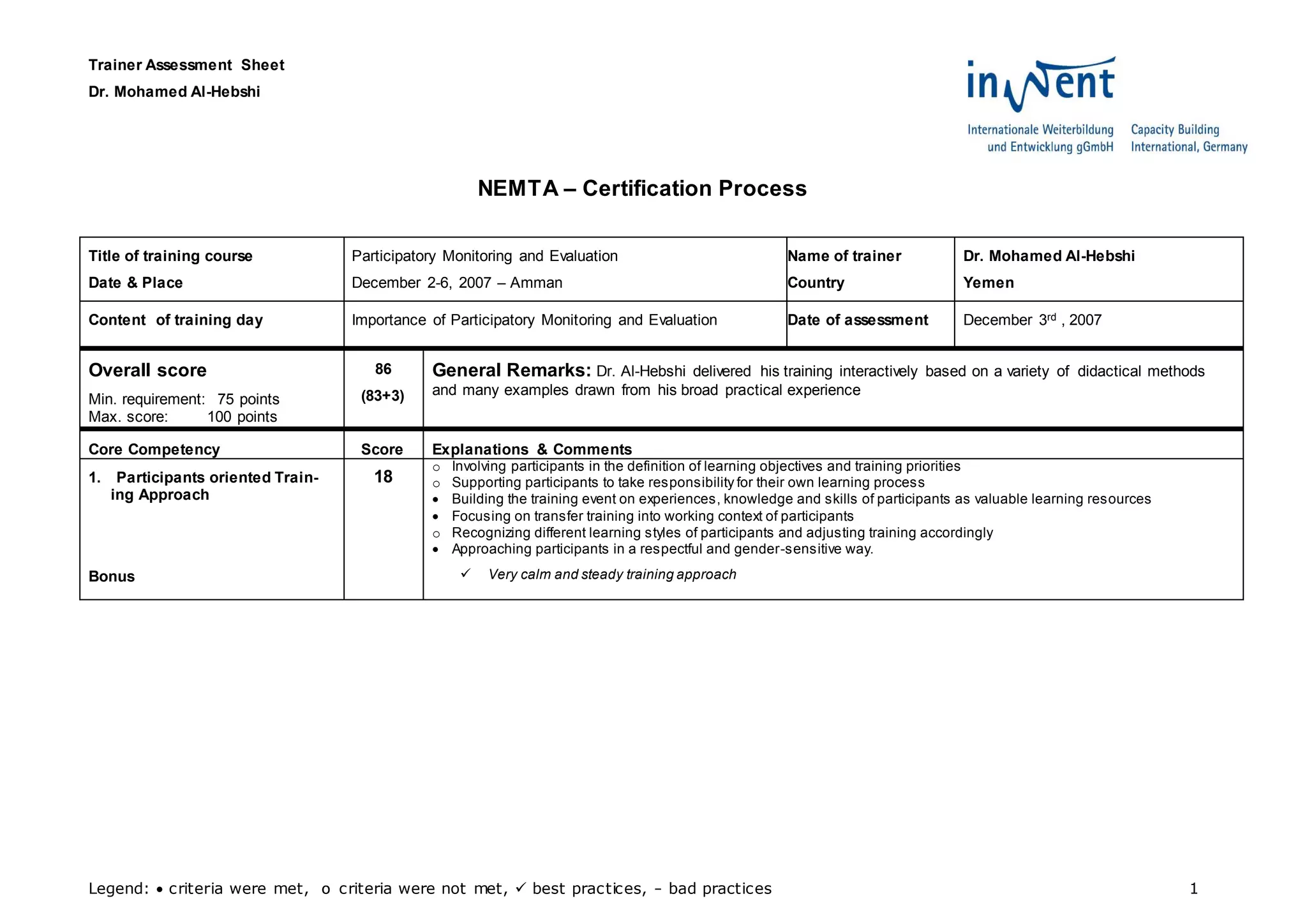
NEMTA – Certification Process
Title of training course
Date & Place
Participatory Monitoring and Evaluation
December 2-6, 2007 – Amman
Name of trainer
Country
Dr. Mohamed Al-Hebshi
Yemen
Content of training day Importance of Participatory Monitoring and Evaluation Date of assessment December 3rd , 2007
Overall score
Min. requirement: 75 points
Max. score: 100 points
86
(83+3)
General Remarks: Dr. Al-Hebshi delivered his training interactively based on a variety of didactical methods
and many examples drawn from his broad practical experience
Core Competency Score Explanations & Comments
1. Participants oriented Train-
ing Approach
Bonus
18
o Involving participants in the definition of learning objectives and training priorities
o Supporting participants to take responsibility for their own learning process
 Building the training event on experiences, knowledge and skills of participants as valuable learning resources
 Focusing on transfer training into working context of participants
o Recognizing different learning styles of participants and adjusting training accordingly
 Approaching participants in a respectful and gender-sensitive way.
 Very calm and steady training approach
Dr. Mohamed Al-Hebshi
Legend:  criteria were met, o criteria were not met,  best practices, - bad practices 2
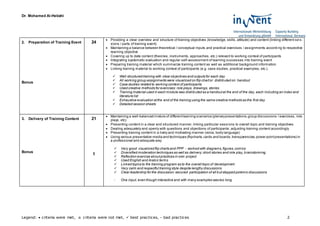
2. Preparation of Training Event
Bonus
24
 Providing a clear overview and structure of training objectives (knowledge, skills, attitude) and content (linking different se s-
sions / parts of training event)
 Maintaining a balance between theoretical / conceptual inputs and practical exercises / assignments accordi ng to respective
learning objective
 Covering up to date content (theories, instruments, approaches, etc.) relevant to working context of participants
 Integrating systematic evaluation and regular self-assessment of learning successes into training event
 Preparing training material which summarize training content as well as additional background information
 Linking training material to working context of participants (e.g. case studies, practical examples, etc.).
 Well structured training with clear objectives and outputs for each day
 All working group assignments were visualized on flip chartor distributed on handout
 Case studies related to working context of participants
 Used creative methods for exercises: role plays, drawings, stories
 Training material used in each module was distributed as a handoutat the end of the day, each including an index and
literature list
 Exhaustive evaluation atthe end of the training using the same creative methods as the first day
 Detailed session sheets
3. Delivery of Training Content
Bonus
21
1
 Maintaining a well-balanced mixture of differentlearning scenarios (plenarypresentations,group discussions / exercises, role
plays, etc)
 Presenting content in a clear and structured manner, linking particular sessions to overall topic and training objectives
 Dealing adequately and openly with questions and objections of participants; adjusting training content accordingly
 Presenting training content in a lively and motivating manner (voice, body language)
 Using various presentation media and techniques (flipcharts,cards and boards,transparencies,power pointpresentations) in
a professional and adequate way
 Very good visualized flip charts and PPP - worked with diagrams,figures,comics
 Diversified moderation techniques as well as delivery:short stories and role play,brainstorming
 Reflection exercise aboutpractices in own project
 Used English and Arabic terms
 Linked topics to the training program as to the overall topic of development
 Very calm and respectful training style despite lengthy discussions
 Clear leadership for the discussion:secured participation of all butstopped polemic discussions
- One input, even though interactive and with many examples was too long
Dr. Mohamed Al-Hebshi
Legend:  criteria were met, o criteria were not met,  best practices, - bad practices 3
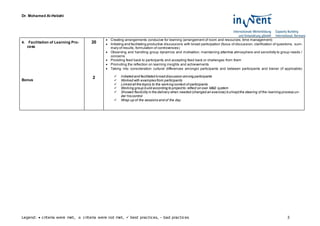
4. Facilitation of Learning Pro-
cess
Bonus
20
2
 Creating arrangements conducive for learning (arrangement of room and resources, time management)
 Initiating and facilitating productive discussions with broad participation (focus of discussion, clarification of questions, sum-
mary of results, formulation of controversies)
 Observing and handling group dynamics and motivation; maintaining attentive atmosphere and sensitivity to group needs /
concerns
 Providing feed back to participants and accepting feed back or challenges from them
 Promoting the reflection on learning insights and achievements
 Taking into consideration cultural differences amongst participants and between participants and trainer (if applicable)
 Initiated and facilitated broad discussion among participants
 Worked with examples from participants
 Linked all the topics to the working context of participants
 Working group build according to projectto reflect on own M&E system
 Showed flexibility in the delivery when needed (changed an exercise) butkeptthe steering of the learning process un-
der his control
 Wrap-up of the sessions and of the day

Cert-YE-Al-Hebshi

  • 1.
    Trainer Assessment Sheet Dr.Mohamed Al-Hebshi Legend:  criteria were met, o criteria were not met,  best practices, - bad practices 1 NEMTA – Certification Process Title of training course Date & Place Participatory Monitoring and Evaluation December 2-6, 2007 – Amman Name of trainer Country Dr. Mohamed Al-Hebshi Yemen Content of training day Importance of Participatory Monitoring and Evaluation Date of assessment December 3rd , 2007 Overall score Min. requirement: 75 points Max. score: 100 points 86 (83+3) General Remarks: Dr. Al-Hebshi delivered his training interactively based on a variety of didactical methods and many examples drawn from his broad practical experience Core Competency Score Explanations & Comments 1. Participants oriented Train- ing Approach Bonus 18 o Involving participants in the definition of learning objectives and training priorities o Supporting participants to take responsibility for their own learning process  Building the training event on experiences, knowledge and skills of participants as valuable learning resources  Focusing on transfer training into working context of participants o Recognizing different learning styles of participants and adjusting training accordingly  Approaching participants in a respectful and gender-sensitive way.  Very calm and steady training approach
  • 2.
    Dr. Mohamed Al-Hebshi Legend: criteria were met, o criteria were not met,  best practices, - bad practices 2 2. Preparation of Training Event Bonus 24  Providing a clear overview and structure of training objectives (knowledge, skills, attitude) and content (linking different se s- sions / parts of training event)  Maintaining a balance between theoretical / conceptual inputs and practical exercises / assignments accordi ng to respective learning objective  Covering up to date content (theories, instruments, approaches, etc.) relevant to working context of participants  Integrating systematic evaluation and regular self-assessment of learning successes into training event  Preparing training material which summarize training content as well as additional background information  Linking training material to working context of participants (e.g. case studies, practical examples, etc.).  Well structured training with clear objectives and outputs for each day  All working group assignments were visualized on flip chartor distributed on handout  Case studies related to working context of participants  Used creative methods for exercises: role plays, drawings, stories  Training material used in each module was distributed as a handoutat the end of the day, each including an index and literature list  Exhaustive evaluation atthe end of the training using the same creative methods as the first day  Detailed session sheets 3. Delivery of Training Content Bonus 21 1  Maintaining a well-balanced mixture of differentlearning scenarios (plenarypresentations,group discussions / exercises, role plays, etc)  Presenting content in a clear and structured manner, linking particular sessions to overall topic and training objectives  Dealing adequately and openly with questions and objections of participants; adjusting training content accordingly  Presenting training content in a lively and motivating manner (voice, body language)  Using various presentation media and techniques (flipcharts,cards and boards,transparencies,power pointpresentations) in a professional and adequate way  Very good visualized flip charts and PPP - worked with diagrams,figures,comics  Diversified moderation techniques as well as delivery:short stories and role play,brainstorming  Reflection exercise aboutpractices in own project  Used English and Arabic terms  Linked topics to the training program as to the overall topic of development  Very calm and respectful training style despite lengthy discussions  Clear leadership for the discussion:secured participation of all butstopped polemic discussions - One input, even though interactive and with many examples was too long
  • 3.
    Dr. Mohamed Al-Hebshi Legend: criteria were met, o criteria were not met,  best practices, - bad practices 3 4. Facilitation of Learning Pro- cess Bonus 20 2  Creating arrangements conducive for learning (arrangement of room and resources, time management)  Initiating and facilitating productive discussions with broad participation (focus of discussion, clarification of questions, sum- mary of results, formulation of controversies)  Observing and handling group dynamics and motivation; maintaining attentive atmosphere and sensitivity to group needs / concerns  Providing feed back to participants and accepting feed back or challenges from them  Promoting the reflection on learning insights and achievements  Taking into consideration cultural differences amongst participants and between participants and trainer (if applicable)  Initiated and facilitated broad discussion among participants  Worked with examples from participants  Linked all the topics to the working context of participants  Working group build according to projectto reflect on own M&E system  Showed flexibility in the delivery when needed (changed an exercise) butkeptthe steering of the learning process un- der his control  Wrap-up of the sessions and of the day